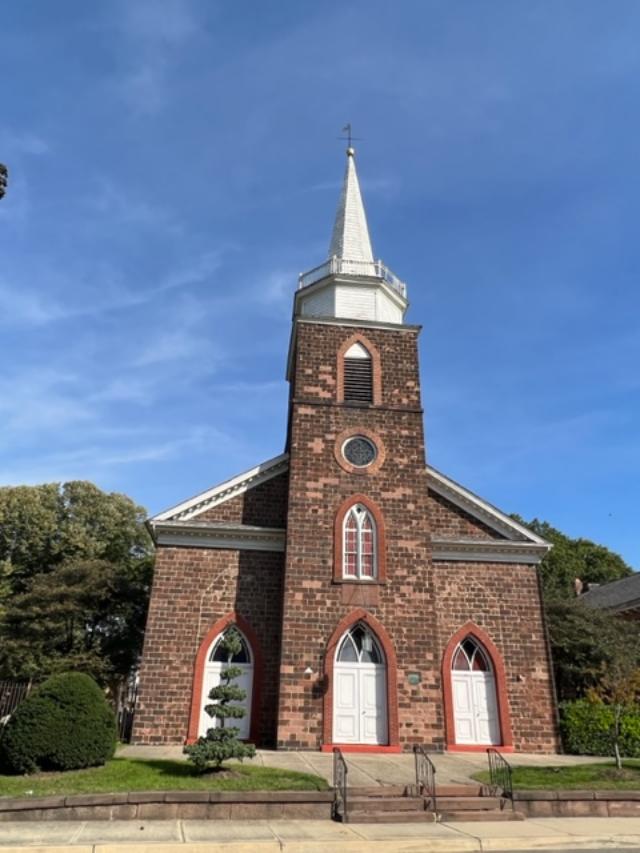
The First Reformed church of Hackensack at 43 Court Street
Due to their national historic significance the church, cemetery and the adjacent Hackensack Green were placed on the National Register of Historic Places in 1983. The Green dates back to 1696 and is one of the oldest public squares in NJ.
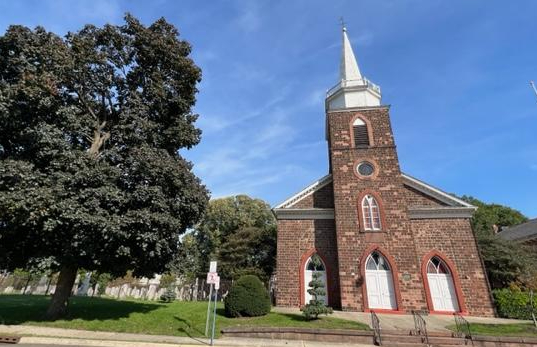
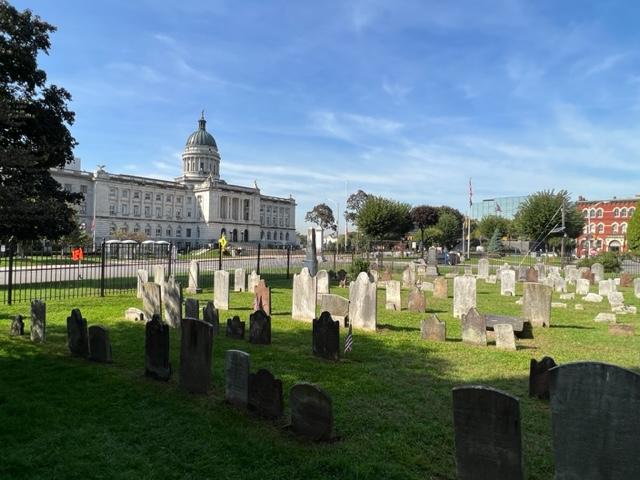
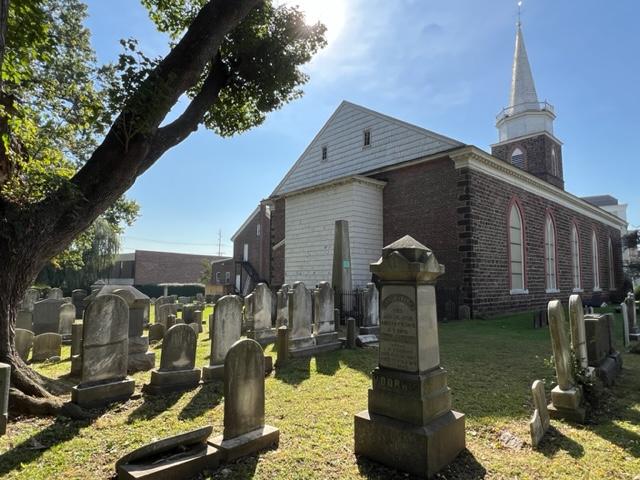
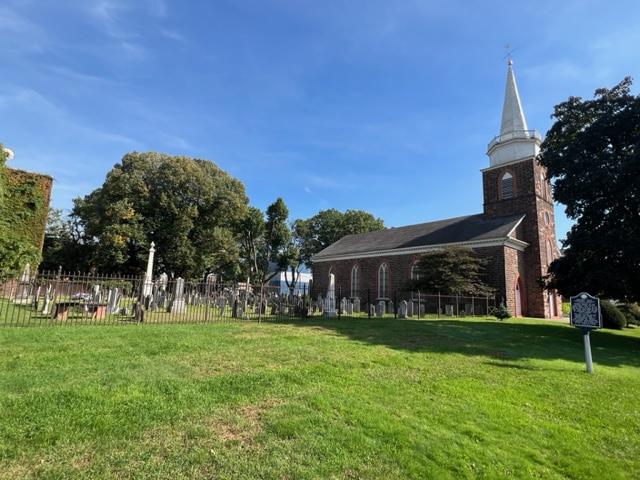
The church and its interesting cemetery.
The inside of the church was visited by General George Washington visited and worshipped here. The church still has the original pews and fixturing.
The inside of the church
The inside of the church
The bell tower and gas light fixture
The light fixture
A strategic point during the American Revolution, Hackensack was a small village centered on The Green, a public meeting place where public notices were posted. In the 18th century it was where punishments were inflicted on criminals and where the local militia trained.
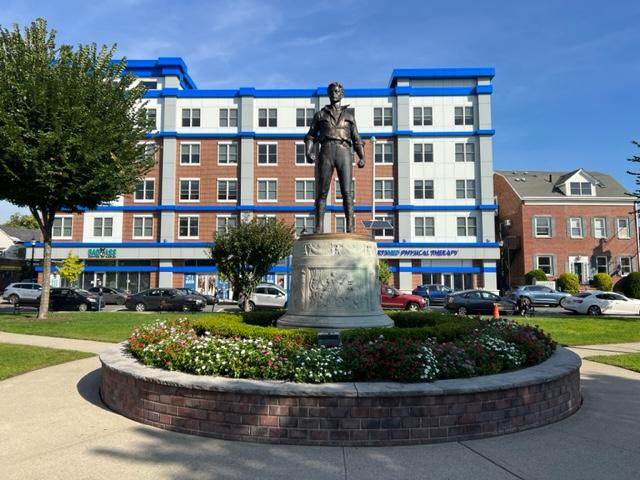
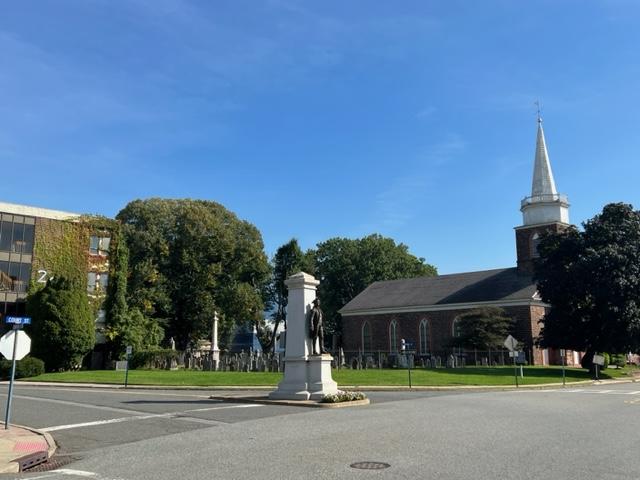
The Hackensack Green
The Hackensack Green
General Washington headquartered here in November 1776, while he surveyed the local roads and bridges. On November 20, 1776, he led his army into Hackensack. The army camped on The Green as Washington made the important decision to continue the retreat from overwhelming British and Hessian forces. On March 23, 1780, the British raided Hackensack and burned the courthouse that stood on the Green at that time. Since 1715, a Bergen County courthouse building faced The Green in Hackensack, the County Seat since 1710, making it the historic heart of Bergen County (County of Bergen Division of Cultural and Historic Affairs).
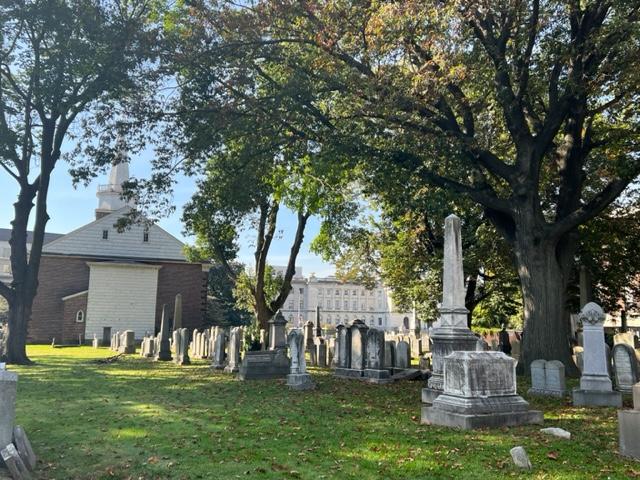
The historic Courthouse of Hackensack, NJ facing the cemetery at the Church.
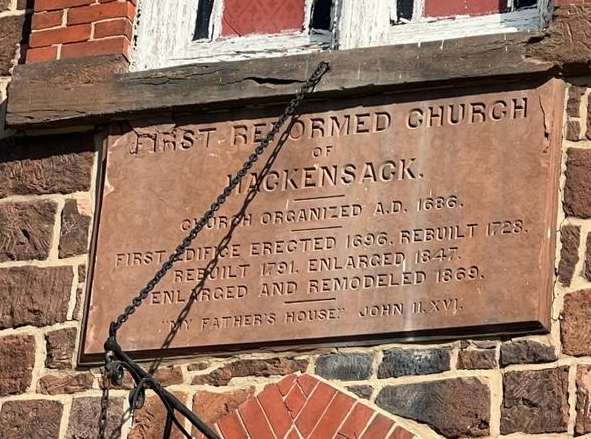
The Cornerstone
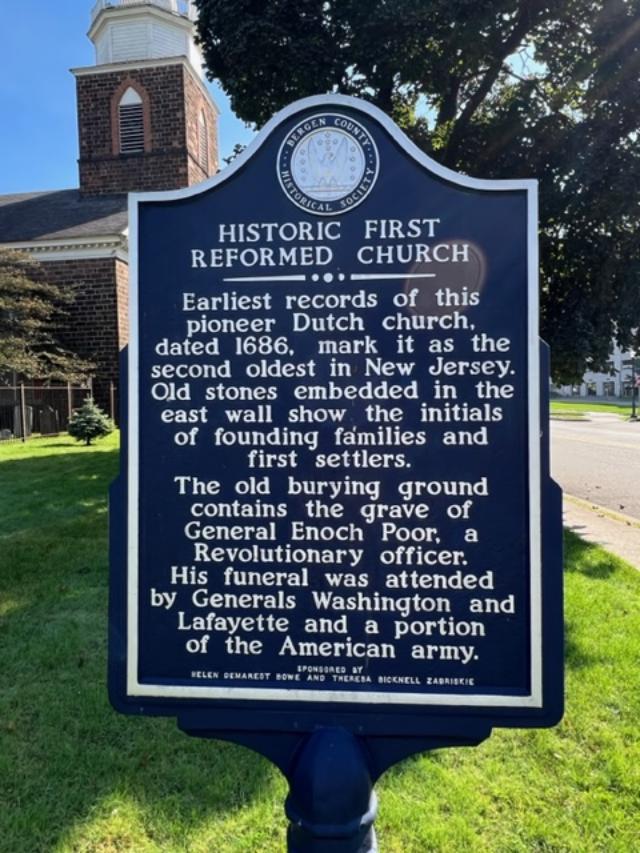
The First Dutch Reformed Church congregation was organized in 1686, the oldest Reformed Dutch congregation in Bergen County and second oldest in NJ. (County of Bergen Division of Cultural and Historic Affairs).
The historic marker outside the church.
The historic marker
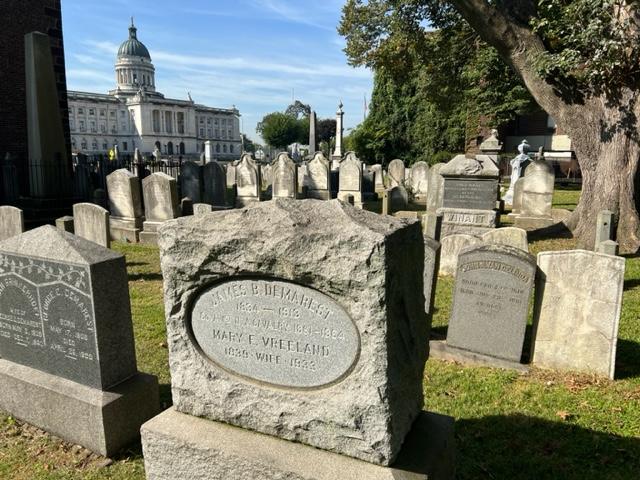
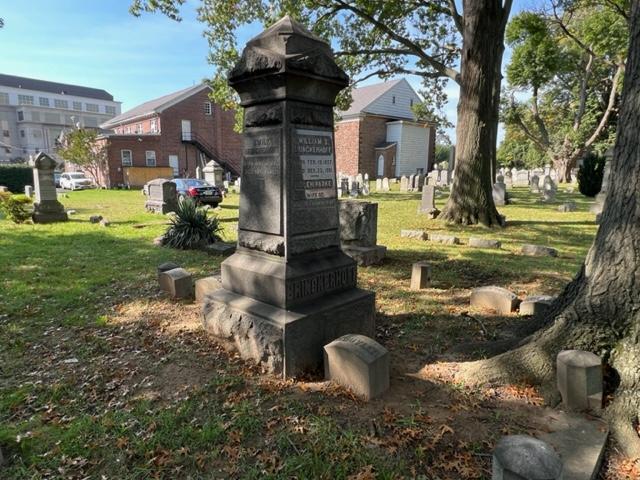
The Hackensack Reformed Church graveyard is one of the most famous in the State of New Jersey with many prominent families of Bergen County whose contributions helped shape not just the State of New Jersey but the United States as well. The graveyard contains the graves of many who fought for our freedom in the Revolutionary War.
The front of the church
The back of the graveyard
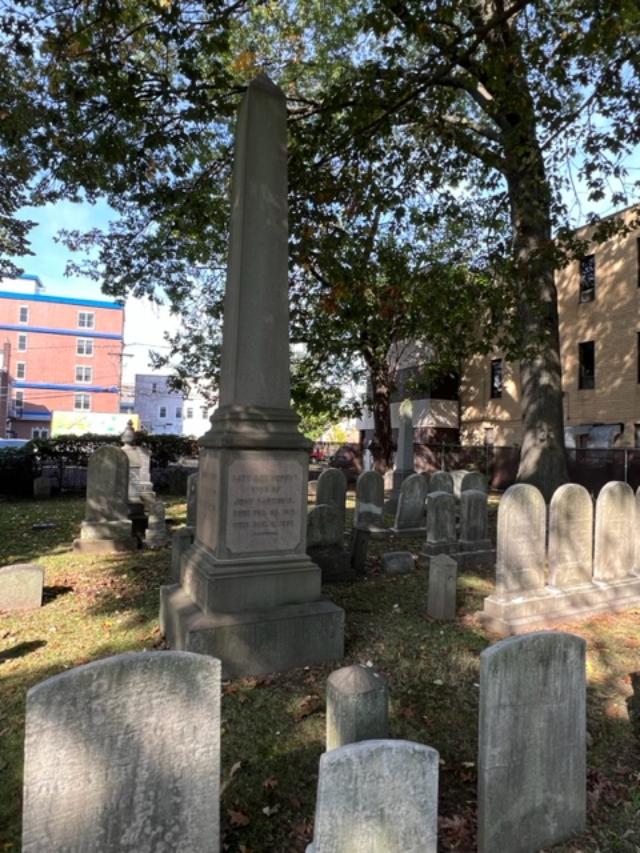
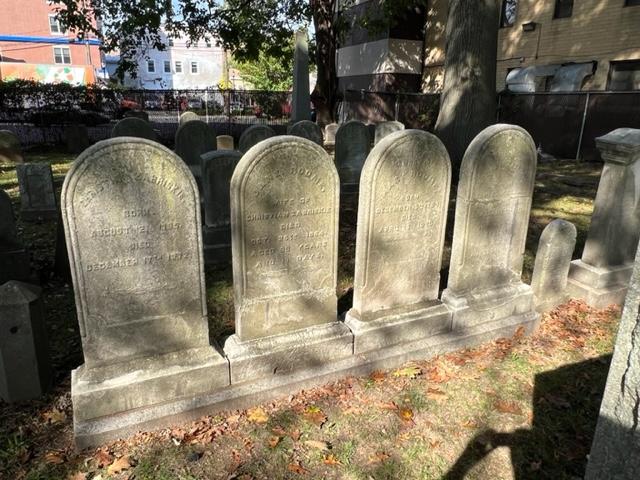
The historic graveyard
During the first ten years, churchgoers worshiped in a private home outside the limits of modern-day Hackensack. The official name of the congregation was the “Dutch Reformed Church of Ackensack” and comprised thirty-three residents from Hackensack, New Barbadoes and Acquackanonk. All three of these townships made up most of northeastern New Jersey.
Acquackanonk was located in the northern portion of modern Essex County. New Barbadoes was comprised of land west of the Hackensack River, while Ackensack was located to the east. In April of 1696, Captain John Berry (1619-1712), the proprietor of a large portion of land in northeastern New Jersey, donated two and three-quarter acres of his property to the congregation to support their efforts to build the church.
Most of present-day Hackensack at that time was called “New Barbadoes Township” and Hackensack is thought to have gotten its unofficial name when the Church relocated to New Barbadoes and brought the name “Ackensack” with it (Church website).
The historic church and cemetery in the back.
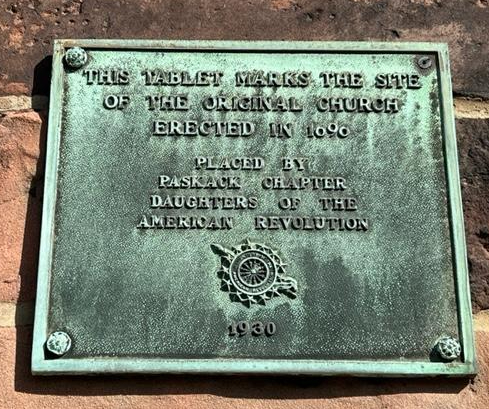
The emergence of the Dutch Reformed Church in America developed from Dutch colonization of New York and New Jersey during the 17th century. Dutch settlement was prominent in these areas before the British took control of the area in the late 1600’s. Still, the Dutch were freely allowed to practice their religion in America, even under British sovereignty. The Hackensack First Reformed Church would become the second oldest Reformed Church in New Jersey and the first in Hackensack. Construction of the church was completed in the latter part of 1696.
The historic cemetery at the church
John Berry’s donation of land was appropriately dubbed, “The Green” and the church soon became known as “The Church on the Green”. The first sermon was preached on November 15th, 1696, based on Psalm 26:8 “Lord, I have loved the habitation of thy house and the place where thine honor dwelleth.” Although the first church was largely completed in 1696, the steeple was not built until 1708. The entire structure was rebuilt in 1728 on the same site. These two early church buildings were thought to have been octagonal structures.
The Schuyler Family marker
In 1780, during the Revolutionary War, the British invaded Hackensack. They burned the courthouse and jail and threatened to destroy the Church on the Green, which was located adjacent to the aforementioned buildings. Fortunately, the church was spared. Dutch Colonial architecture with sandstone walls being the prominent feature of the building. Some aspects, especially the arched and pointed windows, appear to have Gothic elements.
The Zabriskie Family plot
The front of the church has three sets of double doors with similarly arched doorways and transom windows. This style was a precursor for many of the Reformed Dutch churches that were eventually build in New Jersey. Although the present-day building dates from 1791, the church was enlarged in 1847 and again in 1847 and again in 1869, thus containing newer elements.
The Demarest Family plot.
The attached cemetery is original to the first building’s construction in the late seventeenth century but during the renovation in 1847, it was also enlarged. The neighboring service house was built in 1867 and was used as a Sunday school, lecture hall and chapel.
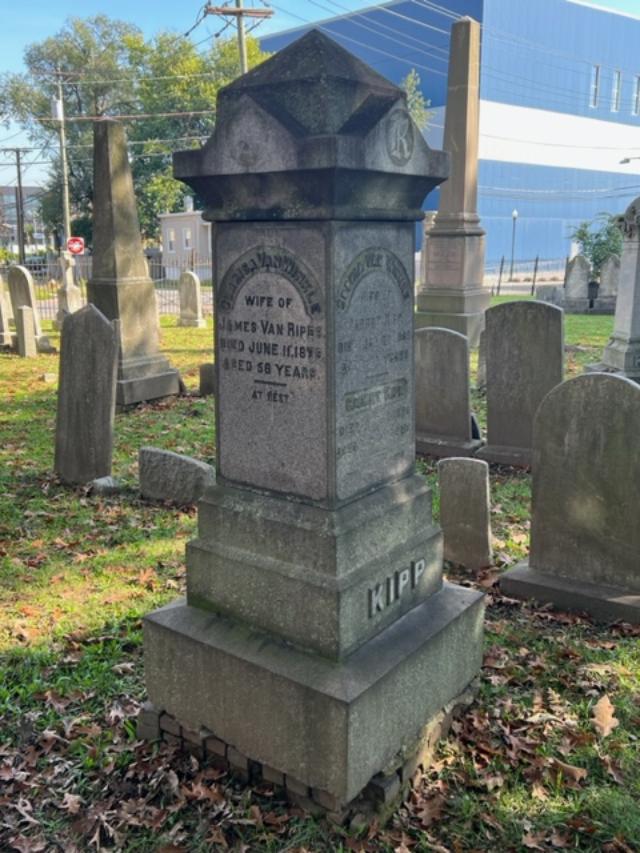
The Van Riper/Kipp Family plot
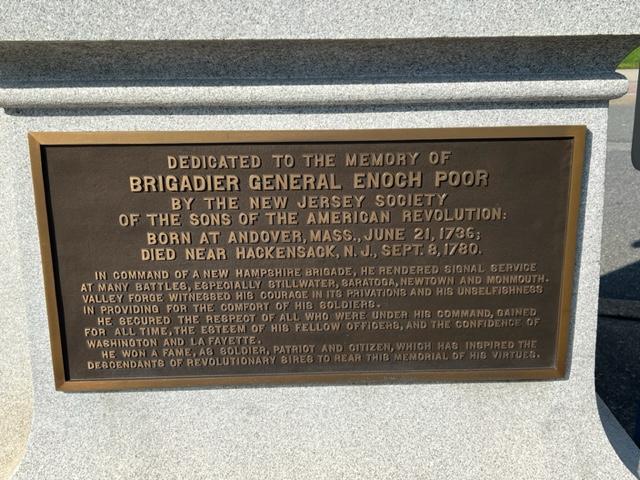
The churchyard cemetery features simple stone tablets and obelisks that are surrounded by a wrought iron fence. Some notable burials include General Enoch Poor (1736-1780), Colonel and New York Mayor Richard Varick (1753-1831), Congressman George Cassedy (1783-1842) and Congressman Adam Boyd (1746-1835). General Enoch Poor’s burial is especially noteworthy as he served alongside George Washington during the Revolutionary War.
Additionally, both Washington and the Marquis de Lafayette were in attendance at Poor’s funeral. Enoch Poor’s gravestone reads: “In Memory of the Hon’ble Brigadier General Enoch Poor of the State of New Hampshire who Departed this Life on the 8 day of Sept: 1780 aged 44 years/Washington, Lafayette and a portion of the American army attended the burial of Gen. Poor.
In 1824, Lafayette visited this grave and turned away much affected, exclaimed, “Ah, that was one of my Generals!” Poor died in 1780, before the close of the Revolutionary War, so this gravestone is clearly not the original (Church website).
The graveyard at the Dutch Reformed Church
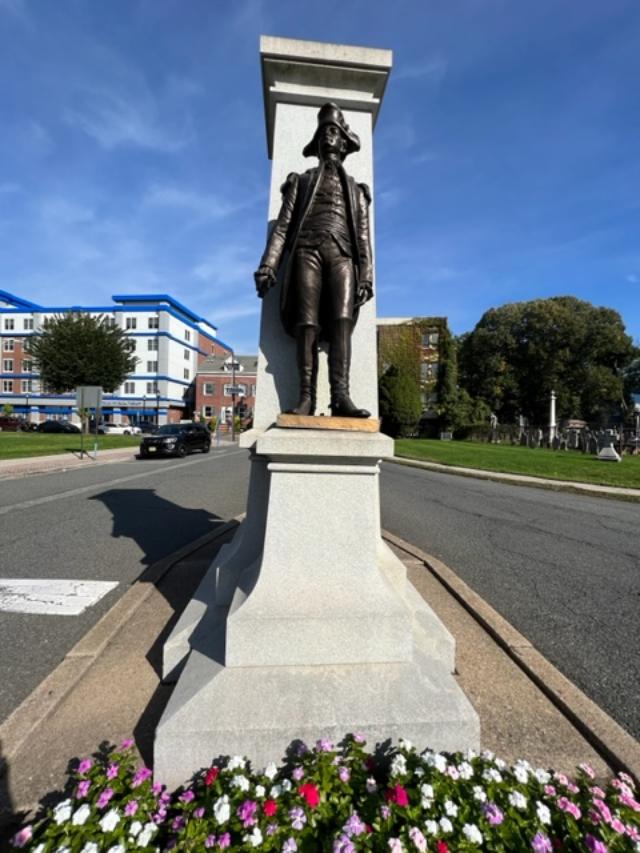
The Reformed Church was nominated to the National Register of Historic Places on April 25, 1983. Included in this nomination was the “Green”, which is one of the oldest public squares in New Jersey. This area encompasses the Churchyard, the cemetery, the church outbuilding and the green area that is adjacent to the Bergen County Courthouse. There are a few monuments that occupy this space, including a statue memorial to General Enoch Poor, which was dedicated in 1904 and the Hackensack War Memorial, which dates to 1924.
The church continues to be a prominent feature of the history of Hackensack through community and self-guided walking tours. In addition to this, there are yearly Memorial Day commemorations, where a wreath is placed over General Enoch Poor’s grave and a tour of the church is provided to the attendees of the celebration.
Surrounding the Green, there are a few other historical buildings:
*The Peter Zabriskie Mansion site at 50 Main Street.
*Archibald Campbell’s Tavern Site at 41 Main Street
*The Hackensack War Memorial
*Site of the Burned Jail
*The Annual Christmas Tree on the Green
Disclaimer: This information was taken directly from the Bergen County Historical Society pamphlet and the Clio Website on the First Dutch Reformed Church of Hackensack and from visiting downtown Hackensack. Please call the church at (201) 342-7050 for details on visiting it. Please remember this is a resting place.
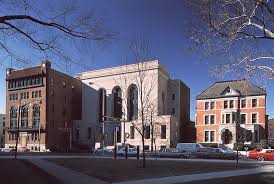
The Newark Museum at 49 Washington Place in Newark, NJ.
I have been a member of the Newark Museum for 29 years and have enjoyed the experience. There is a lot of things to do at all times of the year.
During the Summer months, I enjoy “Jazz in the Garden” where local and international jazz musicians perform in the beauty of the back garden of the museum under the trees. These almost hour and a half performance can be enjoyed on sunny, clear days in the gardens and in the auditorium on a rainy afternoon. It is something I look forward to every summer.
Jazz in the Garden at the Newark Museum. The gardens are amazing in the summer months.
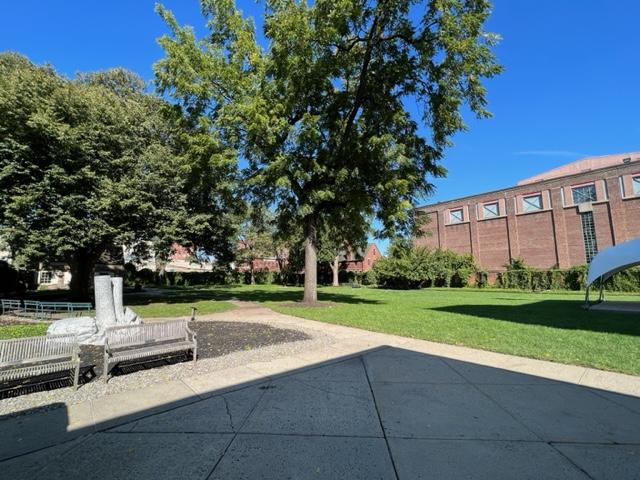
The Newark Garden in the back of the museum.
Jazz in the Garden was a big event before the pandemic. It is on hiatus for now. It had resumed after COVID with a fee and did not happen in the Summer of 2023. Still, I had enjoyed these concerts for years.
I heard Vanessa Rubin perform at the last ‘Jazz in the Garden’. She is amazing.
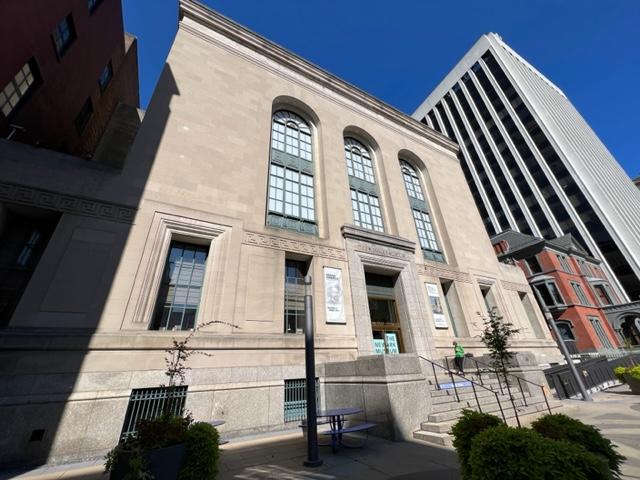
The New entrance opened where the original once was:
The new entrance to the Newark Museum
The video celebration of the new entrance reopening
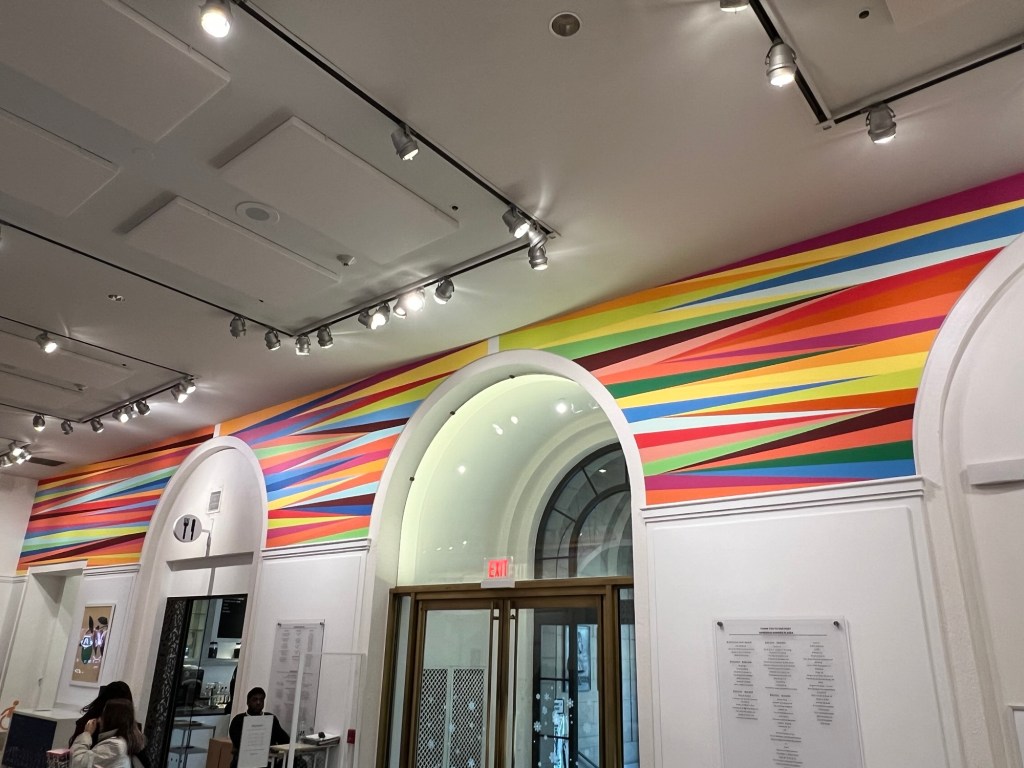
Entering the foyer of the museum
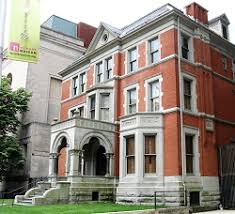
During December of 2019 I attended a holiday afternoon tea at the Ballantine House, the historic home attached to the museum. The Ballantine’s were one of the oldest families in Newark, NJ and were once major brewers in the city. They were considered High Society in Newark and the home, and its renovation reflect that.
The outside of the Ballantine House in 2019.
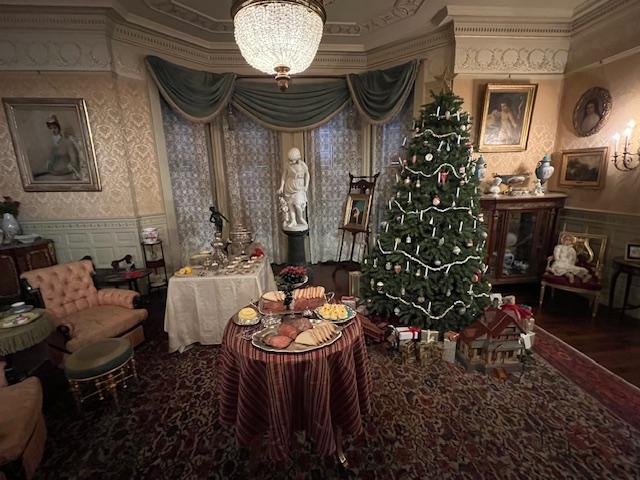
A new tradition was started this year with a Holiday Afternoon Tea and tour of the mansion. The caterer did a nice job with the food and their was plenty of it. We had finger sandwiches, various scones and pastries and different varieties of teas.
After the tea, we had a tour of the house and a talk about how the Ballantine’s and their crowd celebrated the holidays. They would be an open house for the neighbors during the holidays and then on Christmas day were church services in the morning and then a lunch afterwards with the family.
Ballantine House set for the neighborhood open house
Entering the newly renovated Ballantine House.
Another nice event is the Members Mornings of specialty tours of the galleries on a Sunday morning and a light breakfast afterwards. These are really nice, and you get a more in-depth view of the galleries with the docents. This is where I highly recommend membership.
The Ballantine House model
The Ballantine House reopened after a two year renovation of the property and I toured it in January of 2024 to see the redesign of the home. The home had been cleaned and new signage and carpeting had been added to the site. They were new signs with interpretations of the house with some major design changes.
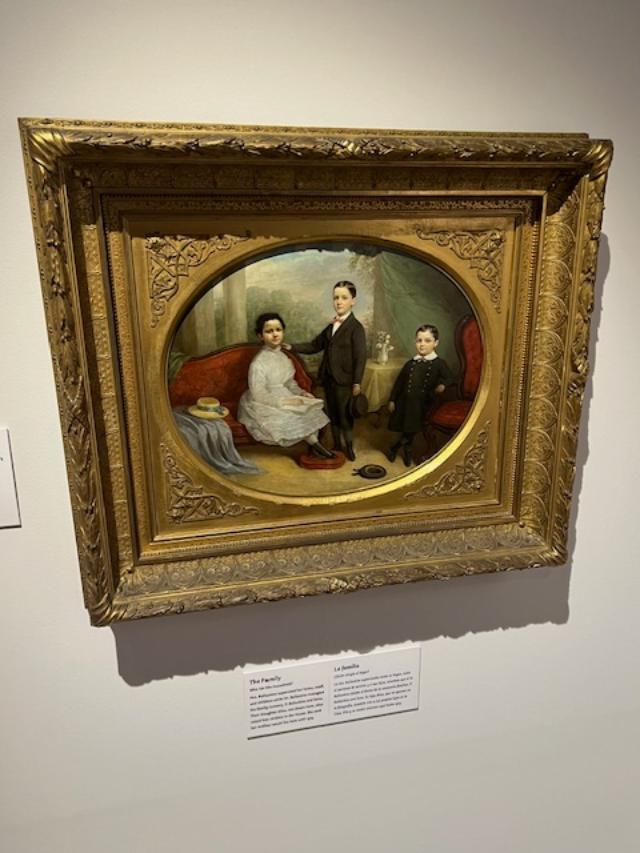
The Ballantine children in portrait.
The house had gotten some much needed renovation work and cleaning and the house looked sparkling and looked like someone had just moved in. In 2024, the house continued its tradition of being decorated for the Christmas holidays but with a twist to it
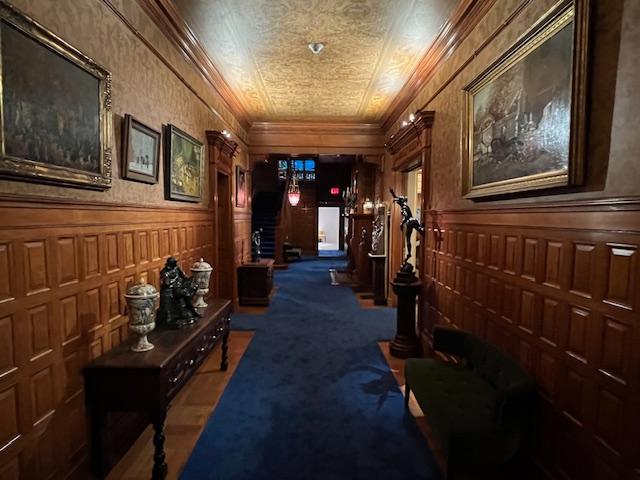
The Foyer of the Ballantine House
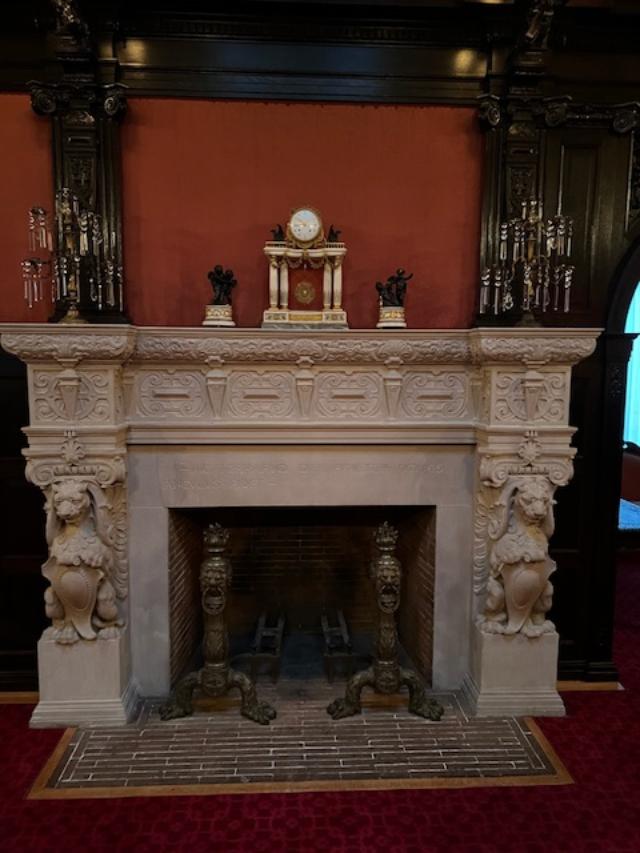
The fireplace in the Foyer of the home at the holidays
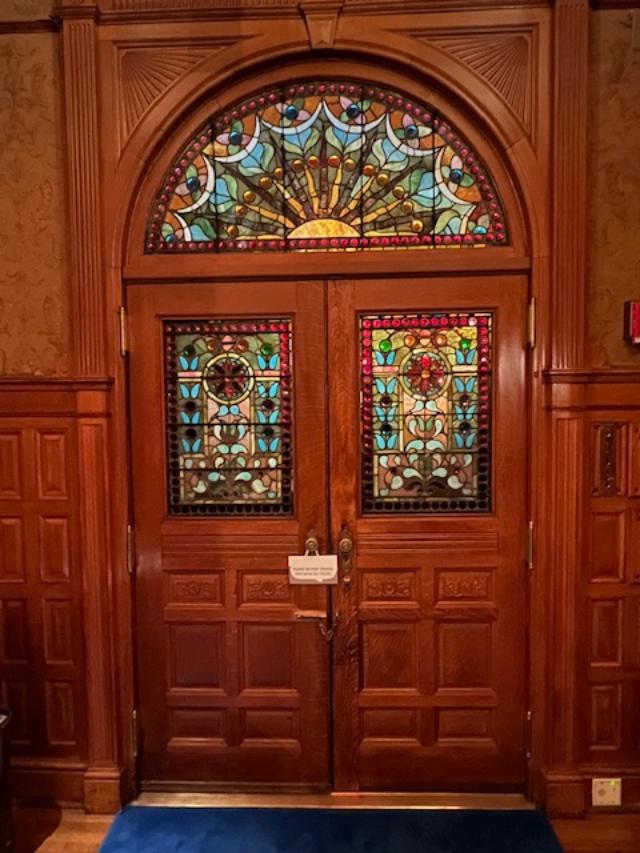
The front door ablaze with colors
The Reception/Receiving Room for guests.
The Receiving Room at the Ballantine House.
The Reception Room decorated for the holidays
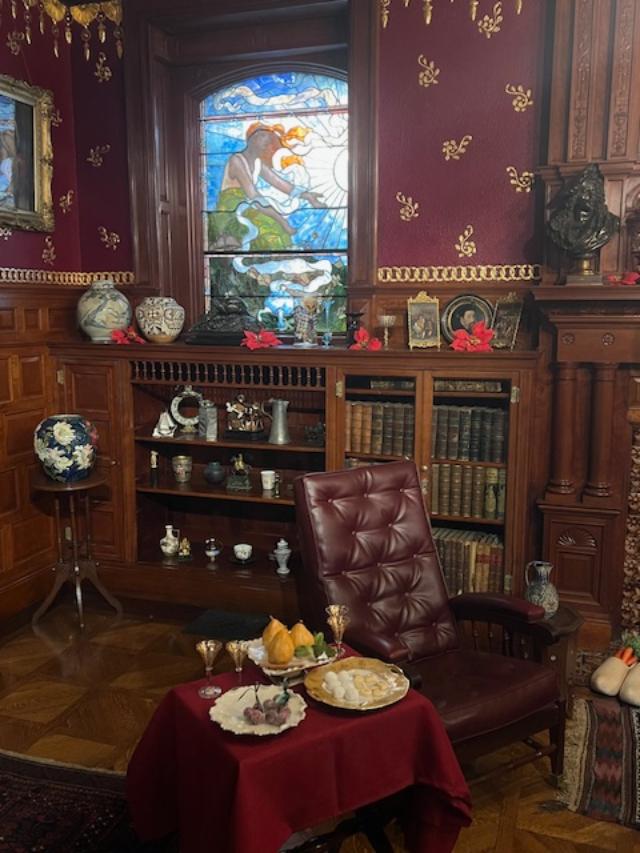
We started the tour clock wise through all the rooms on the first floor starting with the Reception Room where guests would be received for a visit and would wait until the Ballantine’s were ready to greet you. We then moved onto the Library where the whole family would gather in the evenings to read and converse with one another in a more casual setting.
The Library
The Library at the Ballantine House
Mr. Ballantine’s chair and desk in the Library of the Ballantine House.
The Library decorated for the Christmas holidays:
The Library decorated for the Christmas holidays:
The Library decorated for the Christmas holidays:
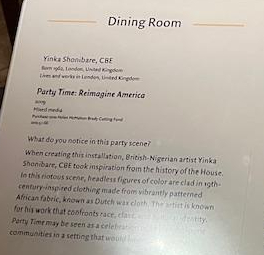
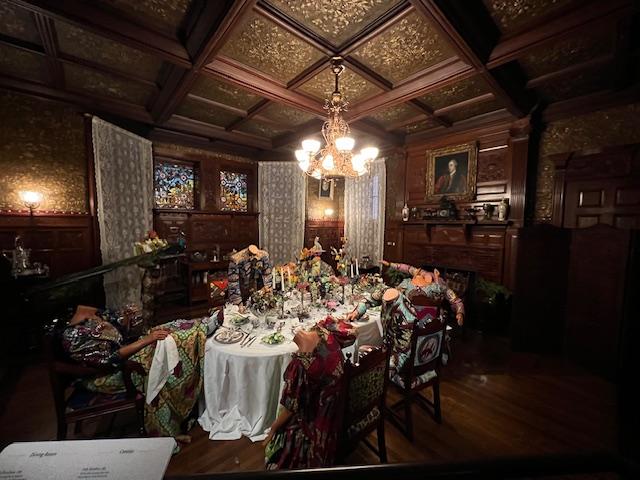
The Dining Room
The Dining Room set for dinner.
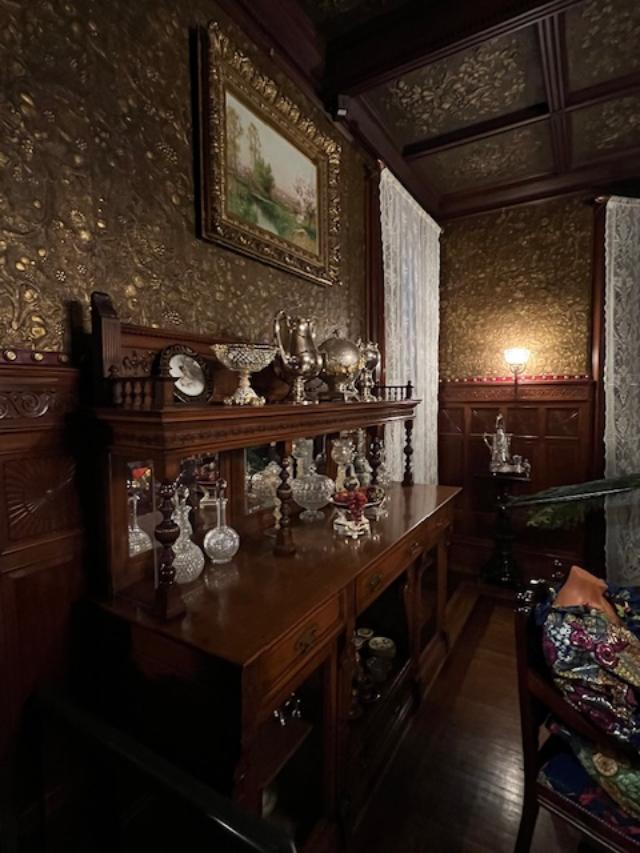
The Dining Room sideboard.
The Dining Room decorated for the Christmas holidays:
The Dining Room decorated for the Christmas holidays:
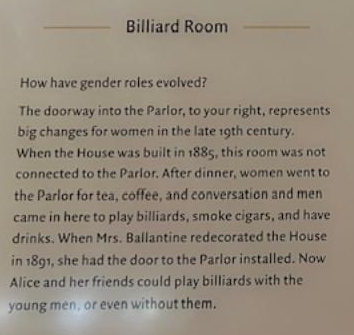
The Billiard Room across the hall from the Dining Room.
The Billiard Room at the Ballantine House.
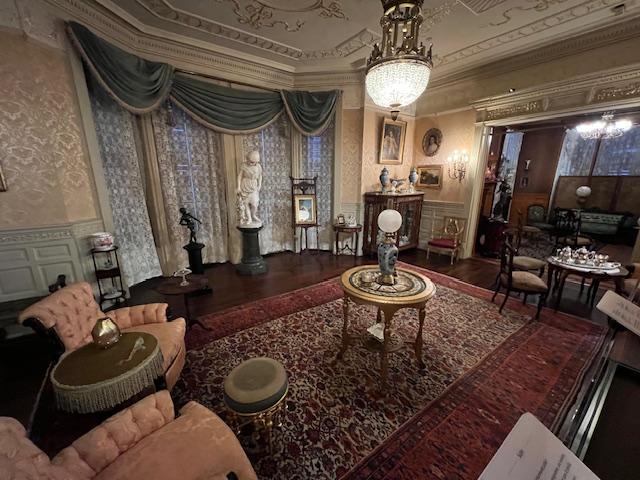
The Parlor at the Ballantine House.
The Parlor for receiving guests for afternoon tea
The other side of the parlor.
The Parlor set for tea.
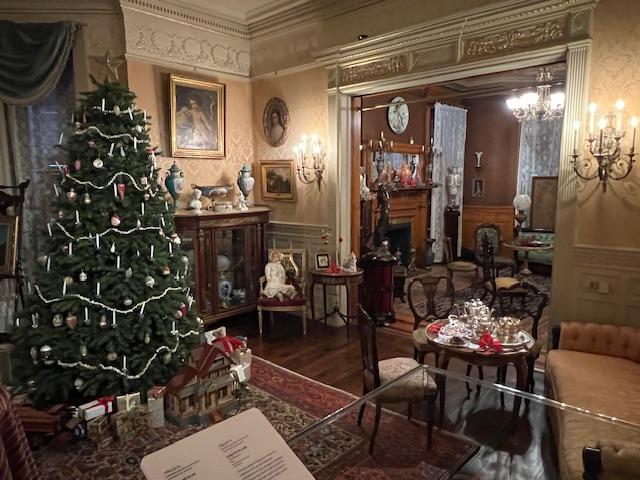
The Parlor set up for the Christmas Eve Tea:
The Parlor set for the Christmas Eve Tea service of the neighbors:
The Parlor would have been set for a light reception on Christmas Eve for the neighbors in the immediate neighborhood to stop in and join the family for a casual conversation and have a light snack. No one would stay more than an hour and it was in bad manners to stay longer than that.
The reception foods would be replenished as they ran out and this would take place for about two to three hours on Christmas Eve night as people would be leaving for church services or on their way to other celebrations.
The tour took us next upstairs to see the renovated bedrooms on the second floor and the galleries where some of the jewelry and art objects were on display.
The Staircase decorated for the Christmas holidays
The beautiful stained glass window on the landing to the second floor.
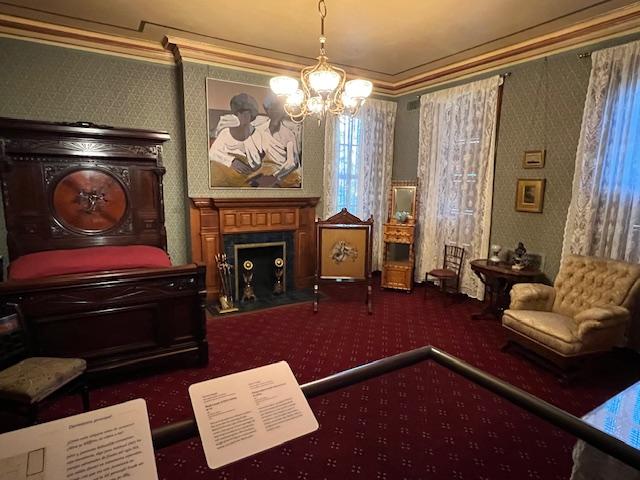
Mr. & Mrs. Ballantine’s Bedroom
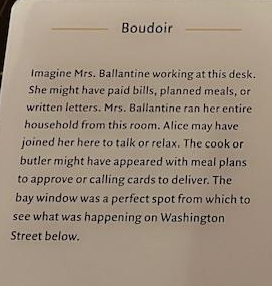
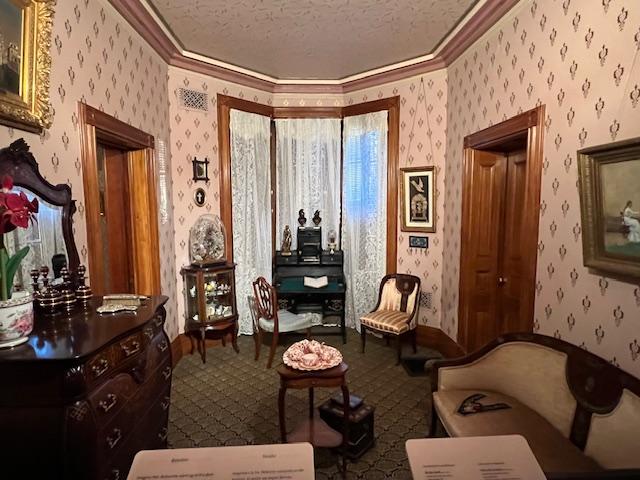
The Boudoir where Mrs. Ballantine did her work.
The Boudoir where Mrs. Ballantine worked.
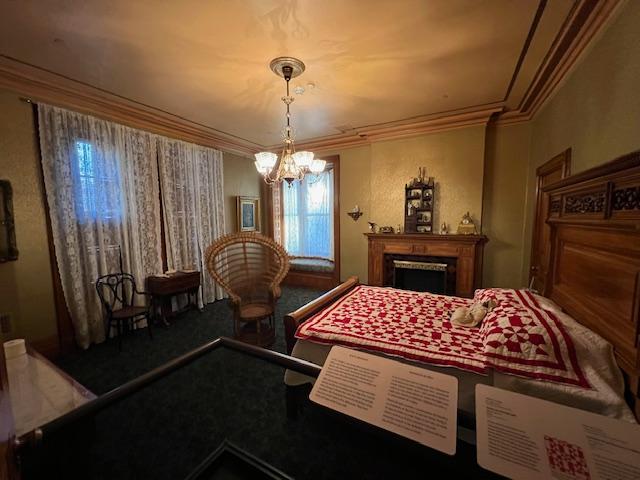
Alice’s bedroom on the second floor that was adjoined to her parents room by the way of the Boudoir.
Alice’s bedroom on the second floor looking over Washington Park.
The staircase to the Third Floor to Alice’s family apartment.
This was the main room of the apartment that was used by the family for entertaining friends and family. Alice, her husband and their four children lived in this apartment until 1919 at the time of Mrs. Ballantine’s death. Then her daughter moved to another part of Newark and then onto Morris County.
The Third floor apartment for Alice and her family that Mrs. Ballantine build for Alice and her family.
The beautiful skylight in Alice’s apartment on the Third floor of the Ballantine house.
The decorative fireplace that worked in Alice’s family apartment on the third floor of the house
On my most recent trip to the museum, I attended the opening of the new ‘Norman Bluhm Metamorphosis’ exhibition on February 11th, 2020.
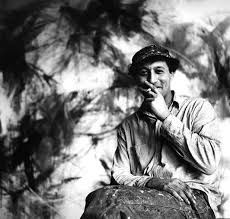
Artist Norman Bluhm
Norman Bluhm: Metamorphosis celebrates six decades of painting by post-war American artist Norman Bluhm (1920-1999), who combined action painting with a lavish sense of color and formal experimentation on a grand scale.
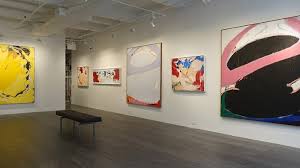
Paintings and works on paper dating from 1947 to 1998 are on view in the Museum’s Special Exhibition Gallery and the Traphagen promenade galleries surrounding the Charles W. Engelhard Court (Newark Museum publication press release).
These large works showcase the artist’s work over a fifty year period.
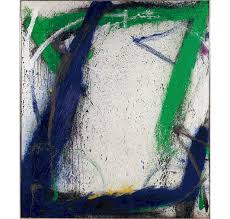
Norman Bluhm’s work is quite dramatic
In 2022, I went on the first Members Morning that we had in almost two years. We toured the “Carlos Villa: Worlds in Collusion” exhibition featuring the works by American San Franciso born artist of Philippine decent Carlos Villa.
Artist Carlos Villa in the exhibition “Worlds in Collison”
Video on the Exhibition “Carlos Villa: Worlds in Collison”
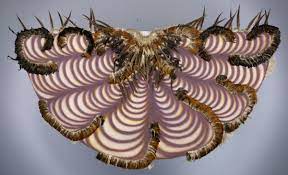
What made this exhibition interesting was the feather work that he used in his art. He was trying to capture the ethnic history of identity not just of the Asian but the Pan-Pacific cultures of Hawaii. He used robes and other costumes to show the dynamic of the background of these cultures. Not just that but what describes Americans who are not of white decadency and where their role plays in society. The impression I got from his work and from the tour was feeling like an outsider in the country he was born in.
One of the feathered cloches that are in the exhibition
I also visited the interactive exhibition “Endangered”, showing video screenings of nature on the walls of the Natural Science Galleries. The exhibition highlights how human behavior is affection the natural environment and what we can do to stop it.
In the Summer of 2022, we had a member’s tour of one of the ongoing exhibitions at the museum and the docent described the works of local Brooklyn based artist Saya Woolfalk.
I joined the membership one morning to tour the exhibition on artist Saya Woolfalk who is based out of Brooklyn. Her current exhibition “Tumbling into Landscape” is being featured on a long-term exhibition. The works are a communication with nature and our relationship with nature and with one another. When you walk through it you are so relaxed between the music and the lighting. The artist ‘uses science fiction and fantasy to reimagine the world in multiple dimensions’ (Newark Museum).
The videos in the Saya Woolfalk exhibition
Her look at nature is very interesting. She looks at our relationship with the natural world and to each other and where we belong. Here works have a calming effect on the visitor and our interaction with the art.
‘The Four Virtues’ (Justice, Prudence, Temperance and Fortitude)
She even did a study of the Hudson River School and how her art worked into that perspective of nature. She included between six paintings from the School of Art with a self-portrait of herself.
It was interesting how she used her own self to compare to the stylized view of nature taken on by these past artists.
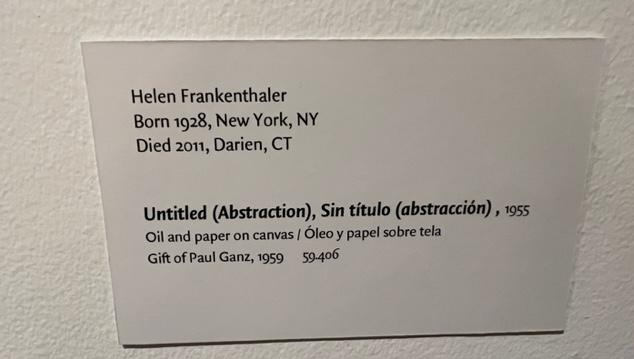
Recently, I joined other members for a special “Members Morning” that happen every third Thursday entitled “The Art of Collecting Abstracts”. It was a look at the contemporary works that have been collected by the Newark Museum over the years. We got a look at works from the early part of the last century to today. Each of the pieces chose were a way for us to think about the artist and what they were trying to convey. Some used bold strokes and colors to tell their story. I thought they were quite colorful.
The group of us on the tour walked through various galleries, admiring and learning about the contemporary collections of abstract work from artists from various periods. Each docent took their take on pieces they admired in the collection.
Abstract by Ilya Bolotwosky “Study for Mural for Hall of Medicine, Public Health Building, New York World’s Fair.
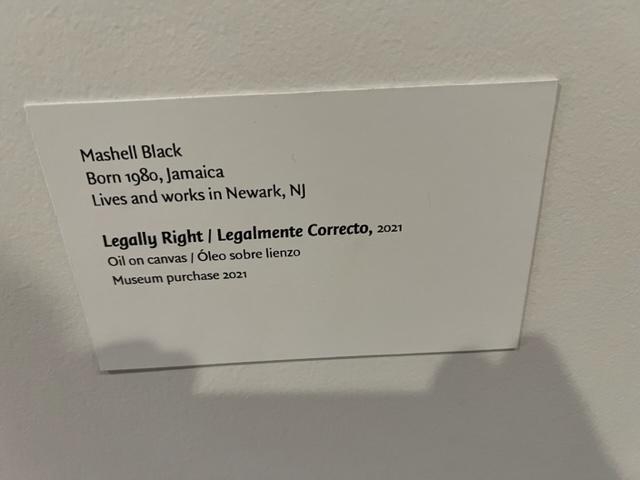
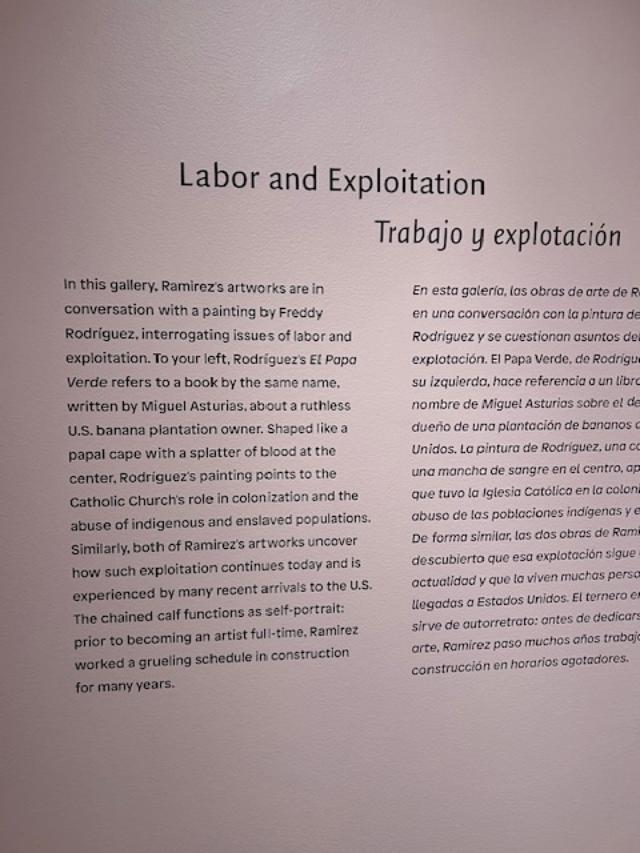
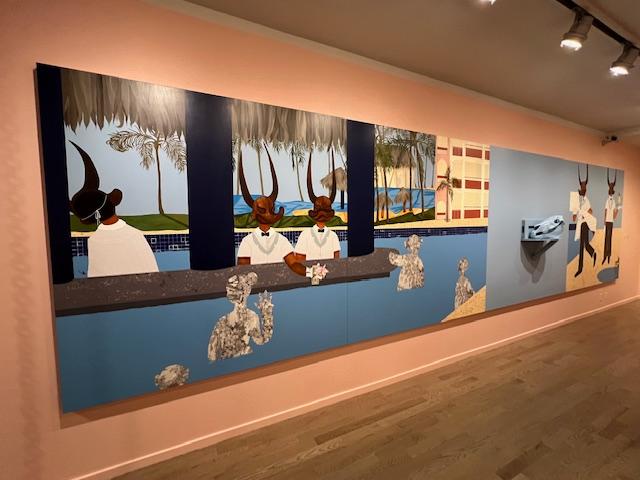
Artist Bony Ramirez is a Dominican artist born in the Dominican Republic and works in New Jersey. He is known for his island influences in his works and reflects life in the Caribbean nation. He uses all sorts of materials to achieve his works of art (Artist’s bio).
The gallery opening of the artist’s work on the second floor of the museum.
The write up on his work.
Cow sculpture
Painting and sculpture
One of the artist’s paintings on Colonialization.
One of the artist’s recent sculptures.
The exhibition was small and it was one of the first shows that the artist mounted at a major museum. I thought the work was okay but nothing dramatic. Still it was a nice opening and a reception. The artist seemed thrilled by it all.
Newark Museum History and Highlights tour:
Welcome to the Newark Museum. Our unique approach to exhibiting our extraordinary art and science collections provides unforgettable experiences for people of all ages. It is a place where people of different generations, cultures and communications encounter a robust science collection and world-class act including the arts of Africa, Ancient arts, Arts of Asia, Decorative arts and American art.
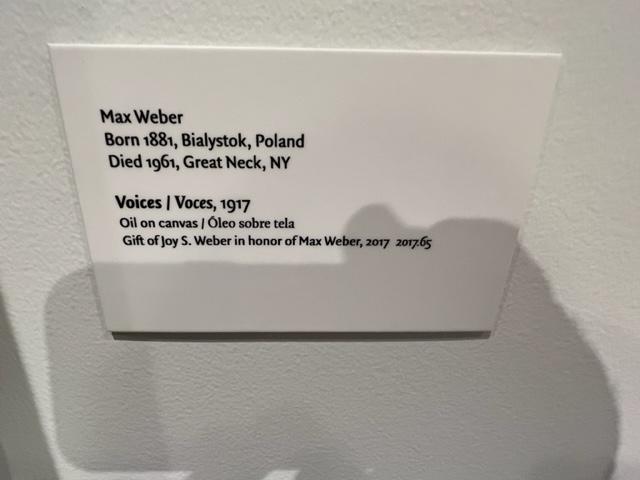
The American Wing galleries at the Newark Museum. The Max Webber piece is to the right.
Take an inspirational journey through our many galleries. Marvel at shooting stars in our popular planetarium. Travel to another era in the Victorian Ballantine House, a National Historic Landmark. Pause at a Tibetan Buddhist altar consecrated by His Holiness, the 14th Dalai Lama. Stroll through our beautiful sculpture garden, visit our Museum Shops and enjoy delicious light fare or snacks at our Cafe (will be reopening soon).
For the Lunar New Year in 2025, the Newark Museum had a wonderful family celebration for Chinese New Year. The museum had all sorts of games and crafts for the kids and tours for the families.
A Chinese musical group started the festivities for Chinese New Year at the Newark Museum. This was the folk band from JTL Band. They sang traditional songs in Chinese.
The group entertained the crowd with a wide applause
After the performance, we were treated to a Ribbon Dance. Dancer Lina Liu
The traditional Ribbon Dance by the Lina Liu Artist Group
The beauty of the dance
The end of the performance
The museum did a wonderful job with all the entertainment. The Planetarium also had a interesting show in the Moon and the phases that show in the evening sky. It was a very interesting show. Even though it was geared towards children, they made it so easy to understand in fun and engaging way.
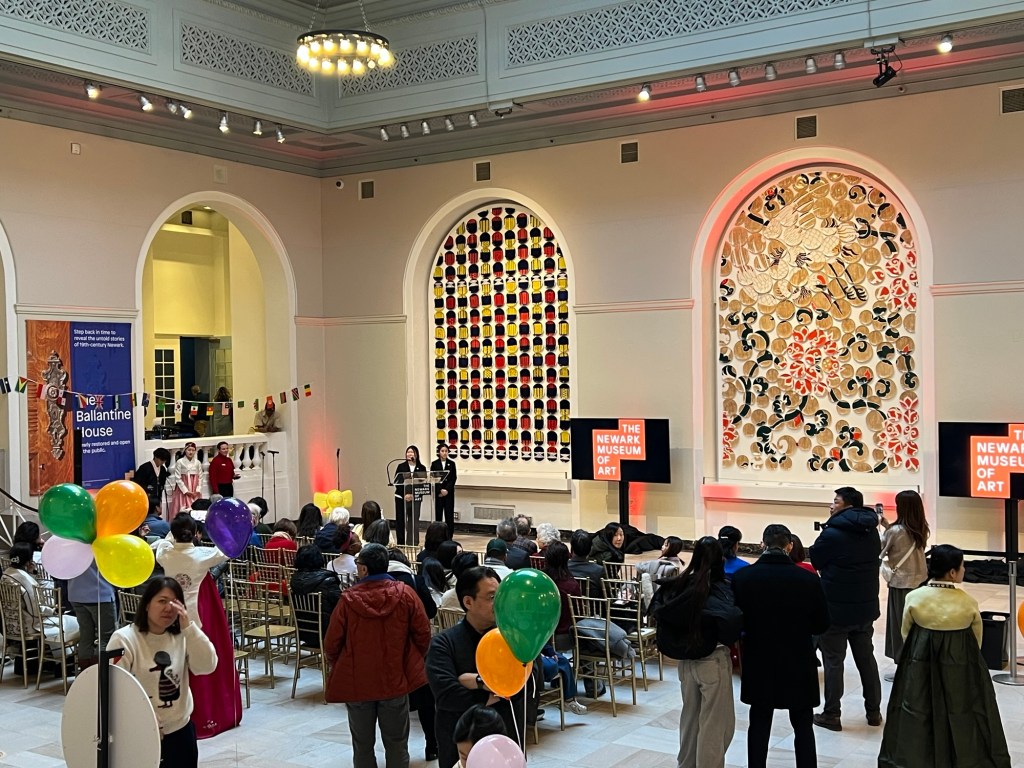
The museum did a nice job for the Lunar holidays. In 2026, they had another interesting festival of Korean music and dance.
Entertainment from the Korean Cultural Society
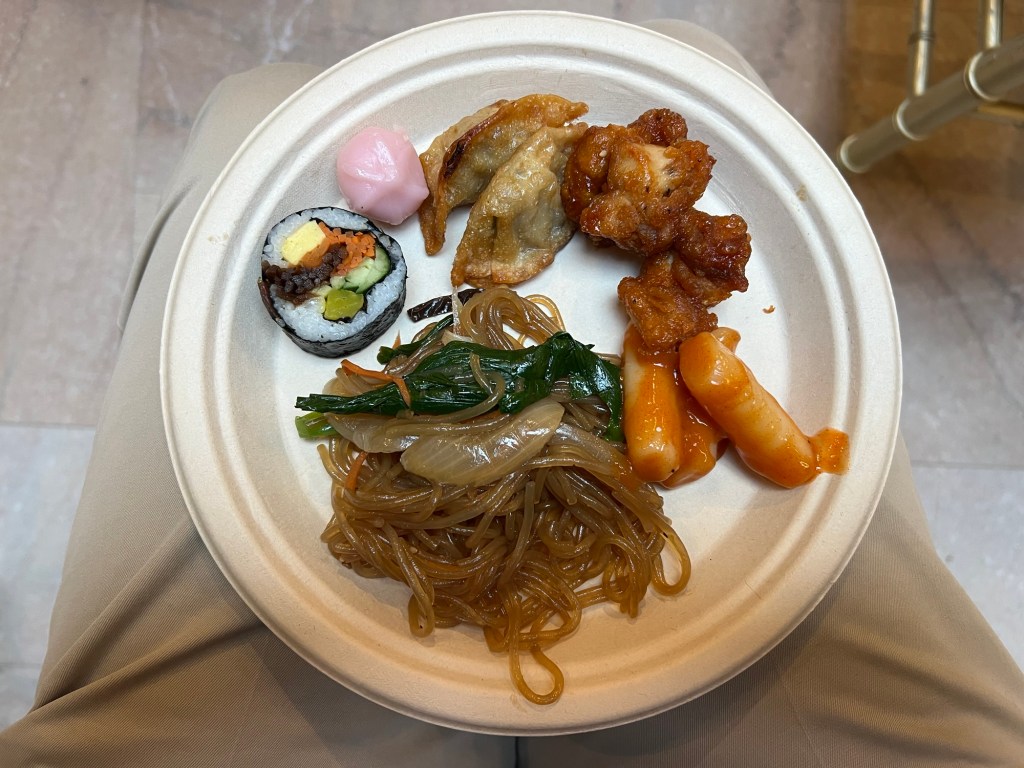
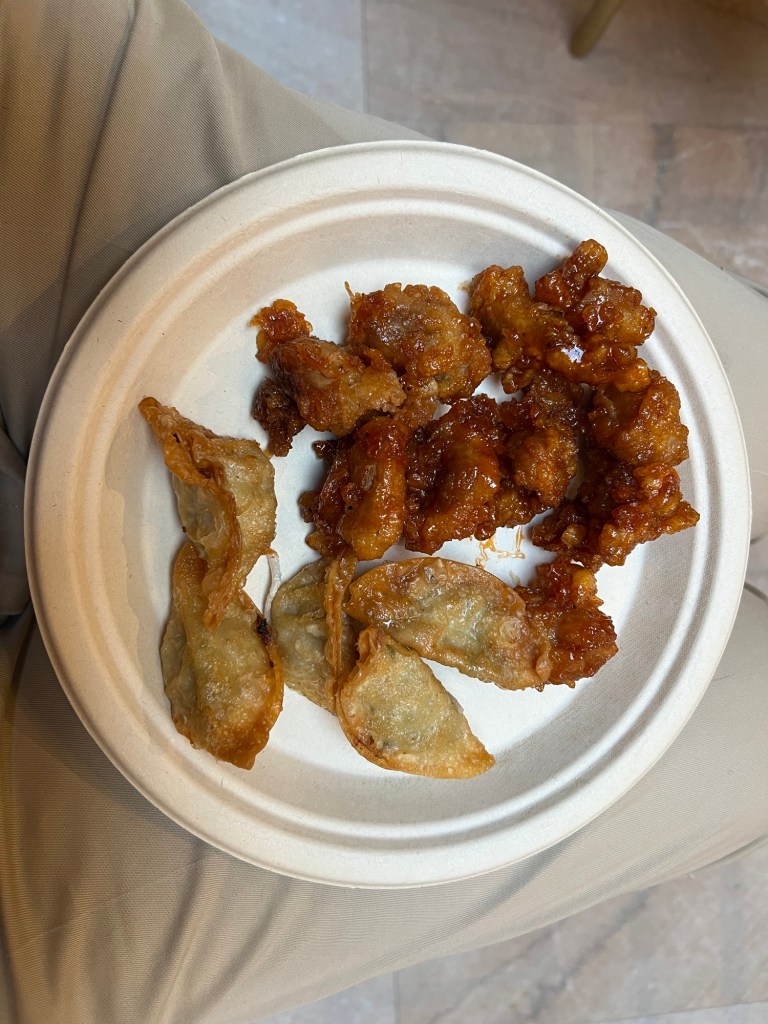
The best was the resfreshments at the end of the program. They had the most delicious Korean Chicken and Dumplings along with other dishes.
The Korean dishes I enjoyed that afternoon. I had to go back for seconds of the chicken and dumplings.
Coming back for seconds
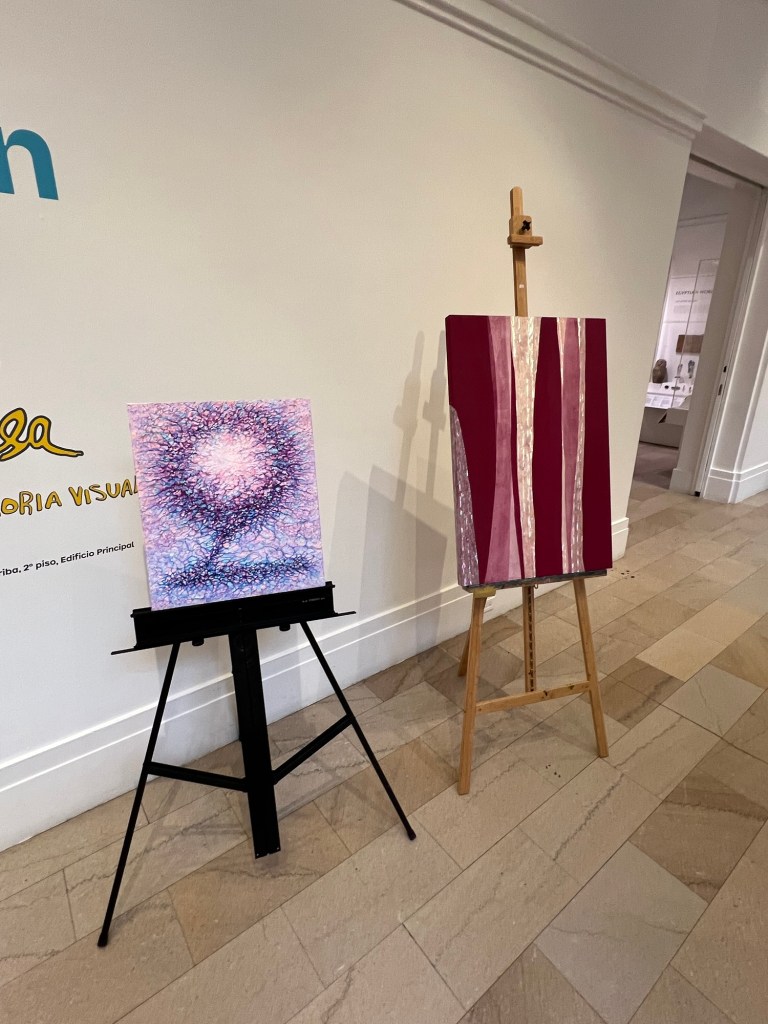
I then walked around the main hall to enjoy the works of local Korean-American artists. I have to admit it was a quick afternoon
The works of local artists
Come visit us. You’ll wonder why you waited:
(from the website and from the museum pamphlet)
The Newark Museum exhibits world-class art and science in a unique way. Visitors feel enriched by what they had planned to see and excited about the unexpected discoveries that they made along the way.
The new entrance of the museum
American Art:
With more than 12,000 paintings, sculptures, works on paper and multimedia art, the American art collection at the Newark Museum, many on view in the Picturing America galleries, is one of the finest in the country. Surveying four centuries, the Museum’s American holdings range from the Colonial to the Contemporary and are particularly strong in works from the 19th and early 20th centuries.
Ancient Art:
The Museum’s art of the ancient Mediterranean cultures, Egypt, the Near East, Greece and Rome, includes a remarkable array of classical antiques, as well as an Egyptian collection featuring the coffin lid of Henet-Mer. The Eugene Schaefer Collection of ancient glass offers a visual history of the evolution of glass technology in Egypt, Greece, Rome and the Islamic worlds and dates from 1500 B.C. to 1400 A.D.
Arts of Africa:
With works ranging from Moroccan textiles in South African beadwork to contemporary fine art, the Museum’s African art collection is as diverse as the continent itself. The collection is among the most comprehensive in the United States with more than 4,000 art works dating from the 17th century to the present day. Its holdings are also distinguished for their breadth of artistic representation, including masks and figural statuary, dress and adornment, photography and paintings.
Arts of Native North America:
The Native North American art collection spans the continental United States, as well as Alaska and Canada. Most of the works date from the 19th to the late 20th centuries. The collection represents the diversity and richness of indigenous arts with a range of object types including tools, household items, personal effects, clothing, ritual and ceremonial objects, paintings and drawings.
Arts of Asia:
The most extraordinary historical collection of Tibetan art in the Western Hemisphere is on permanent view. Additional galleries dedicated to the arts of Japan, Korea, China as well as South and Southeast Asia feature superior examples of sculptures, paintings, ceramics and decorative arts from the past 2,000 years.
Decorative Arts:
Furniture, silver, ceramics, glass, jewelry, costumes and textiles comprise the vast Decorative Arts holdings, which range from the 16th century to the present. A wide variety of American and European household furnishings create an international context for New Jersey-made and owned objects displayed in rotating gallery installations.
Ballantine House:
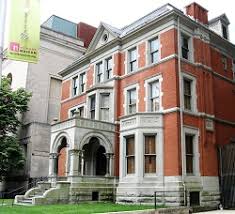
Built in 1885 for Jeanette and John Holme Ballantine of the celebrated Newark beer-brewing family, this brick and limestone mansion was designated a National Historic Landmark in 1985. Wander through history in House & Home, a suite of eight Victorian period rooms and accompanying thematic galleries depicting how people have decorated their homes in America, from the 1650’s to the present day.
The Ballantine House
Science:
You will also find New Jersey’s first planetarium here and an 83,000-specimen natural Science Collection, which is the basis of the exhibit Dynamic Earth: Revealing Nature’s Secrets, located in the Victoria Hall of Science. This engaging exhibit features interactive and multimedia displays that make the natural sciences come alive and help adults and children better understand the natural world.
Newark Fire Museum:
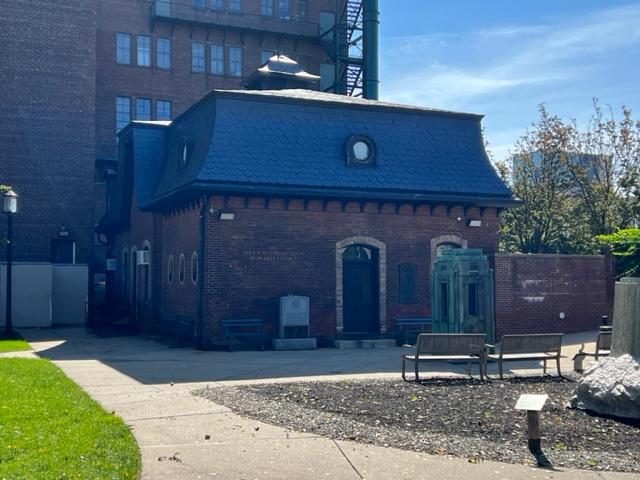
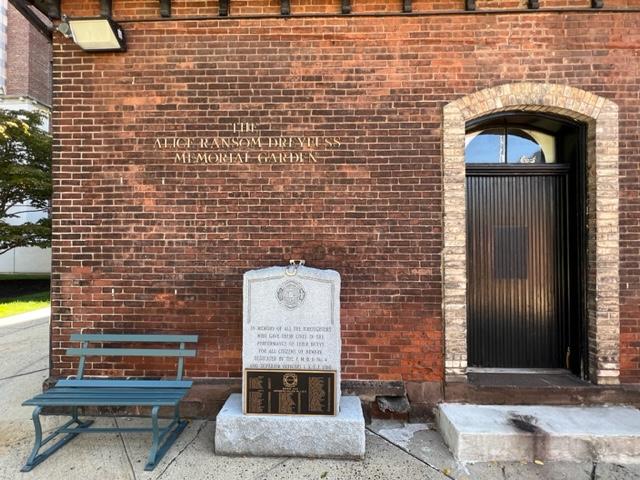
Housed in the circa 1860 Ward Carriage House in the Alice Ransom Dreyfuss Memorial Garden, the newly refurbished Newark Fire Museum tells the story of the challenges faced by firefighters in the 19th century and includes historic fire apparatus and equipment. An exciting new exhibit adds a potentially life-saving element to our mission with a high-tech interactive Fire Safety Center designed to teach fire safety and prevention to children and families.
The Newark Fire Museum in the gardens.
1784 Old Stone School House:
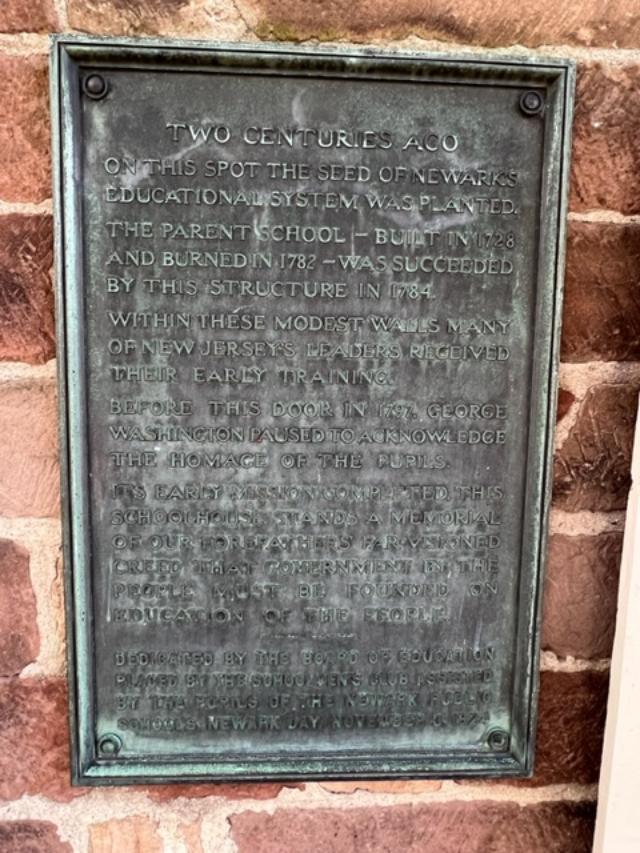
The oldest standing school building in Newark, this one-room school hosted generations of students between 1784 and the early 20th century. Recently restored, its detailed bring the past to life: the foundation built with sandstone from a local Newark quarry, the floorboards sawed by hand from trees cut from a local forest and the old cast iron stove used to heat the school with wood provided by the students.
The Old Stone Schoolhouse in the gardens.
The historic plaque at the Old Stone Schoolhouse
Planetarium:
The Alice and Leonard Dreyfuss Planetarium provides an immersive, out-of-this-world experience through which adults and children can learn about astronomy, planetary science and space travel. Featured is a state-of-the-art, full dome digital video system, a 5.1 surround-sound system and a Zeiss ZKP3B star projector.
Disclaimer: This information was taken directly from the Newark Museum pamphlet. The museum is the pride and joy of the State of New Jersey. It has great programming and wonderful events. Please call or email the museum for more details.
I have visited this interesting small history museum a few times and they do a wonderful job in presenting their displays with interesting facts catering not just to a local crowd, but anyone interested in history and events.
The one-room schoolhouse, built in 1872, operated as a public school until 1905. It was part of the district school system formed in 1864 or 1865, which was geographically defined rather than by township. It was operated as School District No. 45. When the towns incorporated in 1894, that district system was dissolved, and the school became part of the Ridgewood school district.
The Ridgewood Schoolhouse Museum’s permanent collection
Tradition has it that the original land grant to the Dutch Reformed congregation from Pierre Fauconier and his daughter, Magdalena Valleau, stated that room should always be given upon the church land for a school. We know that a small school building opened in 1785. A second stone school was built in 1820 and eventually replaced by a frame structure in 1845.
Eventually the present schoolhouse was built in 1872 at a cost of $4600.00. It is likely that other schools existed on the church property from the time the church was built in 1735 to 1785, for the consistory assumed responsibility for education and the exact time when that responsibility was handed over to the public is not known.
The large bell summoned children from miles away to school each morning. The original belfry is gone but the bell stands in the entryway. It was used in other schools and a church after the school closed in 1905 but was returned to the historical society in 1977.
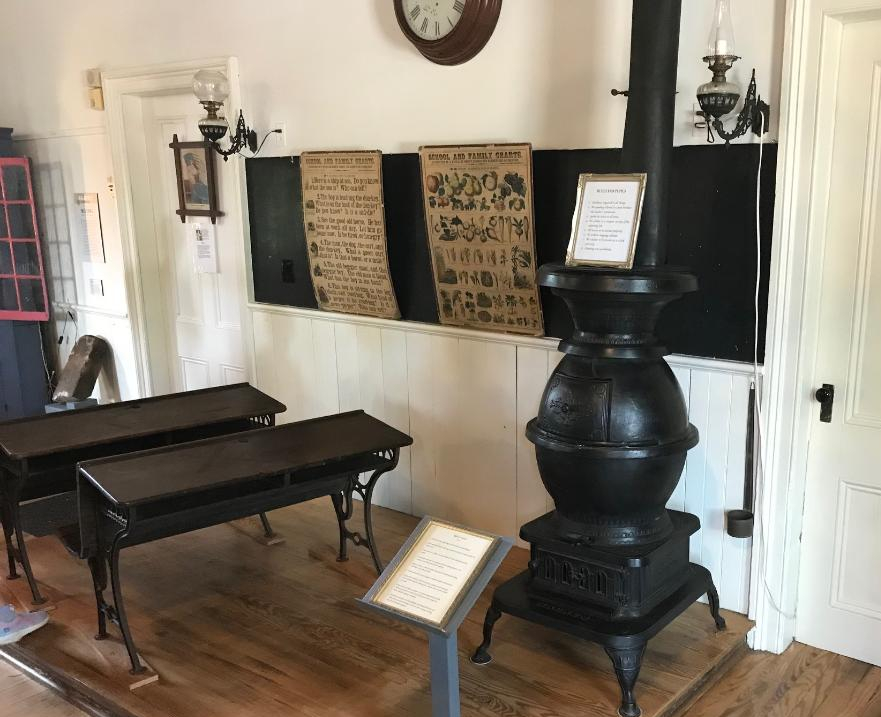
The original entry was divided into separate entrances and cloakrooms for boys and girls. The potbelly stove is original as are the windows and the two central lamps. The black boards around the room have been removed except for one behind the teacher’s platform.
There is a recreation of the old schoolhouse when you walk into the museum
When the Historical Society started the museum, the privy building was attached to the main building to provide more display area. In their special display area, they have an exhibition space for farming and a local comedian.
The schoolhouse display
In April 2018, they have a very interesting exhibition call “The Thread of Life” which tells the story of family’s progression in home life from the end of the Civil War until the beginning of the Depression and times changed between the Civil War and WWI. Between the Victorian Era, the sinking if the Titanic and the devastation of WWI, the baby boom of the teens and the ‘Roaring Twenties’ with the stock market built changed the attitudes.
The way of life for an entire generation until the Great Depression put a halt on it. You can see the changes of behavior in the displays of clothes and household decor. It is an interesting display.
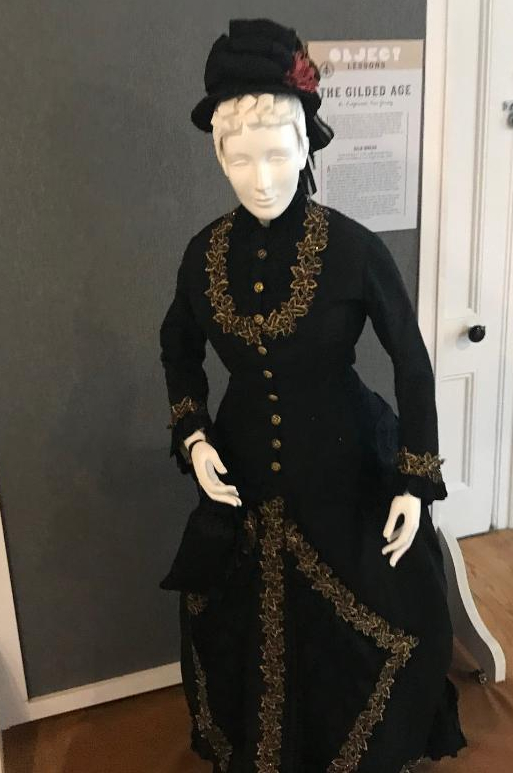
A Morning Outfit during the Victorian Age
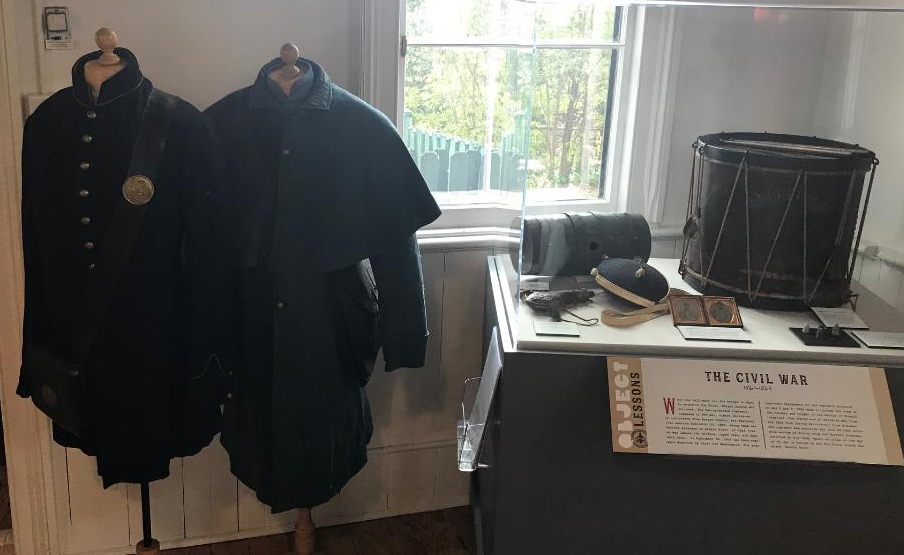
Union Army outfits and display for the “Civil War” artifacts
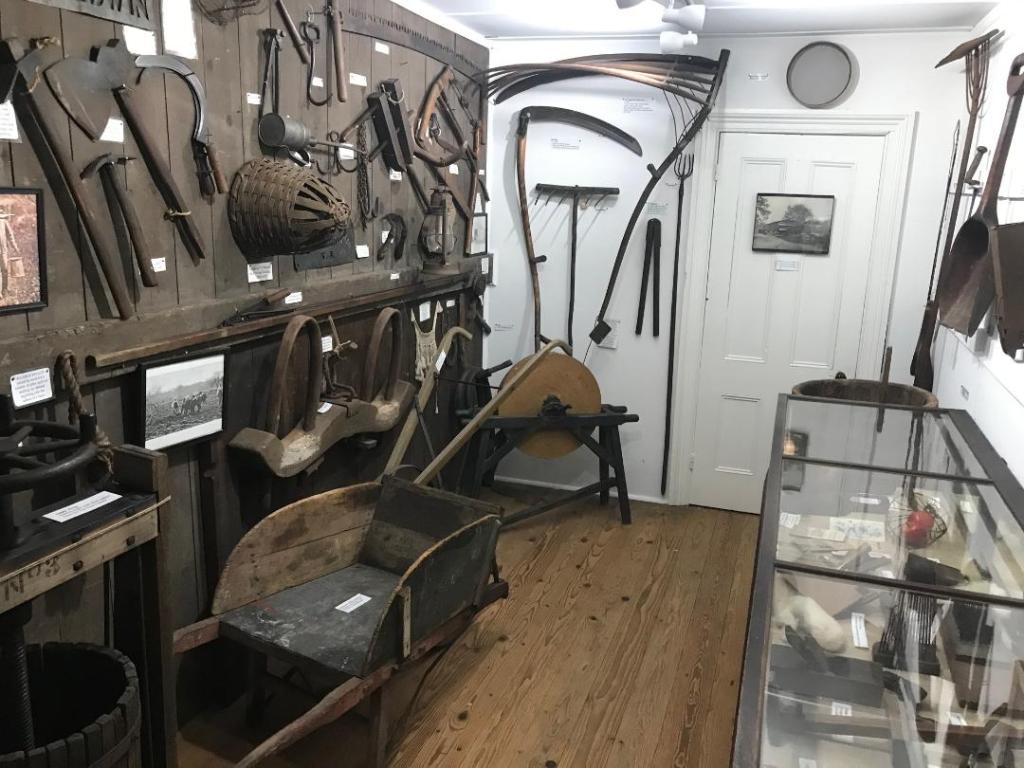
They also have an ongoing exhibition of farm equipment and a continuation of their “Farming in Bergen County” exhibition that just closed before this show. This is how farmers of Bergen County produced their crops.
Dutch items in the collection
The Blauvelt, Zabriskie and Haring families are known farming family names in Bergen County and were important in business and politics during the after the Revolutionary War.
The “Farming and Agricultural” display
Also, see their ‘Halloween Cemetery Walk” in my blog, “MywalkinManhattan.com” entry “This is Halloween” Day Ninety-Six, October 31, 2017. Don’t miss it this year!
Day Ninety-Six: This is Halloween-MywalkinManhattan.com:
The Cemetery Walks in October are extremely popular
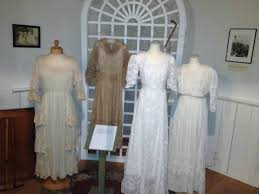
Don’t miss the “Here comes the Brides” exhibition that just opened up in May of 2019. It shows the history of formal wear for weddings along with accessories, menswear, invitations and even cakes toppers.
‘Here comes the Bride’ Exhibition 2019
In July of 2020, as Phase Three of the Opening in the State of New Jersey, the Museum is now open from 2:00pm-4:00pm for viewing with a new exhibition “A” is for Artistry: Celebrating Centuries of Art, Artists & Creativity”. The exhibit is a combination of local donated art and heirlooms from Ridgewood and the surrounding towns.
The Exhibition “A is for Artistry”
There are interesting displays of early photography and portrait painting as a way of preserving a persons’ image for the future. The use of oil painting, tin and then photo ‘sittings’ came in vogue as the technology changed.
Portraits were the form of imagetry before photography was invented
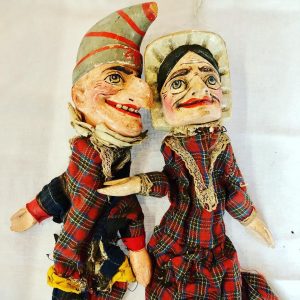
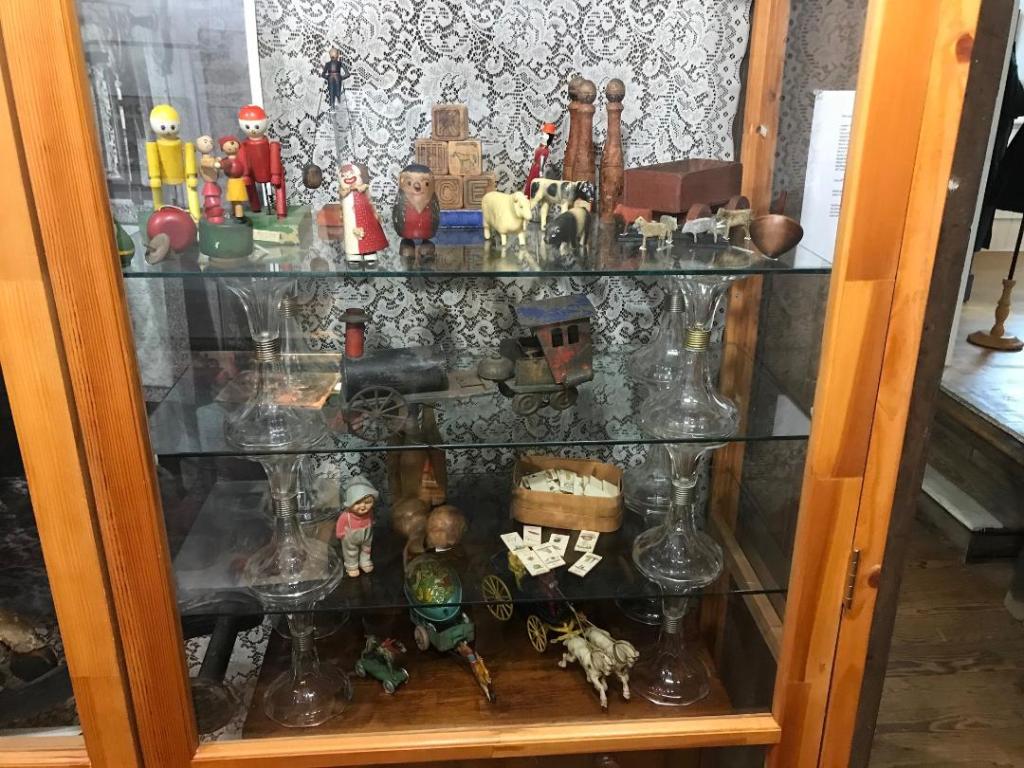
There was an interesting display of Children’s toys from the handmade farm toys of clay and corn husks to the fancier toys of bisque and cloth when imports and specialty toy stores were created for children’s playthings. They even had a collection of the famous “Punch & Judy Dolls”.
The Punch & Judy Dolls at the “A is for Artistry” exhibition
Children’s playthings over the last two hundred years
Another standout of the exhibition was the display from General Westervelt, a local citizen of Bergen County whose shipping expertise helped the North during the Civil War. His use of navigation and sailing was a detriment to the South and there was a $1000.00 bounty on his head. He died during the Civil War.
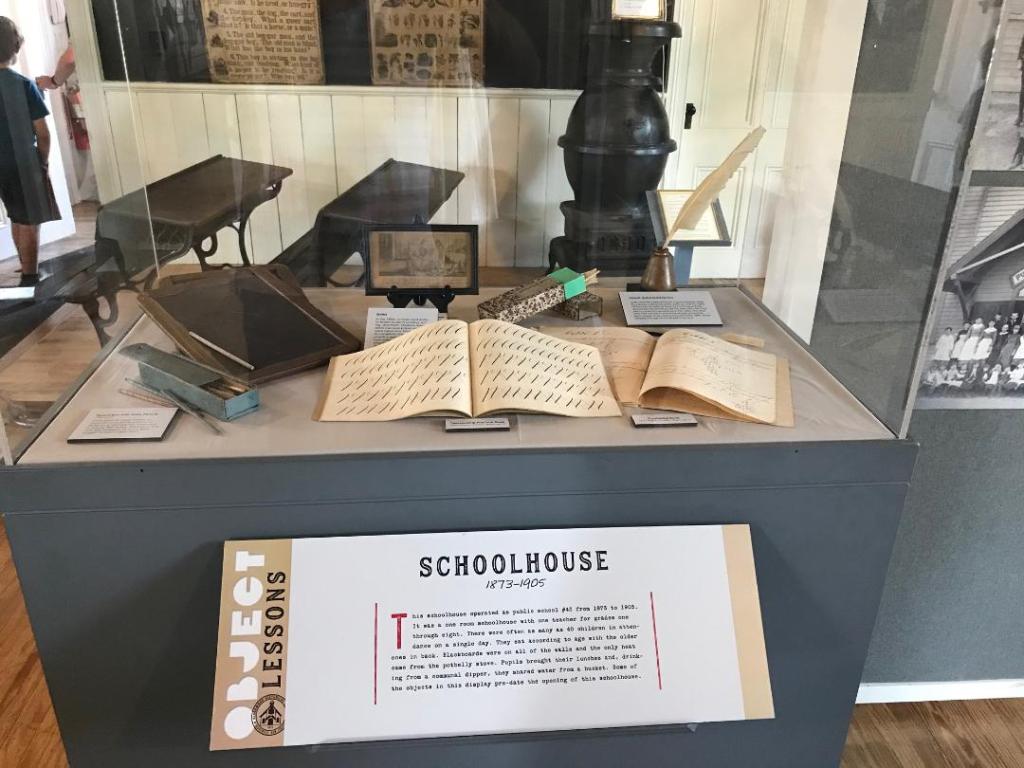
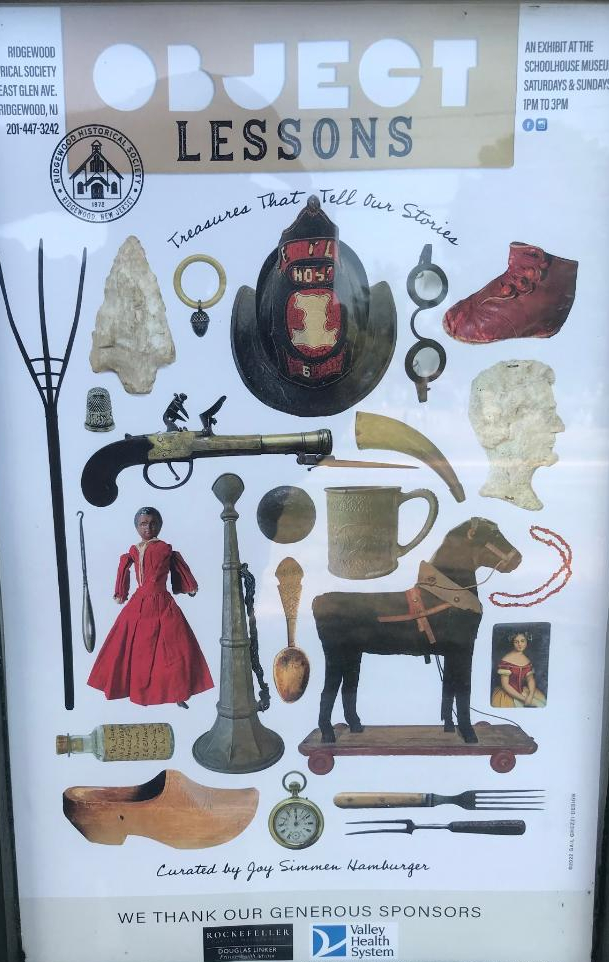
The “Object Lessons-Treasures that tell our Stories” exhibition
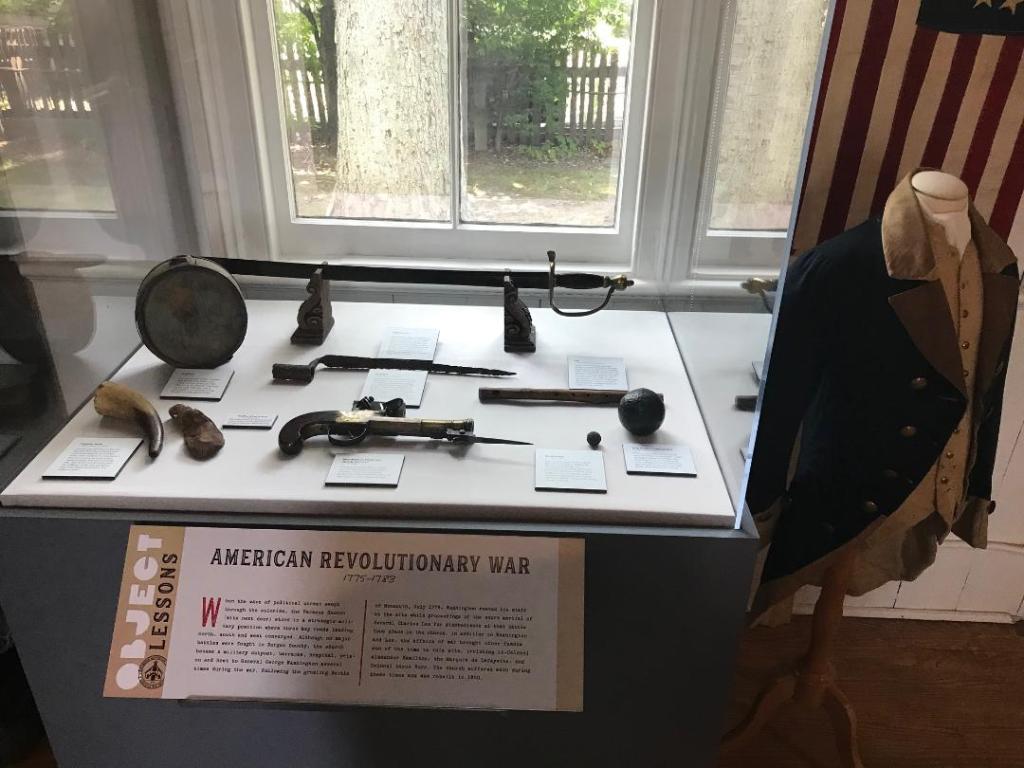
In 2022, when the Museum reopened after a long closure with COVID, they opened with two exhibitions: One was “Object Lessons-Treasures that tell our stories”, in which household objects, farming equipment and all sorts of artifacts from the pre-Revolution, Revolutionary War and Civil War periods were shown. It showed the progression that life took for families between the Revolutionary War and the beginnings of the Victorian Age.
“American Revolutionary War” display
They had local Dutch family heirlooms such as chests, cabinets, china, clothing and even documents. The average Dutch family kept their family linens, china, silver and bedding in a locked chest as these were valuable family luxuries that needed protection and proper care.
Dutch Chest with family items that were locked up.
There was a “Lincoln display” at the museum. They had a copy of the poster from the night that President Lincoln was assassinated at Ford Theater during the performance of “My American Cousin”. There was a family shot of the Lincoln family and items from the period.
The “Lincoln Display” that showed an original poster from “Our American Cousin” the night Abraham Lincoln was assassinated.
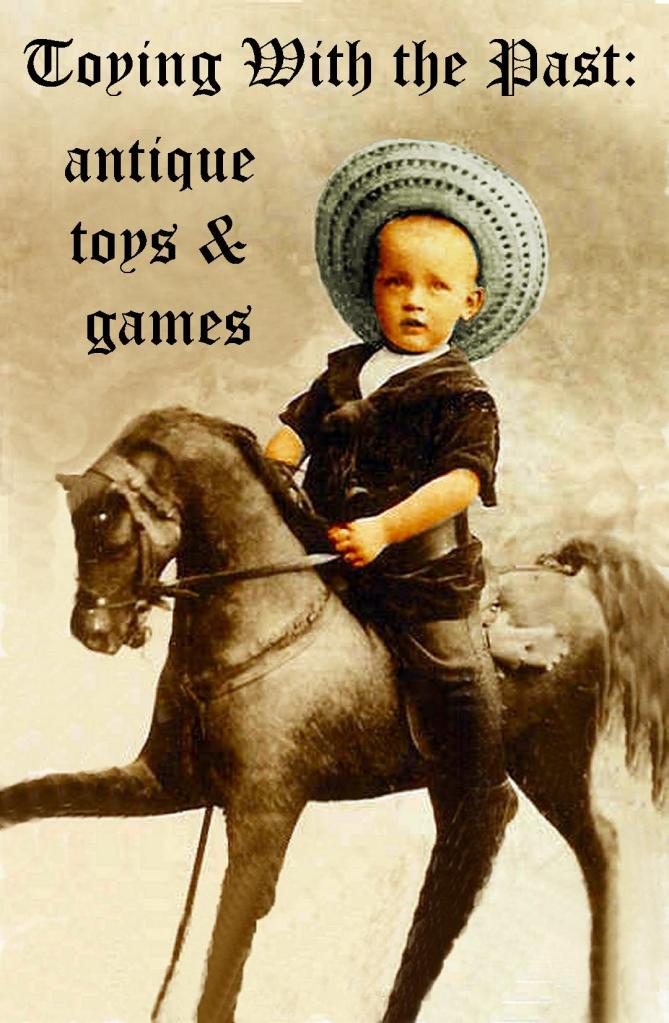
The other exhibition was “Toying with the Past: Antique Toys & Games”:
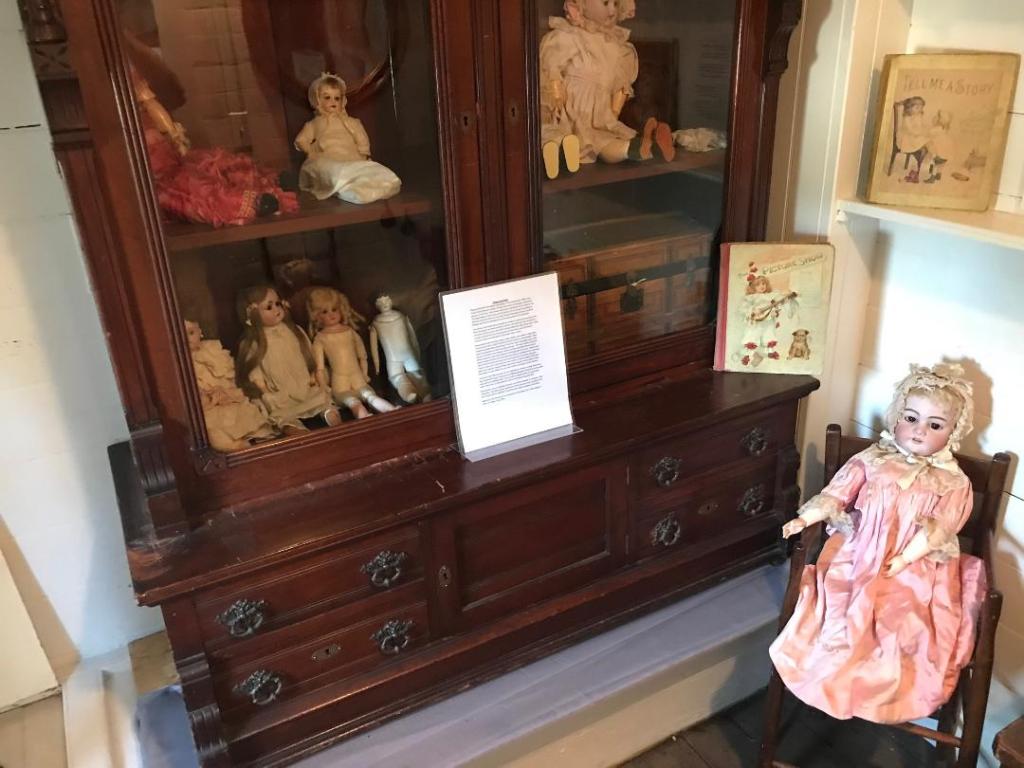
Toying with the Past was an interesting exhibition in that it showed how much toys have developed and changed over the years and how much they have stayed the same. There was a beautiful collection of china and bisque dolls, some that were made as playthings and others used as marketing tools to show women the latest fashions coming out of Europe. The dolls would be dressed in the dressmakers’ newest designs.
The Doll Collection is beautifully displayed
There were older versions of modern board games, everyday items like marbles and Jaxs. There were kitchen-based items that a little girl might be given to improve her domestic skills and there was even an early version of an “Easy Bake Oven”, with an electric oven that could be plugged in and boil water.
The items a young girl would receive to prepare her for homelife
Fancy rocking horses and dolls
Vehicles and Board Games that sparked children’s imagination
More dolls and vehicles over the last 100 years
There was also all sort of toys on wheels and rocking horses that could entertain a grumpy child for hours. They even had a selection of play clothes and school items to show what classroom work was like at the turn of the last century.
Childhood was changing for young people after the Civil War and during the Victorian Age
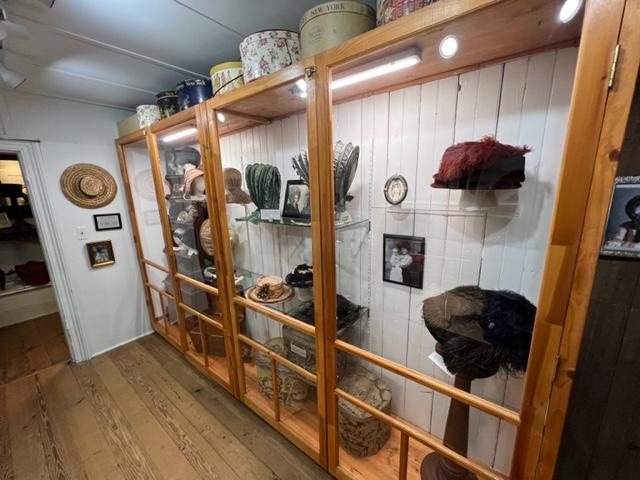
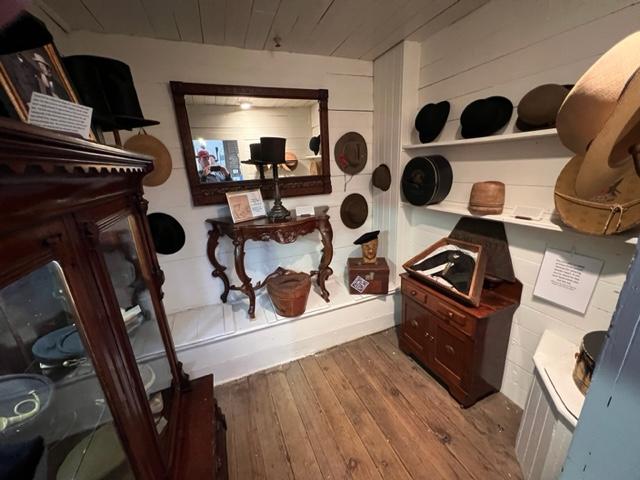
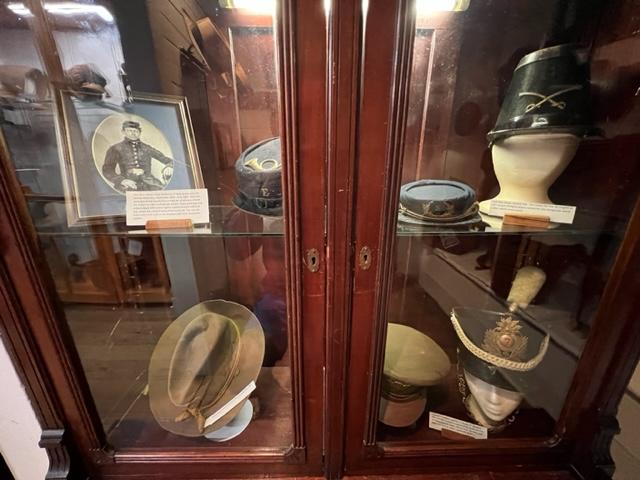
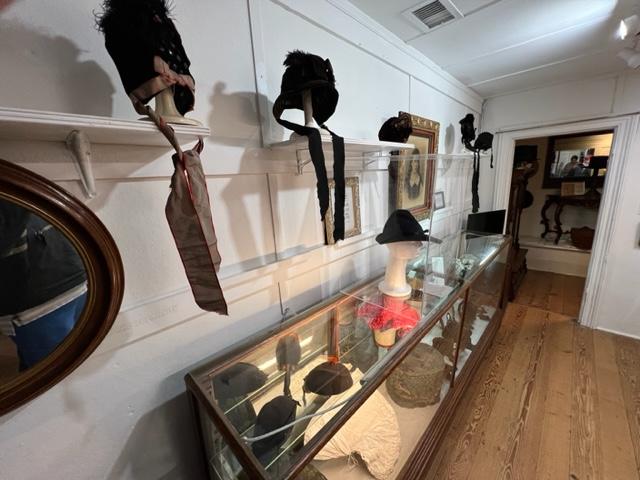
The Latest Exhibition that was on display in April 2023 was the “History of Hats” that replaced the Toy exhibiton:
Hats from all ages
Men’s hats through the ages
Military Hats
General’s Hat
Ladies bonnets
‘Fashion of the 1880’s’
Special Events and Lectures at the Museum:
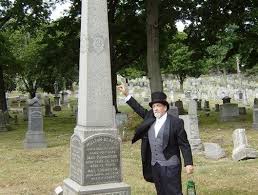
Don’t miss their ‘Cemetery Walks’ during the day. I took one recently at the old Dutch Reformed Church and we discussed the history of the church, the location of the old church versus the building of the new one, which is why the cemetery looks the way it does and the locations of the tombstones as well as how time and advancement in carving went from sandstone, which fades and chips over time when to the production of granite and marble for future tombstones.
The Cemetery Walks in Valleau Cemetery across from the museum
The cemetery is filled with names famous and prominent in Bergen County and North Jersey history which includes participation in the wars and the building of Bergen County including the Westervelt’s, Van Riper’s, Haring’s, Zabriskie’s, Terhune’s, Demerest’s, Blauvelt’s and Tice’s families. It is a fascinating place to learn Bergen County history and its development.
The Cemetery Tours that take place the week before Halloween are interesting as well. The paths of the Valleau Cemetery in Ridgewood are lined with candles and you follow the path with the town historian who takes you on a creepy tour of the famous dead residents of Ridgewood. These include prominent athletes, business people and local laborers. You pretty much tour about a third of the cemetery as you move from one tombstone to another met by costumed actors, who they themselves have to sit in the cemetery in the dark waiting for you. That is a horror movie into itself.
The Valleau Cemetery Walk and Lecture
The best part of the tour is you are greeted at the museum with a tour of the museum and a table laden with fresh apple cider and cider doughnuts that make the perfect refreshment on a cool fall evening. Make sure to take the 7:00pm tour when it is dark out and make the reservation well in advance as these tours fill up fast.
Taking the Cemetery Tours is interesting!
Don’t miss their upcoming tours for Halloween, Christmas and their lecture series.
Please check out the museum’s website for all their very original special programming.
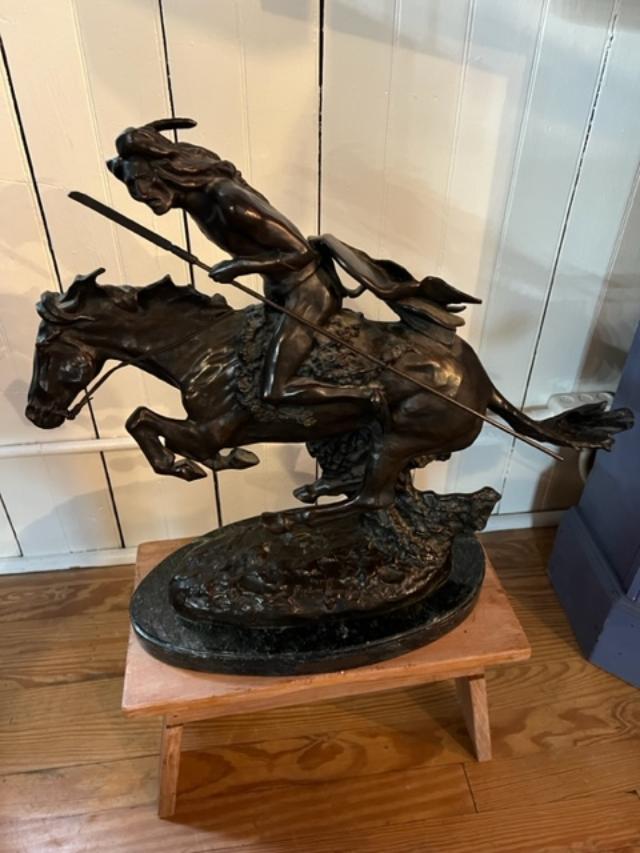
The museum’s latest acquisition, a Native American on horseback
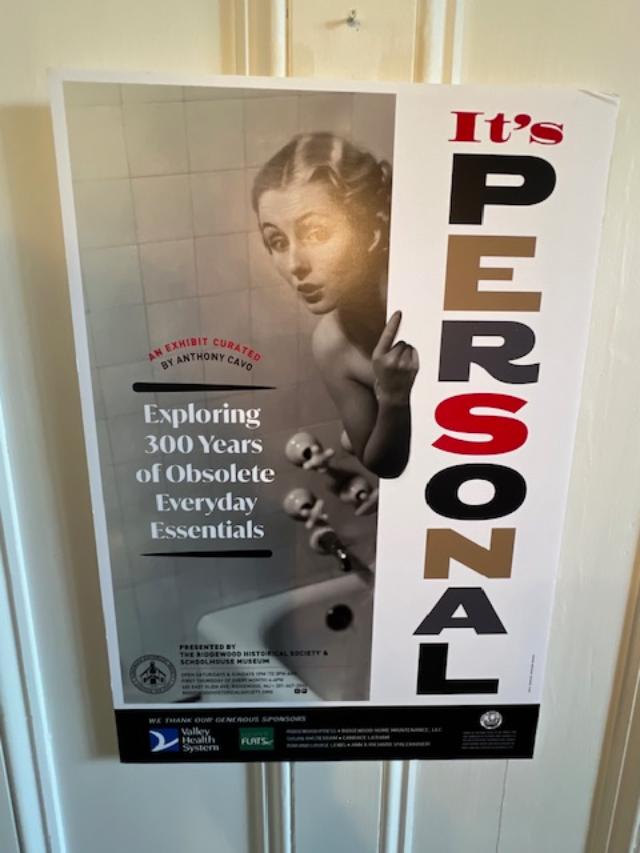
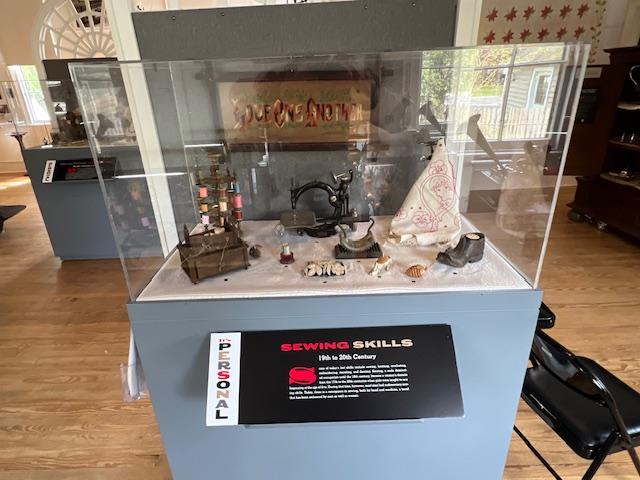
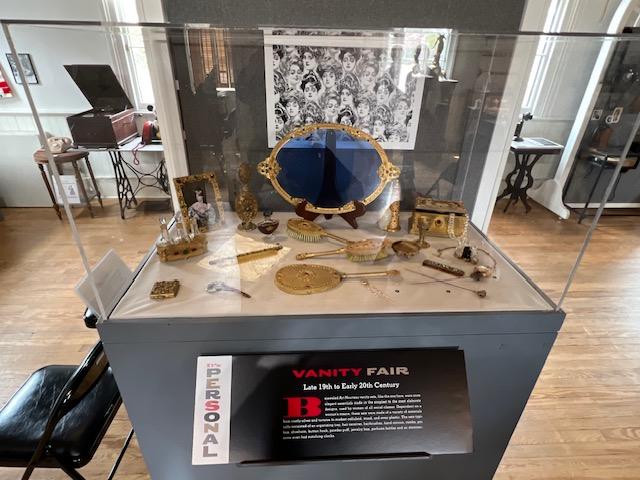
For the 2024 Northwest Bergen Historic Coalition Day, I visited the museum again and they were having an exhibition entitled “It’s Personal-100 years of obsolete Everyday Essentials”. It made me feel old when I saw a rotary phone, ink well and some of the other items that were in the exhibit. Some of them were from my generation and I do not consider myself old.
The sign from the “It’s Personal” exhibition.
The entrance to the Ridgewood Schoolhouse Museum for the “It’s Personal” exhibition
The Ridgewood Schoolhouse Museum “It’s Personal” exhibition.
The Ridgewood Schoolhouse Museum “It’s Personal” exhibition.
The Inkwell display at the “It’s Personal” exhibition to be replaced by the modern pen.
The Sewing Kit at the “It’s Personal” exhibition to be replaced by the modern sewing machine than by Ready to Wear clothing.
The Vanity which is still in use depending on the person in the “It’s Personal” exhibition.
The development of the phone and then the change to the modern cell phone in the “It’s Personal” exhibition.
The exhibition was interesting because its takes the modern perspective of the development of objects and their use over the last 100 years and show them with a modern twist on how times continue to change.
The Pascack Valley Historical Society is now celebrating their 75th Anniversary.
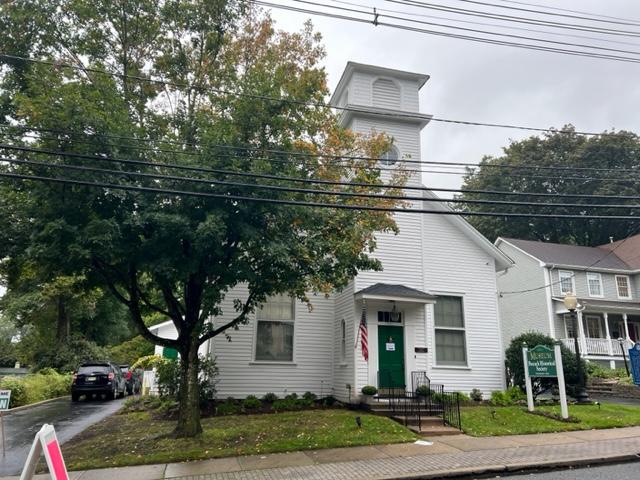
The Pascack Historical Society Museum (John C. Storms Museum), headquarters of the award-winning Pascack Historical Society, is located in the 1873 church building that was dedicated by the Reverend Henry Ward Beecher. The building and all the exhibitions have gone through an extensive renovation and have been reinstalled with more signage and information. Please check out their new displays.
The sign that greets you in the front of the building.
The Historical Marker in front of the building.
As you enter the building, you are welcomed to a comfortable spot.
The extensive exhibits include a general store, colonial kitchen, a Victorian Living Room, dolls, clothing and other displays of American life in the Pascack Valley. The front gallery as you enter serves as a classroom and lecture hall for the society. There you can see a variety of artifacts in the collection from china to guns and clothing.
Artifacts in the front room.
Artifacts in the first gallery.
A collection of antique guns in the front gallery.
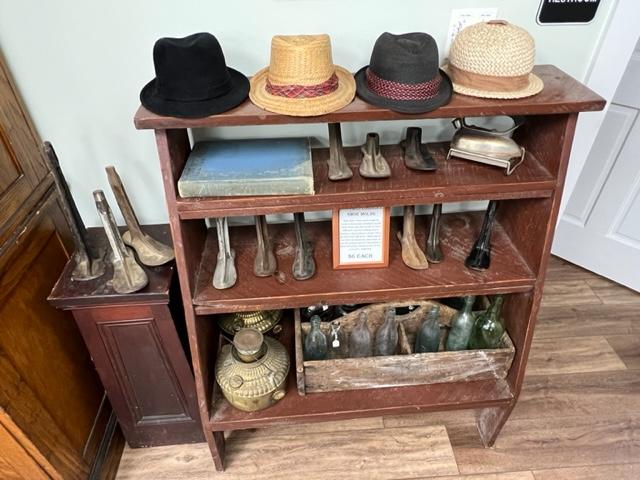
A selection of hats in the front gallery.
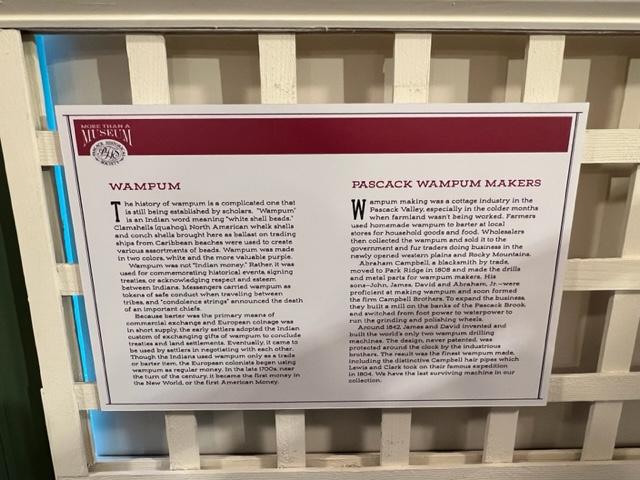
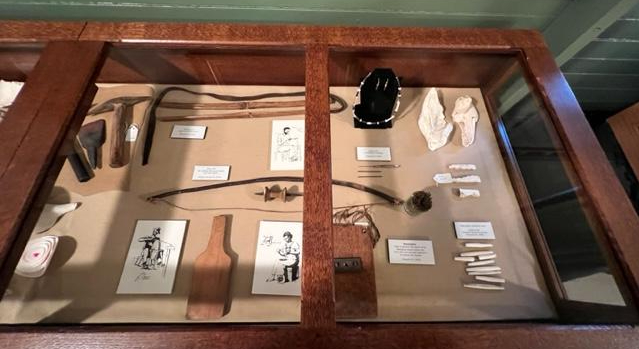
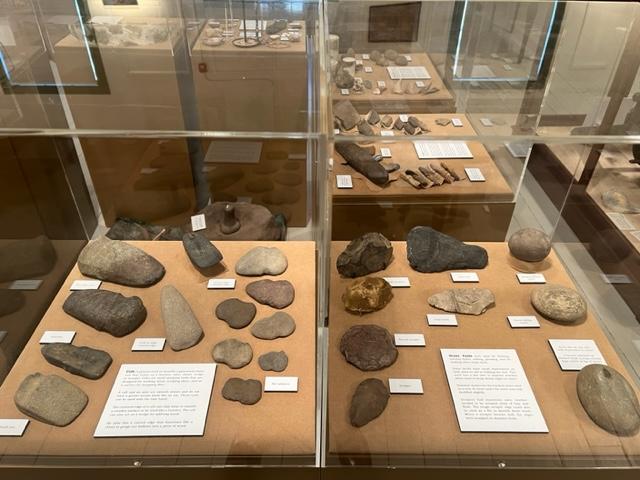
There is also a special exhibition that features the world’s only wampum drilling machine as well as a collection of early colonial currency.
The Wampum Machine sign and how Wampum is made.
Their early Colonial Financial exhibits include an early wampum machine that the tour guide had said that it was the only one of its kind that made a type of rolled wampum from the inner section of a conch shell. Early New Jersey currency is well represented in the collection with several types of dollar bills at a time when states printed their own currency for its citizens. Really take a look at the early detail work of these bills.
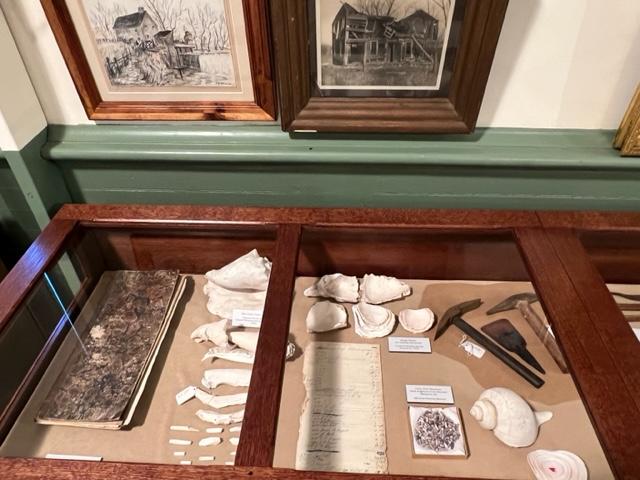
The Wampum display of shells and tools.
The uses of Wampum and how it is made.
The oldest working Wampum machine in the world.
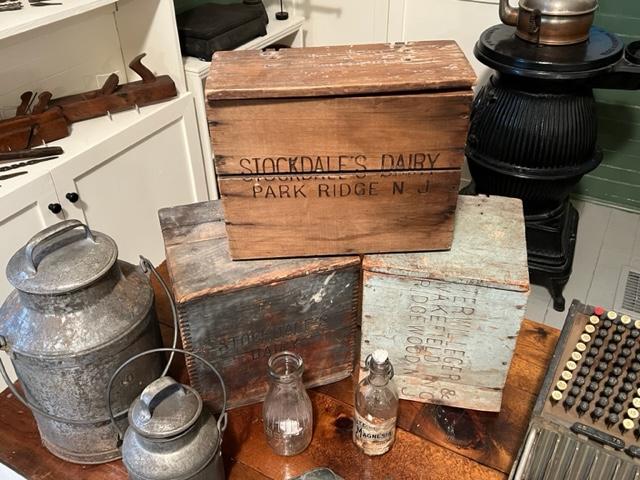
The Van Ripper General Store exhibition features many types of early Colonial artifacts that include weights and measures, food items found in an early grocery store, turn of the last century bottles and many types of appliances for cooking. Several treasures are tucked here and there to create the mood of shopping at the turn of the last century in Bergen County. There are classic groceries, weights and measures to weight groceries and several artifacts from the Van Ripper and Stockdale Farms which used to be located in the area.
The General Store sign
The General Store display.
Stockdale’s Dairy Farm was a popular farm in Park Ridge before the 1960’s.
Tools need on the farm and in the home.
The Tool display at the General Store.
The Toy Collection is extensive and covers several time periods. They have a interesting collection of dolls over the ages that include cloth and china dolls that would cater to children from different economic status. There are also games, wooden and metal pull toys and hobby toys such as marbles and jacks.
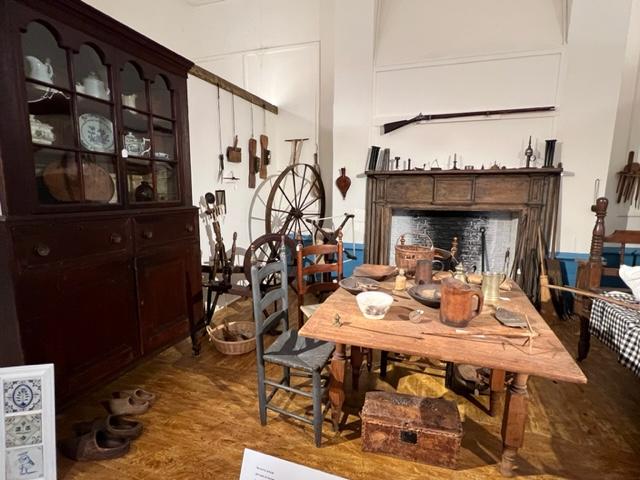
The Early Dutch Farmhouse Kitchen & Dining Room features one of the first beds that has no mattress but constructed by a series of ropes that are tightened. The tour guide explained that this might be where the expression “Sleep tight and don’t let the bed bugs bite” might have come from as the ropes needed to be tightened each evening before the family went to bed.
Early Dutch life sign.
The exhibit also had early furniture hatches, chamber pots, a butter churner, various chairs that were manufactured in the area and several detailed decorative pieces.
The Early Dutch Kitchen and Living Space
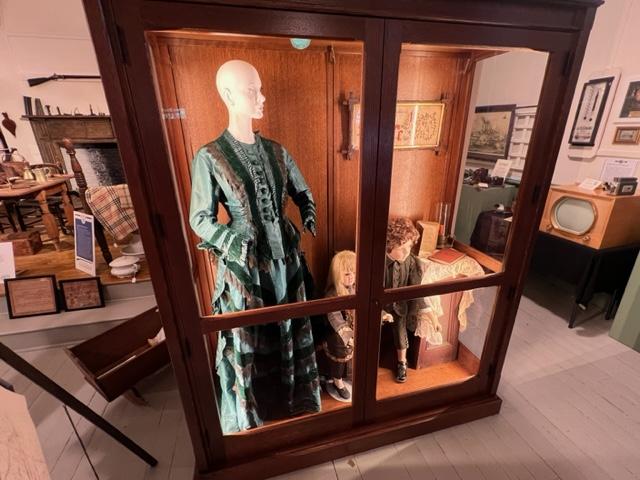
The Victorian Dress of the church visitation.
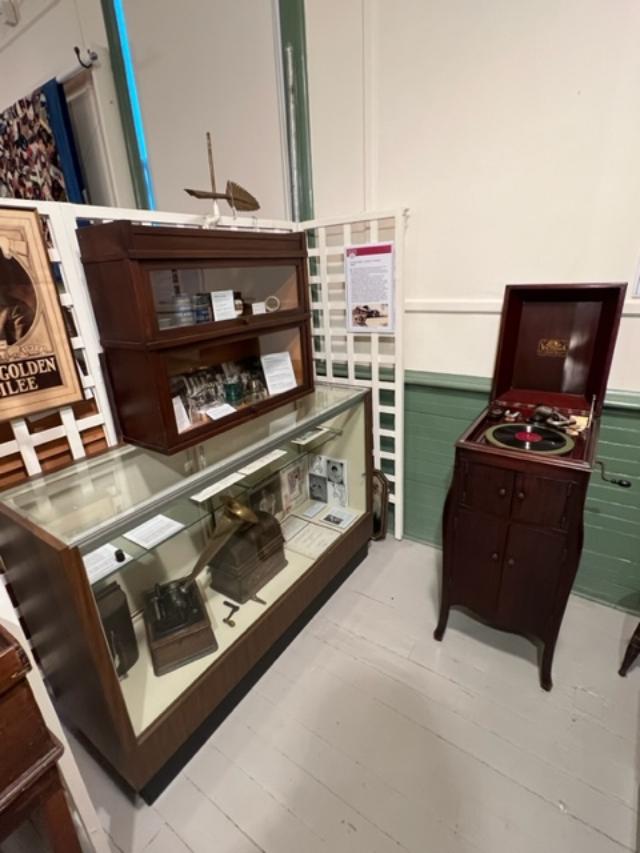
The Victorian Living Room features many plush pieces of furniture, decorative knick-knacks that used to dominate the décor and a graceful piano with mother of pearl keys and decorative carved sides. This model was one of maybe a hundred made for a very elite client. The display also featured one of the early record players that still works.
The ‘Victorian Afternoon’ exhibition in 2024:
The sign for the Victorian home:
The ideal Victorian Home ‘Parlor’
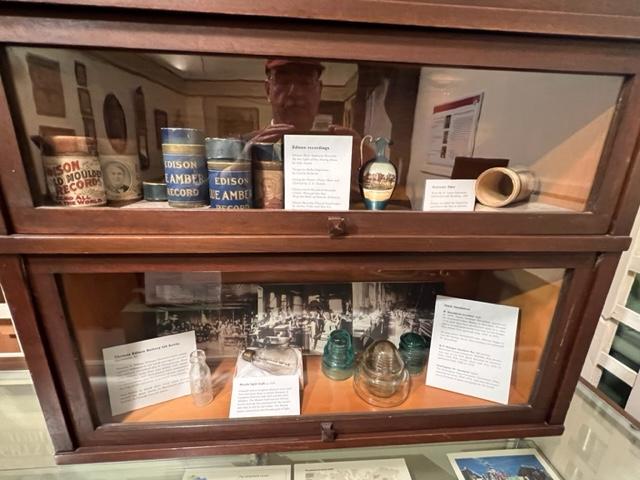
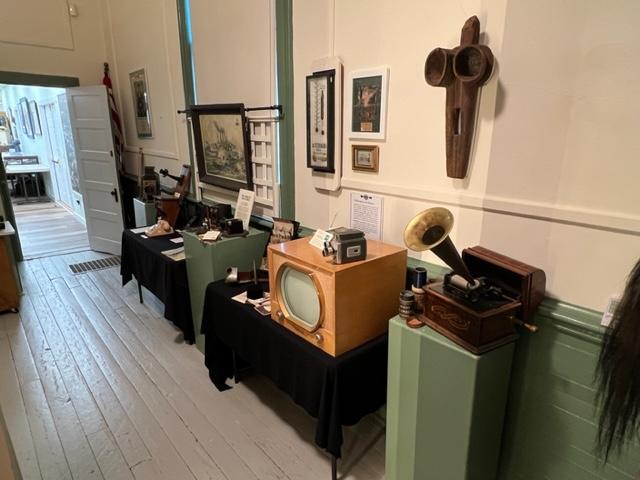
Early Edison products
Early Edison recording equipment was not just musical but decorative.
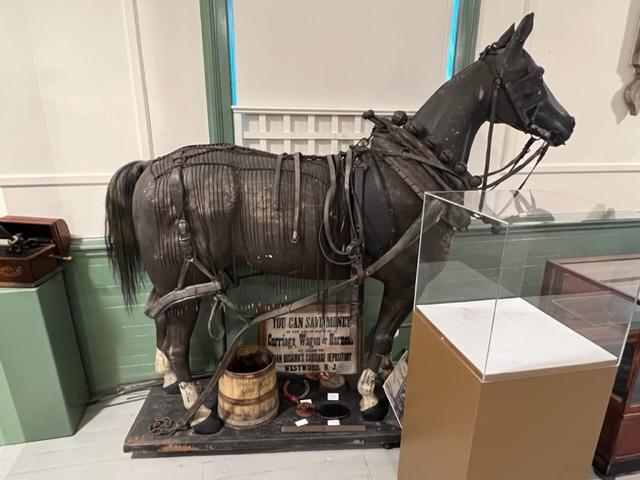
The horse display.
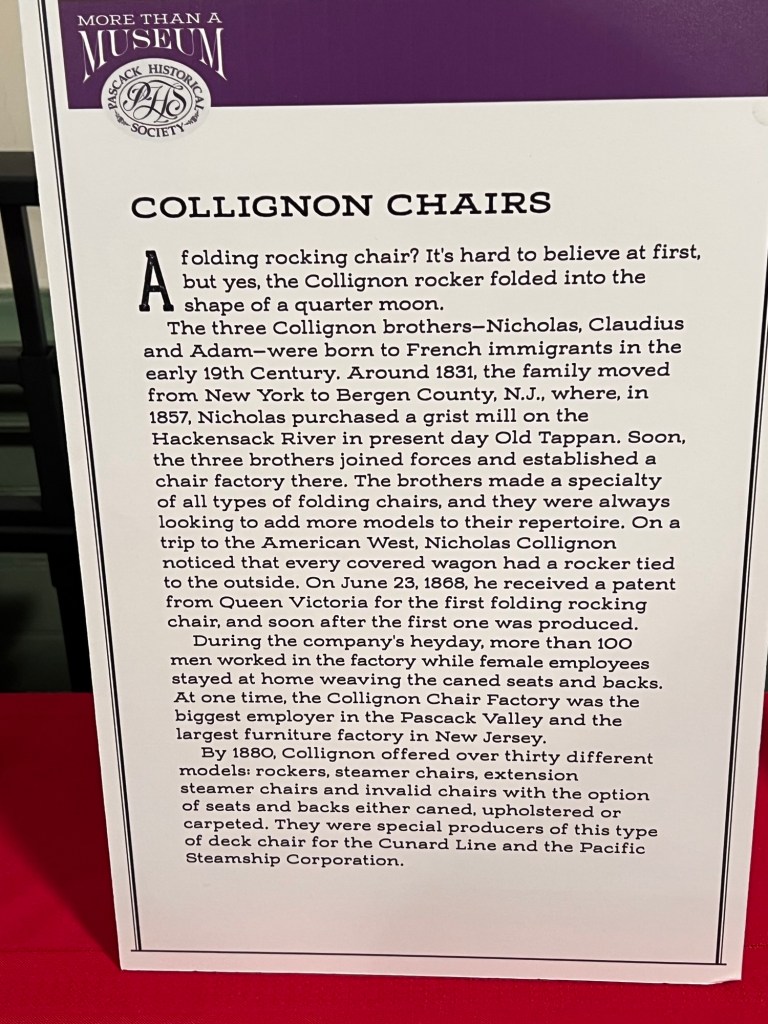
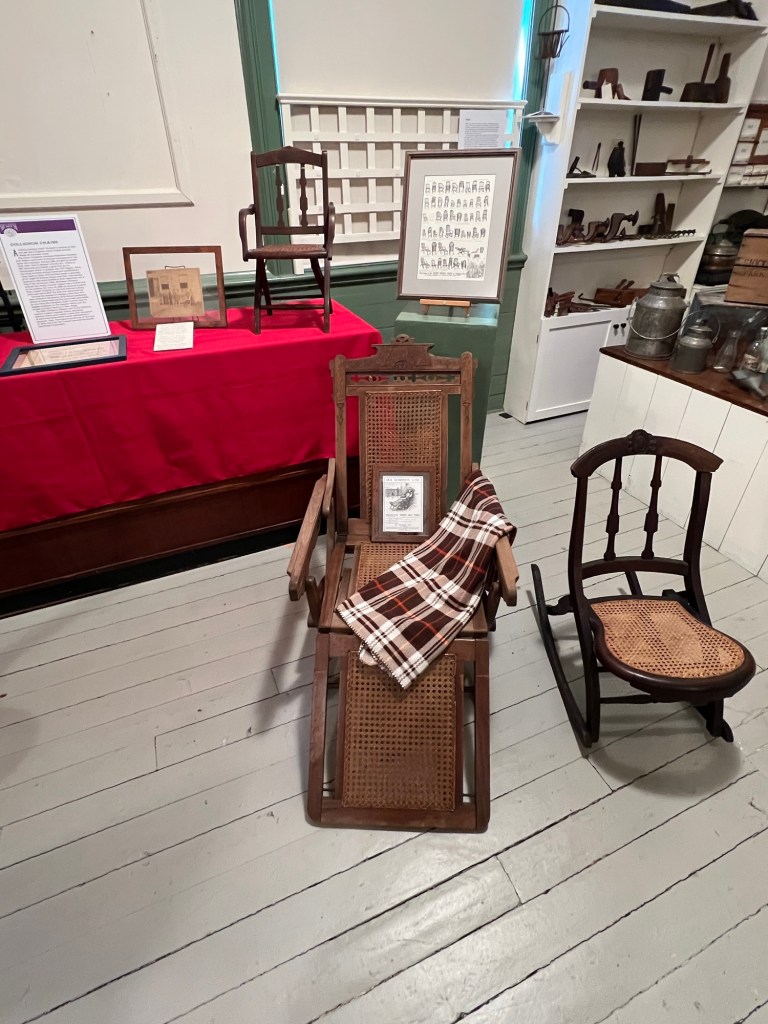
The new exhibition 2025: ‘Collignon Chairs’
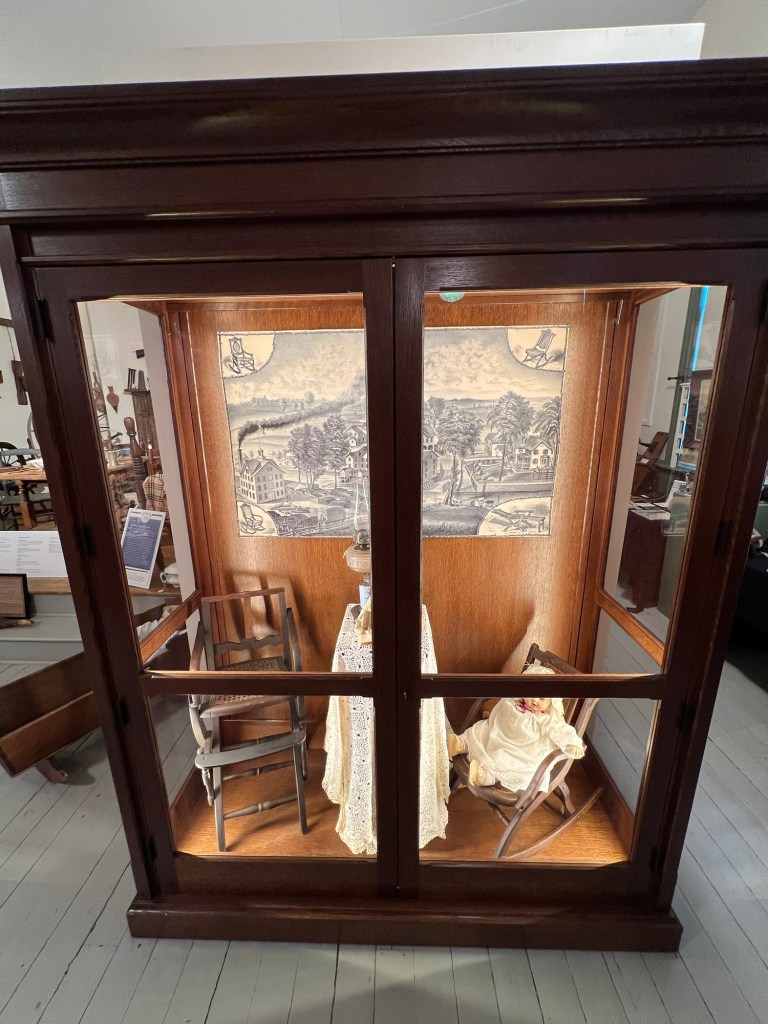
The exhibition is on the Collignon Chair factory of River Vale, NJ and the selection of chairs that the factory once manufactured.
The sign from the exhibition
Some of the collection of Collignon chairs on display including the popular deck chair used on streamlines.
The popular folding rocker from the collection
The display of chairs and a drawing of the old factory
Off to the side, there is an early sleigh and horse display, an exhibit of typewriters and carbon paper as I found out the area was once the leading manufacturer for carbon paper and a complete workshop with tools from all eras.
Typewriter collection at the museum.
Early Electronics
The schoolhouse desk of the school master.
The workshop is a very detailed in its artifacts with early saws, hammers and items that even I could not figure out what they were.
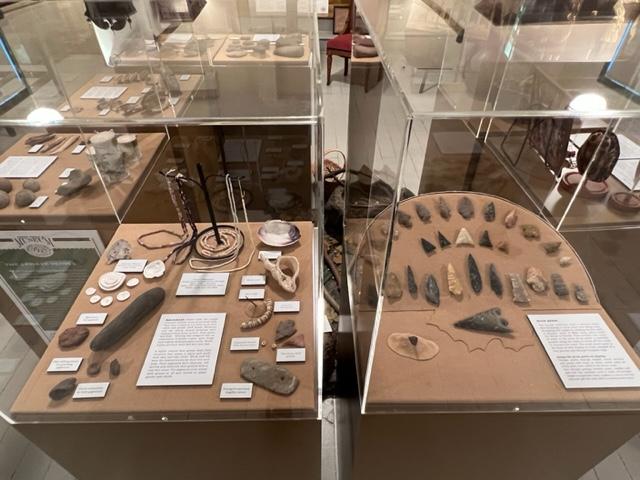
In the main room, there are more cases of toys, Revolutionary items and Native American artifacts to explore.
Native American Artifacts
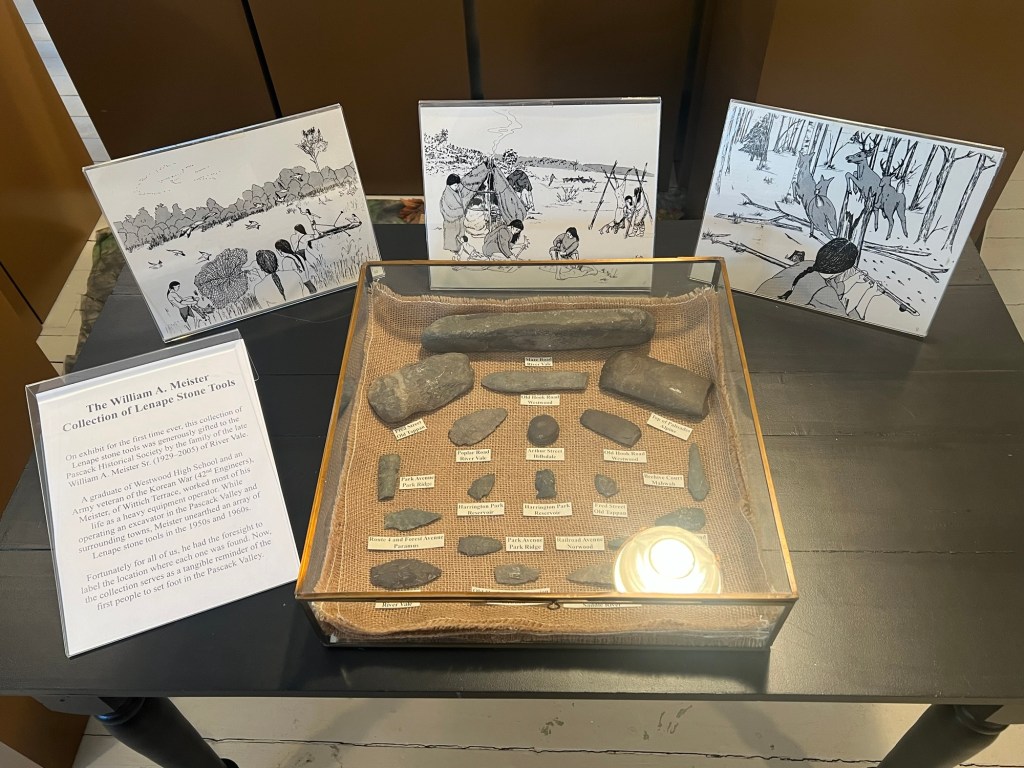
The Lenape display
The Native American display.
A small gift shop is off to the side selling items donated by members.
Become a Friend: From the Friends of the Pascack Historical Society Museum pamphlet:
Pascack Historical Society Information and History:
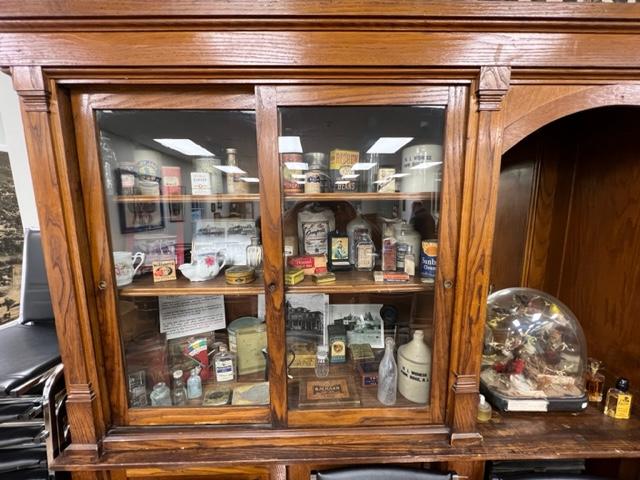
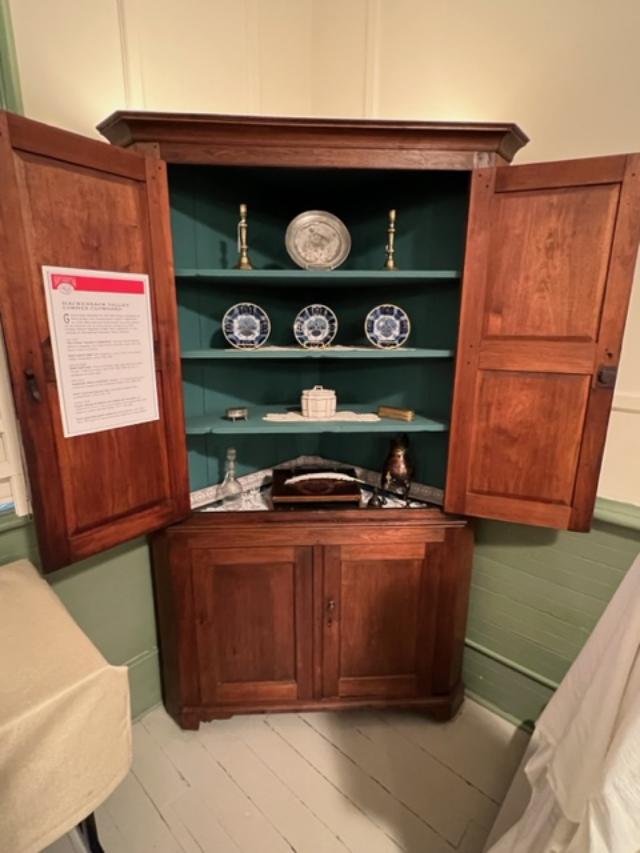
The Corner Cupboard of early American china.
(From their pamphlet):
Membership Benefits:
Become a member of the Pascack Historical Society, a 501C3 organization. Dues are modest and membership has its privileges!
One year of free admission to the museum and most of its activities.
A one year subscription to the Society’s award-winning quarterly newsletter, RELICS.
10% discount on museum gift shop items (Sale items and new books excluded).
50% discounts on programs for children and adults.
You will receive Members Only advance notice mailings and emails about upcoming events and activities.
Members only “behind the scenes tours” of the museum. (By Appointment Only).
You will have the satisfaction of knowing you have joined the ranks of the area’s most passionate historical preservationists, who have a commitment to educate and enrich their neighbors’ lives-young and old.
The Military embellishments
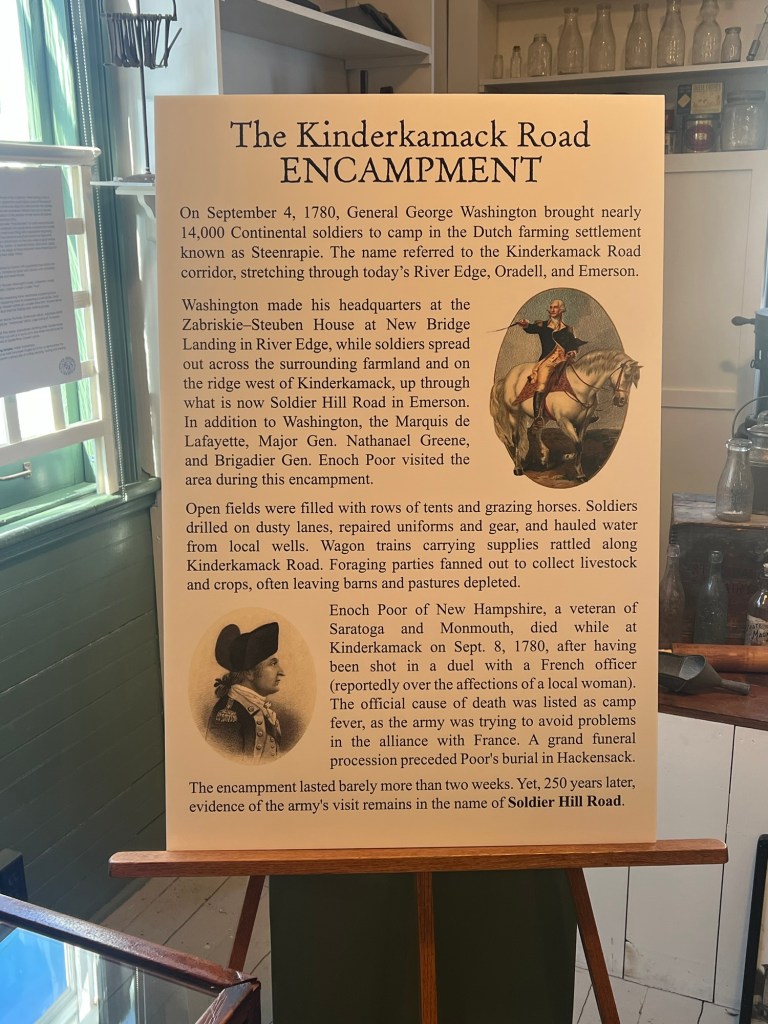
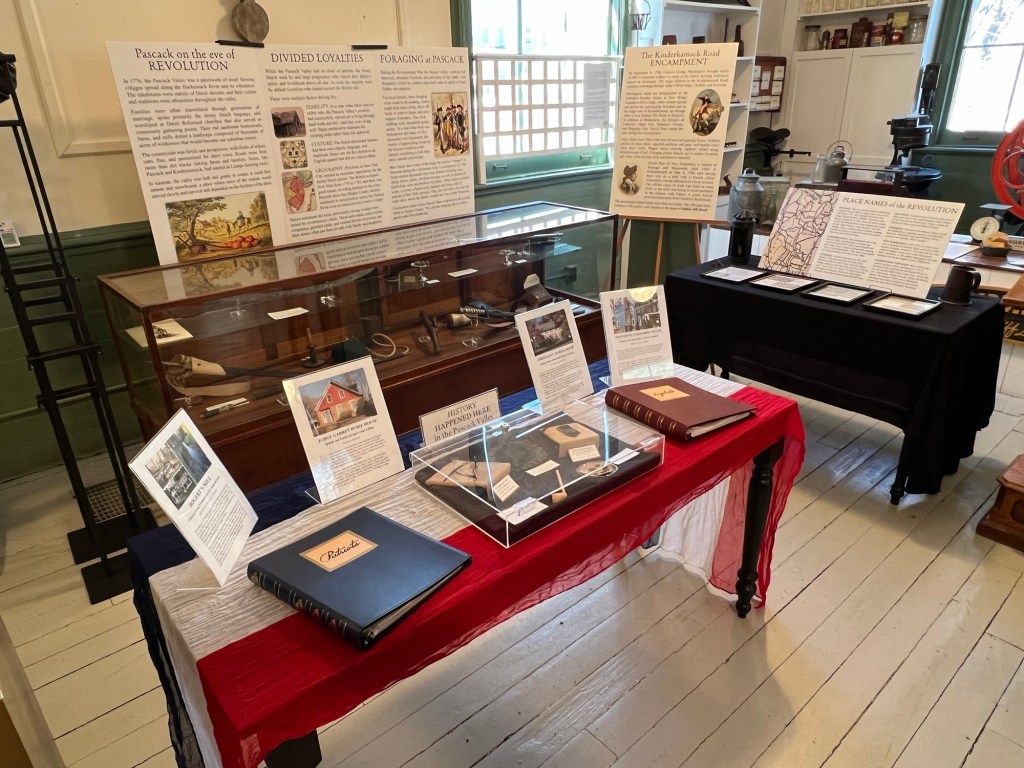
In 2026, the museum was celebrating the ‘250th Anniversary’ of the Revolutionary War and had an exhibition of artifacts from the Pascack Valley.
The ‘250th Anniversary’ of Revolutionary War
This included all the stops that General Washington made in Bergen County, battles and confrontations with British soldiers and family battles by members who were loyalists and patriots.
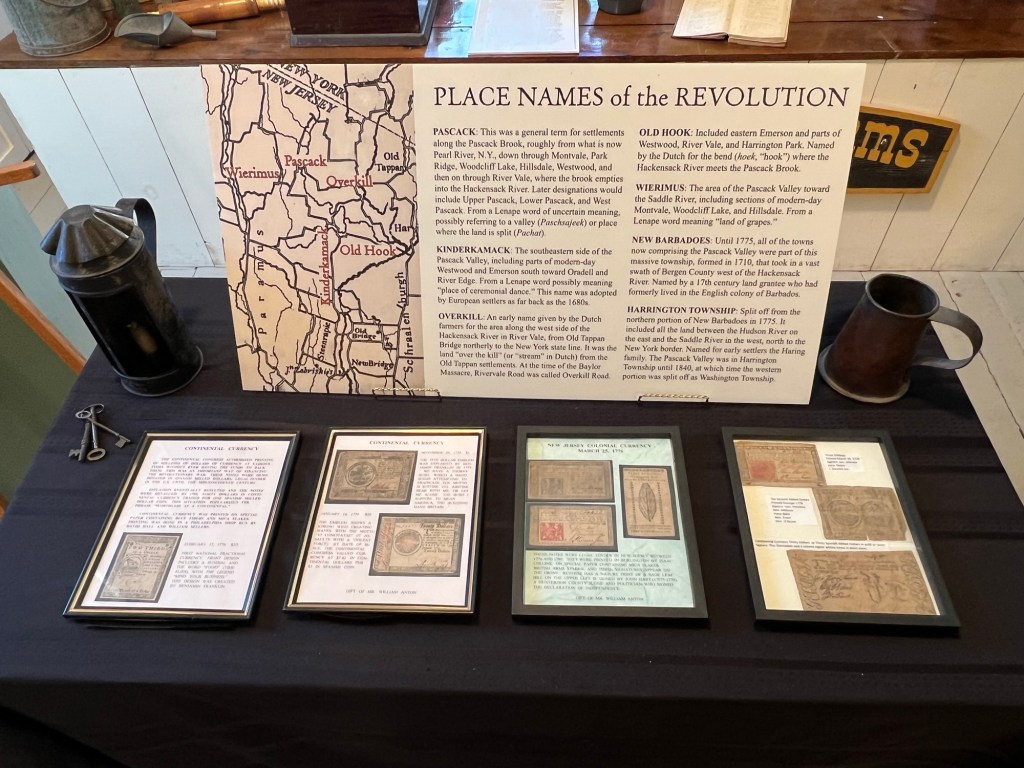
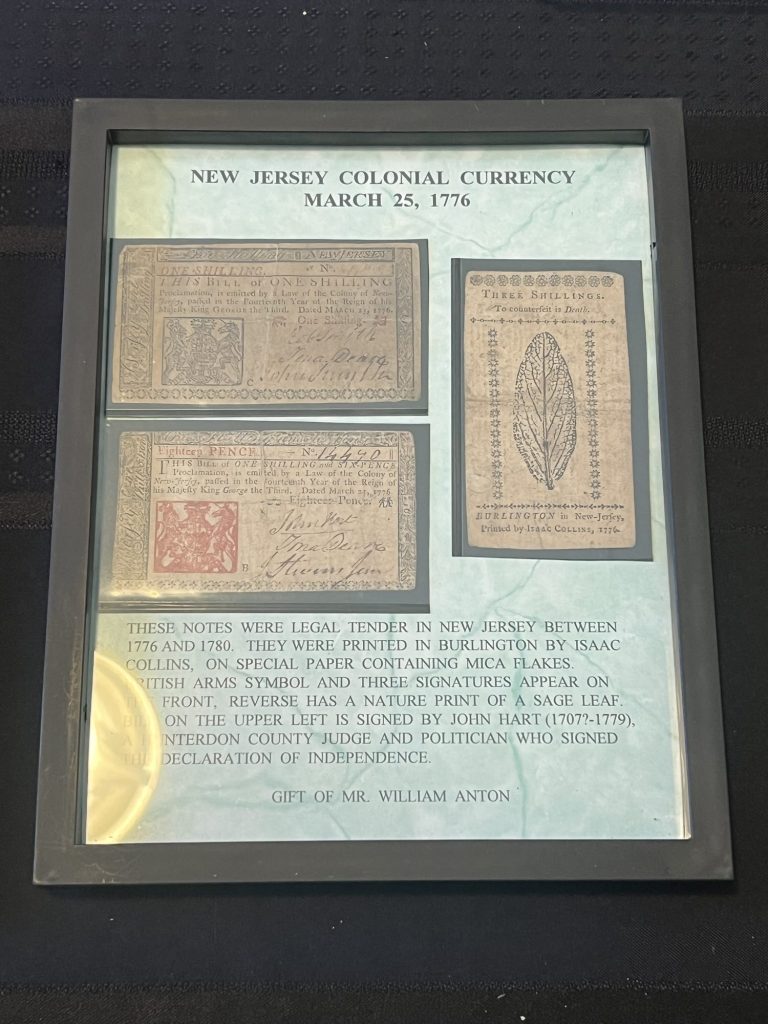
The currency of the war years
The exhibitions shows New Jersey’s contributions to the war effort. This part of the exhibition has Colonial currency from New Jersey.
New Jersey Colonial Currency
The full exhibition of the ‘250th Anniversary’ of the Revolution War
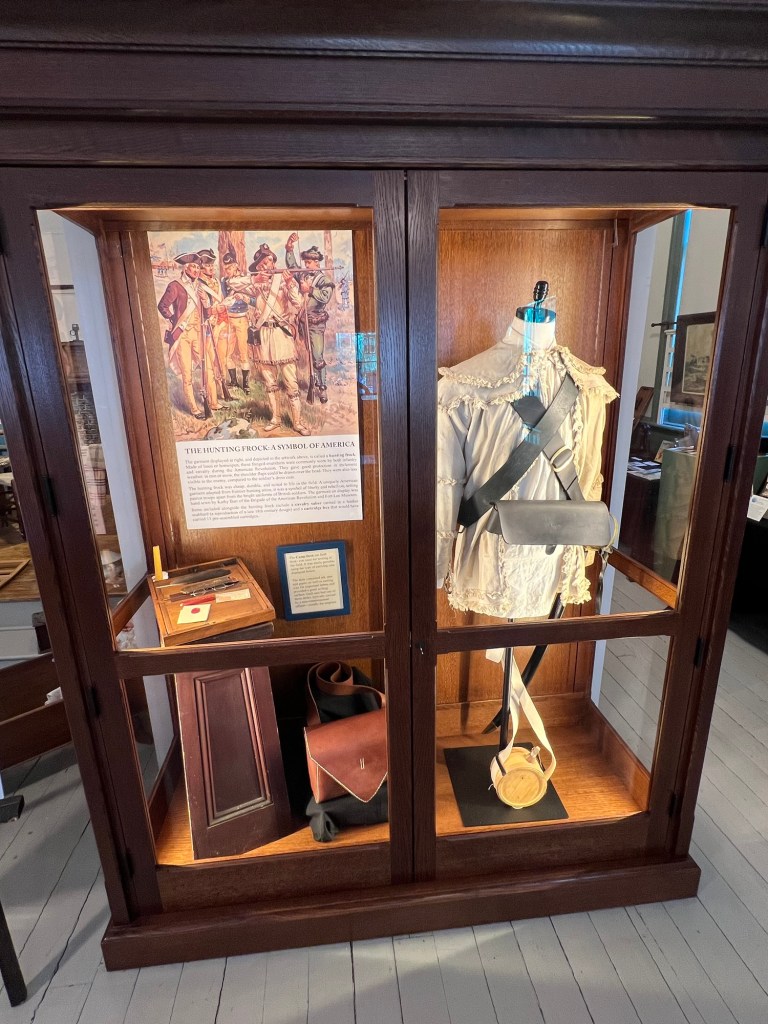
Uniforms and accessories of the War years
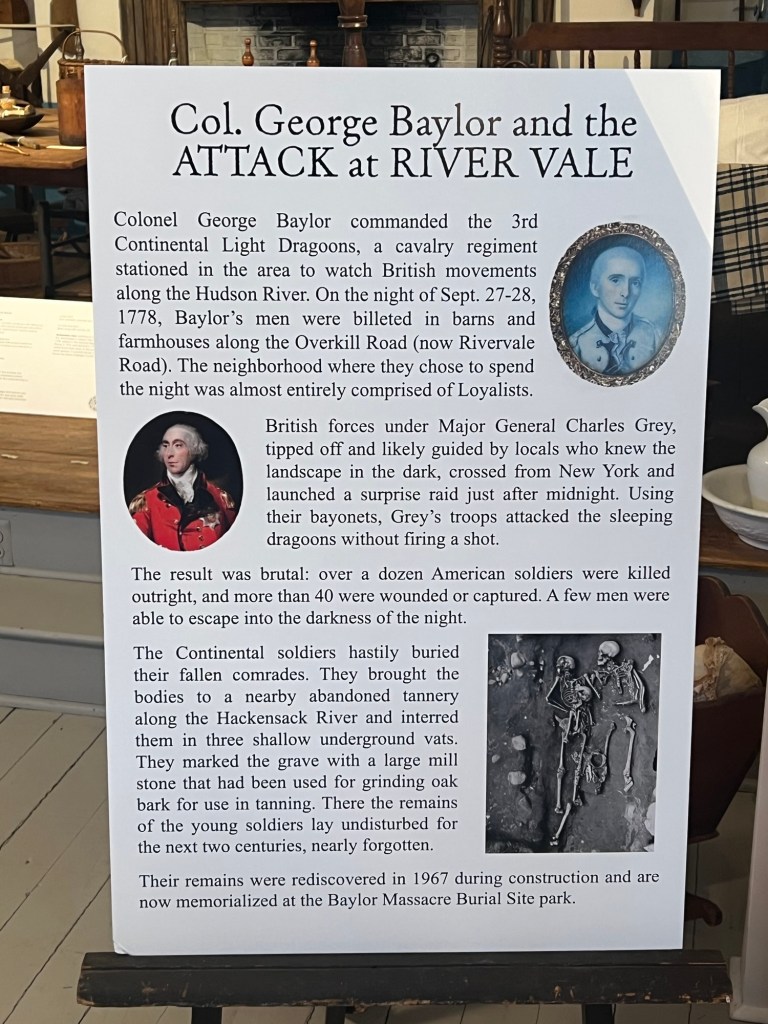
The Baylor Massacre attack
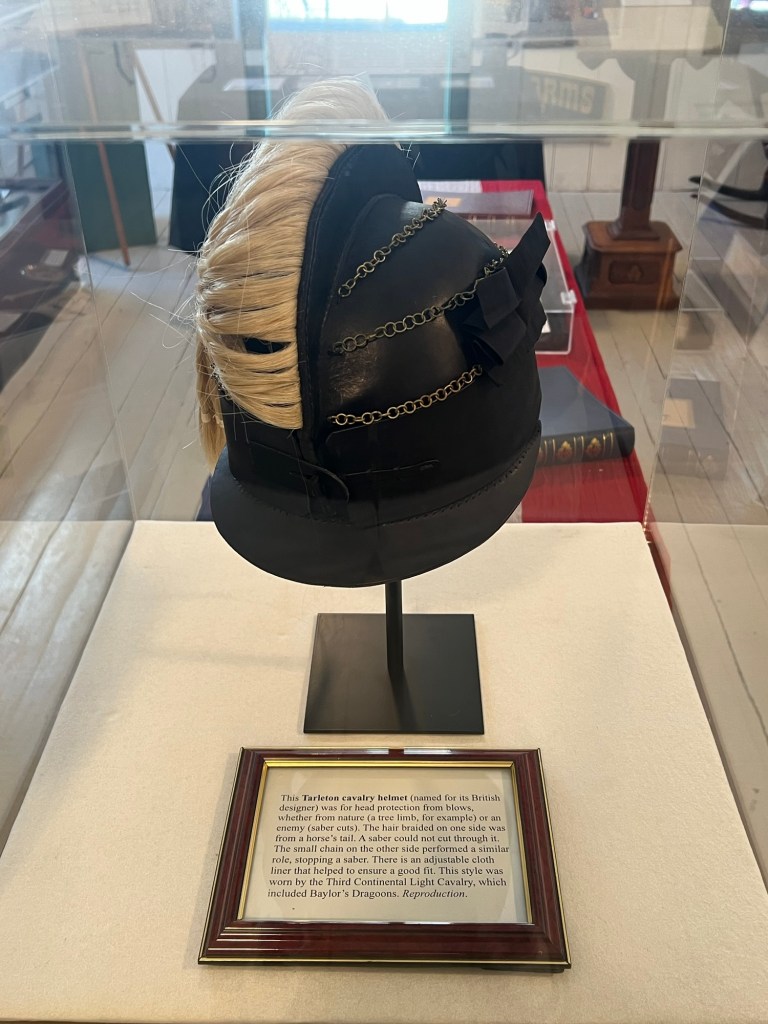
The Tarlatan Calvary helmet
The Lenape artifacts from that era
Membership Opportunities:
Preserving and disseminating local history is a labor of love when you become a PHS member. It is a partnership between you and your fellow members. We encourage you to think about volunteering at some level at the museum or its events. Check out the volunteer opportunities below and give us a call if you would like to participate in any of them.
Docent: Act as a guide when people visit the museum. A simple one-day training session is all it takes.
Researcher: Do you like to wander through books and archives searching for answers to questions?
Archivists: Preserve and catalog the history of the Pascack Valley.
Educators: Work with youngsters and licensed teachers at Society events.
Tech Savvy: Volunteer your time to help with our website or graphic design.
Handy Helpers: Do you like to repair things? Can you sew, do carpentry? This might be for you.
*Disclaimer: Information on Volunteer and Membership opportunities are taken directly from the Pascack Historical Society Museum pamphlet. Most of the descriptions of the displays is what I was able to see in my short time visiting. The museum has a treasure trove of items to look at in detail.
The Reformed Dutch Church with its Colonial cemetery and the Wortendyke Barn is right down the road so take a few hours to explore the area. The members of the Wortendyke family are buried in the church’s cemetery.
Visit from Bergen Community College for the Bergecco- Parc Consulting Inc. on April 9th, 2025: for the ‘Bergen 250’ project:
The project we created for the “Bergen 250: the 250th Anniversary of the Revolutionary War” that was created:
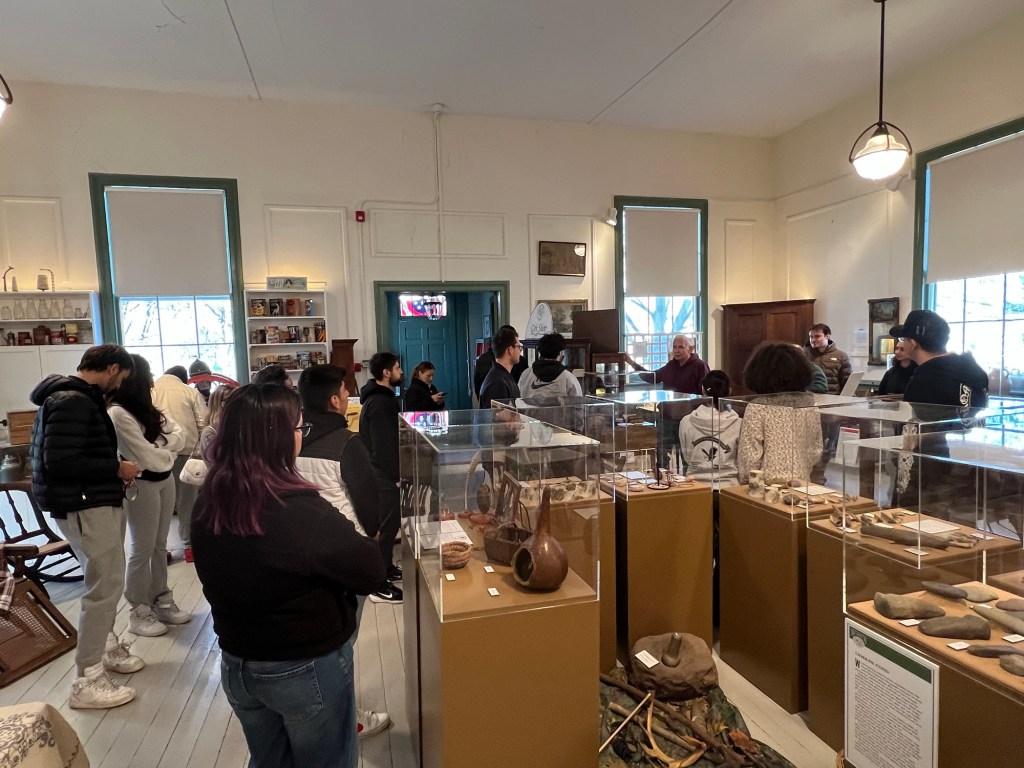
As part of my International Marketing class, I took my students to visit the three sites for our project on the ‘Bergen 250’:
The students toured the museum with the assistance of the Museum’s Board members
As part of the assignment for our ‘Farm to Table Dinner’, the project starts here with a Cocktail Party and tour of the museum. The back room of the museum was where the party takes place and then the guests would tour the museum before heading to dinner at the Wortendyke Barn down the road.
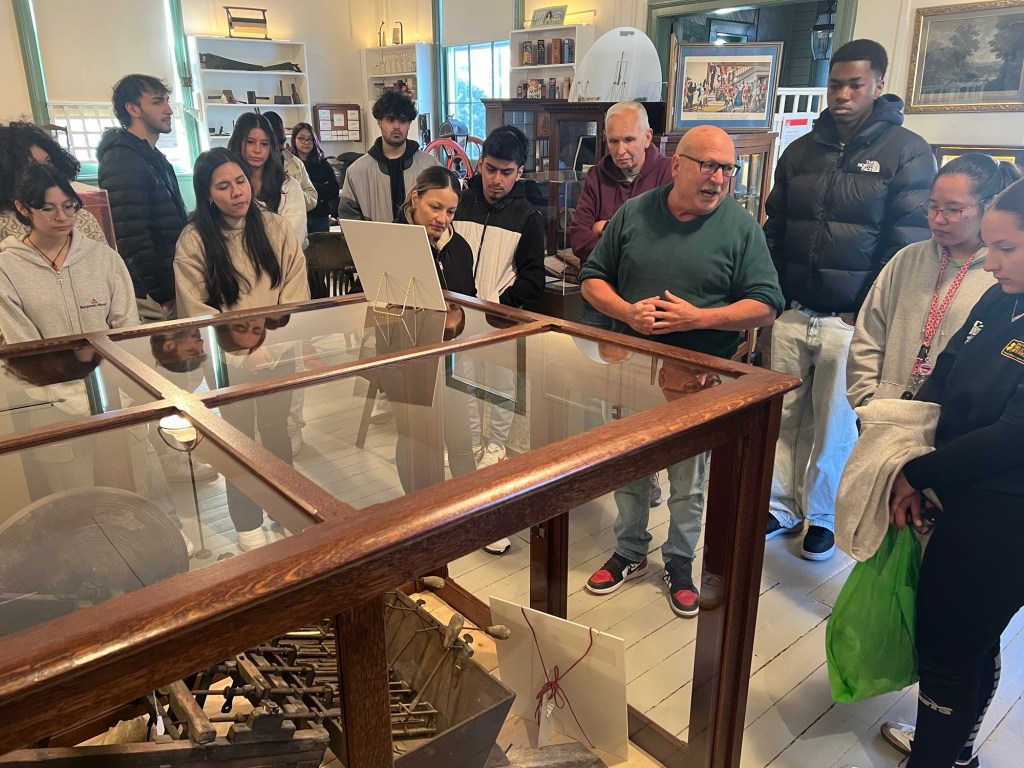
Peter Meany, the First Vice President of the Board explaining the Wampum machine to the students. This form of Native American currency is the only machine in the world like it and is a rare artifact.
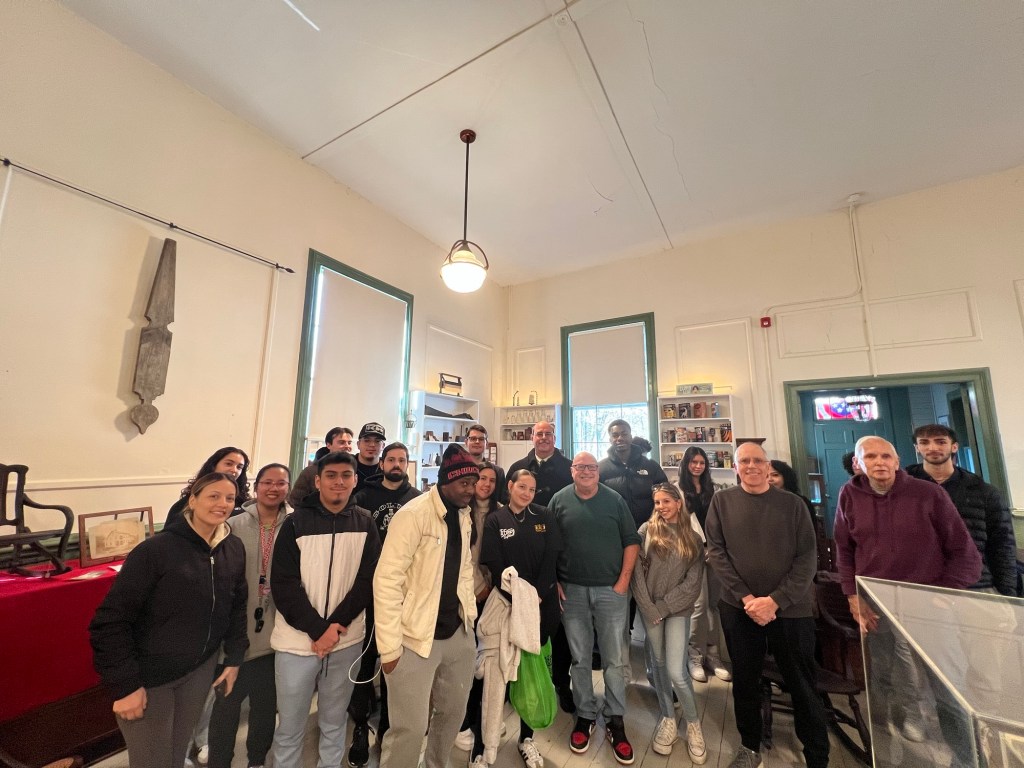
Our Team group picture at the Pascack Valley Historical Society with members of the Museum’s Executive Board Peter Meany, Ralph Donnell Jr. and Christopher Kersting.
We want to thank the Board for taking time out of their busy schedule to support the students on this project.












































































 Visiting a Museum: The Unique, Unusual, Obscure and Historical