Category: Historic Homes in New York

Home of Franklin D. Roosevelt (Springwood)-National Historic Site                                                                             4097 Albany Post Road                                                                   Hyde Park, NY 12538

Home of Franklin D. Roosevelt (Springwood)-National Historic Site 4097 Albany Post Road Hyde Park, NY 12538

Home of Franklin D. Roosevelt (Springwood)-National Historic Site

4097 Albany Post Road

Hyde Park, NY  12538

(845) 229-9115

http://www.nps.gov/hofr

https://www.nps.gov/hofr/index.htm

My review on TripAdvisor:

https://www.tripadvisor.com/Attraction_Review-g60801-d106611-Reviews-Franklin_Delano_Roosevelt_Home-Hyde_Park_New_York.html?m=19905

Springwood, the home of the Roosevelt family in Hyde Park, NY

I have visited the childhood home of Franklin Delano Roosevelt many times over the years. It is an interesting part of not just Hudson River Valley history but of American history.

Parts of the house were built in the late 1700’s and added on later by the families who lived in the house. Franklin D. Roosevelt’s father bought the house and continued to add on to it. Most of the estate is still intact as well as the homes that the President built separate from the main house to give he and his wife some privacy from his mother, Sara Delano Roosevelt, who owned the home until her death.

The entrance to Springwood was decorated for the holidays

Visiting Springwood is like a step back in time. Unlike the grand mansions of the Mill’s and Vanderbilt’s up and down Route 9, Springwood looks more like a home just on a larger scale. The self-guided tour takes you through the first story of the house which includes the dining room, living room, sitting rooms and offices of the President and of his mother, who ran the staff and the household.

The inside of Springwood as you enter the foyer which was decorated for Christmas

The house is done in dark woods, representing a time before the Victorian age when the Federalist look was in and the later additions represent the trends in Victorian style. The furnishings were functional and very homey not like the elaborate ‘over the top’ furnishes in some of the other mansions. The Roosevelt’s were old money Hudson River Valley compared to the Vanderbilt’s who money was earned after the Civil War and did not have to prove themselves to Upper Crust Society.
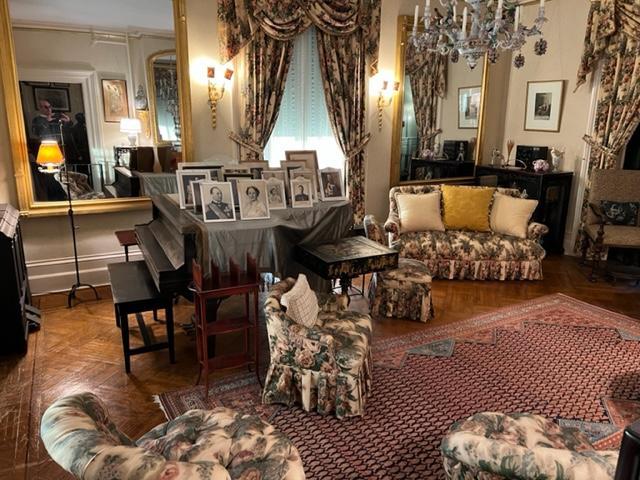
The Living Room/Parlor of the house where people would gather after dinner

I was impressed with the amount of sporting goods, stuffed animal species and just the general hominess of the house. It looked like someone still lived there. The downstairs area for the servants and the kitchen are functional and not huge. This is a house that was built for a family and for entertainment but not on the scale of the Astor’s or Vanderbilt’s. It ran for a growing family that lived in the house.

The Library and the Dining Room were decorated for Christmas as well as the foyer was decked with garland and bows. I am not sure how many times the family celebrated Christmas here being in the White House but I am sure that the family came home for the holidays. Mrs. Roosevelt, Franklin’s mother, ran the roost so the house functioned a certain way while she was alive.

Our first part of the self-guided tour was of the Living Room, Dining Room and Library on the first floor. The Living Room was smaller than most of the homes in this area again reflecting that the mansion was a home not a showplace. It was used all year long by Franklin’s family and was built to accommodate the growing family that he and Eleanor had created.

Th tour guide told us that the house was set up for Christmas the last year that FDR was alive and they had taken it from pictures and accounts that the family had done that year. The Dining Room had been set for Christmas lunch circa 1940’s with elaborate china and silver and even a children’s table so the kids would not be left out.
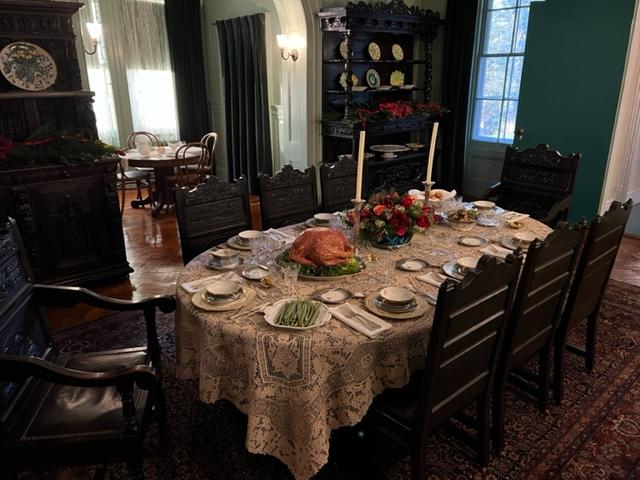
Christmas lunch at Springwood

The full Dining Room with the kids table in the background

The Library was decorated for the holidays as it had FDR’s last year alive and everything the site did was based on those pictures and accounts from family members.

The Library has gone through a full renovation and was decorated beautifully for the holidays

The Library was a very comfortable place to relax and socialize

The Christmas tree and the family presents in the Library

At the holidays when I visited in 2019, the house was going to be closed in April of 2020 for a full restoration and renovation of the lights, interior alarms and plumbing for about a year so the only Christmas decorations in the house was a tree in the library (the books had started to be removed from the shelves) and the formal dining room had been set for dinner. The rest of the mansion was in the process of being packed up so we didn’t get to tour it that time. During December 2022, the whole house was finally opened post-COVID and renovation and you could see it all in its glory.

Springwood at Christmastime

Even the upstairs bedrooms looked like any other American home at the time but a touch bigger. I could see by Eleanor’s room that she did not spend much time there. You can see where the adjustments were made when the President developed polio. I am glad that the man showed determination and did not let that stop him in his life. It proved to me that a disability limits you only if you let it.

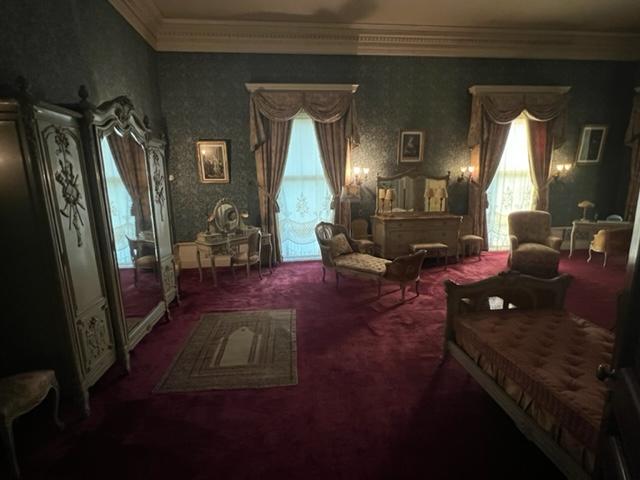
The upstairs held the bedrooms of Mrs. Roosevelt, Franklin, Eleanor and the all the children. Each room was carefully cleaned and refreshed during the renovation so they look pristine now as if the family was still living there.

Eleanor Roosevelt’s Bedroom

Sara Roosevelt’s Bedroom

The Pink Room is where the King and Queen of England stayed when they visited the Roosevelts
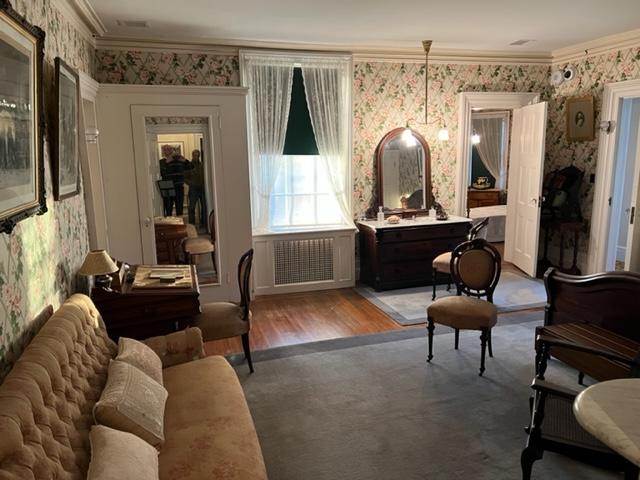
The Pink Room where dignitaries stayed

Franklin Delano Roosevelt’s Bedroom
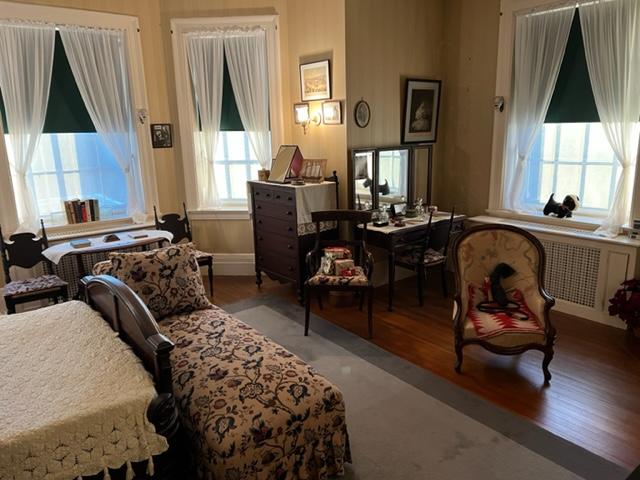
Franklin’s bedroom
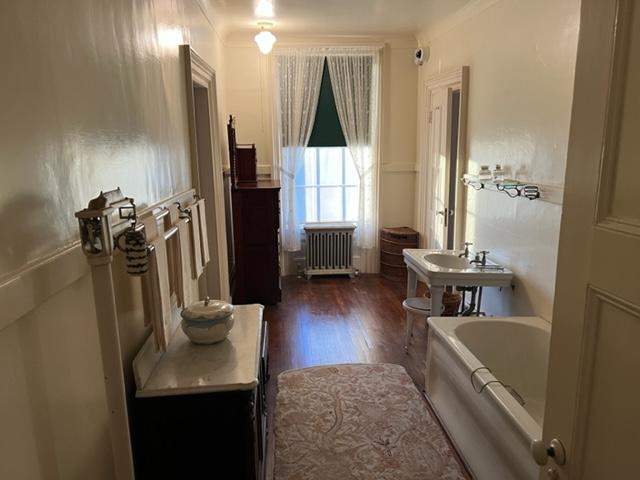
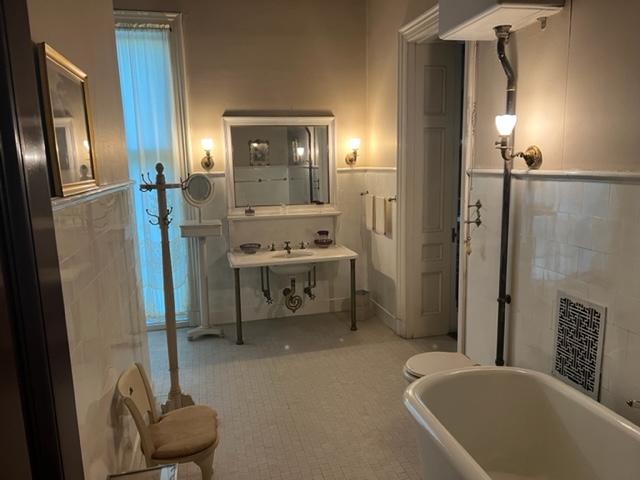
The modern bathroom with indoor plumbing

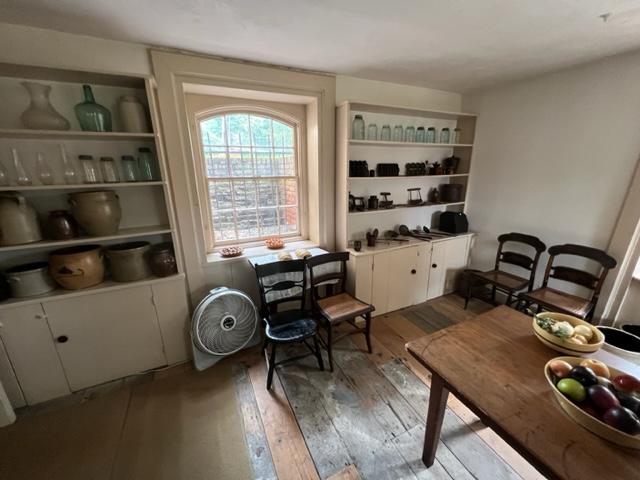
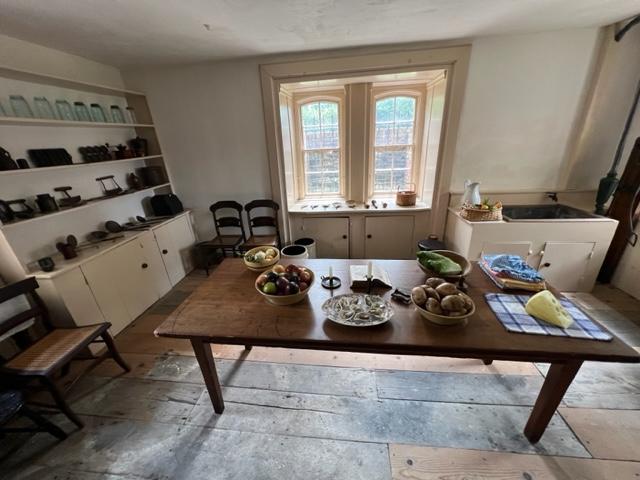
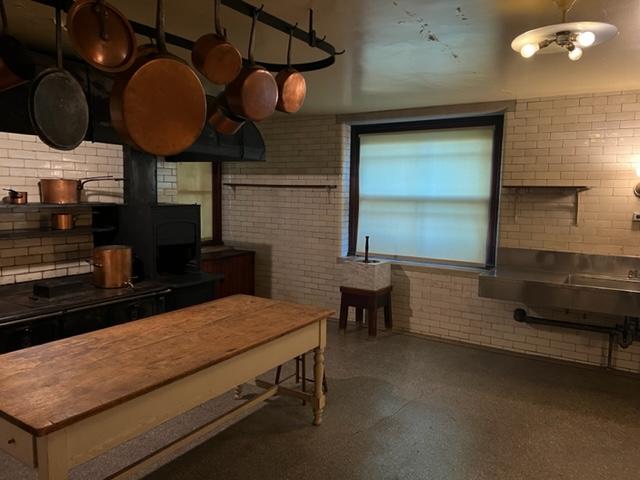
There was a large household staff to take care of things on the estate and in the house. The kitchen was the last stop on the tour in the basement. There must have been a lot of action here with such a big household to feed.

The kitchen at Springwood

The kitchen at Springwood was a busy place with so many people in the household and visiting

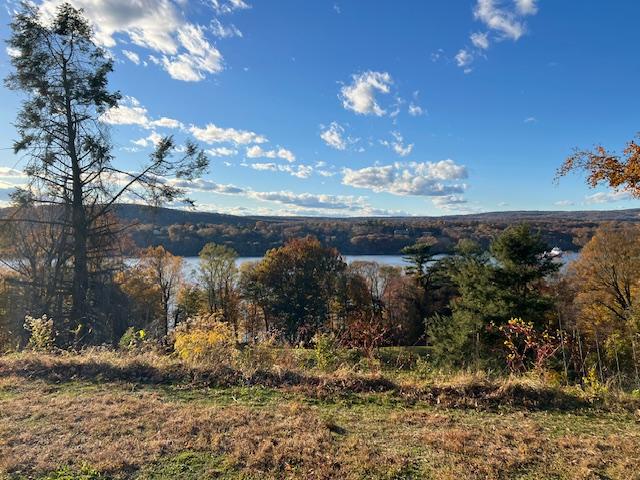
The grounds were interesting. The formal rose gardens are beautiful when in season and the estate does have views of the river. On the grounds of the estate as well is the Presidential Library, Museum and the gravesites of the President and his wife, Eleanor. Thes are located in the Rose Gardens that they loved so much.

springwood estate

The Springwood Estate

The Stables were very elaborate and held the trophies and ribbons of the family’s champion horses. The stables are now long empty but still display all the glories of the past when this was still a working farm.

The Stables

The inside of the Stables

The only problem we faced on our visit in the Summer of 2019 was that the house was that a sweltering heat wave hit the Valley and the humidity hit 98 degrees. The house was boiling hot because they could not open the windows for fresh air and the whole house smelled musty and old. That is the bad part of all that wood trimming and paneling, it does smell when it is hot.

Still the ranger talked about the history of the house and the role it played not just with the government influence during WWII but at the holidays and how Sara Delano Roosevelt had influence on her family.

Still it was an interesting tour that takes about 45 minutes and is an important part of the foundation of a very important family.

History of FDR at Springwood:

Franklin’s father, James Roosevelt purchased the 110 acre estate in 1867 for $40,000. The property included a house overlooking the Hudson River and a working farm. FDR was born in the house on January 30, 1882, the only child of Sara and James Roosevelt. Growing up with a view of the majestic Hudson River, he developed a love of the river and the valley through which it flowed. By age eight, he was sailing the Hudson. As a young adult, racing his ice yacht “Hawk” was a favorite winter pastime.

Franklin accompanied his father on daily horseback rides. During these times, he became immersed in the land, its history and particularly the trees. In later years, he expanded his parents’ land holding to nearly 1,500 acres and planted over half a million trees. His interest in tree farming translated into a New Deal program, the Civilian Conservative Corps (CCC). The CCC provided jobs to unemployed men age 17-28. Over 10 years, enrollees planted over three billion trees and built over 800 parks nationwide.

Surrounded by the rich agricultural heritage of the Hudson Valley all his life, FDR felt a strong affinity with farmers. One of the first New Deal programs instituted during the Great Depression, the Agricultural Adjustment Act, was designed to help farmers retain their land. His subsistence homestead projects relocated poverty-stricken families into government subsidized rural communities that provided decent housing, cooperative work and farming and schools.

When Franklin Roosevelt married Eleanor Roosevelt in 1905, they resided in both at Hyde Park and their New York townhouse. Franklin and Eleanor had six children, one who died in infancy. FDR supervised the expansion and redesign of the house to accommodate his growing family and his political ambitions, ensuring it reflected the Dutch Colonial architecture of the Hudson Valley.

FDR contracted polio in 1921 and was paralyzed from the waist down. He held out hope for a cure but was never able to walk again unaided. The multi-level home was adapted to his needs with ramps along the short steps. The trunk lift, installed years before the onset of FDR’s polio became his transportation to the second floor.

In 1932, FDR was elected to the first of an unprecedented four terms as President of the United States. His presidency redefined the role of government in America, establishing programs designed to improve the lives of all Americans. These programs included Social Security, the Federal Deposit and Insurance Corporation, the Securities & Exchange Commission, the establishment of minimum wage and unemployment insurance.

During his 12 years as President, FDR led the nation through an economic crisis of enormous proportions and the Second World War. He continually returned to this home  he loved, seeking strength and relaxation. He entertained foreign dignitaries here including British Prime Minister Winston Churchill. In the small study, FDR and Churchill initiated a document known as the “Hyde Park Aide Memoire”, that outlined possible future uses of the atomic bomb.

On the afternoon of April 12, 1945, FDR died from a cerebral hemorrhage in Warm Springs, GA. He was laid to rest on April 15th in the rose garden here. One year after his death on April 12, 1946, the home was opened to the public. At the dedication, Eleanor Roosevelt said, “I think Franklin realized that people would understand the rest and peace and strength which he gained here and perhaps go away with some sense of healing and courage themselves.”

(Home of Franklin Delano Roosevelt National Historic Site pamphlet)

History of the Springwood:

The estate was part of the 1697 agreement of the English Crown that gave 220 square miles to a group of nine businessmen from New York City. To ensure that everyone had access to the river, the land was divided into “Water Lots”, one of which was deeded to William  Creed, one of the nine partners.

The central part of Springwood is believed to have been formed from a large farmhouse which was constructed around the year 1800 in the Federal style. In 1845, the estate was purchased by Josiah Wheeler, a merchant from New York City. Wheeler undertook a remodeling of the house, giving it a then fashionable Italianate style with a three story town at the south end as well as front and rear piazzas spanning the entire length of the house.

In 1866, the estate which has been reduced to one square mile, James Roosevelt bought the house and expanded the main house adding the servants wing, two more rooms and the carriage house. James Roosevelt passed away in 1900.

In 1915, FDR and his mother, Sara made the final additions and renovations to the house for the growing family and for entertaining political and family friends. Sara Roosevelt used the New York firm of Hoppin & Koen and doubled the size of the house by adding two large fieldstone wings (designed by FDR), a tower and a third story with a flat roof. The clapboard exterior of the house was replaced by stucco and most of the porch was replaced with a fieldstone terrace  with a balustrade and a small columned portico around the entrance. The inside layout of the house was redesigned also to accommodate FDR’s growing collections of books, paintings, stamps and coins.

The grounds were also changed with the planting of almost 400,000 trees all over the estate in a thirty year period. Today large portions  of the estate have been turned over to the Forestry Department of Syracuse University.

(Wiki)

Disclaimer: The history of the Springwood and of FDR are living there was taken from Wiki writings and the pamphlet of The Franklin Delano Roosevelt National Site and I give their writers full credit for the information. Please see the attachments from the National Park site for more information.

Martin Van Buren National Historic Site-Lindenwald-Martin Van Buren Home               1013 Old Post Road                                 Kinderhook, NY 12106

Martin Van Buren National Historic Site-Lindenwald-Martin Van Buren Home 1013 Old Post Road Kinderhook, NY 12106

Martin Van Buren National Historic Site-Lindernwald-Martin Van Buren Home

1013 Old Post Road

Kinderhook, NY  12106

(518) 758-9689 x2040

Open: Sunday-Saturday 9:00am-4:30pm

Admission: See website

https://www.nps.gov/mava/index.htm

https://www.nps.gov/mava/planyourvisit/index.htm

My review on TripAdvisor:

https://www.tripadvisor.com/Attraction_Review-g60899-d105846-Reviews-Martin_Van_Buren_National_Historic_Site-Kinderhook_New_York.html?m=19905

Lindenwald estate of Martin Van Buren at 1013 Old Post Road

During the beginning of the Halloween season, I decided to explore the Hudson River Valley mansions while the foliage was out. I had never been as high up as Kinderhook, NY before and I wanted to visit the Martin Van Buren National Historic Site. This was the estate Lindenwald-Martin Van Buren home.

Martin Van Buren

President Martin Van Buren

https://www.whitehouse.gov/about-the-white-house/presidents/martin-van-buren/

https://en.wikipedia.org/wiki/Martin_Van_Buren

The tour is really informative and discusses our eighth President’s life in Upstate New York. I had not released that he was not born a wealthy man. He was a barkeeper’s son to Abraham Van Buren and his wife, Maria Hoes. His mother had been married before, so he had three half siblings and four other siblings growing up.

The Lindenwald Estate

He had worked his way through Law School and joined the local political scene of Upstate New York. From the what the tour guide told us; he was a self-made man. He had won the first election but not reelection. His further attempts at Presidency were not successful so after his time in Washington DC, he retired to his home in Kinderhook, NY and remained here until he died in 1862.

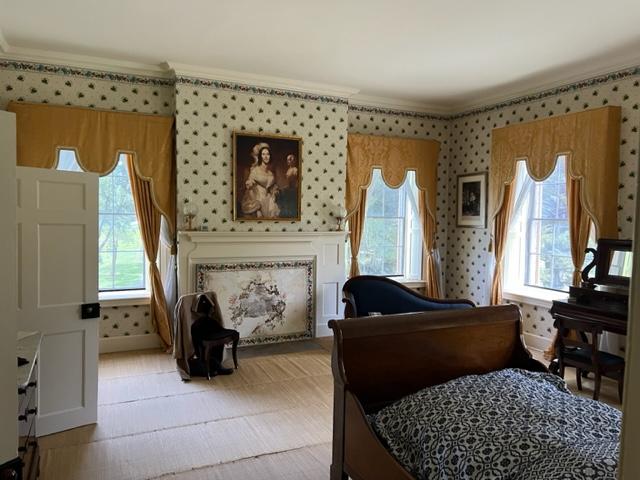
President Van Buren’s son’s and daughter in law’s bedroom. Abigal Van Buren’s portrait sits prominently in the bedroom.

When we took the tour, the tour guide said that the house had many other owners after the President’s death and that was the reason why there was not much left in the house. There is period furniture from the time he lived here but not from the President himself. There are a few pieces from the family that were donated later. They even replaced the wallpaper in the dining room that was from the original French company that manufactured it (it seems that they have records going back almost 400 years).

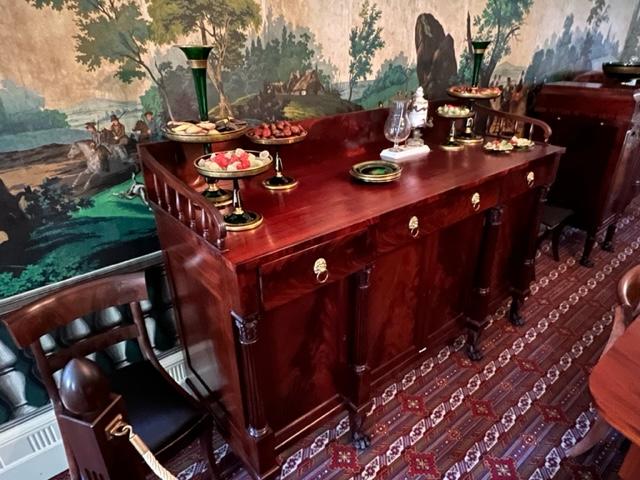
The original Dining Room wallpaper

The grounds are beautiful with the golden and orange leaves on the trees and what is left of the crops in the back fields. There is also the graves of Peter Van Ness and his wife, the original owners of the house.

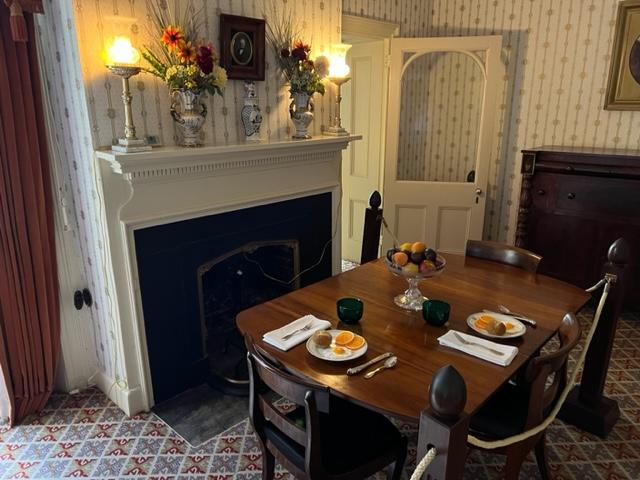
Lindenwald’s Dining Room

The house is not far from downtown Kinderhook so take time to visit the town and the historic sites of the President. There is a lot to see.

Downtown Kinderhook, NY

History of the Martin Van Buren Home & of President Van Buren:

Kinderhook is most noteworthy for its native son. Martin Van Buren, the eighth President of the United States. Van Buren was born here in 1782 and began his road to the White House as a teenager campaigning for Thomas Jefferson in 1800. Van Buren held many positions in New York State government before becoming a United States senator. in 1821. He was elected President of the United States in 1837 after serving as Secretary of State (1829) and vice-president (1833-1837) in Andrew Jackson’s administration. Van Buren was one of only two men to serve as Vice-President, Secretary of State and President. The other was Thomas Jefferson.

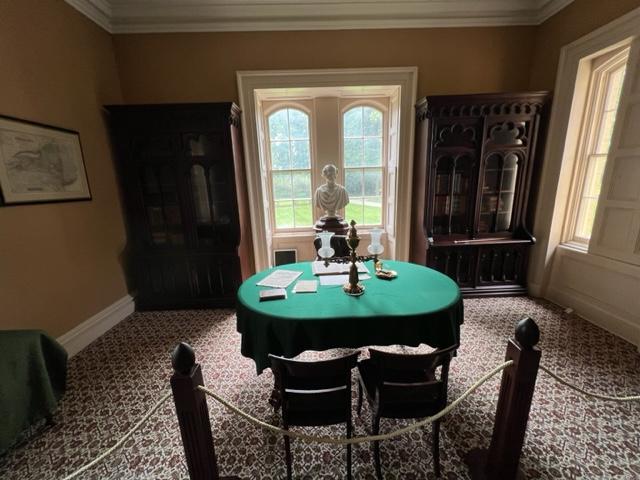
President Van Buren’s office at Lindenwald

Van Buren was the first President to be born as an American citizen. Previous Presidents were born prior to the American Revolution. President Van Buren was an accomplished politician, but his Presidency was characterized by the economic hardship of the time-the Panic of 1837.

The Guest Bedroom

This banking crisis occurred only five weeks into Van Buren’s Presidency and tarnished his administration. Van Buren ran for reelection in 1844 and seemed to have a advantage for the nomination. However, his opposition to the annexation of Texas contributed to his defeat at the Democratic convention. The nomination eventually went to James Polk. As the question of extending slavery into the territory captured in the Mexican War became heightened, Van Buren broke with his party and ran for the Presidency as a candidate of the Free Soil Party in 1848. Following the campaign of 1848, Van Buren returned to his farm, Lindenwald, where he remained until his death in 1862 from bronchial asthma and heart failure at age seventy-nine.

(Lindenwald-Van Buren Home pamphlet)

Lindenwald House:

The house was built in 1797. The knocker on the old front door of this famous mansion bears the date 1797. This however refers to the building of the small and much less imposing building, which was the beginning of this Mansion and was erected by Peter Van Ness. There was still an earlier house on the place when Peter Van Ness bought it about 1780. The house of 1797 was greatly improved by Judge Van Ness, a son and still more improved and enlarged by Mr. Van Buren on his return from Washington when he named it ‘Lindenwald’.

The Lindenwald Parlor for the family

Many of the most distinguished men of the period of the Van Ness and Van Buren families entertained here, among whom were Henry Clay, Washington Irving and Samuel Tilden.

The Lindenwald Living Room

Lindenwald is situated about two miles south of Kinderhook on the Old Post Road from New York City to Albany and sits about 400 to 500 feet back from the road, surrounded by old fir and pine trees. Two separate driveways lead up to the house.

The Lindenwald Kitchen

The Lindenwald kitchen in preparation for dinner

The house is brick, painted yellow and seven windows wide. The main building had two stories and a large garret. Three chimneys rise above this main or front part of the house, two to the north and a wide one to the south. The middle of the front is pedimented and there is a dormer on each side of the gable, which in the bedroom story below has a large triple central window with a curved pedimental top and two windows on each side. The two windows on the south side are in the room where Van Buren died.

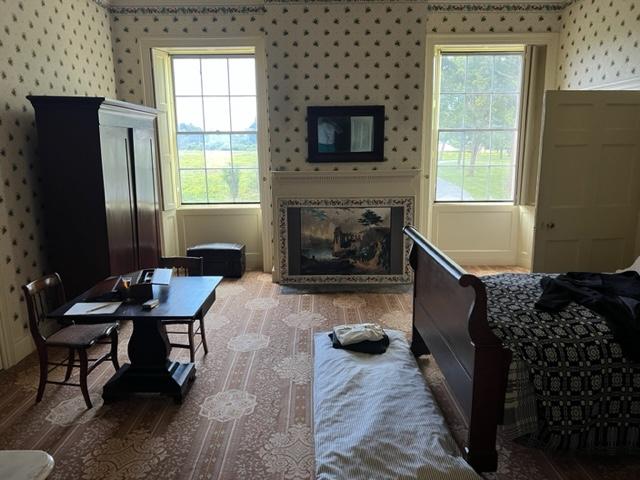
President Van Buren’s bedroom

Before the center of the main story is a small, covered portico with an easy flight of steps and balusters. To the left is the living room or double parlor to the right the sitting room and dining room.

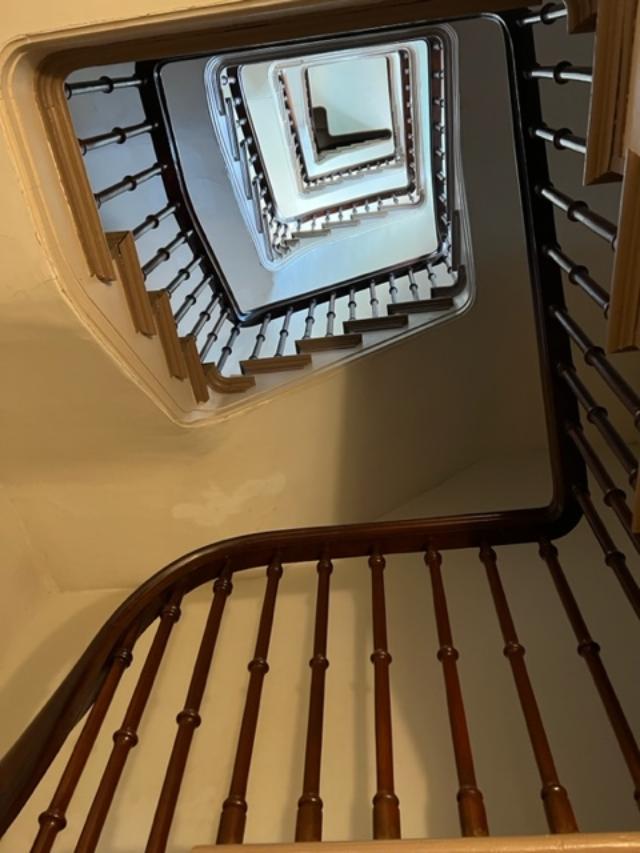
The spiral staircase to the tower

The oblong house is four windows deep on the north side. A colonnade or arched porch separates it from a domestic building, mainly kitchen and laundry. This undoubtedly was the Peter Van Ness original home. The library was added in the rear of the south side by Mr. Van Buren and next to this he built a tower, like a donjon keep with an Italian summit, the openings few and slitted, the object, stateliness and the view.

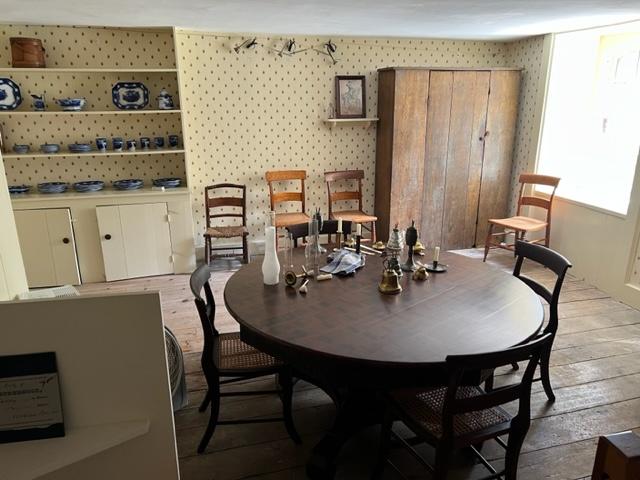
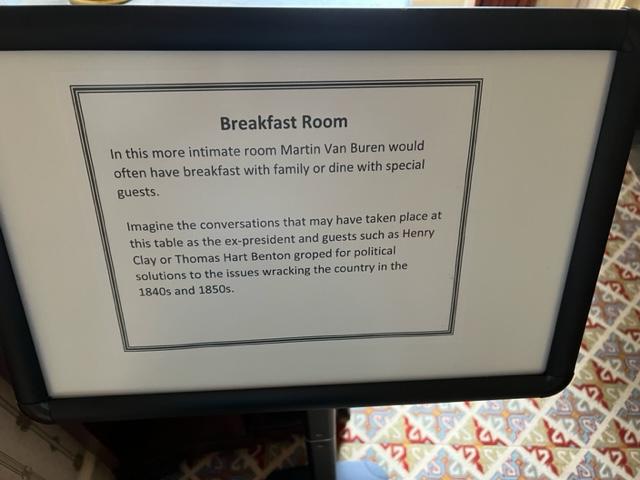
The Breakfast Room

Beyond the front door is a fine straight hall. The four doors opening off of it are of early carpentry. At the rear, nearly concealed in the side of the hall under sort of an alcove is the stairway, wide and low and long stepped. The main feature of the hall, is the foreign wallpaper in large landscapes, representing hunters on horseback and with guns and dogs breaking into Rhenish vales, where milkmaids are surprised and invite flirtation, the human figures are nearly a foot high, the mountains and woods, rocks and streams, panoramic the colors dark and loud.

The wallpaper at Lindenwald

The servant’s Breakfast Room

After the death of President Van Buren the house was sold several times.

Another bedroom at Lindenwald

(Lindenwald-Wiki)

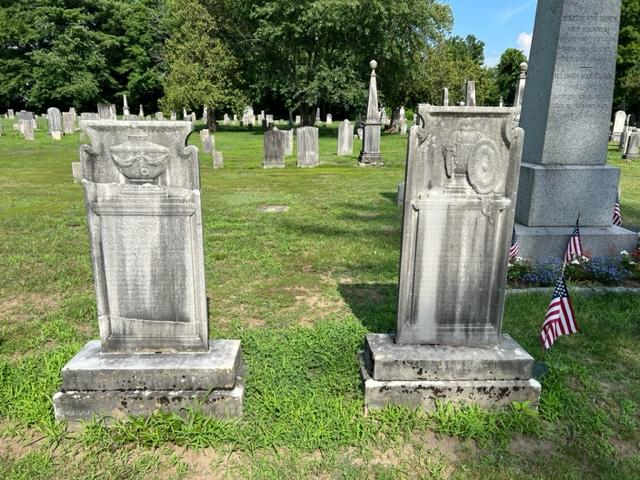
The Cemetery where the President and his family are buried a few blocks from the Downtown.

President Van Buren’s grave in the cemetery in Kinderhook, NY

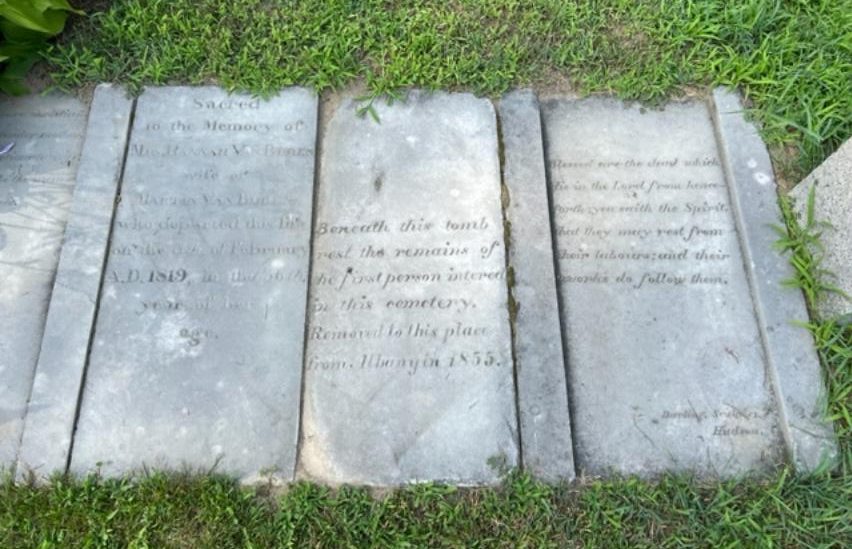
Martin Van Buren’s parents gave who were moved here to be near the President.

Hannah Van Buren was moved here to be near her husband.

Van Cortlandt House Museum in Van Cortlandt Park at Broadway & West 246 Street                                              Bronx, NY 10471

Van Cortlandt House Museum in Van Cortlandt Park at Broadway & West 246 Street Bronx, NY 10471

Van Cortlandt House Museum

Van Cortlandt Park at Broadway & West 246 Street

Bronx, NY  10471

(718) 543-3344

infor@vchm.org

Open: Tuesday-Friday 10:00am-4:00pm/Saturday & Sunday 11:00am-4:00pm

Admission: $5.00 for Adults/$3.00 for Seniors & Students/Children under 12 are free/General Admission is free on Wednesdays. Guided and group tours are available.

Review on TripAdvisor:

https://www.tripadvisor.com/Attraction_Review-g47369-d103501-Reviews-Van_Cortlandt_House-Bronx_New_York.html?m=19905

The Van Cortlandt House:

Welcome:

Van Cortlandt House during Christmas time

The entrance of the Van Cortlandt House decorated for the Revolutionary era Christmas

I visited the Van Cortlandt House Museum for the their Annual Christmas Decorated House event. The mansion was decorated for Christmas in the 1700’s so it was not overdone as it would during the Victorian times. The front of the house entrance was done with sprays of holly, mistletoe above the door and garlands of pine around the banister and fireplaces. The windows had candles in them and the dining room was set for Christmas luncheon in post-Revolutionary War era.

Van Cortlandt House VI.jpg

Van Cortlandt House for Christmas is Post-Revolutionary War in 2019

The entrance hall welcomes you to a Revolutionary era holiday season

While most of the house is represented during the Dutch era with floors with no rugs, vintage furniture and decorations and the second and third floors are set for family entertainment. The first floor is set for entertaining for the holidays with the formal dining room, family parlor and the formal living room for games and dancing. The formal dining room was the only room decorated post-Revolutionary War era.

van cortlandt mansion xmas ii

Van Cortlandt Mansion at Christmas 1800’s

The current entrance to the house from the back of the building

Until the Victorian era, Christmas was a more religious affair with church service in the morning and luncheon in the afternoon. Things were formal and less elaborate. The acts of gift giving, sleigh rides, tree decorating and card giving came during the affluence of Queen Victoria’s reign in the post Civil-War era. This is the reason why the house is decorated so simply and elegantly.

Dining Room set for Christmas lunch circa 1780’s

In 2019, the site celebrated the holidays with a Sinterklaas, a Dutch Christmas celebration, a candlelight tour and a reading from Santa Claus. Please check their website for more information on future events. The house was closed for most of the COVID years and nothing had been planned. The house was open in December of 2022 for touring again for the holidays but was not decorated as much as in the past.

In 2022, when the house reopened after a long period of COVID, the self-guided tours were back and you could tour the house at your own pace ($5.00 donation) and tour the three floors of furnished rooms. You can see how the family lived from the three generations that lived in the residence.

The tour starts at the front hallway where guests would be received for formal affairs and for business meetings with the head of the household.

You would be greeted by servants at the entrance of the home

On either side of the front hallway is the East and West Parlors where you would be directed where the family would receive you. The West Parlor would have been used for business calls and more informal meetings when meeting with the Van Cortlandt family. The family’s wealth would be on display with fine furniture, china and bric-a-brac that would show off the family’s merchant roots and business.

The West Parlor

The West Parlor decorated for Christmas

The East Parlor on the other side of the entranceway would have been used for more formal affairs. The East Parlor is where the family would formally entertain guests with dancing, music and card playing. This is where long evenings of entertaining would take place and the family would enjoy their holiday celebrations.

The East Parlor

The East Parlor decorated for the Christmas holidays

The Dining Room was toward the back of the hallway and was decorated in the Empire Design of the late 1700’s to early 1800’s. The look is very similar to styles used today and the wallpaper is a copy from one of the styles used by the family that was imported in from France. The table was set for Christmas luncheon circa the late 1780’s.

The Dining Room

The Dining Room at the Van Cortlandt House

There are two sets of stairs to the second level of the house where the family bedrooms were located. There was the formal stairs and then there was the stairs that the servants used to go from floor to floor so that they would not be seen.

The steps upstairs to the second floor

On the second floor of the home are the bed chambers of the family. The main bedrooms for the family were located here and then the nursery and servants quarters were located on the Third floor of the home.

The West Chamber:

The bedroom

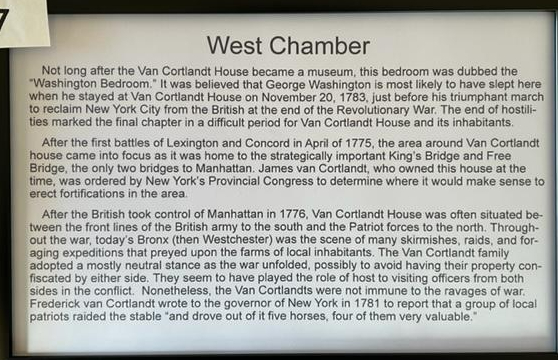
The ‘Washington Bedroom’ in the Van Cortlandt House

The East Chamber Bedroom:

The Bedroom:

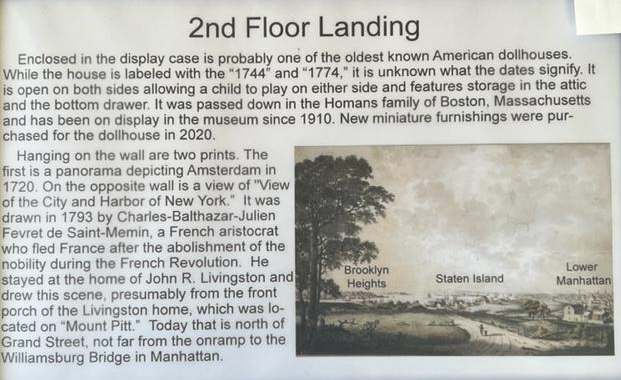
The Landing of the stairs to the third floor lead to the Nursery, an additional guest room and the enslaved servants quarters. These were kept out of site from the other members of the household. It is a reminder of the pecking order of the household and the conditions that people lived under at this time.

The Second Floor Landing leads to the nursery and servants quarters

The Dutch Chamber was formerly a guest room that is used to show life in early Colonial New York City:

The Dutch Chamber:

The Dutch Chamber shows early life in Colonial America

The Second Floor Setup:

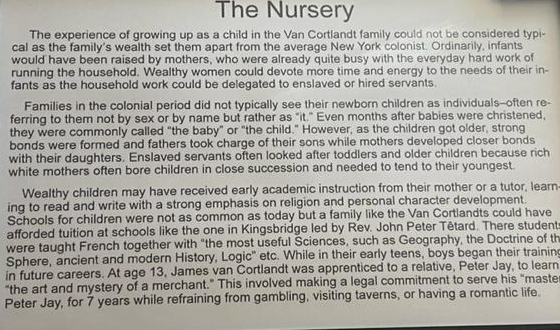
The Nursery:

The nursery set up room:

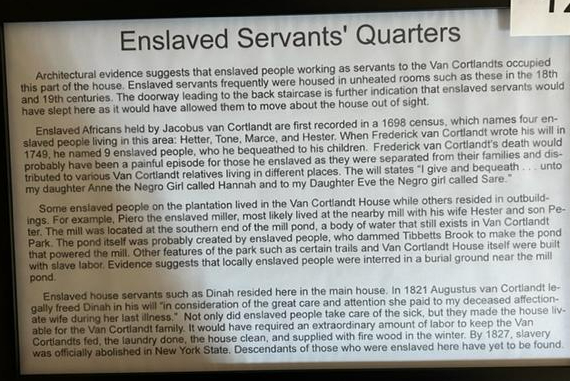
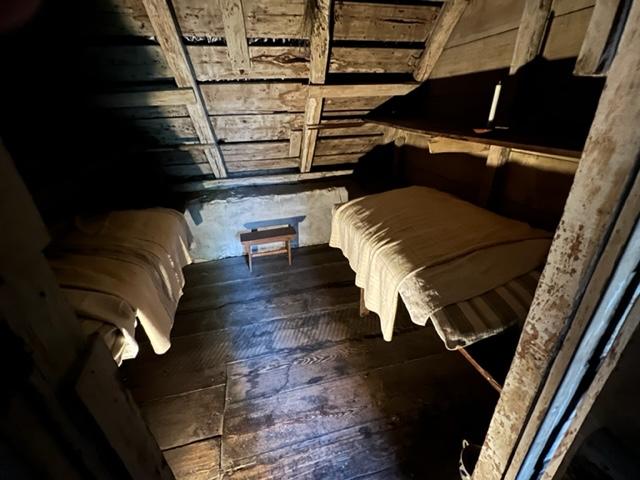
The servants quarters were to the back of the house and were not the most glamorous place to live in the house. There were drafty and not insulated. The amount of time a servant would be here would have been minimal.

The servants quarters:

The servants quarters:

History of the Van Cortlandt’s:

The Van Cortlandt House Museum, also known as Fredrick Van Cortlandt House or Van Cortlandt House, is the oldest surviving building in New York City’s borough of The Bronx. The Georgian style house, begun in 1748, was build of fieldstone by Fredrick Van Cortlandt (1699-1749) on the plantation that had been owned and farmed by his family since 1691. Fredrick intended the house to be a home for him and his wife, Francis Jay and daughters, Anna Maria, 14 and Eve, 13. His sons, Augustus, 21 and Fredrick, 19, were not intended to be permanent residents of the house.

Sadly, Fredrick died before the new house was completed. In his will written in 1759, Fredrick left the house to his son, James Van Cortlandt (1726-1781) and a lifetime tenancy to his widow, Francis Jay Van Cortlandt (1701-1780).

Van Cortlandt House IV.jpg

The Van Cortlandt House gardens in the Summer

The Van Cortlandt’s were a mercantile family prominent in New York affairs. Fredrick’s father, Jacobus, established a thriving wheat growing and processing business on the plantation including a grist mill for processing the wheat into flour and a fleet of shallow draft boats to carry the flour from the south end his lake down Tibbet’s Brook and out to the Harlem and Hudson Rivers to market. During the Revolutionary War, the house was used by Rochambeau, Lafayette and Washington.

(From History of Van Cortlandt House and Museum)

In 1887, after 140 years of occupancy by the Van Cortlandt family and the community of plantation workers, the property was sold to the City of New York and made a public parkland. Before the house became a museum, it saw a variety of uses including as a temporary police precinct house and as a dormitory for ranch hands responsible for taking care of a herd of buffalo.

Van Cortlandt House historic marker

By 1895, The National Society of Colonial Dames in the State of New York expressed their interest in restoring the house as a museum open to the public. There was only one obstacle keeping the Colonial Dames from this important project, there was no provision in the New York State Law allowing the stewardship of a publicly owned building by a private organization. Undaunted, the first Society President, Mrs. Townsend, took the Society’s cause to Albany where on May 22, 1896 in the 199th session of the New York Legislature, Chapter 837 was approved by the governor and passed by a 3/5 majority to become law.

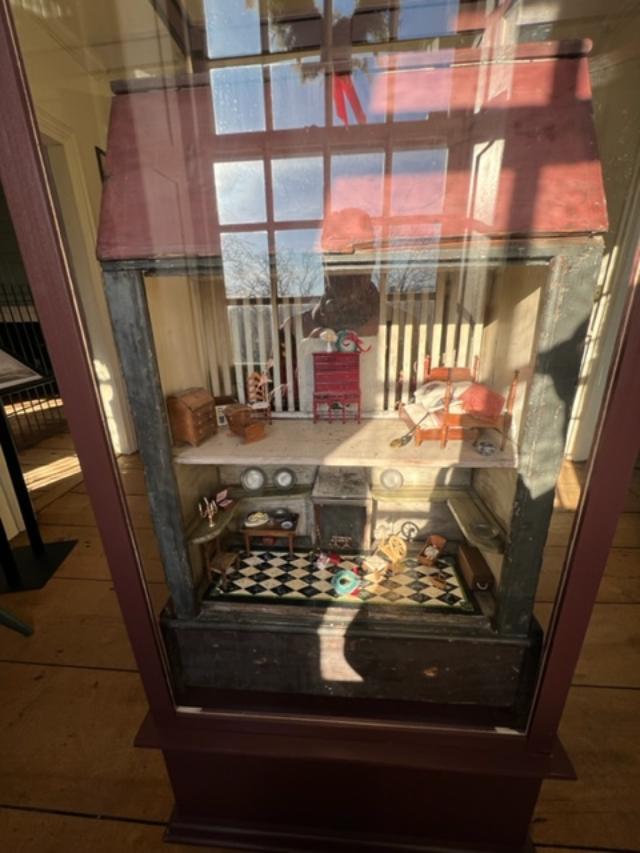
The Van Cortlandt House dollhouse

After nearly a year if repairs and restoration, Van Cortlandt House Museum was opened to great fanfare on May 25th of 1897. The original license agreement grained custody of the house to the National Society of Colonial Dames in the State of New York for a period of 25 years at a ‘peppercorn’ rent of $1.00 per year. Although the Society no longer pays the city rent, they remain, to this day as dedicated to Van Cortlandt House as they were in 1896.

Van Cortland Park.jpg

Van Cortlandt Park in the Summer Months

In 1967, Van Cortlandt House was added to the National Register of Historic Places and was designated a National Historic Landmark in 1967. The house was declared a New York City Landmark on March 15, 1966, recognizing the historic and architectural importance of both the exterior and interior.

(From the Van Cortlandt House Museum NSCDNY)

The Van Cortlandt House gardens during the winter of 2022

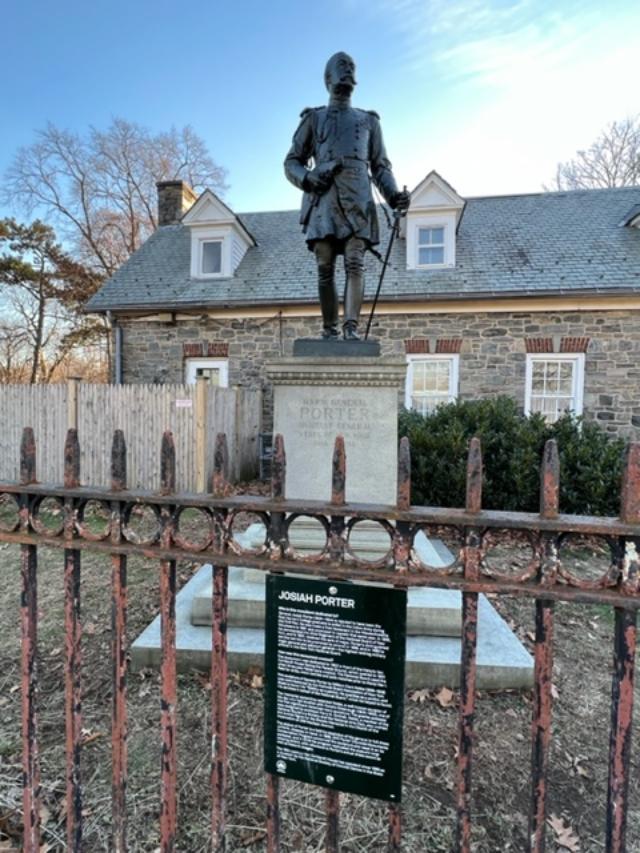
The General Porter Statute in front of the house

The Vanderbilt Mansion & Estate National Historic Site                                                        4097 Albany Post Road                                                          Hyde Park, NY 12538

The Vanderbilt Mansion & Estate National Historic Site 4097 Albany Post Road Hyde Park, NY 12538

The Vanderbilt Mansion & Estate

National Historic Site

4097 Albany Post Road

Hyde Park, NY  12538

(845) 229-7770

http://www.nps.gov/vama

https://www.nationalparks.org/explore-parks/vanderbilt-mansion-national-historic-site

TripAdvisor Review:

https://www.tripadvisor.com/Attraction_Review-g60801-d105845-Reviews-Vanderbilt_Mansion_National_Historic_Site-Hyde_Park_New_York.html?m=19905

I have visited the Vanderbilt Estate many times over the years and every time I visit I learn something new about the family and about the property. It takes many visits to truly see the beauty of the house and grounds.

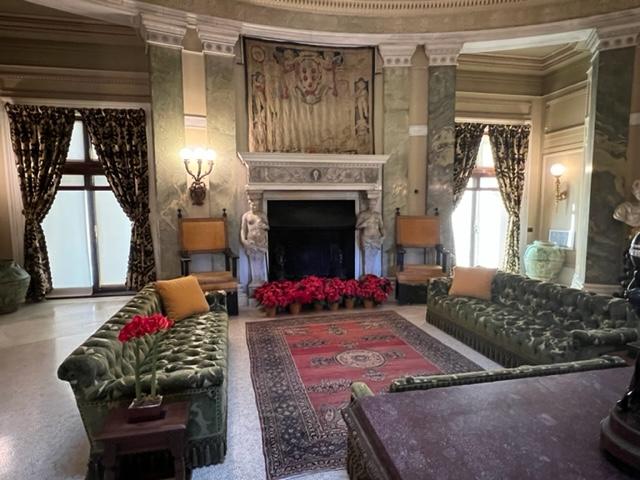
The Vanderbilt Mansion foyer on the first floor decorated for the holidays

I found the best time to visit is in the late Spring as the buds are coming in and Christmas time when the house is decorated for the holidays. It is quite spectacular. The holiday tour is amazing and after Thanksgiving, make a special trip to the Hudson River Valley and go mansion hopping as all the houses are decorated for the holidays.

The Christmas tree in the library of the Vanderbilt Mansion

The tour will take you to three floors of the house: the first floor with the living room, dining room, parlors, and studies. Then there is the second floor with Fredrick, Louise and the guest family and single women rooms. The last floor you will visit is the basement workrooms, servant quarters and kitchen.

On the first floor is the formal dining room and the library, the offices of both Fredrick and Louise for their social and business obligations and the formal receiving foyer of the home. Things were decorated for the Christmas holiday season and it gave a very festive appearance.

The Library was set up for the Christmas holidays

The other side of the Library for the Christmas holidays

The house was only used about four months out of the year, being used in the Spring and then again in the Fall from the end of September to right after Thanksgiving and then the family would go to New York City for the social season. After Louise’s death, Fredrick sold his other houses and moved here permanently. The house was used full time and Fredrick must have enjoyed his time here.

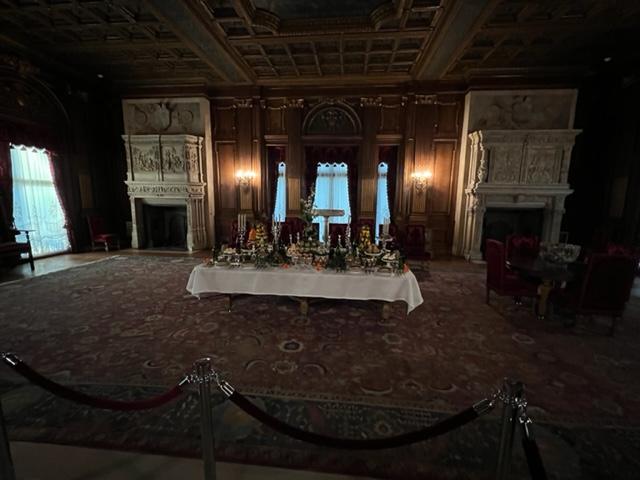
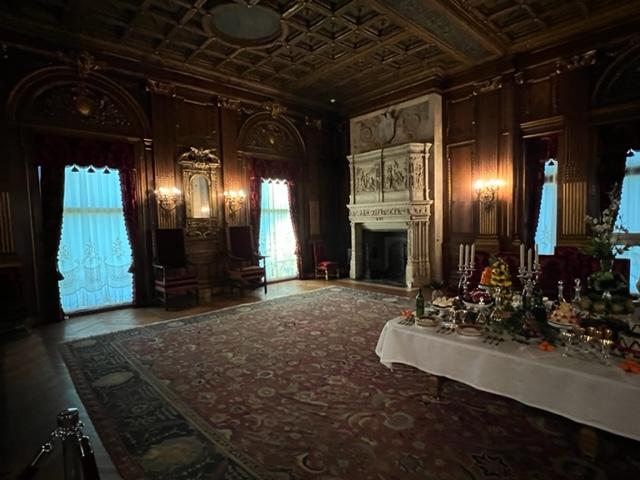
When she was alive, they used to have a very active social life and were active in local affairs. The formal dining room was used for parties and get togethers. For the holiday season, the room was decorated for a formal Christmas dinner.

The Dining Room set for holiday dinner

The beautiful fireplaces and paneling of the Dining Room

The Dining Room table set for the Christmas holidays

The formal staircase takes you up the to the bedrooms and the formal baths. The house was one of the first in the community to have electricity and hot and cold running water with all modern plumbing.

The stairs were wide and long due to the ladies dresses of the time

The artwork on the walls and landings was just breathtaking

The artwork on the landings and hallways is magnificent

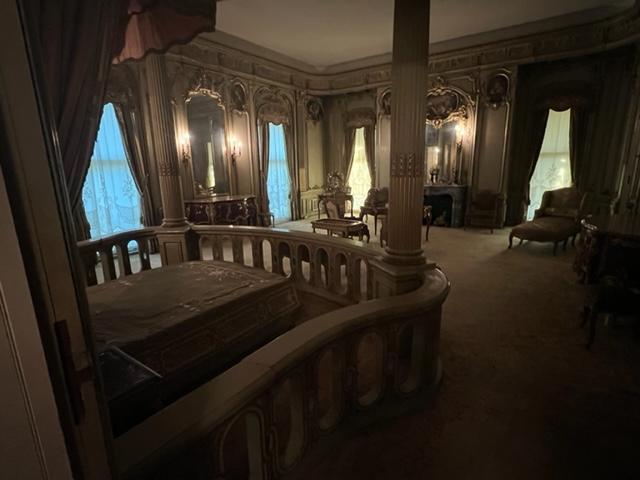
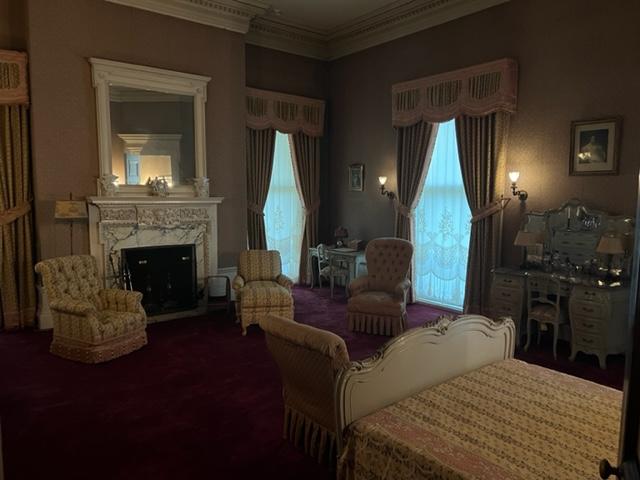
The bedrooms on the second floor are as elaborate as the rest of the house. While Fredrick’s bedroom was very plain in comparison to Louise’s who designed her bedroom after Marie Antoinette’s that she saw at Versailles. The room has a railing around it.

Louise’s Bedroom was based on what she saw in Europe.

Fredrick’s bedroom is less formal

The Bathroom with its modern plumbing and lighting

The elaborate rooms of the Vanderbilt Mansion

The household had a staff of over thirty people to attend to the household and grounds with their formal gardens. The kitchen staff had a well attended kitchen to work with and according to the tour guide, the staff was well treated at the Vanderbilt mansion. Fredrick was a good boss and provided well for his loyal staff.

The basement kitchen of the Vanderbilt Mansion

Touring the Vanderbilt Mansion at the Christmas holidays is always a treat but if you miss it, you can go during the year and still the elaborate rooms and beautiful grounds during the summer months. Take time to walk around the extensive lawns and gardens.

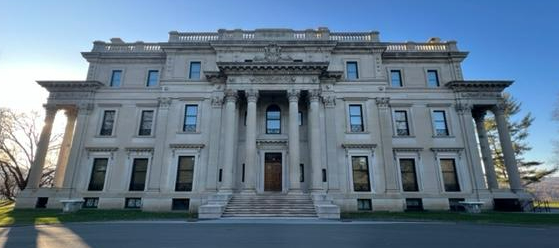
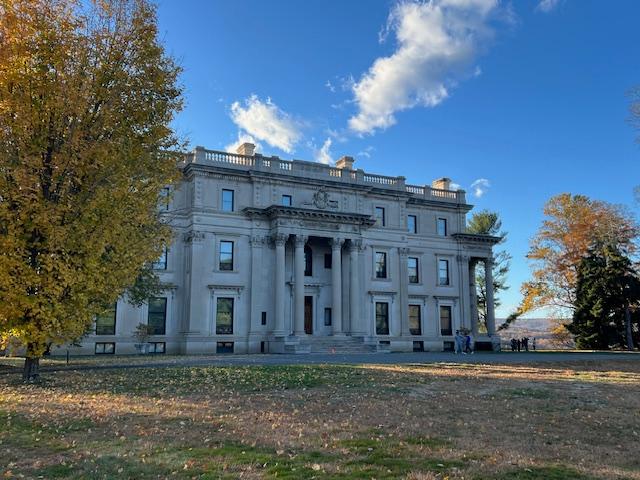
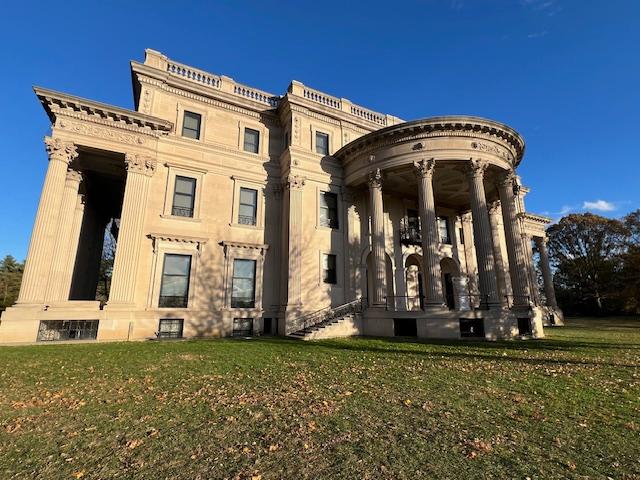
The Vanderbilt Mansion in the Fall of 2024

The Vanderbilt Estate in the Fall of 2024

The back of the mansion facing the Hudson River

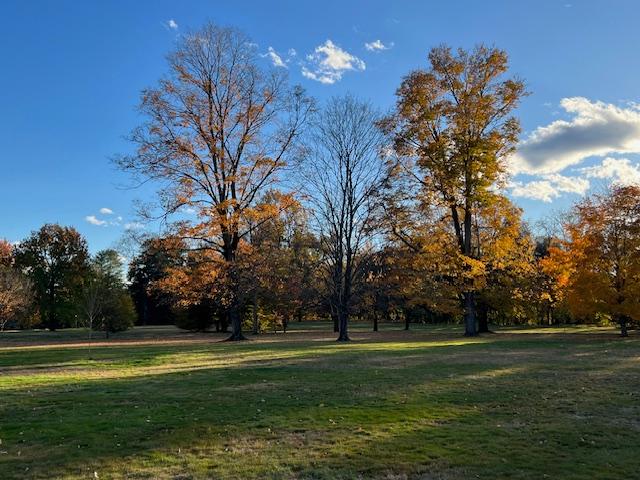
The estate grounds in the Fall of 2024

The estate in the Fall of 2024

History of the Vanderbilt Mansion:

The Gilded Age, the period following the Civil War to the turn of the century, was a time of unparalleled growth in industry, technology and immigration. Captains of industry, men like Cornelius Vanderbilt, Andrew Carnegie, J.P. Morgan, John D. Rockefeller and others who amassed unimaginable wealth, while the average annual income in the US was around $380, well below the poverty line.

The term “Gilded Age” was coined by Mark Twain and Charles Dudley Warner in their 1873 book, The Gilded Age: A Tale of Today. The term refers to the process of gilding an object with a superficial layer of gold to improve its appearance. Established millionaires viewed nouveau riche families like the Vanderbilt’s, who flaunted their wealth by building ostentatious  homes, throwing extravagant balls and using their money to buy social prominence, as gilded-all show, no substance.

Cornelius “Commodore” Vanderbilt (1794-1877) rose from poverty to become a shipping and railroad tycoon. He turned a 100 dollar loan from his parents into a multi-million dollar fortune and left the bulk of his money to his eldest son William.

William expanded the railroad operations doubling the Vanderbilt fortune in just eight years but his eight children lived lives of excess, extravagance and self-indulgence. They built 40 opulent mansions and country estates and entertained lavishly, largely depleting the family money.

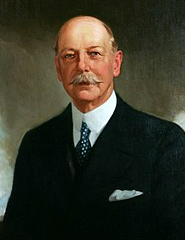
Fredrick William Vanderbilt later in life

In 1895, William’s son, Fredrick (1856-1938) and his wife, Louise (1854-1926) bought Hyde Park to use its their spring and fall country estate. McKim, Mead & White, America’s top architecture firm, designated the mansion in the neoclassical style with Beaux-Arts ornamentation and incorporated the latest innovations: electricity, central heating and indoor plumbing.

They added the Pavilion, a coach house, power station, gate houses, two new bridges over Crum Elbow Creek, boat docks, a railroad station and extensive landscaping. Many of the mansion’s contents were bought in Europe from wealthy families who had fallen on hard times. Furnishings and construction coast totaled around $2,250,000.

Louise Vanderbilt

Hyde Park was in many ways self-sustaining, providing food and flowers for the family’s needs here and at their other homes. When the Vanderbilt’s were in residence, as many as 60 staff worked here. Staff lived on or near the property and attended to the grounds and extensive farm. Personal staff traveled with the Vanderbilt’s and lived in the mansion with the family. Seasonal laborers were hired from the community and lived in the servants’ quarters.

The Vanderbilt Mansion in Hyde Park, NY in Fall 2024

The Vanderbilt Estate in Fall 2024

Fredrick, a quiet man, preferred to avoid social occasions but Louise loved to entertain, throwing lavish weekend parties with horseback riding, golf , tennis and swimming followed by formal dinners and dancing.

When Louise died in 1926, Fredrick sold his other houses and returned to this estate for the last 12 years of his life. He was active in business, directing 22 railroads until his death in 1938. His estate totaled $76 million, over 1.2 billion today. Gilded Age estates like this flourished in the 1890’s until the income tax (1913), World War I (1914) and Great Depression (1930’s) made their upkeep all but impossible.

The couple had no children and left the Hyde Park mansion to Louise’s niece, Margaret Louise Van Alen, who tried to sell the estate but there were no buyers. Her neighbor, Franklin D. Roosevelt, suggested she donate the estate to the National Park Service as a monument to the Gilded Age. She agreed and the Vanderbilt Mansion National Historic Site opened to the public in 1940.

The farmlands were not part of the donation and remain in private hands. The lavish mansion and its contents remain virtually unchanged from the time the Vanderbilt’s lived here.

(The National Park Foundation pamphlet)

The Vanderbilt Family History:

1650: Jan Aertsen Van Der Bilt is the first Vanderbilt ancestor known to reside in American.

1794: Cornelius “Commodore” Vanderbilt born on Staten Island, New York City, to Cornelius and Phoebe Hand Vanderbilt.

1810: Cornelius borrows $100 from parents and buys first two-masted sailing barge to start a ferry service from Staten Island to Manhattan.

1817: Cornelius captains a steamship for Thomas Gibbons and assists in legal battle against steamship monopolies, opening the way for his own shipping business.

1821: William Henry Vanderbilt, one of 13 children and first son, born Cornelius and first wife Sophia.

1830’s-1840’s: Cornelius expands shipping empire, begins railroad management.

1841: William marries Maria Kissam. They have eight children.

1851: Cornelius’ Accessory Transit Company provides shorter, cheaper transportation from New York to San Francisco. He gains national prominence.

1856: Fredrick, sixth child, is born to William and Maria

1861-65: During the Civil War, Cornelius donates steamship to the Union Navy. Receives Congressional Gold Medal. Acquires and consolidates rail lines in the Northeast and Midwest.

1870’s: Cornelius consolidates two core companies, creating New York Central & Hudson Railroad. William slashes cost, increases efficiency, turning it into one of the most profitable large enterprises in America.

1871: Cornelius opens Grand Central Depot on 42nd Street, New York City, the largest train station in North America

1877: Cornelius dies. William inherits most of his father’s fortune, nearly $100 million, to great displeasure of his siblings.

1878: Fredrick graduates from Sheffield Scientific School (Yale). Marries Louise Anthony.

1885: William dies, leaving an estate of $195 million to his eight children.

1895: Fredrick and Louise purchase the Hyde Park estate.

1899: Grand Central Depot is enlarged and becomes Grand Central Station.

1904-13: The new Grand  Central Terminal (GCT) is built in sections on Depot site.  Design insures trains are not delayed.

1926: Louise dies.

1938: Fredrick dies, leave the Hyde Park estate to niece Margaret Louise Van Alen.

1940: Vanderbilt Mansion National Historic Site established.

1949: 65 million passengers pass through GCT, equivalent 40% of the American population.

1950: Glory days of rail travel end.

1967: GCT designated New York City landmark, saving it from demolition.

1968: New York Central merges with Pennsylvania Railroad to form Penn Central.

1970: Penn Central files for bankruptcy and is dissolved by the courts.

1994: Metro-North takes over the GCT operation and restores it to 1913 splendor.

(The National Park Foundation pamphlet)

A legacy of landscape design:

The estate’s landscape was first developed by Dr. Samuel Bard, who died here in 1821. In the European picturesque style, he planted exotic plants and probably the gingko tree, one of the continent’s oldest dating back to 1799. Bard’s son, William sold the to his father’s medical partner, Dr. David Hosack, who built the first formal gardens and greenhouses. After his death, the estate was broken up. Later Walter Langdon Jr. reunited the estate, laid out the formal garden’s and hired Boston architects to design a gardener’s cottage, tool houses and garden walls. These structures, the only ones to pre-date Vanderbilt ownership, still exists. Vanderbilt redesigned the formal gardens and planted hundreds of trees and shrubs. On weekends, Fredrick and Louise liked to walk through the gardens twice a day. Today the landscape, restored to its 1930’s appearance, encompassing five acres of tiered gardens, gravel paths, shady arbors, ornate statues and bubbling fountains.

(The National Park Foundation pamphlet)

Disclaimer: This information comes directly from the National Park Service pamphlet of the Vanderbilt Estate and I give the author full credit on the information. Please refer to the National Park System website for any further information on the site as the hours vary during the different times of the year.