Tag: travel

Hamden Covered Bridge Park                                     Route 10                                                                    Hamden, NY 13782

Hamden Covered Bridge Park Route 10 Hamden, NY 13782

Hamden Covered Bridge Park

Route 10

Hamden, NY 13782

https://en.wikipedia.org/wiki/Hamden_Bridge

Open: Sunday-Saturday 24 Hours

My review on TripAdvisor:

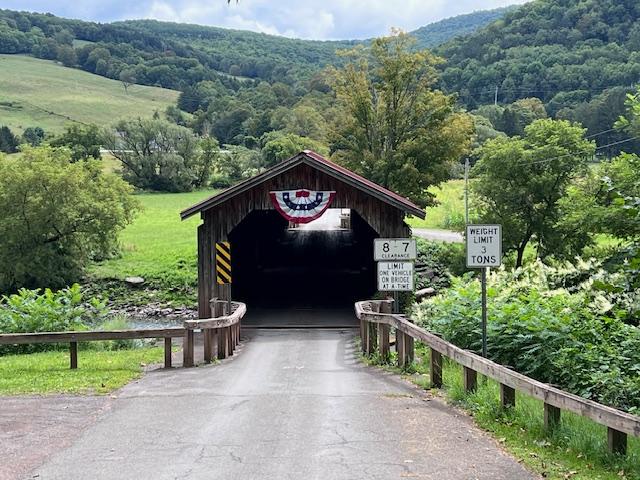
The Hamden Covered Bridge

I was driving through Hamden on my way to Ithaca and had just left Delhi and wanted to travel through the back roads of the state. I came across the Hamden Covered bridge while driving down the highway. I had never seen one that looked like this and had to stop to see this interesting bridge.

The historic sign

The History of the Covered Bridge:

(From the New York State Covered Bridge Society)

The Hamden Covered Bridge is one of six covered bridges still standing in Delaware County. It is one of three bridges owned and maintained by Delaware County; the other three bridges are
privately owned.

Built by Robert Murray in 1859, this 128-foot-long, single span structure incorporates the Long truss design patented on March 6, 1830 by Lieutenant Colonel Stephen H. Long of Hopkinton, New Hampshire. It is New York’s only covered bridge that incorporates a pure Long truss design, unassisted by an arch or Queen post truss and is rare to northeastern covered bridges. The Hamden Covered Bridge is one of three covered crossings that still carry traffic across branches of the Delaware River. A contract to construct the bridge was signed between Mr. Murray and the Town of Hamden on April 27, 1859, for the sum of $1,000.

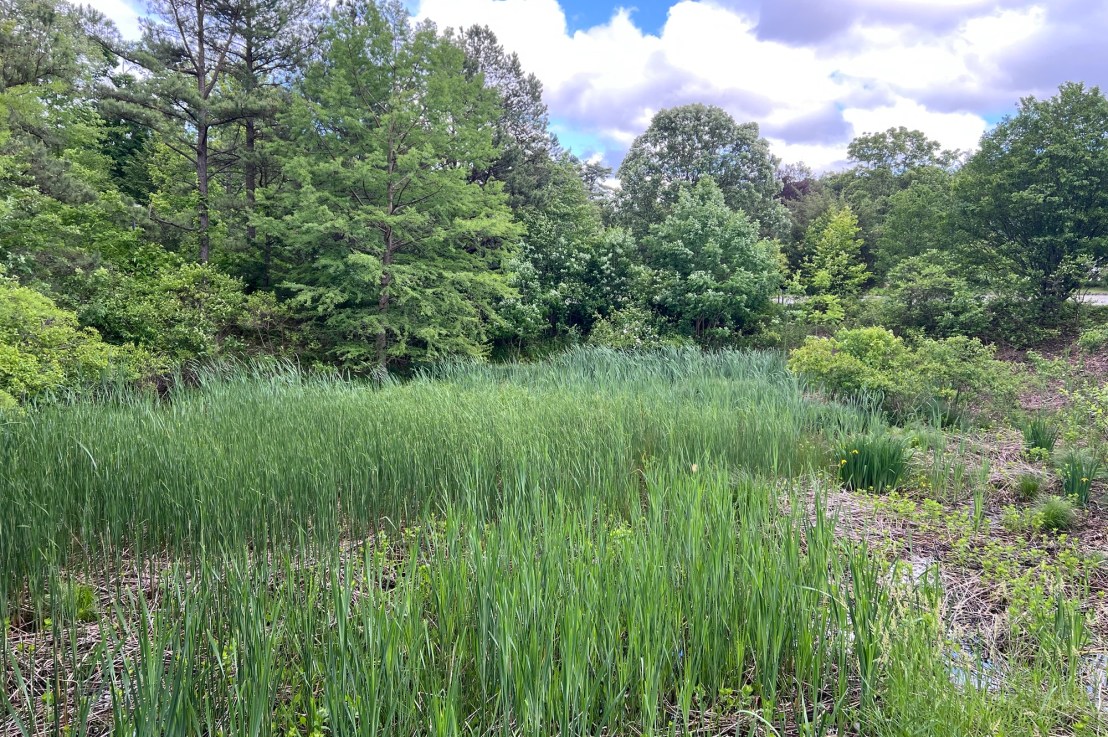
The beautiful little park that surrounds it

The little park does not have the best parking (as I had to park by the side of the highway) but this is a beautiful and picturesque little park. I loved walking through the gardens and taking a break from all the driving. Its a nice place to take a rest.

The beautifully landscaped park

The signage tells the story of the town, the rail system Upstate and the communities that was affected by it.

The history of the Bridge and the surrounding area

The history of the town

I had never walked through a old covered bridge before and found it fascinating. I loved the architecture and the history behind it. I imagined all the horses and wagons and cars that must have traveled through it over the years.

Touring the bridge

I want to share my tour of the bridge with all of you so you can see how magnificent this little historical bridge. It is amazing and nice to see a part of our history.

My walking tour of the inside of the bridge

The inside of the bridge

Take your time to take this walk through the bridge.

The historic sign

The beauty of the road trip down Route 10

The surrounding around Route 10 is just breathtaking in the summer and I can imagine what this is like during the Fall foliage. I took my time to drive down Route 10. It is just so beautiful to drive down and stop and take pictures.

Driving down Route 10

Driving down Route 10 is worth the trip

A better look at the lakes and rivers

The views are amazing
Third Shearith Israel Cemetery                                             98-110 West 21st Street                                            New York, NY 10011

Third Shearith Israel Cemetery 98-110 West 21st Street New York, NY 10011

Third Shearith Israel Cemetery

98-110 West 21st Street

New York, NY 10011

https://www.findagrave.com/cemetery/2260432/third-cemetery-of-congregation-shearith-israel

Open: Closed to the Public but you can see it from outside the fence.

My review on TripAdvisor:

Closed to the public

The cemetery sits behind the former ‘Ladies Shopping District’ department stores

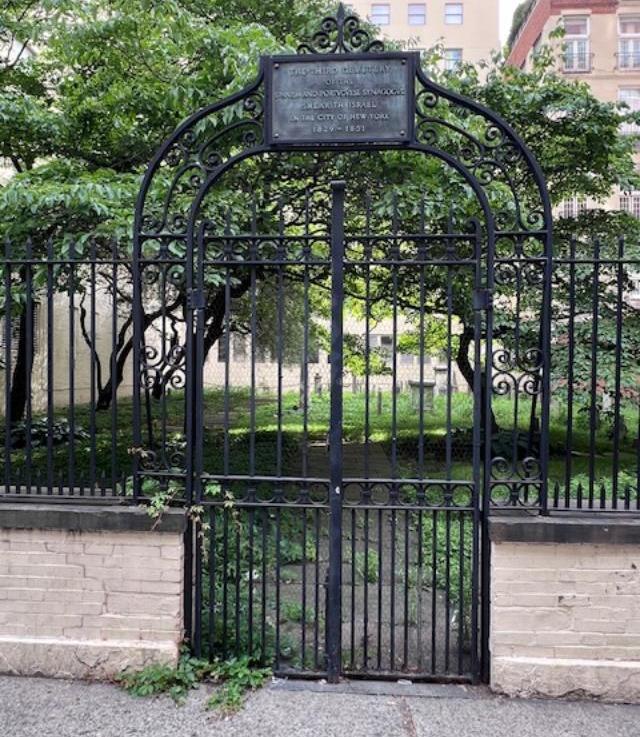
The front of the cemetery

When I was finishing my walk of the streets of Lower Chelsea, I came across this quiet and respectful cemetery in the middle of a busy neighborhood. This small graveyard was the third of series of moves that Shearith Israel made to bury their dead since the original cemetery open on the edge of what is today Chinatown.

Like its earlier counterparts, the cemetery is locked to visitors. So you can only admire it from a far. The graves date back to the early 1800’s.

The History of the cemetery:

(From the New York City Cemetery Project and Find a Grave)

This cemetery is located on 21st Street between 6th and 7th Avenues, in use 1829-1851. Shearith Israel, the first Jewish congregation in North America, was formed in 1654 by Spanish and Portuguese Jews who journeyed from Recife, Brazil, seeking refuge from the Inquisition.

The entrance to the cemetery is always locked

The sign for the cemetery

While New Amsterdam’s city fathers did not recognize freedom of worship, they respected the Jews’ right to their own consecrated burial ground. Shearith Israel purchased the cemetery plot on West 21st Street in 1829 for $2,750. It, too, was on the outskirts of the expanding city, which for sanitary reasons had prohibited interment below Grand Street after the yellow fever epidemic of 1822.

The view of the cemetery from the fence

In 1832 the congregation bought land extending the cemetery east to Sixth Avenue and south to 20th Street. Fifty years later the land was sold to Hugh O’Neal, who built a dry goods store there. Shearith Israel used the cemetery for burials until 1851.

The graves are from the early 1800’s

That year, New York City prohibited burials south of 86th Street and the establishment of any new cemeteries within city limits (Find a grave.com).

The side section of the cemetery and pathway

The view of the cemetery and its quiet respect to those buried there

The history of the Cemetery from the Congregation of Shearith Israel The Spanish & Portuguese Synagoge website:

According to rules of ritual purity, Cohanim are prohibited from coming into contact with the deceased (except for their immediate family.)  This means that ordinarily Cohanim cannot participate in any of the mitzvoth related to burial.  One particularly commendable priest, Mr. Lewis I. Cohen, realized that the consecration of a new and unused cemetery afforded him an opportunity to participate in a mitzvah usually off limits to Cohanim.  So it was Mr. Cohen who volunteered to dig the first grave for the first burial of the new cemetery in November 1829.

Some of the notable persons laid to rest in the 21st Street cemetery were Moses Levy Maduro Peixoto and Isaac Seixas, ministers of our congregation, and Harmon Hendricks, founder of one of America’s first great industrial companies and whose descendants are still members of our congregation today. Perhaps the most influential person to be buried in the 21st Street cemetery was the great Jewish diplomat and proto-Zionist, Mordecai Manual Noah.

In 1851, the city prohibited burial in Manhattan below 86th Street.  Rather than continue to look north (as Trinity Church did), the Congregation searched outside of Manhattan for its next burial ground.  Together with Bnai Jeshurun and Shaarei Tefila, the congregation purchased a large plot of land in Ridgewood, Queens.

Day Three Hundred and Fifty-Five Private Members Morning ‘Oasis in the City’ tour at the MoMA                                                                          August 9th, 2025

Day Three Hundred and Fifty-Five Private Members Morning ‘Oasis in the City’ tour at the MoMA August 9th, 2025

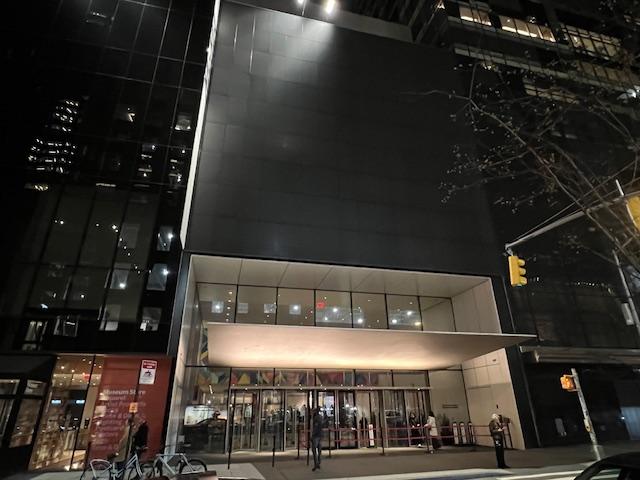
The entrance to the Museum of Modern Art 11West 53rd Street in New York City

https://www.moma.org/

My review on TripAdvisor:

https://www.tripadvisor.com/Attraction_Review-g60763-d105126-Reviews-The_Museum_of_Modern_Art_MoMA-New_York_City_New_York.html

The sign for the gardens

What I love about being a member of the museums in New York City is that there is an opportunity to see the museum in the early hours for private events. This morning I got up early to experience Manhattan on a spectacular sunny morning for the event ‘Oasis in the Garden’, a talk on the design, purpose and art in the MoMA outdoor garden.

We met inside the museum before the tour

Since the museum opened at 9:30am and there was no one at the museum at that hour, we had the outdoor garden to ourselves for almost an hour and a half.

The outdoor garden at the MoMA at 10:00am in the morning

Our tour guide led about fifteen of us through a history of the creation of the gardens, the purpose in the museum, its renovation in 2004 when I joined and the sculpture in the garden.

She also talked about taking her students here and that some of them wanted specific answers to what the art meant rather than forming their own opinion. It is funny how I see this in my own students.

What I liked about our tour group was that it was an older, very educated crowd of people who brought different opinions on how the art we were seeing should be thought about. From the time the artist created it to it modern interpretation by the ‘politically correct police’, I was amazed by the other members take on each piece of art.

The gardens are a refuge from the noise and crowds of the museum and the City

Video of the fountain

The Albert Giacometti ‘Talk Figure III’

Each piece of sculpture we touch upon was chosen specifically for the gardens and we talked about its place from when it was made to the modern interpretation and how they differ. Our first discussion was about the Albert Giacometti sculpture ‘Tall Figure III’. Some people talked about hunger and the stance on poverty. I asked if her students had different thoughts of the statue when it was made versus today.

She explained everything is seen differently through the artist’s eyes versus the modern I perception. It was hard to compare the two opinions without a debate. I thought today’s students needed to lighten up a little and stop taking art at face value and just enjoy it. The context of work over a hundred years ago is very different from how it can be looked at today.

We had time to talk and relax between art pieces and I swear the sound of the fountains relaxed me so much I almost feel asleep.

The fountains were so calming that morning

Video of the Japanese fountain

The August’s Rodin ‘St. John the Baptist Preaching’

We talked about the religious standpoint of the sculpture versus its place in modern society. I thought it was a naked guy hitchhiking. It’s funny how you see art.

The Jacques Lipchitz ‘Figure 1926-30’

With the ‘Figure’ many of the member talked about their interpretation of the modern take of Cubism and some members asked about whether these were arms and legs or something else.

The back of the gardens

The back of the gardens were so peaceful. I stood back from the tour so I could just hear the water rumble.

The Henry Moore sculpture ‘ The Family Group 1948-49

We discussed the modern family unit of today versus when the sculpture was created.

The back of the gardens

The Henri Matisse ‘The Back (III) 1913-16

The Aristide Maillol ‘The River’

We talked about the fall from God. One person said it looked like someone was tripping into the fountain. I thought that was clever.

The Jean Dubuffet ‘Study for Tower with Figures’

This was the last figure we discussed and we were asked as a group what was the first thing that came to our minds when we saw this. I said ‘Juxtaposed’. So much going on and a lot being said. We talked about children and their make up in the family unit. How they change things.

I have to say that I saw the art in a different light this morning. It was interesting to hear the artist’s interpretation versus what members thoughts were on what the art meant. I thought it was a good take away when we finished the tour. There were so many interesting opinions on the art. What I liked was the weather was so amazing, and it was so nice to be outside.

The garden as the public entered later that morning

I know I got a lot out of the tour. It’s always nice to see different points of view of what the art means and how we interpret it. This is why it is fun to be a member of the MoMA. It’s nice to see the museum when it is quiet and you can just take your time.

The gardens really are an “Oasis in the City”.

John Burrough’s Slabsides and Nature Sanctuary                                          500 Burroughs Drive                                                           West Park, NY 12493

John Burrough’s Slabsides and Nature Sanctuary 500 Burroughs Drive West Park, NY 12493

John Burrough’s Slabsides and Nature Sanctuary

500 Burroughs Drive

West Park, NY 12493

(845)384-6320

https://www.hudsonrivervalley.com/sites/John-Burroughs-Slabsides-/details

https://johnburroughsassociation.org/

Open: The Second and Forth Saturday of the month when in season. Please visit the website for the days open. The cabin is open from 12:00pm-4:00pm when in season.

My review on TripAdvisor:

The entrance to John Burroughs ‘Slabsides’

The entrance to Slabsides is located on a local country road off another local country road off Route 9. Use your Google Map carefully when visiting or you will miss the turn off. The parking lot is really small and holds only about eight cars so please make the turn around on the road above and park facing down from the parking lot (word of advice on parking).

The pathway from parking lot to the house is really beautiful and lush in the summer. It seemed more desolate in the cooler months and just empty. Still it is only about a five minute walk from the parking lot to the cabin.

The original cabin “Slabsides” from the pathway. This one room cabin was used by Naturalist John Burroughs as a home away from home to write and to think.

The lawn outside the cabin

The historic sign outside the cabin

The porch of Slabsides in the summer

John Burroughs work area inside the cabin and his kitchen

John Burroughs work station overlooked the woods and rock formations

The fireplace and resting area

The kitchen area in the back of the cabin

The bedroom and sleeping area of the cabin

The bedroom of the cabin

The pictures of Walt Whitman and John Burroughs in the bedroom

https://www.britannica.com/biography/John-Burroughs

https://exhibits.archives.marist.edu/s/marist-heritage-project/page/Esopus-Community-John-Burroughs

John Burroughs as a young man

https://johnburroughsassociation.org/about/about-john-burroughs

(From the John Burroughs website)

John Burroughs was one of the most popular authors of his day and is credited with creating the modern nature essay. Using easily understood prose, he described nature that was familiar and local, bringing the natural world to his readers. He encouraged them in the art of observation by sharing a sense of place and purpose in the land. Burroughs wrote more than three hundred articles published in leading magazines and in twenty-seven books over sixty years. Through his writings and friendships with influential leaders he had a profound impact on the emerging conservation movements.   

Born in the Catskill Mountains in 1837 he settled on a nine-acre fruit farm on the west bank of the Hudson River north of Poughkeepsie that he named “Riverby.” Poet Walt Whitman and Burroughs tramped through its surrounding woods during Whitman’s several visits, moving Burroughs to call these woods “Whitman Land.” In 1895 he purchased a nearby tract of land and built a two-story cabin as a place to write and entertain, calling it “Slabsides.”  

Though Burroughs was a writer particular to the Hudson Valley region, his travels were widely known and celebrated. In 1899 he joined the Harriman Expedition to Alaska and wrote the “Narrative” of the expedition. He accompanied Roosevelt into the wilderness of Yellowstone, telling the story in Camping & Tramping with Roosevelt, which provided the narrative for a segment of Ken Burns’s The National Parks. Burroughs also traveled to the Grand Canyon and Yosemite with John Muir and went on elaborate camping trips with his industrialist friends Henry Ford, Thomas Edison and Harvey Firestone. Accounts of these events are in Burroughs’ journal archived at Vassar College. 

Burroughs received honorary doctorates from Yale, Colgate, and the University of Georgia, and the Gold Medal of the American Academy of Arts and Letters.  

The ceiling of the cabin

The stairs to the upstairs loft

The cabin was small and is pretty much one full room with one or two walls partitioning the rooms. This seems more like a summer cabin. Still it had its charm.

We then finished the tour outside along the trails outside the cabin.

I admired the outside woods from the patio

(From the John Burroughs Association website)

The land around Slabsides informed many of his essays in which he described nature close at hand. Through works written here, John Burroughs inspired national leaders to preserve land and its wildlife and generations of readers to head out-of-doors. For nearly three decades Slabsides drew devoted readers and prominent friends. There are nearly seven thousand signatures in his Slabsides guest books. Among the early signers were ornithologists Frank Chapman and William Brewster, conservationist John Muir, leader of the Arts and Crafts movement Gustav Stickley, and his friends Theodore Roosevelt and Henry Ford, who gave him a series of three Ford cars. The young journalist Theodore Dreiser interviewed Burroughs at Slabsides.

The trail outside the cabin which Aldo served as the lawn when it is not full of vegetation from all the recent rain.

The trail signs

Looking down the trails outside the cabin

The rock formations outside the cabin on the trails

One last look back at the cabin before I left that morning

Walking along the trails outside back to the car

Walking along the trails bank to the car

Walking along the trails

Walking along the trails

The parking lot before I left that day

It was a wonderful private tour with Joan, who is the President of the organization. She explained who John Burroughs was, his significance in writing and his life. It was a very interesting tour.

The pathways were so beautiful and there is a full series of trails to follow throughout the property to explore.