Tag: hiking

Stone Harbor Bird Sanctuary                                         11400 3rd Avenue                                                                Stone Harbor, NJ 08247

Stone Harbor Bird Sanctuary 11400 3rd Avenue Stone Harbor, NJ 08247

Stone Harbor Bird Sanctuary

11400 3rd Avenue

Stone Harbor, NJ 08247

(609) 368-5102

https://www.facebook.com/p/Stone-Harbor-Bird-Sanctuary-100064916130839/

Open:Sunday-Saturday 24 Hours

Admission: Free

My review on TripAdvisor:

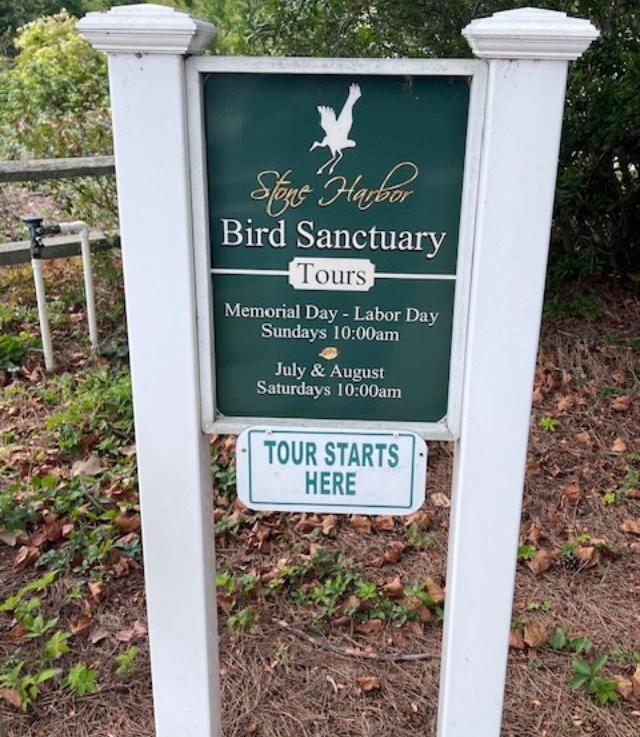
The sign welcoming you

The History of the Stone Harbor Bird Sanctuary:

(from the park’s website)

The Stone Harbor Bird Sanctuary is a wonderfully preserved microcosm of what the barrier islands of New Jersey looked like hundreds of years ago.  As you walk along Sanctuary paths, it is easy to imagine the Lenni-Lenape Indians wandering through the maritime forest, crossing wind swept sand dunes, past groves of white cedar, birch, pine, holly and sassafras trees, taking time to drink water from a spring fed freshwater pond and then, fishing in the salt water meadows surrounded by herons and songbirds.

As early as the 1870’s and 1880’s, the Sanctuary area was recognized as a “veritable paradise of birds” for ornithologists.  The primary attractions were Little Blue Herons, Black-crowned Night Herons, Green Herons and egrets.  Once the 96th Street Bridge opened in 1911, those who wanted to study, hunt or collect the eggs of birds no longer had to walk across four miles of marsh.  Easy access to the heronry was a boon to birders but also a threat to birds whose plumes and eggs were valued.

In 1941, the Stone Harbor Bird Club was organized in the home of Lillian R. Leuallen.  The Bird Club was renamed in 1946 as the Witmer Stone Club to honor Witmer Stone, one of the first ornithologists to document birds in the Sanctuary area.  With considerable foresight, the Witmer Stone Club proposed early in 1947 that the Borough of Stone Harbor establish a “sanctuary”.  In October of 1947, the Borough Council passed Ordinance #208 which preserved 31 acres of land as a wildlife sanctuary.  Subsequent to expert study in 1961 which demonstrated that no birds were nesting on the beach side sanctuary acreage, the Stone Harbor Borough Council sold ten acres to the east of Second Avenue.  The remaining 21 acres bounded by Second Avenue to the East, Third Avenue to the West, 111th Street to the North and area between 116th and 117th on the South represents the Sanctuary as we know it today.  The Sanctuary remains one of the few bird sanctuaries in the world that are completely within municipal boundaries.

One can’t overstate the foresight and commitment of the residents and Borough officials to conservation as well as the preservation of open space and wildlife in 1947, 1961 and every year since.  This commitment was reinforced by the United States Park Service in 1965 when it designated the Sanctuary as a National Natural Landmark.

Over the years, the Sanctuary has been home to thousands of birds and visited by more than a million people representing all fifty states and most countries in the world.  It has been estimated that Sanctuary visitors spend more than $5 million each year, locally. Although some like the New York Times in 1960 glorify the Sanctuary, referring to it as “The Everglades of New Jersey”, Stone Harbor residents think of the Sanctuary as a symbol of the character of this quiet, single family town which respects the nature and wildlife that surrounds them while placing a premium on livability, aesthetics and serenity.

The front of the sanctuary from 3rd Avenue

I took a walk when I was in Stone Harbor through the town’s Bird Sanctuary to hopefully view some rare birds. While I did not see much, I heard a lot of singing and scrawling as I walked the path through the trees.

The front gardens in the sanctuary

The gardens were still in bloom in the late Summer and many colorful wildflowers attracted all sorts of butterflies and other insects.

The sign greeting you about the experience

The front path of the sanctuary

You head over the bridge to the paths that take you into the woods

Walking down the pathways through the woods

The path takes you into a deep wooded area in the middle of the town and by the time you get to the middle of the path, you can hear the mating calls of many birds. It’s funny to note that we are a couple of blocks from the shore.

Walking through the pathways

Reaching the middle of the beach woods

The middle of the bird sanctuary noisy with bird calls

Walking back through the pathways through the roads

Touring through the Bird Sanctuary does not take a long time, but offers relief from a busy shore town.

Video on the park:

Hamden Covered Bridge Park                                     Route 10                                                                    Hamden, NY 13782

Hamden Covered Bridge Park Route 10 Hamden, NY 13782

Hamden Covered Bridge Park

Route 10

Hamden, NY 13782

https://en.wikipedia.org/wiki/Hamden_Bridge

Open: Sunday-Saturday 24 Hours

My review on TripAdvisor:

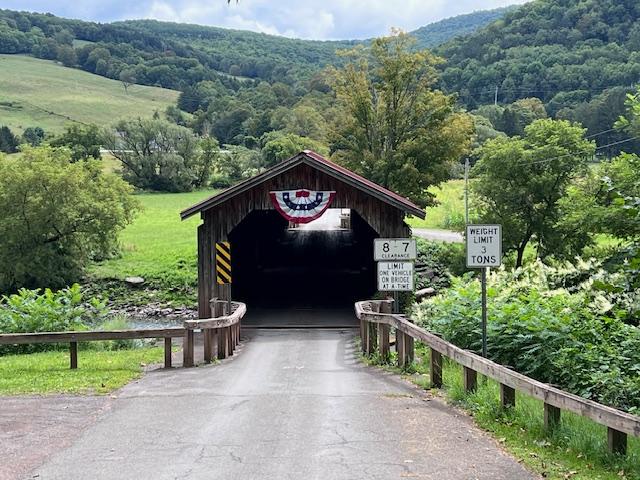
The Hamden Covered Bridge

I was driving through Hamden on my way to Ithaca and had just left Delhi and wanted to travel through the back roads of the state. I came across the Hamden Covered bridge while driving down the highway. I had never seen one that looked like this and had to stop to see this interesting bridge.

The historic sign

The History of the Covered Bridge:

(From the New York State Covered Bridge Society)

The Hamden Covered Bridge is one of six covered bridges still standing in Delaware County. It is one of three bridges owned and maintained by Delaware County; the other three bridges are
privately owned.

Built by Robert Murray in 1859, this 128-foot-long, single span structure incorporates the Long truss design patented on March 6, 1830 by Lieutenant Colonel Stephen H. Long of Hopkinton, New Hampshire. It is New York’s only covered bridge that incorporates a pure Long truss design, unassisted by an arch or Queen post truss and is rare to northeastern covered bridges. The Hamden Covered Bridge is one of three covered crossings that still carry traffic across branches of the Delaware River. A contract to construct the bridge was signed between Mr. Murray and the Town of Hamden on April 27, 1859, for the sum of $1,000.

The beautiful little park that surrounds it

The little park does not have the best parking (as I had to park by the side of the highway) but this is a beautiful and picturesque little park. I loved walking through the gardens and taking a break from all the driving. Its a nice place to take a rest.

The beautifully landscaped park

The signage tells the story of the town, the rail system Upstate and the communities that was affected by it.

The history of the Bridge and the surrounding area

The history of the town

I had never walked through a old covered bridge before and found it fascinating. I loved the architecture and the history behind it. I imagined all the horses and wagons and cars that must have traveled through it over the years.

Touring the bridge

I want to share my tour of the bridge with all of you so you can see how magnificent this little historical bridge. It is amazing and nice to see a part of our history.

My walking tour of the inside of the bridge

The inside of the bridge

Take your time to take this walk through the bridge.

The historic sign

The beauty of the road trip down Route 10

The surrounding around Route 10 is just breathtaking in the summer and I can imagine what this is like during the Fall foliage. I took my time to drive down Route 10. It is just so beautiful to drive down and stop and take pictures.

Driving down Route 10

Driving down Route 10 is worth the trip

A better look at the lakes and rivers

The views are amazing

John Burrough’s Slabsides and Nature Sanctuary                                          500 Burroughs Drive                                                           West Park, NY 12493

John Burrough’s Slabsides and Nature Sanctuary 500 Burroughs Drive West Park, NY 12493

John Burrough’s Slabsides and Nature Sanctuary

500 Burroughs Drive

West Park, NY 12493

(845)384-6320

https://www.hudsonrivervalley.com/sites/John-Burroughs-Slabsides-/details

https://johnburroughsassociation.org/

Open: The Second and Forth Saturday of the month when in season. Please visit the website for the days open. The cabin is open from 12:00pm-4:00pm when in season.

My review on TripAdvisor:

The entrance to John Burroughs ‘Slabsides’

The entrance to Slabsides is located on a local country road off another local country road off Route 9. Use your Google Map carefully when visiting or you will miss the turn off. The parking lot is really small and holds only about eight cars so please make the turn around on the road above and park facing down from the parking lot (word of advice on parking).

The pathway from parking lot to the house is really beautiful and lush in the summer. It seemed more desolate in the cooler months and just empty. Still it is only about a five minute walk from the parking lot to the cabin.

The original cabin “Slabsides” from the pathway. This one room cabin was used by Naturalist John Burroughs as a home away from home to write and to think.

The lawn outside the cabin

The historic sign outside the cabin

The porch of Slabsides in the summer

John Burroughs work area inside the cabin and his kitchen

John Burroughs work station overlooked the woods and rock formations

The fireplace and resting area

The kitchen area in the back of the cabin

The bedroom and sleeping area of the cabin

The bedroom of the cabin

The pictures of Walt Whitman and John Burroughs in the bedroom

https://www.britannica.com/biography/John-Burroughs

https://exhibits.archives.marist.edu/s/marist-heritage-project/page/Esopus-Community-John-Burroughs

John Burroughs as a young man

https://johnburroughsassociation.org/about/about-john-burroughs

(From the John Burroughs website)

John Burroughs was one of the most popular authors of his day and is credited with creating the modern nature essay. Using easily understood prose, he described nature that was familiar and local, bringing the natural world to his readers. He encouraged them in the art of observation by sharing a sense of place and purpose in the land. Burroughs wrote more than three hundred articles published in leading magazines and in twenty-seven books over sixty years. Through his writings and friendships with influential leaders he had a profound impact on the emerging conservation movements.   

Born in the Catskill Mountains in 1837 he settled on a nine-acre fruit farm on the west bank of the Hudson River north of Poughkeepsie that he named “Riverby.” Poet Walt Whitman and Burroughs tramped through its surrounding woods during Whitman’s several visits, moving Burroughs to call these woods “Whitman Land.” In 1895 he purchased a nearby tract of land and built a two-story cabin as a place to write and entertain, calling it “Slabsides.”  

Though Burroughs was a writer particular to the Hudson Valley region, his travels were widely known and celebrated. In 1899 he joined the Harriman Expedition to Alaska and wrote the “Narrative” of the expedition. He accompanied Roosevelt into the wilderness of Yellowstone, telling the story in Camping & Tramping with Roosevelt, which provided the narrative for a segment of Ken Burns’s The National Parks. Burroughs also traveled to the Grand Canyon and Yosemite with John Muir and went on elaborate camping trips with his industrialist friends Henry Ford, Thomas Edison and Harvey Firestone. Accounts of these events are in Burroughs’ journal archived at Vassar College. 

Burroughs received honorary doctorates from Yale, Colgate, and the University of Georgia, and the Gold Medal of the American Academy of Arts and Letters.  

The ceiling of the cabin

The stairs to the upstairs loft

The cabin was small and is pretty much one full room with one or two walls partitioning the rooms. This seems more like a summer cabin. Still it had its charm.

We then finished the tour outside along the trails outside the cabin.

I admired the outside woods from the patio

(From the John Burroughs Association website)

The land around Slabsides informed many of his essays in which he described nature close at hand. Through works written here, John Burroughs inspired national leaders to preserve land and its wildlife and generations of readers to head out-of-doors. For nearly three decades Slabsides drew devoted readers and prominent friends. There are nearly seven thousand signatures in his Slabsides guest books. Among the early signers were ornithologists Frank Chapman and William Brewster, conservationist John Muir, leader of the Arts and Crafts movement Gustav Stickley, and his friends Theodore Roosevelt and Henry Ford, who gave him a series of three Ford cars. The young journalist Theodore Dreiser interviewed Burroughs at Slabsides.

The trail outside the cabin which Aldo served as the lawn when it is not full of vegetation from all the recent rain.

The trail signs

Looking down the trails outside the cabin

The rock formations outside the cabin on the trails

One last look back at the cabin before I left that morning

Walking along the trails outside back to the car

Walking along the trails bank to the car

Walking along the trails

Walking along the trails

The parking lot before I left that day

It was a wonderful private tour with Joan, who is the President of the organization. She explained who John Burroughs was, his significance in writing and his life. It was a very interesting tour.

The pathways were so beautiful and there is a full series of trails to follow throughout the property to explore.

Sautjes Tave’s Begraven Ground Cemetery                                Bogart Road & Everett Road                                                   Demarest, NJ 07627

Sautjes Tave’s Begraven Ground Cemetery Bogart Road & Everett Road Demarest, NJ 07627

Sautjes Tave’s Begraven Ground Cemetery

Bogart Road & Everett Road

Demarest, NJ 07627

(732) 260-7877

https://www.revolutionarywarnewjersey.com/new_jersey_revolutionary_war_sites/towns/demarest_nj_revolutionary_war_sites.htm

https://www.findagrave.com/cemetery/1586040/sautjes-taves-begraven-ground

https://www.hmdb.org/m.asp?m=63548

My review on TripAdvisor:

https://www.tripadvisor.com/Attraction_Review-g46390-d33256525-Reviews-Sautjes_Tave_s_Begraven_Ground_Cemetery-Demarest_New_Jersey.html

The Sautjes Tave Begraven Ground Cemetery is an example of an early Dutch Cemetery of some of the first Colonists in Bergen County with some families arriving in the early 1600’s .

The entrance to the Sautjes Tave Begraven Ground Cemetery in Demarest, NJ

The historic sign at the entrance placed by the David Demarest Chapter of the Daughters of the American Revolution

The inside of the historic cemetery

These early families once owned farms under royal patents of hundreds of acres and these would be passed down from generation to generation. These small family cemeteries were once located on the edge of family land that have since been replaced by modern suburbs. This is now in the middle of a traffic circle surrounded by homes. The cemetery is a wonderful shape and is nicely landscaped.

The cemetery from the south side

Generations of a Bogarts, Blauvelts, Haring, Demarest, Du Bois, Van Scivan and other prominent families all inter married into each family were buried here.

The Bogart-Bauvelt family plot

The Bogart-Blauvelt family plot

The Demarest family plot

The Demarest-Haring family plot

The Ann Marie Demarest grave

The Cornelius Demarest grave site, a Revolutionary War veteran

Patriot Douwe Talema, who was killed by the Tories during the Revolutionary War

The Daniel Van Scivan grave, another Revolutionary War veteran

The Haring Family plot

The Haring family plot

The James Haring grave

The Sophia Haring grave

The Du Bois family plot

The Cemetery view from the southern corner

My video of Touring the Cemetery and its historic roots:

My tour of the cemetery

Leaving the cemetery you can see the landscaping offers these families privacy in both life and death.

After the tour of the cemetery, I explored Downtown Demarest, NJ and discovered a beautiful little town with small local stores and a beautiful set of parks surround the streams and the train station just off the downtown.

The town of Demarest Veteran’s display

The town of Demarest has its own rich beauty and you can see this by visiting its Downtown area and its parks.

The breathtaking Duck Pond Park attracted a lot of painters who set their easels by the banks of the streams.

The Duck Pond is really beautiful

They also have a really nice railroad terminal that is now a senior center

The historic Demarest Railroad Station

This wonderful community has so many wonderful attributes.