
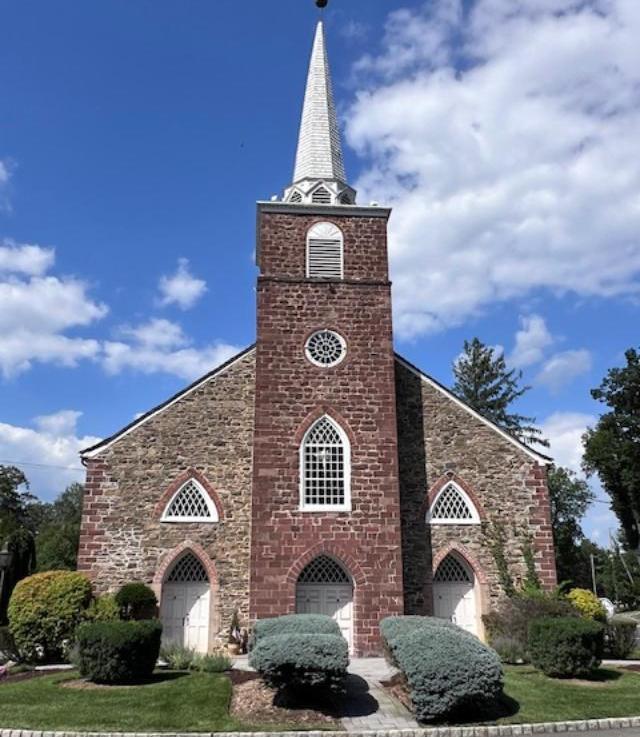
Saddle River Reformed Church and Cemetery
481 East River Road
Saddle River, NJ 07458
(201) 327-5242
https://oldstonechurchonline.org/about-us/
Open: Sunday 9:00am-12:00pm/Monday-Saturday Be Appointment
My review on TripAdvisor:

The Saddle River Reformed Church at 481 East Saddle River Road in Saddle River, NJ is also known as the “Old Stone Church”

The historic marker of the church
I visited the ‘Old Stone Church’ in Saddle River, one of the oldest churches in the state and was taken not just by the beauty of the church but by the respect the church has for the people who are buried here. There is much recognition for the contributions of the soldiers and the armed forces not just for the Revolutionary War soldiers but current ones as well.

The oldest part of the cemetery is the closest to the church
The oldest part of the cemetery contains names like Demarest, Haring, Hopper, DeBraun, Eckerson, Terhune and Zabriskie. These are the first settlers of the area whose families owned farms in Saddle River. Many of the families have family plots in the cemetery.

The Hopper family plot

The Zabriskie family plot

The Gilderston family plot

The DeBaum family plot

The DeBaum family plot

The oldest part of the cemetery holds so much history of the founding members of the Saddle River and Bergen County community.
The History of the Church:
(from the Saddle River Reformed Church website)
Our church, known to many as the Old Stone Church, was organized in 1784 as a daughter church of the Old Paramus Church. It is a part of the Reformed Church in America, a denomination which traces its roots to the Dutch colonists.
While there is evidence that the original church building was erected in 1789, our present sanctuary was built in 1819. An extensive renovation in 1971 – 1972 recreated the appearance of the original structure.

The Old Stone Church and the historic Revolutionary War Cemetery that is located behind it.
The History of the Cemetery:
(From the Saddle River Reformed Church website):
Our cemetery is the resting place of numerous American Revolution and Civil War Veterans. Church records indicate that the following veterans have been buried at our historic site.
The Saddle River Reformed Church Cemetery is one of the most historic in this part of the country. Our cemetery is over 230 years old and is the burial ground of nine known Veterans of the American Revolution. Tracing back to the founding of this nation, these resting places designate the cemetery as an historic spot of great significance, with a special interest to historians and antiquarians. Surrounded by mature and lush foliage, its peaceful setting by the banks of the Saddle River make for an esteemed and hallowed resting place for your loved ones.

Some of the most fascinating part of the cemetery is its historical section
With the Bergen 250-The 250th Anniversary of the Revolutionary War next year, I wanted to point out the veterans buried here from the war.

Jacob David DeBraun
(from the church website)
David DeBaun was born in Schraalenburg (Bergenfield) in 1759 to Abraham DeBaun and Bridget Ackerman. About 1770 the family moved to Hempstead in New York. David served as a private in the Second Regiment of Hay’s Militia, Captain Garret Ackerson’s Company. He married Hannah Forshay, b. 1868, d. 1836. David died in New Hempstead, NY in 1820. He was tax officer of Hempstead in 1811 and 1812; supervisor of Haverstraw 1811-1814. An enclosed plot in the Upper Saddle River Cemetery is the resting place of his entire family.

John Tallman
(from the church website)
John Tallman was a Sergeant in Hays Regiment of Militia, Orange County, NY Militia, Company of Captain Hogenkamp, William Sickles, and Aurie Smith, and is listed on the Revolutionary War pension records. He was born in Tappan, the son of Jan Tallman and Helena Gerritse Blauvelt. He married Margrietje Forseur (Forshay). He died in New Hempstead, NY in 1839.

David Eckerson
(from the church website)
David Thomas Eckerson, was born in Schraalenburgh (Bergenfield) in 1738. He married Angenetye Vanderbeek and they had a sons Thomas, Paul, Jon, David and Aurie and daughters Hannah, Mary and Angenetye. He is on the Revolutionary War rolls in Rockland County. Revolutionary War veteran Peter van Orden was an executor to his will.

Thomas Eckerson
(from the church website)
Thomas Eckerson, 1745-1818, was married to Cornelia Eckerson. They had children, Thomas Eckerson, Edward T. Eckerson, Maria Eckerson Crouter, and Jacob Eckerson. He is listed as a Private, New Jersey Regiment. He also served in the War of 1812.

Abraham Haring
(from the church website)
Abraham G. Haring was born in 1755 in Tappan, Orange, NY to Garret J. Haring and Cornelia Lent. He married Elizabeth Blauvelt. He died in 1832 in Hempstead, Rockland, NY. He served in the Revolutionary War 1775-1783, Coopers Regiment, NY Militia.

John Terhune
(from the church website)
John A. Terhune, 1753-1805, was the son of Albert A. Terhune and Elizabeth Doremus. He inherited the stone house on the sw corner of Lake Street and West Saddle River Road, known as the Terhune-Hopper house. He married Catherine Lutkins, daughter of Harman Lutkins of Paramus. He is on the SAR list.

Jacob Zabriskie
In the modern day, I wanted to point out a hero to the Bergen Country Firefighting Community and former Saddle River Fire Chief Larry Rauch and his wife, Sherry who both contributed so much to the firefighting community.

Chief Larry Rauch
https://www.northjersey.com/obituaries/ber091143
Many members of the Revolutionary, Civil, war of 1812 to WWI and II to Desert Storm are buried here. These church treats our veterans with great respect.

The cemetery sign





 Visiting a Museum: The Unique, Unusual, Obscure and Historical