Tag: Author Justin Watrel

Ocean City Historical Museum 1735 Simpson Avenue Ocean City, NJ 08226

Ocean City Historical Museum

1735 Simpson Avenue

Ocean City, MD 08226

(609) 339-1801

https://www.ocnjmuseum.org/

https://www.facebook.com/ocnjmuseum/

My review on TripAdvisor:

https://www.tripadvisor.com/Attraction_Review-g46696-d15122158-Reviews-Ocean_City_Historical_Museum-Ocean_City_Cape_May_County_New_Jersey.html

The entrance to the museum is inside the Municipal Building and Library 1735 Simpson Avenue

The original map of Ocean City, NJ

I made a trip to many of the beach towns at the Jersey Shore recently visiting the small historical societies that explain the history and development of these small towns. It is amazing to see how they have developed in just 150 years from Native American fishing villages to thriving vacation spots and permanent residential districts. Ocean City, NJ itself has an interesting history.

The entrance gallery with the history of the town

As you enter the museum from the back of the library, you are warmly greeted by a docent who will explain the museum to you. Then you will follow a semicircle through the exhibitions in a genealogical order from when the town was founded to modern times and events.

The first exhibition is called “From Hunting Ground to the Modern Resort:

The early history from the time the Native Americans used the shore line for fishing and hunting to the history of the Miller family who owned parts of the island. The exhibit explained how the Miller family owned this section the island and how it was developed. These were the early years of the island until the coming of the Methodist colony.

The original map of the barrier island and artifacts of the local Native American tribes

The second Exhibition was “The Founders and the Early Years”:

In 1879, four Methodist ministers came to Ocean City to develop a Summer Colony and resort for their members based on Christian values. This lead to the development of the “Blue Laws” in which some traces are found today. The displays discussed the how the resort moved into modern times and how this development shaped the resort as it is today. There are interesting pictures of the development of the Camp in the turn of the last century.

The early growth of the island as a resort

Early Motel sign

The early Bathing exhibition

The third Exhibition was “The Boardwalk”:

The development of the first Boardwalk in 1887 to give access to the shoreline lead to early development around it. You could follow the developments of many versions of the Boardwalk over the years due to storms and development. There were displays of old movie theaters that used to dot the Boardwalk along with other family businesses that opened over the years. Old hotels that have since closed or being used for other uses had their histories told. The Flanders Hotel’s history was displayed.

The Boardwalk rebuilt into its present form

The Boardwalk in the beginning

The Beach Patrol display

The Beach Patrol sign

The Ocean Patrol exhibition and artifacts

The forth Exhibition was “The Sindia”:

The Sindia was a shipwreck off the coast of Ocean City that ran aground in 1901. It still lies off the coast but many of the artifacts of the wreck are displayed here. There is all sorts of bottles, dishware and other household and decorative items displayed here. There is also an interesting display of model ships.

The Porcelain artifacts

The model ship display

The model ship display

The ship mass display

The museum Parlor exhibition

The museum Parlor exhibition

The last Exhibition was on actress Grace Kelly and her family:

Princess and Actress Grace Kelly used to vacation with her family in Ocean City from the time she was a little girl until her death. I never realized that her father was an Olympic Rower and used to row at the Jersey Shore. Her brother was a lifeguard for the town as well. There are all sorts of family pictures of her and her siblings growing up here. What I thought was interesting was she bought her royal family to the Jersey shore to vacation with her family and there were pictures before she passed enjoying her time here. That I thought was very interesting that she never forgot her roots.

The Grace Kelly exhibition

The Princess and Movie Star never forgot her roots

There was a special exhibition on the local theaters that once used to dot Ocean City, NJ:

The history of movie theaters in Ocean City, NJ

The Village Theater exhibition

The theaters of Ocean City, NJ

It was an interesting look at the development and then the closure of the local theaters that had become a part of everyone’s lives.

Don’t miss their nice gift shop that has all sorts of decorative items and jellies and honey.

The Gift Shop at the Museum

The Gift Shop

History of the Museum:

(from the Museum’s Website)

The Ocean City Historical Museum is a nonprofit 501(c) 3 corporation established in April of 1964. It was created by a group of enthusiastic volunteers with the support of the local government. The purpose of the Museum is to preserve the city’s history for future generations for both visitors and residents.

The first museum was located on the first floor of the old elementary school at 409 Wesley Avenue. It was only open during the summer of its first full year, as the building was still being used as a school. In July of 1965, it was opened for year round visitors when the school moved to its new location. The museum moved to its current location at the Ocean City Community Center at 1735 Simpson Avenue in 1990.

Mission:

The mission of the Ocean City Historical Museum is to delight, inspire and educate the public about the story of Ocean City, NJ and to collect, preserve and promote items relevant to its heritage, traditions and memories.

The Recycle Man display

Vision:

The Vision of the Ocean City Historical Museum is to be an inviting, informative and innovative community resource that is recognized and respected as the place for exploring and celebrating the rich history and heritage of Ocean City, NJ.

The Toy Collection

Stone Harbor Museum                                                           9410 Second Avenue                                                              Stone Harbor, NJ 08247

Stone Harbor Museum 9410 Second Avenue Stone Harbor, NJ 08247

Stone Harbor Museum

9410 Second Avenue

Stone Harbor, NJ 08247

(609) 368-7500

Home

https://www.facebook.com/stoneharbormuseum/

My review on TripAdvisor”

https://www.tripadvisor.com/Attraction_Review-g46850-d12832764-Reviews-Stone_Harbor_Museum-Stone_Harbor_Cape_May_County_New_Jersey.html

The entrance to the Stone Harbor Museum at 9410 Second Avenue

On a recent trip to the Jersey Shore, I took an long drive down the coastline visiting small historical museums of the shore towns and they gave me an interesting perspective of how these towns were developed from the time of Native American fishing and hunting villages to the advent of railroads and Victorian hotels to the modern development of the town today. Stone Harbor, NJ has had an interesting path since its development in the late 1800’s.

The Stone Harbor Museum display from the Women’s Civic Club of Stone Harbor

The Stone Harbor Museum was founded in 1996 by a group of involved residents who wanted to showcase their town’s history. The current museum was opened in 2016 and has many different exhibitions going on, some permanent and others are seasonal and keep rotating within the museum. When you walk in, the museum is divided by sections and displays of their museum.

The Stone Harbor Museum Historical Window

Leading into the entrance, there was a very interesting exhibit on “9/11” for the Twentieth Anniversary of the event by a Chief from the Stone Harbor Fire Department. It was a series of articles from local and national papers, some artifacts and information on the fire service. It was a very touching reminder of what fire fighters did that horrible day.

The Stone Harbor Fire Department display in 2024 (the 9/11 exhibit closed a year later)

There were many displays on the history of Stone Harbor with the Stone Harbor School System and the Borough of Stone Harbor exhibiting artifacts. Interesting pictures and items of the Stone Harbor Beach Patrol were proudly displayed which I noticed from my many stops at various historical societies on the Jersey Shore is very much a part of the town culture. These teams take their competitions amongst the towns very seriously with events like boating and swimming.

The Stone Harbor Beach Patrol display

There were many pictures of old homes at a time when the town was a Victorian beach resort and people came to the Jersey shore for extended vacations. You could see the progression of the town over a century from a seaside resort to a permanent residential town. The architecture has significantly changed over the years to slightly smaller homes but no less impressive all over the town.

The Stone Harbor Hotels

There were extensive pictures and displays of the importance of the rail system and the role it played in the growth of the area and to all shore communities. Its history pretty much ended with the advent of the Model T and the growth of cars to the Jersey shore. Soon the modern highways made the rail system obsolete.

Ladies at the shore enjoying a ride

Still there are many displays of ‘fun in the sun’ and the growth of beach activities and recreation with the growth of sun bathing, swimming, boating and fishing. People’s leisure time was growing and the Jersey shore filled their time with sun bathing and swimming. The changes of attitude in swimwear have been tremendous especially from the one piece and hats to the modern bikini in just 80 years.

Swimwear at the turn of the last century

There were pictures and artifacts from various shipwrecks off the coast of the town. It showcased the maritime history of the town and of the Jersey shore in general. It showed the importance of the town in a era of trade that is long gone. This shipping lines too became obsolete as rail service replaced them.

The main gallery of the museum

There was a interesting collection of items entitled Church and Faith of all the churches in the town that played such a important role in the social life of the turn of the last century. This was a time before TV, radio, the advent of movies and especially the Internet. This was at time when people’s social life revolved the social life of places of worship.

The Office Display

In the center of the museum there is an extensive library with shelves lined with notebooks full of pictures and historical details neatly bound. This is the records of the town and the citizens who have lived here over the years.

Artifacts from the town

The two big displays right now for kids has been the Taylor Swift, the famous singer, display of items that her family donated to the museum. It seems that she summered here as a child and played in the local clubs. The other was the dinosaur bone display of items found locally in the area and around New Jersey. The museum has a popular scavenger hunt for the kids where they have to find items on display.

The new Taylor Swift display on the years she vacationed here

The Taylor Swift exhibition

The Dinosaur Display

The Dinosaur display

The Dinosaur display

The one thing I liked about the museum is that it does not overwhelm you when you are visiting. The exhibits are detailed but compact. You learn a lot about the town with enough information and artifacts but you can still enjoy the display in about twenty minutes to about a half hour. The whole museum takes about an hour to two hours to visit maybe more if you are really enjoying yourself.

The staff could not have been nicer and take such pride in the museum. The afternoon I visited the museum one of the long time residents who volunteers at the museum was able to share her knowledge of the town. For a small town, it is chockful of interesting history.

The Maps display

The Stone Harbor Museum History:

(from their website and pamphlets)

The Mission:

To acquire, preserve, display, celebrate and promote archival and artifact items relevant to the development of our unique cultural heritage and to delight, inspire and educate the present and future generations about the story of Stone Harbor, NJ.

The Vision:

To be inviting, informative and innovative community resource that is recognized and respected as the place for exploring and celebrating rich cultural heritage of Stone Harbor, NJ.

The Restaurant display

Titanic Memorial Lighthouse                            Pearl Street/South Street Seaport                     New York, NY 10038

Titanic Memorial Lighthouse Pearl Street/South Street Seaport New York, NY 10038

Titanic Memorial Lighthouse

Pearl Street/South Street Seaport

New York, NY 10038

(212) 830-7700

https://www.lighthousefriends.com/light.asp?ID=585

https://en.wikipedia.org/wiki/Titanic_Memorial_(New_York_City)

Open: Sunday-Saturday 24 Hours

My review on TripAdvisor:

https://www.tripadvisor.com/Attraction_Review-g60763-d7738946-Reviews-Titanic_Memorial_Park-New_York_City_New_York.html

The Titanic Memorial Lighthouse

I have been to the South Street Seaport dozens of times over the years and can’t believe that I never noticed this memorial dedicated to those lost in the Titanic disaster. I was visiting the Seaport recently after finishing another walk down the length of Broadway for my blog, “MywalkinManhattan.com” and was walking past the Seaport on my way to Chinatown. Something about it this time caught my attention and I stopped to look at the dedication of this small lighthouse.

It was really touching to see that the people from the 1912 disaster were not forgotten in New York City, its ultimate destination. This was the work of Molly Brown, the ‘Unsinkable Molly Brown’ from the movie. She wanted to be sure that the people who survived were never forgotten. The small lighthouse structure sits at the entrance to the main part of the seaport on an island just off the cobblestone walkway into the complex.

The Memorial plaque on the lighthouse

The tower that it was originally placed a top of the Seamen’s Church Institute Building and it was put up for sale and demolished in 1965 and the small lighthouse memorial was donated to the South Street Seaport Museum. It was placed in its current location in 1976 (Friends of the Lighthouse).

The little lighthouse is a touching reminder of Manhattan’s connection to the event over 100 years ago. Try not to miss it when you are visiting the Seaport.

The history of the Titanic Memorial Lighthouse:

(This is from the Friends of the Titanic Memorial Lighthouse website)

On April 15th, 1913, one year after the sinking of the Titanic, the Titanic Memorial Lighthouse and Time Ball, mounted atop the Seamen’s Church Institute, were dedicated to honor the passengers, officers and crew who perished in the tragedy. The dedicatory service opened with a hymn and prayer and then Rt. Rev. David h Greer, Bishop of New York, read the following lines of dedication:

“To the glory of Almighty God and in loving memory of those passengers, officers and crew who lost their lives in the foundering of the steamship, Titanic, on April 15, 1912, I, David Hummell Greer, Bishop of New York and president of the Seamen’s Church Institute of New York, do solemnly dedicate the Titanic Memorial Lighthouse Tower. As its light by night shall guide pilgrims and seafaring men from every clime into this port, so may they follow Him who is the Light of Life across the waves of this troublesome world to everlasting life and looking at noon toward this place to note the time of day, may they remember that our days pass as the swift ships and in view of the shortness and uncertainty of human life, strive to fulfill their duty well as the beat preparation for Eternity. Amen.”

The Titanic Memorial Lighthouse exhibited a fixed green light that could be seen throughout New York harbor and down as far as Sandy Hook. Five minutes before noon each day, a time ball would be hoisted to the top of a steel rod mounted atop the lighthouse and dropped at the stroke of twelve as indicated over the wires from Washington DC. According to The Lookout, the magazine of the Seamen’s Church Institute, the Titanic Memorial Lighthouse would be a much needed daily reminder for ‘in a busy, carless city the average person so soon forgets’.

The Seamen’s Church Institute was established in 1834 and had announced plans for its new twelve story headquarters at South Street and Coenties Slip in Lower Manhattan several years before the loss of the Titanic. The Flemish style building was meant to reflect new York’s Dutch origins and was to be crowned by a tower whose beacon would welcome incoming seamen. The cornerstone for the building was laid one day after the sinking of the Titanic and a week later the institute announced the lighthouse atop their building would be a memorial to the victims of the tragedy.

Betsy Ross House                                                    239 Arch Street                                      Philadelphia, PA 19106

Betsy Ross House 239 Arch Street Philadelphia, PA 19106

Betsy Ross House

239 Arch Street

Philadelphia, PA 19106

(215) 619-4026

Betsy Ross House

Admission: Adults $7.00/Children-Seniors-Military $6.00/Audio Tour Add $2.00-Please check Website

My review on TripAdvisor:

https://www.tripadvisor.com/ShowUserReviews-g60795-d144052-r793537657-Betsy_Ross_House-Philadelphia_Pennsylvania.html?m=19905

The Betsy Ross House Museum at 239 Arch Street

I visited the Betsy Ross House Museum when touring the small museums of Old Town Philadelphia. What an interesting historical site. You felt like you were invited into Betsy Ross’s house by Betsy Ross herself.

Betsy Ross was an upholsterer and ran her business dealings from the front of the house where her small showroom and workroom were located to the street level. Many people in Philadelphia had this work arrangement where the business was in the front of the home and then living quarters were in the back or up above.

In the showroom area, an actress playing Betsy Ross, was there answering all our questions and she was very interesting. When she had been approached to design and create the flag, she had never made a flag before. The actress explained that she had to keep making flags ‘under the wraps’ so that Loyalist would not shut the business down during the war. Her business pretty much was shut down during the War years as people did not have the money or time for her work. I really felt like I was talking to the real person in that time.

The tour will only take about an hour but you will learn so much about business and living arrangements in homes at that time and of the family who lived there. I never knew much about Betsy Ross herself and her husbands and children from different marriages. So you will learn a lot about the family themselves and the lives that she lived with each of them.

It is an interesting tour if you have interest in the American Flag origins and the Revolutionary War.

The History of the Betsy Ross House Museum:

The building at 239 Arch Street, now known as the Betsy Ross House, was built over 250 years ago. The front portion of the house was built around 1740 with the stair hall (or piazza) and the rear section added 10 to 20 years later. The structure is a variation of a ‘bandbox’ or ‘trinity’ style home, with one room on each floor and a winding staircase stretching from the cellar to the upper floors.

The building’s front façade, with a large window on the first floor to display merchandise and it proximity to the Delaware River, made it an ideal location for a business. The house served as both a business and a residence for many different shopkeepers and artisans for more than 150 years. The first floor front room was used as the workshop and showroom. The business owner and his or her family lived in the rest of the home.

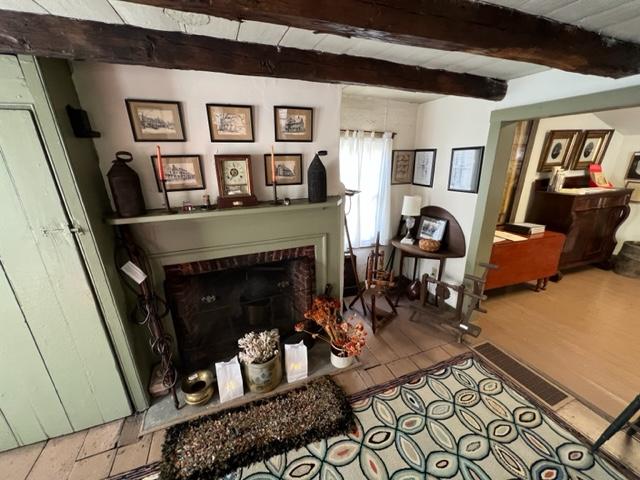
The sitting room recreation

When you enter the house, you will be able to visit all the rooms of the house and the kitchen area on the lower level. The interesting part of this self guided tour is that you learn that the house was not owned by Betsy Ross or any of her three husbands. They rented the rooms out from a widow who owned the house at the time and that there had been other people living at the home at the time. Each of the rooms were rented and lived in by other family members.

In each of the upstairs rooms, there are recreations of what the family living arrangements were and how they were decorated. The bedrooms were furnished with vintage furniture of the time and items used in every day life.

A period bedroom in the house

The house and museum is broken up into different sections. When you walk into the museum complex, you will get to visit a very patriotic gift shop stocked with Revolutionary War memorabilia. Out side the gift shop is the formal gardens and the courtyard which is a nice place to relax and enjoy the weather.

The courtyard of the house

The role of Betsy Ross during the Revolutionary War

The story of the flags creation

George Washington had done personal work with the Ross’s before the war

When she became a flag maker

The historic marker on the house

The courtyard of the home

Historic Marker One

Historic Marker Two

Historic Marker Three

The Parlor area where Betsy Ross would have met her clients

The recreation of the parlor area

What the meeting would have looked like

Another look at the parlor

The story of the creation of the flag

A view of the upstairs bedrooms

The house was a rented space for the Ross family

A better view of the upstairs bedroom

The Betsy Ross bedroom with a recreation of the flag

The bedroom where the flag was created

At the end of the tour we could talk to Betsy Ross herself and ask her questions about her life and her business. The actress who played Betsy asked all our questions in historic terms and to contemporary living. She was able to talk to us on her career and family and her visit from General Washington. She continued working until she was 76 years old.

Meeting Betsy herself while she talked about her life

The Kitchen and Laundry area of the house:

The kitchen area was for family cooking and was stocked with items that would have been in day to day process of preparing meals.

The Kitchen tour

Kitchen and bath equipment

The job of a Laundress

The role of the household

Cooking in the household

Betsy Ross’s life in business

The kitchen equipment

The kitchen area of the house

By the late 19th century, most of the other colonial era buildings that once stood on this block of Arch Street, had been torn down and replaced with large industrial buildings and warehouses. Many people feared that Betsy’s home would meet the same fate.

In 1898, a group of concerned citizens established the American Flag House and Betsy Ross Memorial Association to raise money to purchase the house from the Munds, the people who resided there, to restore it and open it as a public museum in honor of Betsy Ross and the first American Flag.

Charles Weisgerber was one of the founding members of the Memorial Association. In 1892, he painted Birth of Out Nation’s Flag, a 9′ x 12′ painting that depicts Betsy Ross presenting the first American flog to George Washington, Robert Morris and George Ross.

To raise money to purchase the house, members of the American Flag House and Betsy Ross Memorial Association sold lifetime memberships to the organization for 10 cents. Each donor received a membership certification imprinted with an image of Birth of Our Nation’s Flag. Individuals were encouraged to form ‘clubs’ of thirty members. The person who formed the club would receive a ten-color chromolithograph of the Weisgerber painting, suitable for framing, in addition to certificates for each club member.

Weisgerber moved his family into the upstairs floor of the home in 1898 and immediately opened two rooms to the public. The first floor front room was a souvenir shop and the room in the back of the house where the meeting between Betsy Ross and the Flag Committee was said to have occurred, was open for visitors to view.

The courtyard of the home when you leave the house

The grave of Betsy Ross

The historic marker outside the home

The Restoration of the Betsy Ross House:

The American Flag Hose and the Betsy Ross Memorial Association wanted to protect the house from fire and other dangers. They purchased the two properties on the west side of the house in 1929, in hopes of creating a civil garden. When the Great Depression hit, tourism and donations to the house slowed and much of the work on house and courtyard were delayed.

In 1937, structural changes and general wear and tear on the house led to the dire need for restoration work. A. Atwater Kent, a Philadelphia radio mogul, offered to pay up to $25,000 for the restoration of the house. Historical architect, Richardson Brognard Okie was commissioned to do the work.

Under Okie, the house’s original architectural elements were spared wherever possible. When the original components could not be reused, materials were obtained from demolished homes from the same period. A small structure containing a boiler room and a restroom was constructed in back of the original house with Revolutionary War era bricks.

In the historic house, three hidden fireplaces were uncovered, the front stairway and dormer were replaced and the door leading from the kitchen to the back of the house was restored. The most notable change, however, was to the front of the house. The doorway in the front of the building was moved from the western to the eastern corner and a new window was installed. Construction was completed and all eight rooms of the house were open to the public on Flag Day, June 14th, 1937.

By the 1940’s, the Betsy Ross House began to look like the place we recognize today but the Association’s work was not complete. A. Atwater Kent worked with the Association to pay off its final debts on the property. The entire property, including the historic house and courtyard was given to the City of Philadelphia in 1941.

In 1965, an annex building was added to the property and in 1974, the courtyard was renovated and the fountain was added. Two years later, the remains of Betsy Ross and her third husband, John Claypoole were moved from Mount Moriah Cemetery in Yeadon, PA to the garden on the west side of the Betsy Ross House courtyard.

In 1965, a private non-profit organization, Historic Philadelphia Inc. began leasing the property from the City of Philadelphia and continues to manage the site. The Betsy Ross House remains dedicated to its mission of preserving the historic site and interpreting the life of Betsy Ross, a working class, 18th Century tradeswoman. Visitors can view six period rooms, including the only interpretation of an 18th century upholstery shop in the country. The rooms are furnished with period antiques, 18th century reproductions and objects that belonged to Betsy Ross and her family. Highlights of the collection include Betsy Ross’s walnut chest on chest, her Chippendale chair, her eyeglasses and her bible.

(Betsy Ross House Museum website/Wiki/Pamphlet)

The historic district of ‘Old Town’