The graveyard at the church dates back to before the Revolutionary War. The graveyard has veterans from all the wars since the Revolutionary War to the current wars.
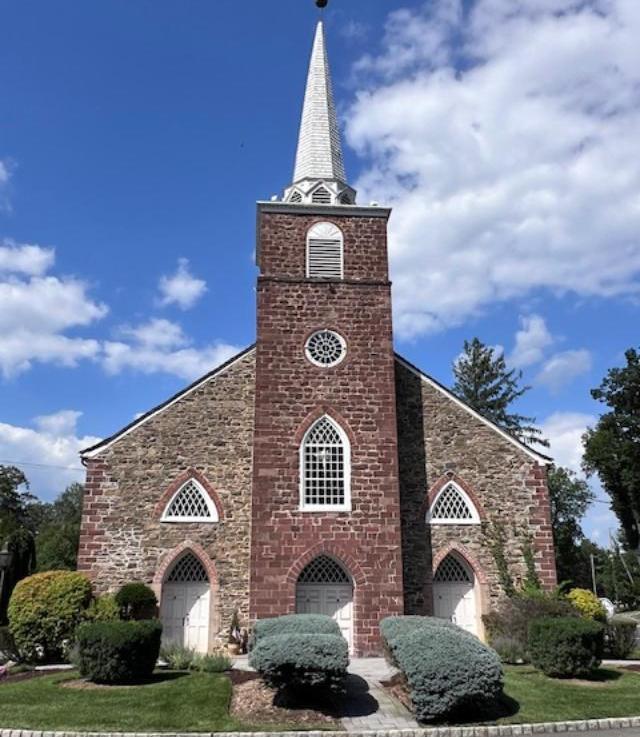
The Wyckoff Reformed Church was built with local fieldstone in 1806. The carpentry inside was done by Daniel Baldwin. The style features vernacular Early Republic, Federal architecture and the windows are done in the Gothic Revival style (Wiki).
The historic graveyard in the back of the church
The back of the graveyard that reaches further back into town
The part of the graveyard from the mid to late 1800’s. There are Civil War veterans buried here.
The back of the church from the 1800’s
The graveyard from the 1800’s
The Revolutionary War era section of the graveyard
The graves of the Revolutionary War veterans
The grave of Revolutionary War veteran Albert N. Van Voorheis
When Albert Voorhees was born on 24 July 1759, in Bergen, New Jersey, British Colonial America, his father, Albert Van Voorhees, was 54 and his mother, Cornelia H. Van Gieson, was 42. He married Rachael Hopper on 26 July 1788, in Acquackanonk Township, Passaic, New Jersey, United States. They were the parents of at least 5 sons and 6 daughters. He died on 17 October 1820, at the age of 61 (FamilySearch.com).
The grave of William P. Winter
The grave of Vanithy Van Voorheis, the wife of Albert Van Voorheis.
The historic part of graveyard right behind the church
The graves of Bridget Ackerman and Martin Myers
The graves of Jack Van Saun and his wife, a descendant of the Van Ripper farm family
The graves of the Van Ripper family
The family plots
The grave of David Stagg
The graves of Peggy Willis and Margaret and Abraham Van Voorheis
The graves of the Mickler family
The graves Abraham and Sara Ann Quackenbush
This historic church and graveyard are really interesting to walk around. It is a glimpse into the past of Bergen County, NJ and the entire State of New Jersey
Open: Sunday 9:00am-12:00pm/Monday-Saturday Be Appointment
My review on TripAdvisor:
The Saddle River Reformed Church at 481 East Saddle River Road in Saddle River, NJ is also known as the “Old Stone Church”
The Saddle River Reformed Church in Saddle River, NJ is one of the nicest church’s in Bergen County for Sunday services. The Pastor is very inspirational in her speaking, the service is well planned out and enjoyable to follow, the congregation is very nice and very welcoming to new people attending church and they have nice refreshments in which they ask you to enjoy after service is over. I found the whole experience very engaging and enjoyable.
Inside the Old Stone Church during Sunday service there is still a sense that you are revisiting the time of the Revolutionary War and the period around it. The pews still have the same details they have had for three hundred years. You are no just going for Sunday service you are experiencing part of history.
The inside of the Old Stone Church
The inside of the Old Stone Church for Sunday Mass
The podium at the Old Stone Church
The Chandelier inside the Old Stone Church
The refreshment table after mass. It is a nice way to gather with other parishioners.
I thought it was very nice of the congregation to invite me to join them for pastries after the service was over. I had a nice time talking to everyone.
The historic marker of the church
I visited the ‘Old Stone Church’ in Saddle River, one of the oldest churches in the state and was taken not just by the beauty of the church but by the respect the church has for the people who are buried here. There is much recognition for the contributions of the soldiers and the armed forces not just for the Revolutionary War soldiers but current ones as well.
The oldest part of the cemetery is the closest to the church
The oldest part of the cemetery contains names like Demarest, Haring, Hopper, DeBraun, Eckerson, Terhune and Zabriskie. These are the first settlers of the area whose families owned farms in Saddle River. Many of the families have family plots in the cemetery.
The Hopper family plot
The Hopper family plot
The Hopper family plot
The Zabriskie family plot
The Gilderston family plot
The DeBaum family plot
The DeBaun family plot
The DeBaun family plot
The Hopper family plot
The Hopper family plot
The oldest part of the cemetery holds so much history of the founding members of the Saddle River and Bergen County community.
The History of the Church:
(from the Saddle River Reformed Church website)
Our church, known to many as the Old Stone Church, was organized in 1784 as a daughter church of the Old Paramus Church. It is a part of the Reformed Church in America, a denomination which traces its roots to the Dutch colonists.
While there is evidence that the original church building was erected in 1789, our present sanctuary was built in 1819. An extensive renovation in 1971 – 1972 recreated the appearance of the original structure.
The Old Stone Church and the historic Revolutionary War Cemetery that is located behind it.
The History of the Cemetery:
(From the Saddle River Reformed Church website):
Our cemetery is the resting place of numerous American Revolution and Civil War Veterans. Church records indicate that the following veterans have been buried at our historic site.
The Saddle River Reformed Church Cemetery is one of the most historic in this part of the country. Our cemetery is over 230 years old and is the burial ground of nine known Veterans of the American Revolution. Tracing back to the founding of this nation, these resting places designate the cemetery as an historic spot of great significance, with a special interest to historians and antiquarians. Surrounded by mature and lush foliage, its peaceful setting by the banks of the Saddle River make for an esteemed and hallowed resting place for your loved ones.
Some of the most fascinating part of the cemetery is its historical section
With the Bergen 250-The 250th Anniversary of the Revolutionary War next year, I wanted to point out the veterans buried here from the war.
David DeBaun was born in Schraalenburg (Bergenfield) in 1759 to Abraham DeBaun and Bridget Ackerman. About 1770 the family moved to Hempstead in New York. David served as a private in the Second Regiment of Hay’s Militia, Captain Garret Ackerson’s Company. He married Hannah Forshay, b. 1868, d. 1836. David died in New Hempstead, NY in 1820. He was tax officer of Hempstead in 1811 and 1812; supervisor of Haverstraw 1811-1814. An enclosed plot in the Upper Saddle River Cemetery is the resting place of his entire family.
John Tallman
(from the church website)
John Tallman was a Sergeant in Hays Regiment of Militia, Orange County, NY Militia, Company of Captain Hogenkamp, William Sickles, and Aurie Smith, and is listed on the Revolutionary War pension records. He was born in Tappan, the son of Jan Tallman and Helena Gerritse Blauvelt. He married Margrietje Forseur (Forshay). He died in New Hempstead, NY in 1839.
David Eckerson
(from the church website)
David Thomas Eckerson, was born in Schraalenburgh (Bergenfield) in 1738. He married Angenetye Vanderbeek and they had a sons Thomas, Paul, Jon, David and Aurie and daughters Hannah, Mary and Angenetye. He is on the Revolutionary War rolls in Rockland County. Revolutionary War veteran Peter van Orden was an executor to his will.
Thomas Eckerson
(from the church website)
Thomas Eckerson, 1745-1818, was married to Cornelia Eckerson. They had children, Thomas Eckerson, Edward T. Eckerson, Maria Eckerson Crouter, and Jacob Eckerson. He is listed as a Private, New Jersey Regiment. He also served in the War of 1812.
Abraham Haring
(from the church website)
Abraham G. Haring was born in 1755 in Tappan, Orange, NY to Garret J. Haring and Cornelia Lent. He married Elizabeth Blauvelt. He died in 1832 in Hempstead, Rockland, NY. He served in the Revolutionary War 1775-1783, Coopers Regiment, NY Militia.
John Terhune
(from the church website)
John A. Terhune, 1753-1805, was the son of Albert A. Terhune and Elizabeth Doremus. He inherited the stone house on the sw corner of Lake Street and West Saddle River Road, known as the Terhune-Hopper house. He married Catherine Lutkins, daughter of Harman Lutkins of Paramus. He is on the SAR list.
Jacob Zabriskie
In the modern day, I wanted to point out a hero to the Bergen Country Firefighting Community and former Saddle River Fire Chief Larry Rauch and his wife, Sherry who both contributed so much to the firefighting community.
Many members of the Revolutionary, Civil, war of 1812 to WWI and II to Desert Storm are buried here. These church treats our veterans with great respect.
The Sautjes Tave Begraven Ground Cemetery is an example of an early Dutch Cemetery of some of the first Colonists in Bergen County with some families arriving in the early 1600’s .
The entrance to the Sautjes Tave Begraven Ground Cemetery in Demarest, NJ
The historic sign at the entrance placed by the David Demarest Chapter of the Daughters of the American Revolution
The inside of the historic cemetery
These early families once owned farms under royal patents of hundreds of acres and these would be passed down from generation to generation. These small family cemeteries were once located on the edge of family land that have since been replaced by modern suburbs. This is now in the middle of a traffic circle surrounded by homes. The cemetery is a wonderful shape and is nicely landscaped.
The cemetery from the south side
Generations of a Bogarts, Blauvelts, Haring, Demarest, Du Bois, Van Scivan and other prominent families all inter married into each family were buried here.
The Bogart-Bauvelt family plot
The Bogart-Blauvelt family plot
The Demarest family plot
The Demarest-Haring family plot
The Ann Marie Demarest grave
The Cornelius Demarest grave site, a Revolutionary War veteran
Patriot Douwe Talema, who was killed by the Tories during the Revolutionary War
The Daniel Van Scivan grave, another Revolutionary War veteran
The Haring Family plot
The Haring family plot
The James Haring grave
The Sophia Haring grave
The Du Bois family plot
The Cemetery view from the southern corner
My video of Touring the Cemetery and its historic roots:
My tour of the cemetery
Leaving the cemetery you can see the landscaping offers these families privacy in both life and death.
After the tour of the cemetery, I explored Downtown Demarest, NJ and discovered a beautiful little town with small local stores and a beautiful set of parks surround the streams and the train station just off the downtown.
The town of Demarest Veteran’s display
The town of Demarest has its own rich beauty and you can see this by visiting its Downtown area and its parks.
The breathtaking Duck Pond Park attracted a lot of painters who set their easels by the banks of the streams.
The Duck Pond is really beautiful
They also have a really nice railroad terminal that is now a senior center
The historic Demarest Railroad Station
This wonderful community has so many wonderful attributes.
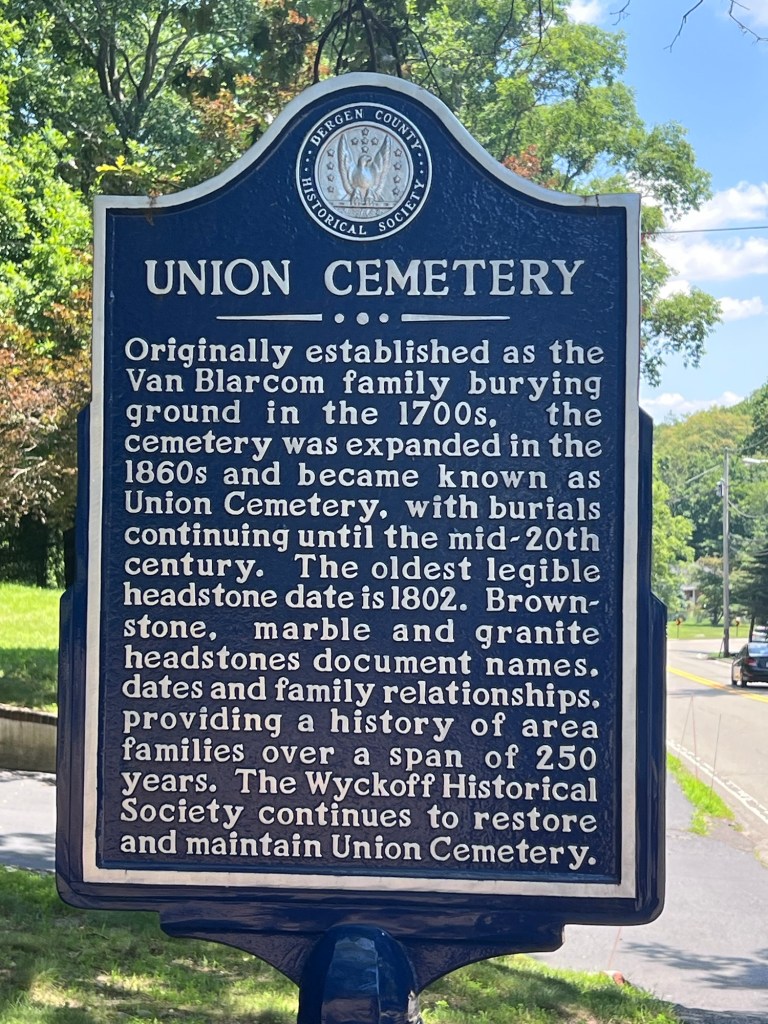
The historical sign for the Union Cemetery at 151 Franklin Avenue in Wyckoff, NJ
The marker sign put up by the Wyckoff Historical Society
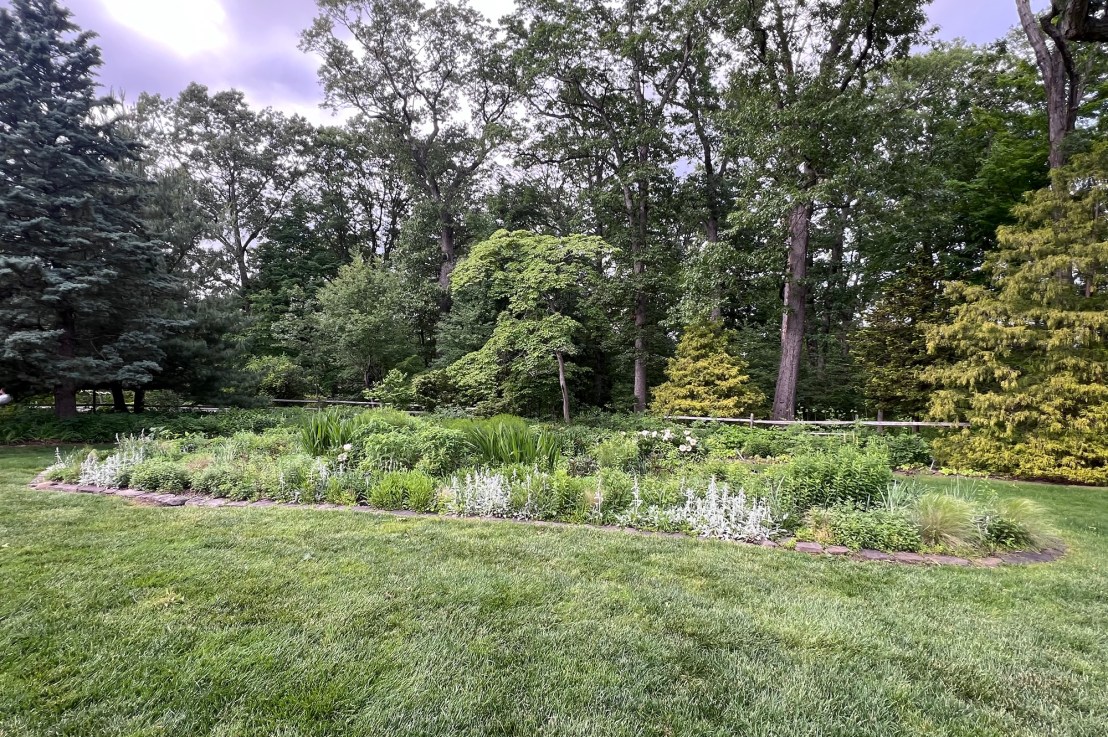
The walled garden just outside the cemetery in bloom
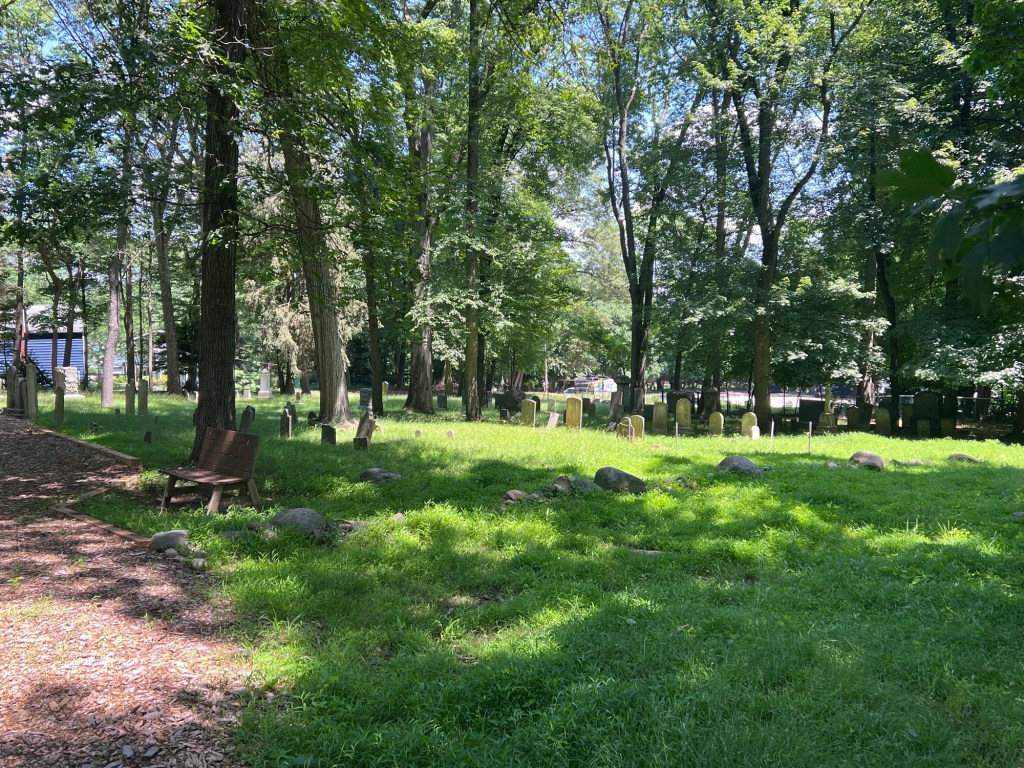
The Union Cemetery was originally the resting place of the Van Blarcom family and the right hand side of the cemetery has the Van Blarcom family plot
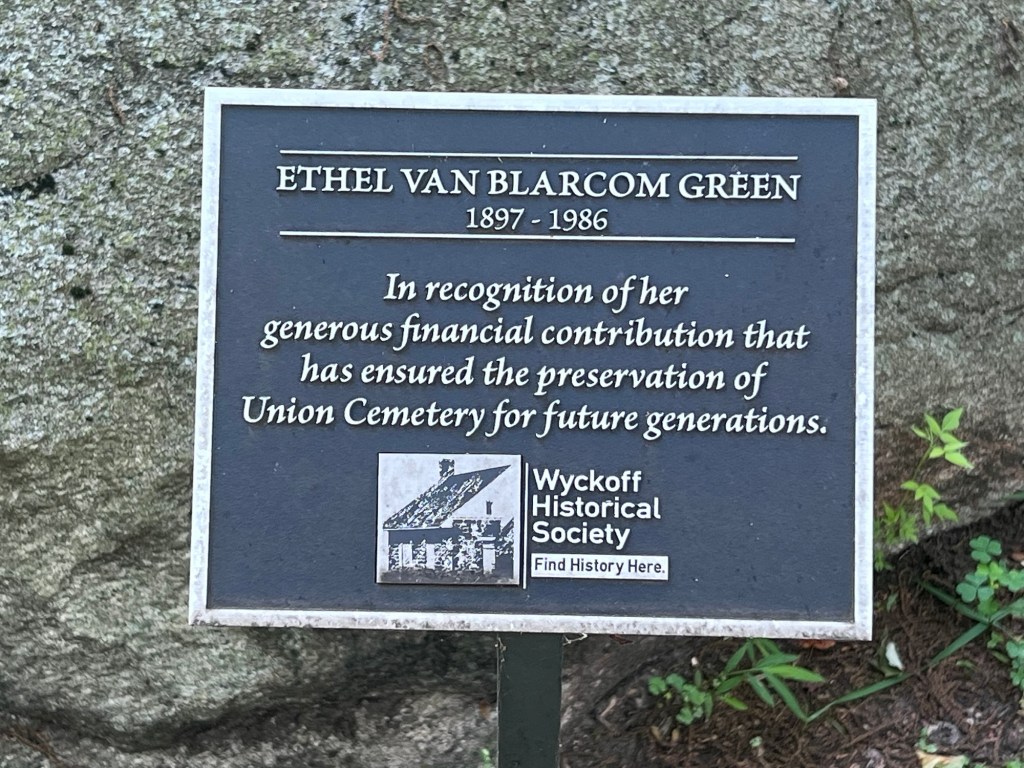
One of the descendants of the family, Ethel Van Blarcom Green donated money for the preservation of this family plot.
The Biography of Ethel Van Blarcom Green:
(From the Wyckoff Historical Site)
If you at all familiar with the Wyckoff Historical Society’s recent activities at Union Cemetery, you may know that the 250 year-old site was the original Van Blarcom burial site. The name can be traced to the early 1700s when the first Van Blarcom family settled in New Jersey. The oldest legible headstone dates to 1764.
What you may not know, is that Ethel Van Blarcom, a direct descendant, bestowed a significant financial contribution to the Society beginning in 1978, with her wish that her beloved family cemetery be maintained. Although she lived in California for most of her adult life, Union Cemetery obviously held a special place in her heart, and she wanted to see it survive. The Society has Ethel’s hand-written letters that confirm her generous donation. She also continued to renew her Society membership until 1984.
However, it wasn’t until 2019 that the current trustees decided it was time to use the funds for its intended use, and honor Ethel’s wishes. Several headstones were repaired, new fencing is being installed, and yearly grounds maintenance is conducted, thanks, in part, to Ethel’s generosity.
It was at this time that Society trustees, Doris Noerr, Melanie Long, and Linda Vreeland, dove into genealogy websites and Society archives to learn more about Ethel’s life and to particularly find a photograph of her.
“After several week of research, we obtained Ethel’s death certificate which led to contacting her niece Naomi who is now 92,” said Society president, Lynn Groel-Lynch. “To our delight, she had a photo of Ethel and her husband, Roy Green that we believe is her 1916 wedding photo.”
Ethel was born in Paterson in 1897 and lived to the age of 89. She and Roy moved to the Los Angeles, California area most likely around the time of her mother’s death in 1933. The couple had no children.
“We are still in the process of contacting a few descendants, and those we’ve spoken to have been happy to share what they know about Ethel,” said Melanie Long. “We also will install a plaque in her memory near where her father, Edward is buried in Union Cemetery. There are thousands of Van Blarcom names as they were the one of the prominent families in our area’s farming community, and after all these years, the Society is thrilled to finally honor the legacy of one very important Van Blarcom, Ethel Van Blarcom Green. As they say, ‘It’s never too late’”.
The current history of the Union Cemetery:
(Wyckoff Historical Society website)
The original Grange sign from the 1960s at the Franklin Avenue entrance of Union Cemetery was weathered and fragile. The Wyckoff Historical Society recently replaced the old sign with one that is also hand-lettered, and includes the Grange logo which was barely visible on the old sign. Two new posts display the new sign.
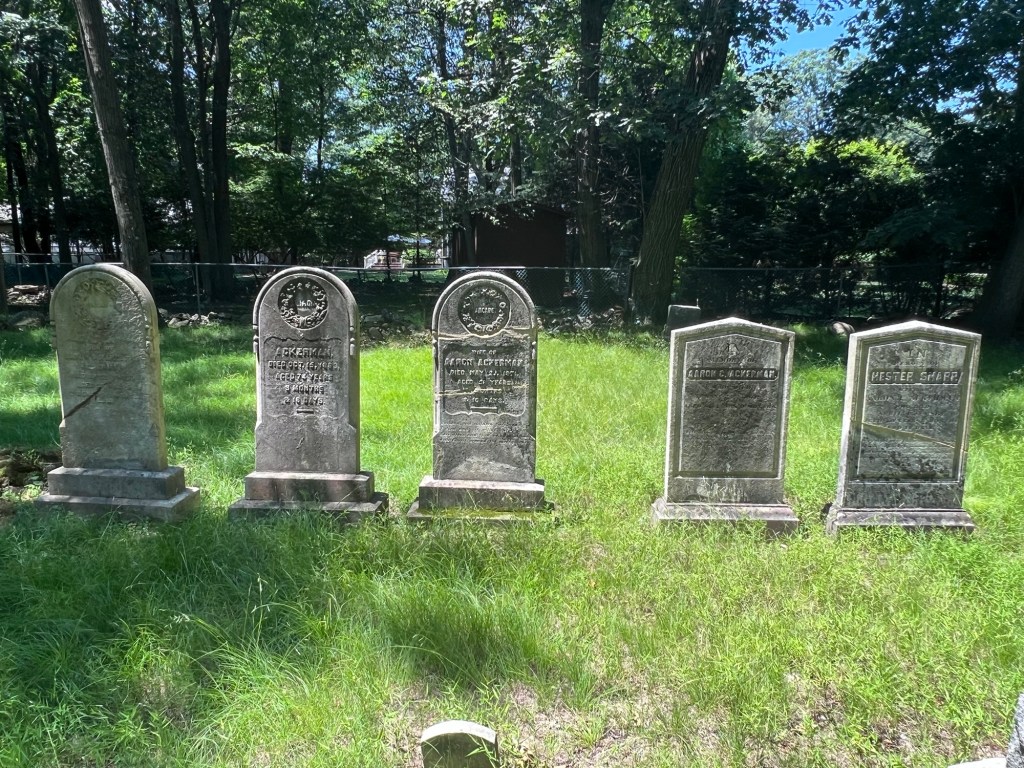
The Ackerman and Terwilliger families are buried to the left/northern side of the cemetery
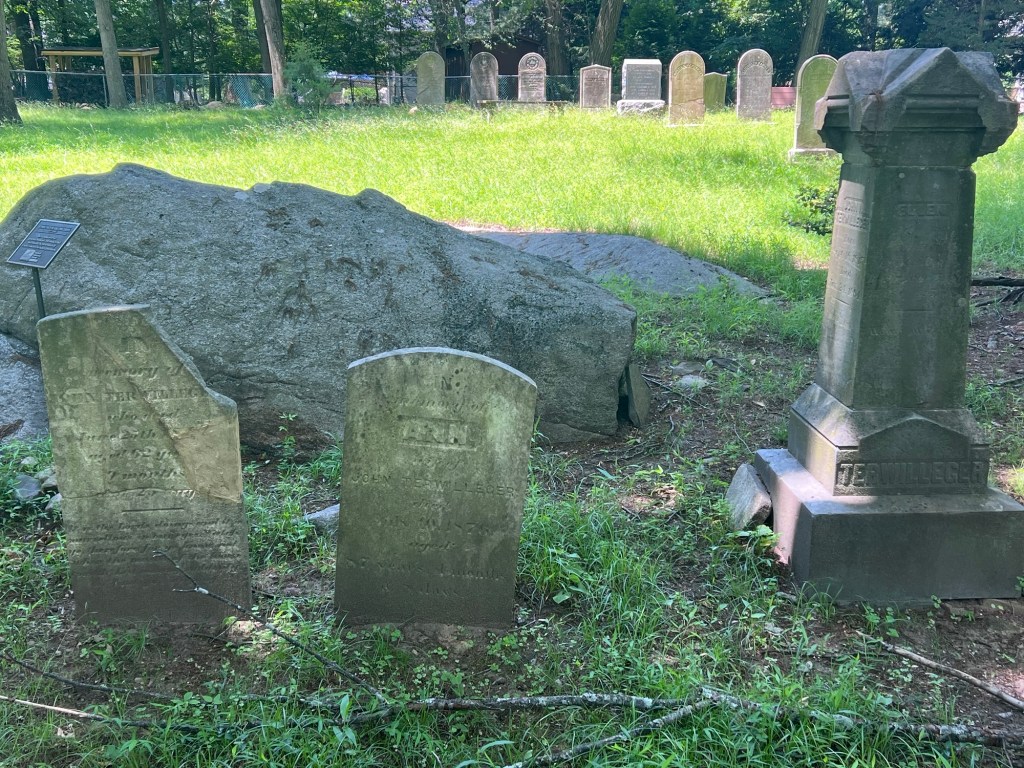
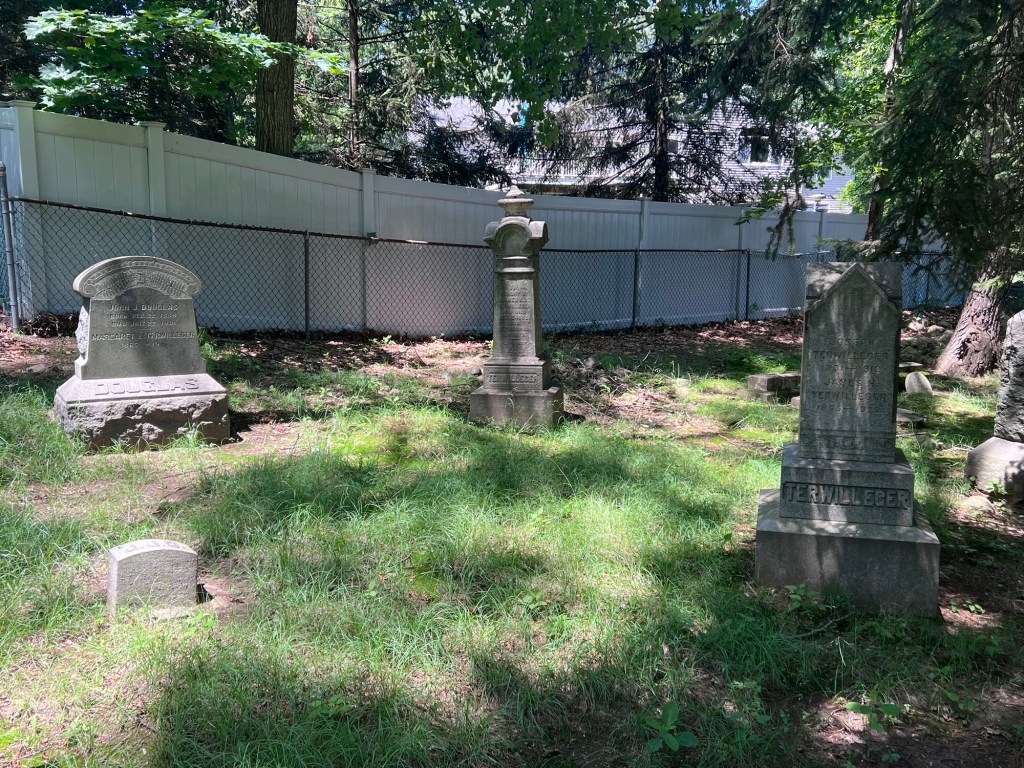
The Terwilliger family plot
The resting place of James Terwilliger’s tombstone
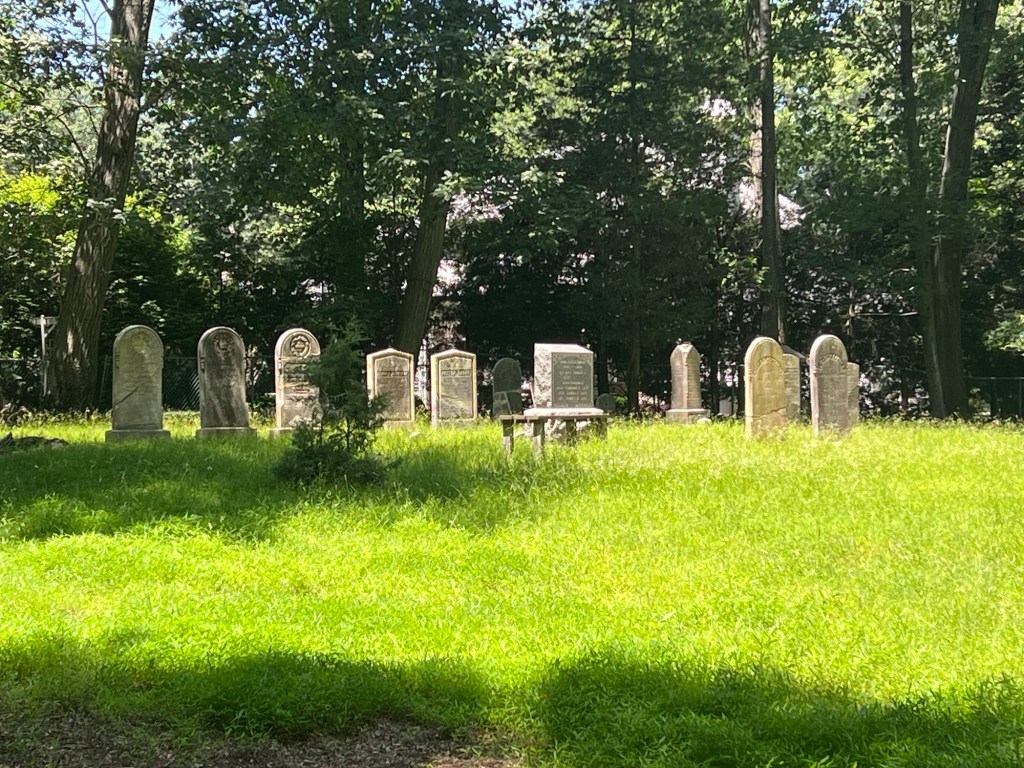
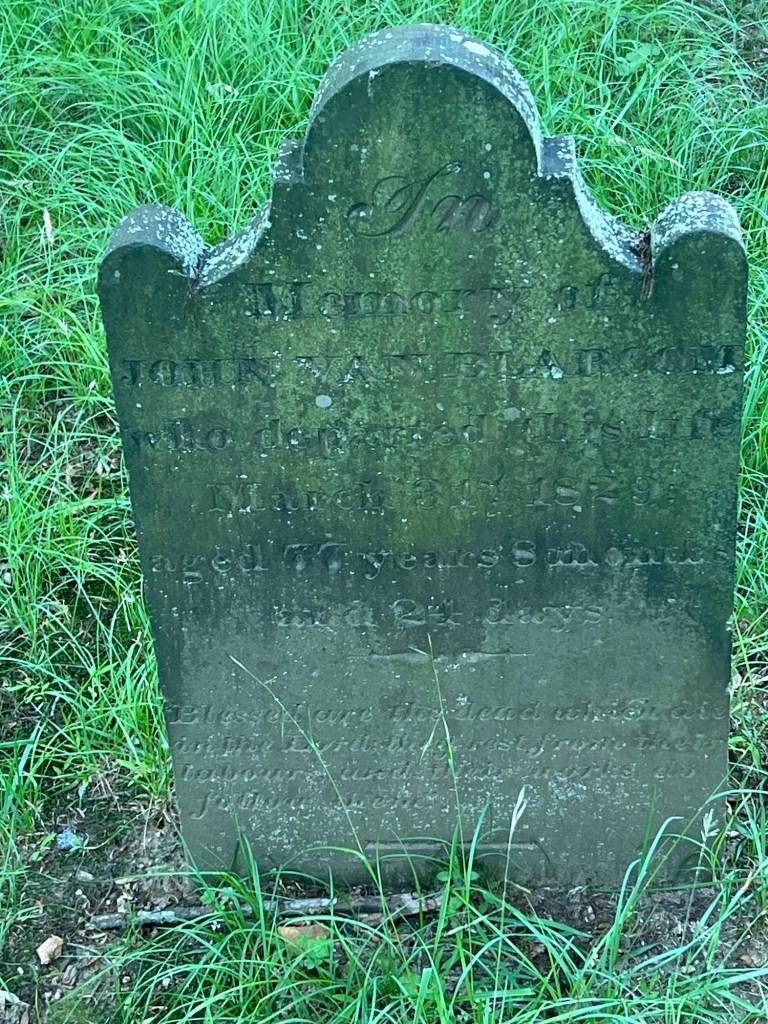
To the right of the pathway around the cemetery to the south is the Van Blarcom family plot where on the oldest graves is that of John Van Blarcom, a veteran of the Revolutionary War.
The resting place of Revolutionary War veteran, John Van Blarcom
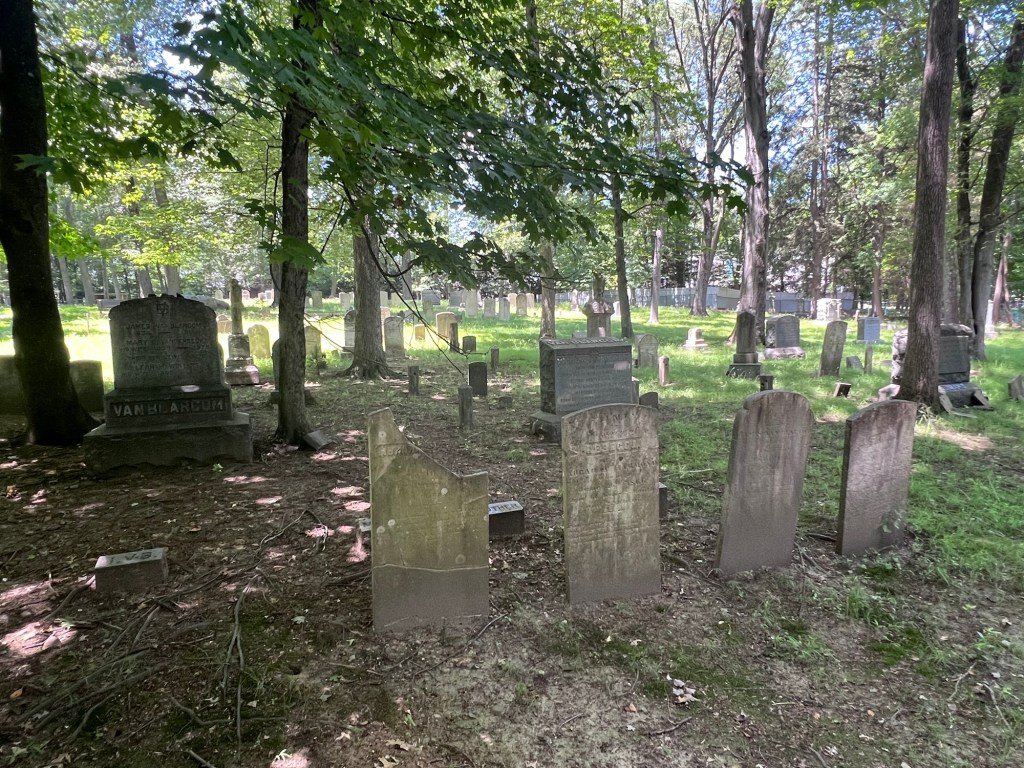
The original section of the Van Blarcom family plot dating back to the Revolutionary War
The later burial section of the Van Blarcom family
The resting place of Daniel and Rebecca Van Blarcom
The Terwilliger family has two sections of the family plot in the northern section of the cemetery
The Ackerman family’s plot is to the middle most northern end of the cemetery
The Mallinson/Westervelt family has the further most family plot of the cemetery
The cemetery is so peaceful and relaxing to walk around. The Wyckoff Historical Society has done a wonderful job maintaining the property. Even though it is the resting place of many family plots, it’s still a very welcoming place and you can feel it as you walk the paths. There is a respect of remembering the people of the past that can be felt here
As you walk the pathways, you visit the people who have contributed to the growth and history of Bergen County and the surrounding area. They shaped their communities from before the Revolution War to today.
My video of visiting the cemetery and the families that rest here.
The History of the Cemetery:
(From the Wyckoff Historical Society website)
The Union Cemetery on Franklin Avenue dates back to the first half of the 1700s, when Johannes Van Blarcom set aside an area of his property to become a burial place. The earliest readable stone is from 1764 and thought to mark the grave of a slave girl because there is no surname given. Johannes Van Blarcom’s daughter, who died in 1725, is alleged to be buried there also. Various community groups have volunteered to maintain the cemetery, including the Wyckoff Historical Society. In 2018, dead trees, underbrush, and poison ivy were removed.
Most are early Van Blarcom family members as the cemetery was one of the original family cemeteries.













 Visiting a Museum: The Unique, Unusual, Obscure and Historical