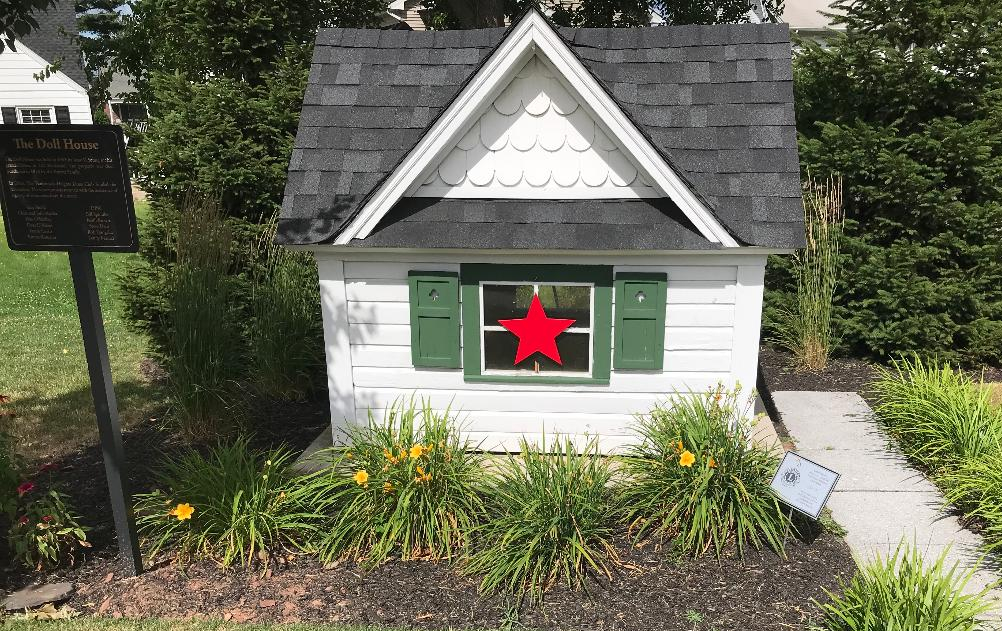
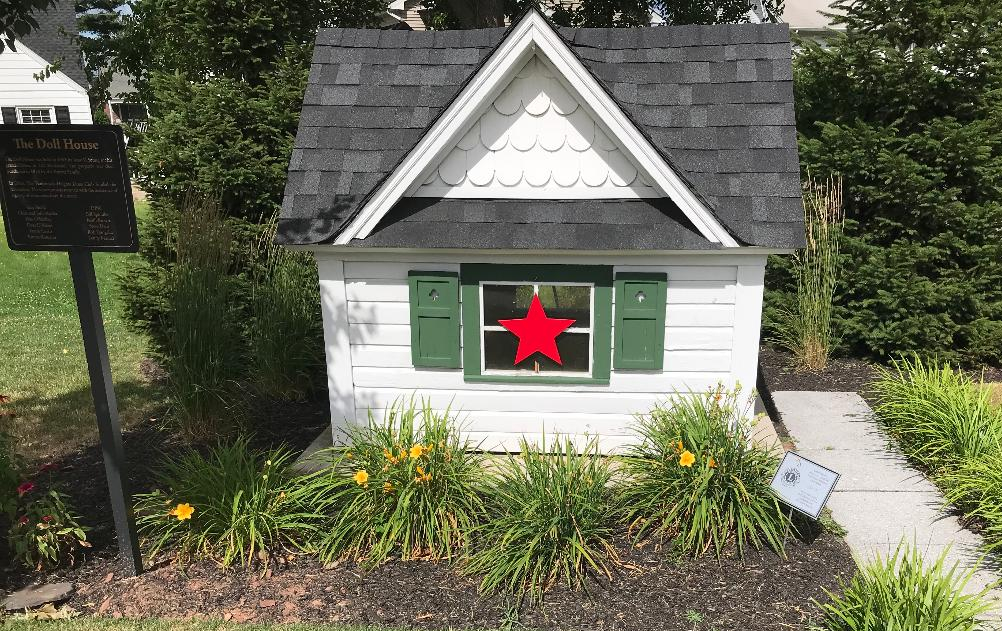
The Doll House at the Boulevard Circle in Hasbrouck Heights, NJ during the 4th of July
The Little Doll House on the Boulevard Circle in Hasbrouck Heights has been a landmark in town almost eighty years. The little house stood in the back of 122 Boulevard since I had moved into town in 1988 and was always painted the same way as the Neil Parrott Reality Company.
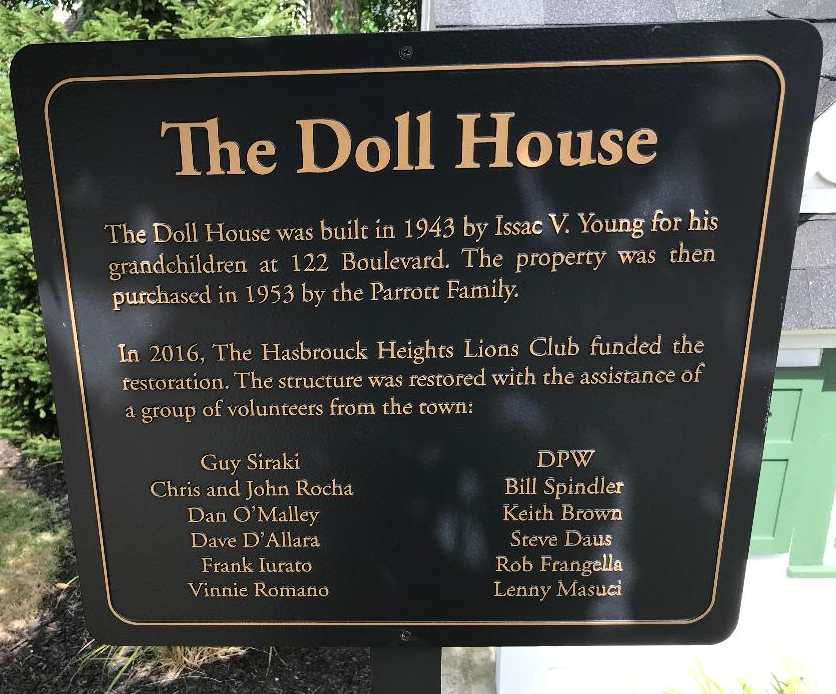
The Doll House was built in 1943 by owner Issac V. Young for his grandchildren and then the house was purchased by Neil Parrott for the family realty business. It was used as a playhouse for client’s children while their parents’ conducted business inside the office.
The Historical sign at the Circle in Hasbrouck Heights, NJ
Neil Parrott Realty closed back in the early 2000’s and the Doll House was overgrown with vines and was in disrepair. When the new owners bought the house, they were approached by members of the community to see what they were going to do with the Doll House. When it looked like they were going to demolish it, a group of citizens wanted to save it and restore it.
The restoration was funded by the Hasbrouck Heights Lions Club and conducted by a group of citizens from Hasbrouck Heights fixed the Doll House and placed it on town land so that the colorful landmark can be shared by everyone driving into Hasbrouck Heights.
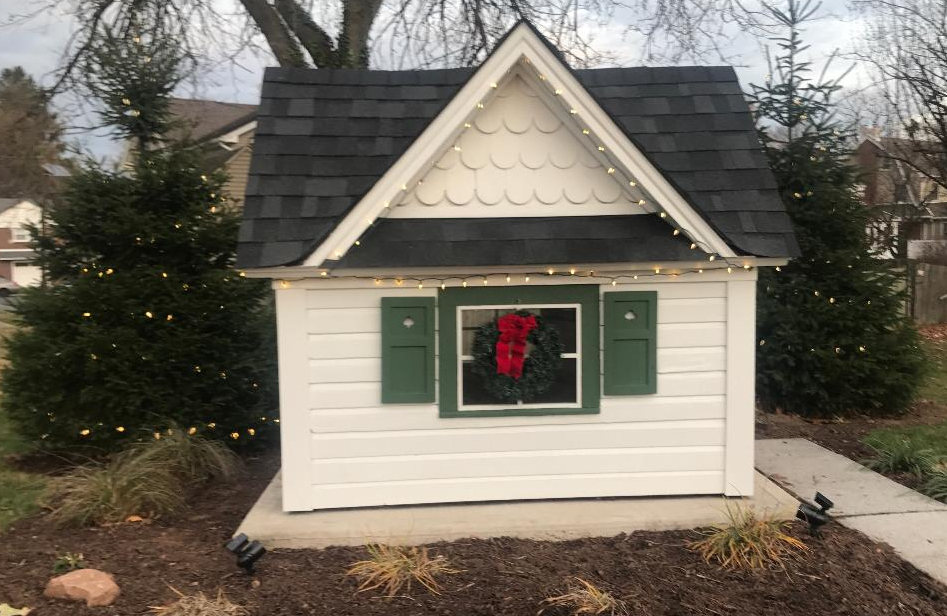
The Dollhouse is decorated each season at the holidays:
Christmas:
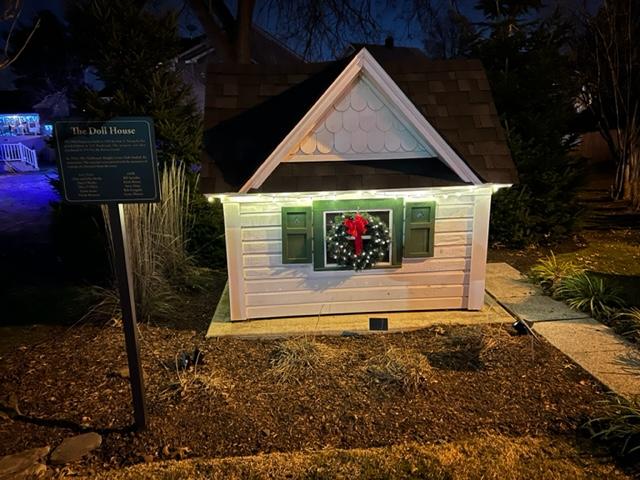
The Doll House in Hasbrouck Heights at Christmas time
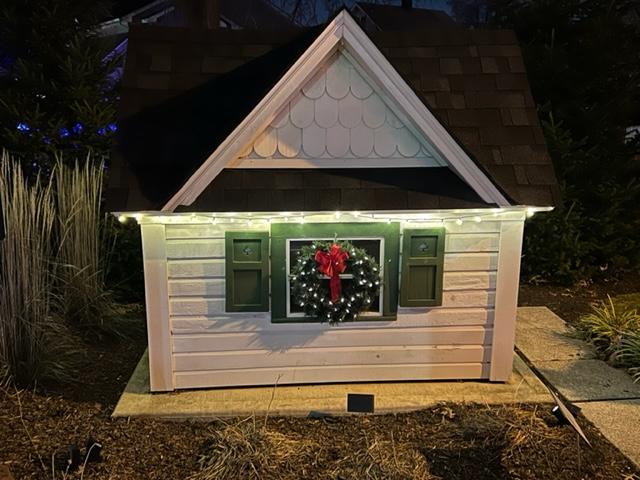
The Dollhouse at Christmas 2022
The Dollhouse decorated for the Christmas Holidays in 2022
Spring:
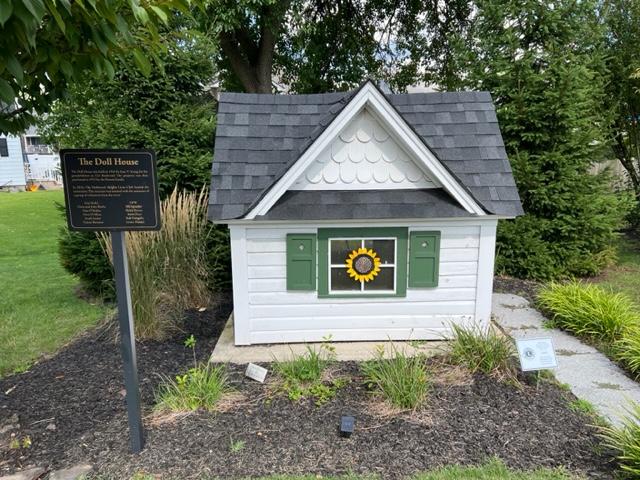
The decorations in the Summer of 2023
Halloween:
The Hasbrouck Heights Dollhouse decorated for the Halloween Holidays
The sign at the Dollhouse welcoming in Halloween
The committee decorates the Doll House for all the holidays. We want to thank all the members of the Hasbrouck Heights community for putting the effort together to take care of this fun and whimsical landmark.
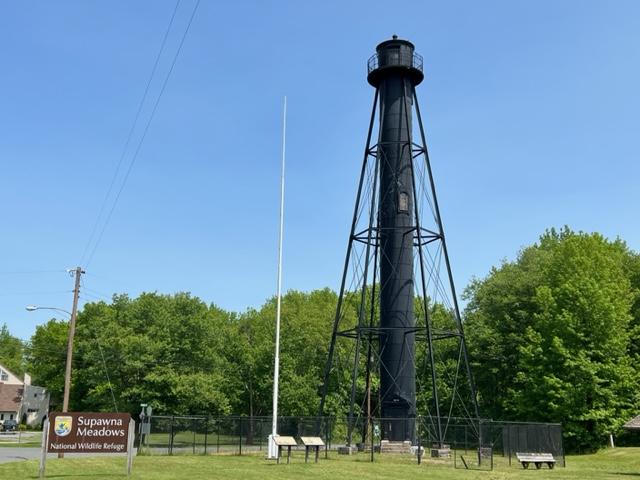
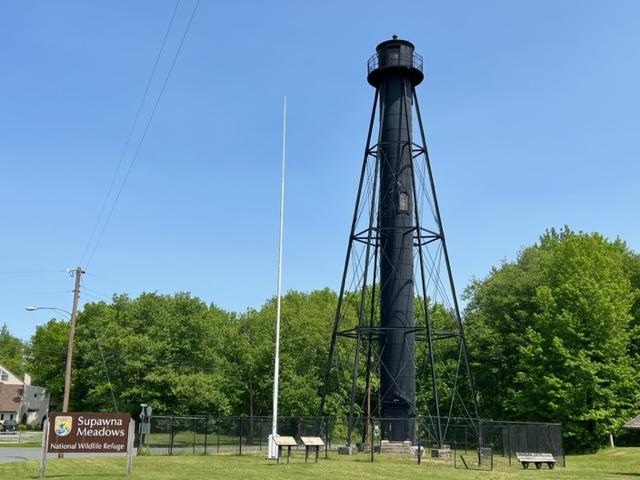
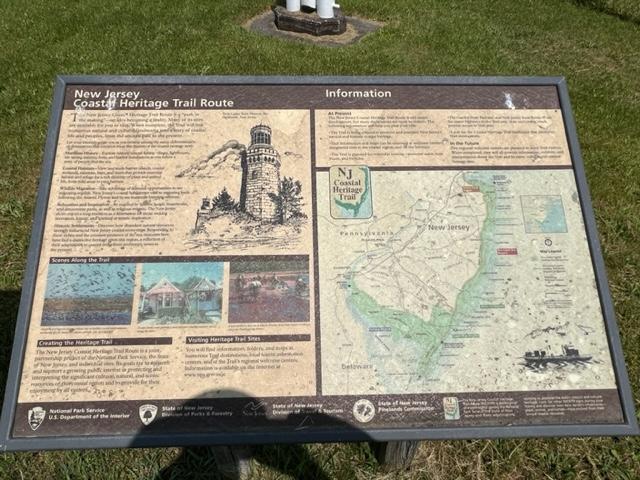
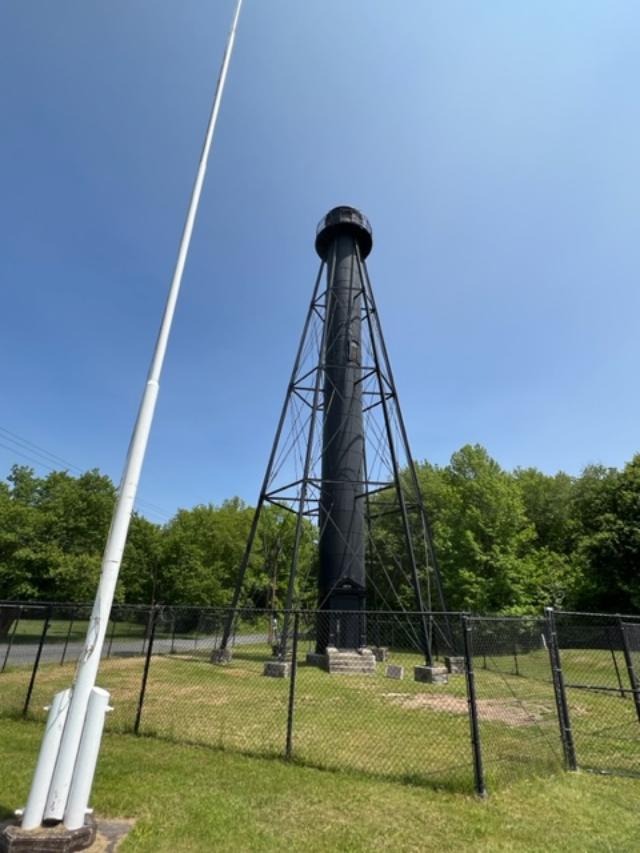
The Finns Point Lighthouse is located in the Fort Mott State Park and the afternoon that I was there which was the third Sunday of the month of June, it was not open. In fact, it looked like it had never opened for the day.
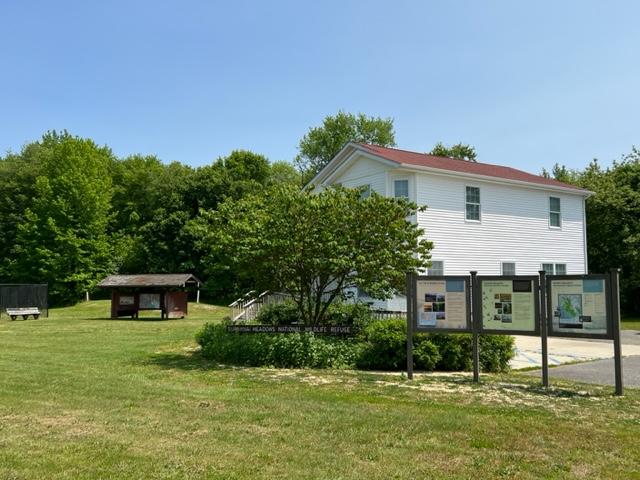
The gift shop/information center had a sign from 2019 with the hours of operation and the steps were not well cared for and the gardens around the building were over-grown. The lighthouse itself is behind a fence that you can look at but not enter and from what I read online is not open even when it should be if it is too hot or too cold because conditions inside can be impossible. The lighthouse and the Visitors Center will reopen for the 2023 season.
The Finns Lighthouse Visitors Center is now open in 2023
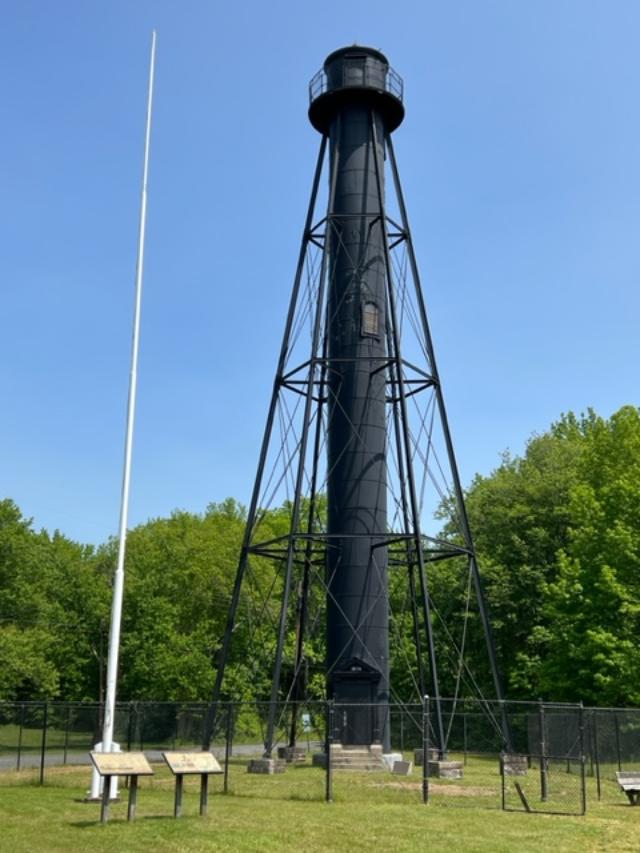
Still, the lighthouse has a majestic look to it and must have some views when it is open. If it is not open, take time to visit Fort Mott and the State Park, which offers spectacular views of Delaware Bay and the surrounding grounds. Take time to explore the fort and the where the guns were mounted. Very interesting.
Fort Mott also has a very good Visitors Center and small museum inside to see the history of the fort, artifacts from the fort and from the war years and all sorts of interesting information on the area.
The Finns Point Lighthouse
The History of the Finns Point Lighthouse”
(From the Friends of the Finns Point Lighthouse website-modified):
(Please read the above Friends Website for the complete history in detail of the ligthouse)
Soon after the 1638 landing of the Finnish colonists near the present site of Wilmington, DE, a small group of settlers crossed over to the east bank of Delaware River, where the land was though to be more fertile and established farms. One group selected land near the sweeping turn in the Delaware River and this area remains known to this day as Finns Point.
By an act of Congress in 1875, $55,000 was set apart for two pairs of range lights to help vessels transition from Delaware Bay into the Delaware River. Port Penn Range, located in Delaware, would guide traffic along the shipping channel from Ship John Shoal to Ready Island, while Finns Point Range would help vessels continue upriver, passing between Reedy Island and Baker Shoal.
Lt. Colonel William F. Reynolds of the U.S. Corps of Engineers oversaw construction of the front and rear range lights at Finns Point. The front light was located near the banks of the Delaware River and was displayed from a frame dwelling of the following description: “one and one half stories high with shingle roof, double weather-boarded on outside and lathed and plastered inside. Its rests on stone walls founded on wooden piles. The first story is divided into three rooms with the hall and stairways to the second floor and cellar and shed over the back door, porch and bay window in the front. The second story is divided similarly to the first, with a step ladder to lantern on the third floor, a gallery supported by brackets surrounds the lantern on front and sides.”
The illuminating apparatus for the front light was a fourth order range lens manufactured by Barbier & Fenestre in Paris, which focused the light from a fourth-order Funk Heap Lamp with one wick. In 1882, a “wooden screen painted white, with open spaces so as to show horizontal stripes” was placed atop the front lighthouse’s red tavern room to make the structure more conspicuous during the day. The daymark was removed in 1897.
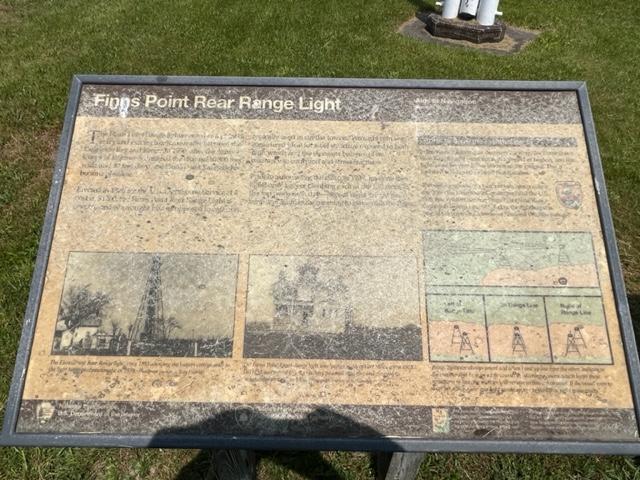
The lighthouse sign
Three acres of land, roughly one and a half miles inland from the front light, were purchased from Joshua and Mary Dickinson on April 20th, 1876, as the site for the rear range light. To provide a focal plane higher than that of the front light, the project plans called for a tall, wrought iron tower to be used for displaying the rear light. The Kellogg Bridge Company of Buffalo, NY was contracted to manufacture the components of the wrought tower, which were then transported to Salem, NJ by railcar. From Salem, teams of mules pulled large wagons loaded with pieces of the iron tower to the construction site.
A frame keeper’s dwelling was built just west of the tower, along with a wood-framed privy and an oil house. The first keeper of Finns Point Rear Range Light was Edward Dickerson, who started serving on December 8th, 1876, even though the light was not lit until April 2nd, 1877.
The lighthouse sign
Fast forward to the 1970’s when the old dwelling was razed because it was unsafe, but locals showed an interesting in the lighthouse and having it moved. Resident Betty Husarik formed the “Save the Lighthouse Committee”. They faulted in moving the lighthouse but placed it on the National Register of Historic Sites in 1978.
In 1981, the committee set out to Washington DC to meet with their local congressman and the drive resulted in a contract for $33,600 being signed between the US Fish and Wildlife Service, on whose land the tower now stood and K & K Painting Company of Baltimore to have the tower repairs, sandblasted and painted. An open house was held at the tower on October 14th, 1984 to honor the determined effort shown by the “Save the Lighthouse Committee” and others in restoring the tower.
Today it is opened for limited tours and special events.
I visited the Somers Mansion, the three story former home to five generations of the Somers Family. The mansion sits on a buff overlooking the bay and the bridge to the barrier island where Ocean City is located. The original part of the house was built in 1725 and in 1920 the last family members moved from the home and deeded it to the town. The modern additions of the home have been stripped off so you see the original house.
The historic marker of the home when it was donated by the family
I have to say that I was very disappointed with the condition of both the house and of the rooms and displays inside the house. There was not much to see. The lower level of the home has the main room with the hearth known in most early homes as the “Keeping” or “Everything” room where all the cooking, household chores and socializing was done because of the warmth of the fire.
Here and there were pieces of furniture but nothing labeled or decorated to make the room look ‘period’. Just old furniture here and there to fill the space. Some of the original family china was in the cupboards built into the walls.
The upstairs which must be reached by a rope bannister lead up a narrow stairs to two upstairs bedrooms. The home is not handicapped safe. The front bedroom had a fireplace with a small side room that held spinning wheels and some children’s furniture. There was not much to see in the upstairs.
The tour guide did not offer much in the way of information on the house and the only period pieces of the Somers family that were left inside the house were a chest, a clock, some of the china that was in the side cabinents and a bedwarmer.
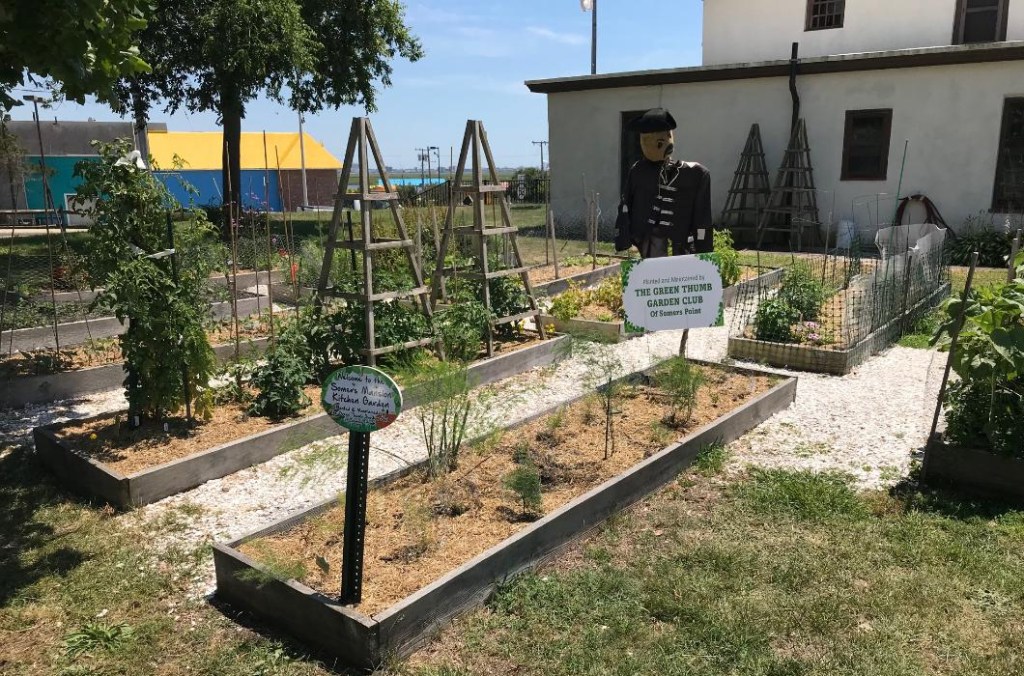
Outside the house the Somers Point Garden Club planted a period garden of fruits and vegetables on the back lawn and lead tours of the gardens.
The Somers Mansion Kitchen Garden
The Garden Club planted fruits and vegetables that would have been grown in the time periods of the late 1700’s to early 1800’s. You can walk amongst the beds to see the plantings.
Somers Mansion Kitchen Garden planted by the Garden Club
The whole tour takes less than a half hour and it is more impressive from the outside. You are also not allowed to take pictures of the house for security reasons.
The back of the mansion
The History of the Somers Mansion:
(From the NJ State Historical Site.com):
The mansion and surrounding city bear the name of the family who owned and occupied the house for 200 years.
The Somers Mansion, a three story home constructed of brick in the Flemish bond pattern, sits overlooking the Great Egg Harbor Bay at Somers Point. In the late 1600’s, the property which surrounds the mansion was acquired by John Somers, who operated a ferry service across The Great Egg Harbor Bay to Cape May. He referred to it as Somers Plantation and Somers Ferry and the surrounding settlement, the olders in what became Altantic County and then Somers Point in the mid-18th Century.
The mansion is considered to be the oldest existing house in Atlantic County, predating the County itself. His son, Richard, the first of the family to be born in New Jersey, built what is now referred to as the mansion by 1726. That year the local Society of Friends (Quakers) used the home for a meeting and memorialized it in their minutes, making the earliest recorded date of the home’s existence.
By the end of the 19th century, the mansion’s architecture had been added to and changed to reflect a Victorian style. The house remained in the Somers Family until 1937 when it was deeded by Florence Hayday Brooks and Lulu Hayday Smith, daughters of Hannah Hayday Somers to the Atlantic County Historical Society for the purpose of creating a permanent memorial to the Somers family.
In 1941, it was transferred to the State of New Jersey, dedicated on September 26th, 1942 and in the early 1940’s was restored to its colonial appearance as a Works Progress Administration (WPA) project. Laborers for the WPA both renovated the surviving furnishings and conducted a historical restoration, including the elimination of rooms and architectural details dating to the 19th century. The site was added to the National Register of Historic Places in 1970 and is now a State Historic site.
The Somers Family burial ground further down off Shore Avenue off New York Avenue
Somers Point was originally settled by John Somers, an Englishman and practicing Quaker, who bought the land from Thomas Budd. Early names for the area were Somerset Plantation, Somers Ferry and Somers Plantation named after the first settlers in 1693. The land purchased originally covered all of Somers Point, part of Linwood and went into Egg Harbor Township. In the early years, it was part of Gloucester County, because Atlantic COunt had not yet been named.
The name “Somers Point” was adopted in 1750. It was a seafaring town and sloops, schooners and barges were built in the many shipyards located along the Greate Egg Harbor Bay, Greate Egg Harbor River and Patcong Creek.
The estate overlooking the bay
The back of the mansion and gardens
The Sooy Boatworks was located on Shore Road and the completed ships were rolled on logs down Shore Road to Delaware Avenue and then down to the bay. Shipbuilding and life along the waterways was a very important part of life in early Somers Point.
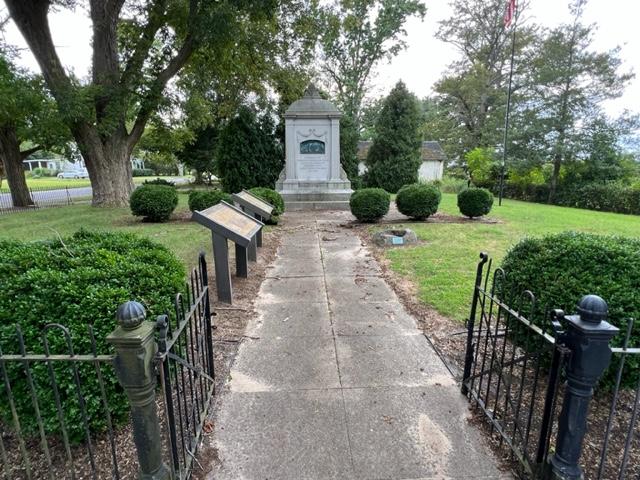
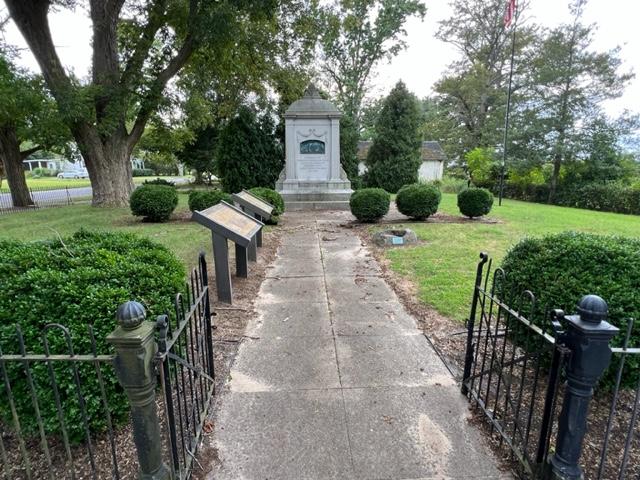
The Greenwich Tea Burning Monument in Greenwich, NJ
I am a firm believer in that you learn something new everyday and on a recent trip to visit historical sites of Southern New Jersey I came across this one in a guide book. I never even knew this monument existed let alone that we had our own version of the Boston Tea Party right here in New Jersey. It really showed me the significance of the Revolutionary War and how people from the past fought for the freedoms that we have today.
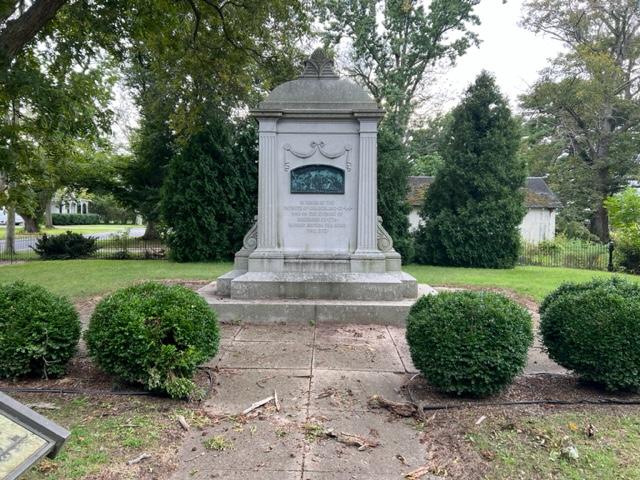
The monument in its glory.
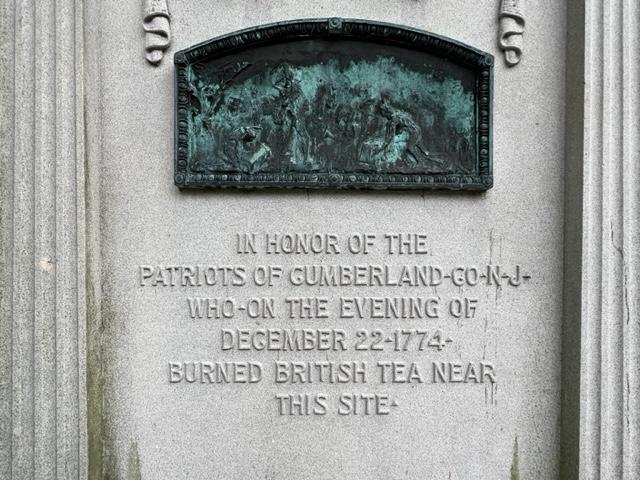
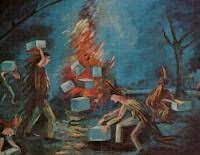
On the night of December 22nd, 1774 forty people from the community took possession of tea chests and piling them together burnt them in protest of the Tea Tax that had been imposed on the residents of New Jersey. This act of defiance was a reaction to the actions of the British Rule.
The monument honorarium.
This beautiful and graceful monument lies now at the end of a sleepy country road in Greenwich, NJ which is still surrounded by farmland. It is hard to miss the monument in its location in the middle of a small park surrounded by a small fence. The monument was dedicated in 1908 and then again in 2008 there was a second ceremony to honor the 100th anniversary of the monument (Wiki).
The moument sits down the road from the Museum of Prehistoric History and from the Gibbon House so there are many things to see in Greenwich, NJ on this quiet country road.
The History of the Greenwich Tea Burning in 1774:
(From the Cumberland County, NJ website):
Liberty was not cradled in Philadelphia alone. The spirit was also alive in the inhabitants of Cumberland County when they destroyed a cargo of tea in 1774.
On the evening of Thursday, December 22nd, 1774, a company of about forty young Whigs, disguised as Indians, entered the cellar of Bowen’s house. They took possession of the whole cargo, conveyed the tea chests from the cellar into an adjoining field and piling them together, burnt them in one general conflagration. Forty miles from Philadelphia, was (and still is) the little town of Greenwich, the principal settlement of Cumberland County in 1774.
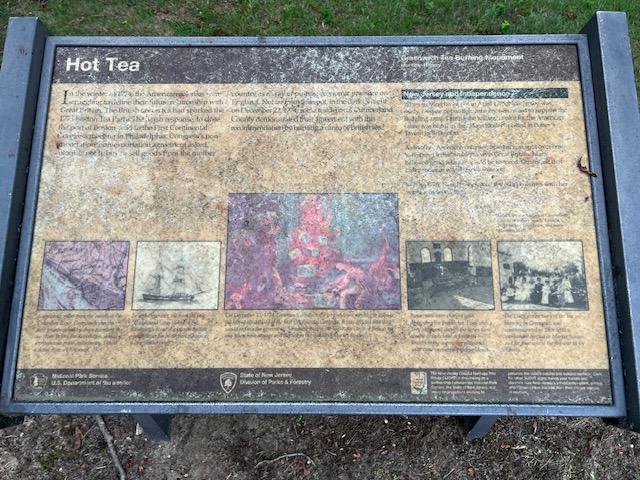
The Greenwich Tea Burning of 1774 (NJ Historical Society)
It was founded in 1675 by John Fenwick and is older than Philadelphia, which was not founded until 1682. The hand of time has hardly touched Greenwich. It is much the same today as it was three hundred years ago, when the British flag flew high over it. Today you will still find a wide street, which they still call “Ye Greate Street.” It was laid out in 1684 and its course has never been changed.
The storyboard on the event.
The Cohansey Creek is a navigable stream of some size running through the county of Cumberland and emptying into the Delaware Bay. In the autumn of 1774, the quiet inhabitants along the banks of the creek were startled by the appearance of a British brig called called the “Greyhound.” Sailing about four miles up the Cohansey, the brig stopped at the village of Greenwich, which was the first landing from its mouth.
She was laden with a cargo of tea sent out by the East India Tea Company, which was undoubtedly under the impression that the conservative feelings and principals of the people of New Jersey would induce them to submit quietly to a small tax. The result showed that the temper of the people was little understood by the East India Tea Company (Similar to the Toilet Paper Tax of the Governor Florio in the 1990’s).
The storyboard on the event.
Having found an English sympathizer, a Tory, as they were called, one Daniel Bowen, the Greyhound’s crew secretly stored the cargo of tea in the cellar of his house. However, this unusual procedure was noted by the citizens who immediately appointed a temporary committee of five to look after the matter until a county committee might be appointed.
A general committee of thirty-five was later appointed with representatives from Greenwich, Deerfield, Jericho, Shiloh, Bridgeton, Fairfield and perhaps other places.
Greenwich Tea Burning Monument News of the Boston Tea Party had already reached Greenwich and the defiant example was regarded by many of the local settlers as worthy of their own contempt for the British. Fate now presented them with a ready-made opportunity to duplicate the act.
On the evening of Thursday, December 22nd, 1774, a company of about forty young Whigs, disguised as Indians, entered the cellar of Bowen’s house. They took possession of the whole cargo, conveyed the tea chests from the cellar into an adjoining field and piling them together, burnt them in one general conflagration.
Thus, the patriots of Cumberland County living in Greenwich expressed their discontent by reacting to oppressive governmental measures. They had clearly taken a stand for independence and democracy.
Greenwich has been granted the distinction of being one of the five tea-party towns in America, the others being Charlestown, Annapolis, Princeton and Boston. In 1908, the monument seen above was erected in the old market place on Ye Greate Street to commorate the burning of a cargo of British tea on December 22nd, 1774.