Category: Parks and Historical Sites

Van Cortlandt House Museum in Van Cortlandt Park at Broadway & West 246 Street                                              Bronx, NY 10471

Van Cortlandt House Museum in Van Cortlandt Park at Broadway & West 246 Street Bronx, NY 10471

Van Cortlandt House Museum

Van Cortlandt Park at Broadway & West 246 Street

Bronx, NY  10471

(718) 543-3344

infor@vchm.org

Open: Tuesday-Friday 10:00am-4:00pm/Saturday & Sunday 11:00am-4:00pm

Admission: $5.00 for Adults/$3.00 for Seniors & Students/Children under 12 are free/General Admission is free on Wednesdays. Guided and group tours are available.

Review on TripAdvisor:

https://www.tripadvisor.com/Attraction_Review-g47369-d103501-Reviews-Van_Cortlandt_House-Bronx_New_York.html?m=19905

The Van Cortlandt House:

Welcome:

Van Cortlandt House during Christmas time

The entrance of the Van Cortlandt House decorated for the Revolutionary era Christmas

I visited the Van Cortlandt House Museum for the their Annual Christmas Decorated House event. The mansion was decorated for Christmas in the 1700’s so it was not overdone as it would during the Victorian times. The front of the house entrance was done with sprays of holly, mistletoe above the door and garlands of pine around the banister and fireplaces. The windows had candles in them and the dining room was set for Christmas luncheon in post-Revolutionary War era.

Van Cortlandt House VI.jpg

Van Cortlandt House for Christmas is Post-Revolutionary War in 2019

The entrance hall welcomes you to a Revolutionary era holiday season

While most of the house is represented during the Dutch era with floors with no rugs, vintage furniture and decorations and the second and third floors are set for family entertainment. The first floor is set for entertaining for the holidays with the formal dining room, family parlor and the formal living room for games and dancing. The formal dining room was the only room decorated post-Revolutionary War era.
van cortlandt mansion xmas ii

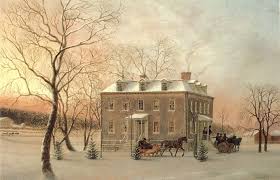
Van Cortlandt Mansion at Christmas 1800’s

The current entrance to the house from the back of the building

Until the Victorian era, Christmas was a more religious affair with church service in the morning and luncheon in the afternoon. Things were formal and less elaborate. The acts of gift giving, sleigh rides, tree decorating and card giving came during the affluence of Queen Victoria’s reign in the post Civil-War era. This is the reason why the house is decorated so simply and elegantly.

Dining Room set for Christmas lunch circa 1780’s

In 2019, the site celebrated the holidays with a Sinterklaas, a Dutch Christmas celebration, a candlelight tour and a reading from Santa Claus. Please check their website for more information on future events. The house was closed for most of the COVID years and nothing had been planned. The house was open in December of 2022 for touring again for the holidays but was not decorated as much as in the past.

In 2022, when the house reopened after a long period of COVID, the self-guided tours were back and you could tour the house at your own pace ($5.00 donation) and tour the three floors of furnished rooms. You can see how the family lived from the three generations that lived in the residence.

The tour starts at the front hallway where guests would be received for formal affairs and for business meetings with the head of the household.

You would be greeted by servants at the entrance of the home

On either side of the front hallway is the East and West Parlors where you would be directed where the family would receive you. The West Parlor would have been used for business calls and more informal meetings when meeting with the Van Cortlandt family. The family’s wealth would be on display with fine furniture, china and bric-a-brac that would show off the family’s merchant roots and business.

The West Parlor
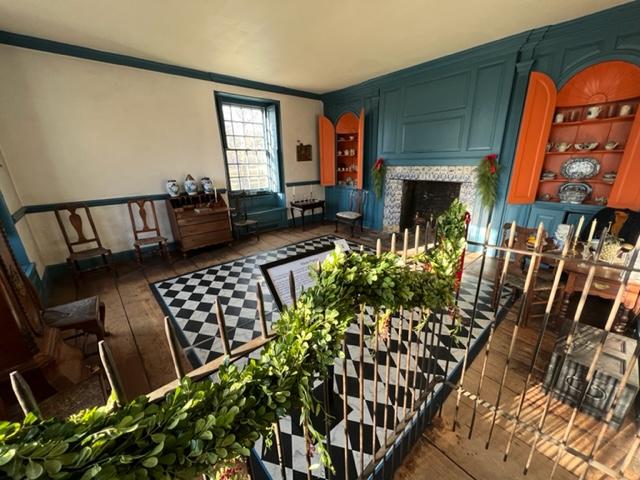
The West Parlor decorated for Christmas

The East Parlor on the other side of the entranceway would have been used for more formal affairs. The East Parlor is where the family would formally entertain guests with dancing, music and card playing. This is where long evenings of entertaining would take place and the family would enjoy their holiday celebrations.

The East Parlor
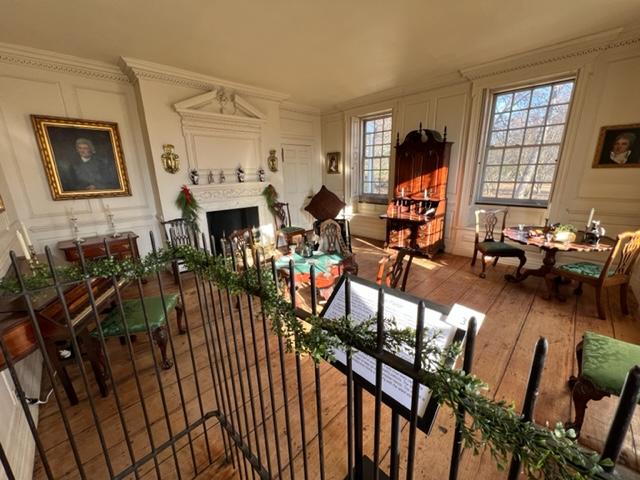
The East Parlor decorated for the Christmas holidays

The Dining Room was toward the back of the hallway and was decorated in the Empire Design of the late 1700’s to early 1800’s. The look is very similar to styles used today and the wallpaper is a copy from one of the styles used by the family that was imported in from France. The table was set for Christmas luncheon circa the late 1780’s.

The Dining Room

The Dining Room at the Van Cortlandt House

There are two sets of stairs to the second level of the house where the family bedrooms were located. There was the formal stairs and then there was the stairs that the servants used to go from floor to floor so that they would not be seen.
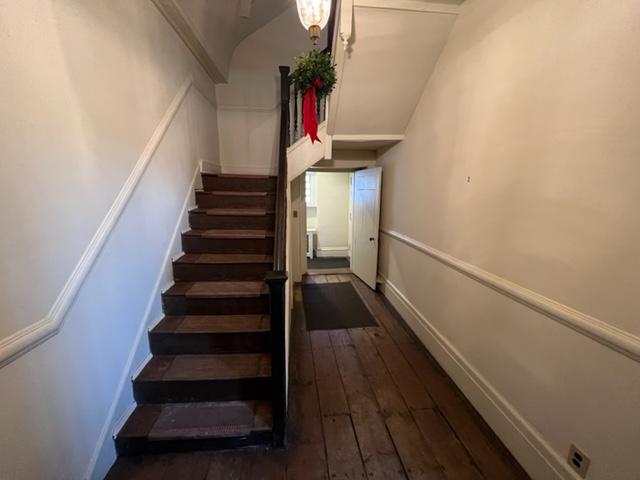
The steps upstairs to the second floor

On the second floor of the home are the bed chambers of the family. The main bedrooms for the family were located here and then the nursery and servants quarters were located on the Third floor of the home.

The West Chamber:
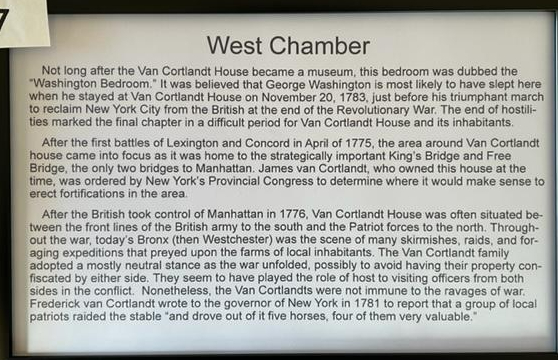
The bedroom

The ‘Washington Bedroom’ in the Van Cortlandt House

The East Chamber Bedroom:

The Bedroom:

The Landing of the stairs to the third floor lead to the Nursery, an additional guest room and the enslaved servants quarters. These were kept out of site from the other members of the household. It is a reminder of the pecking order of the household and the conditions that people lived under at this time.
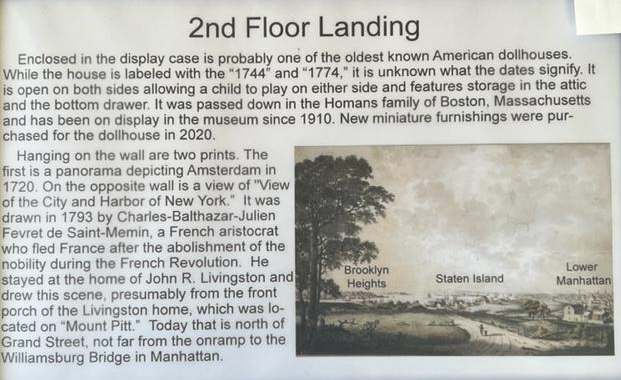
The Second Floor Landing leads to the nursery and servants quarters

The Dutch Chamber was formerly a guest room that is used to show life in early Colonial New York City:

The Dutch Chamber:

The Dutch Chamber shows early life in Colonial America

The Second Floor Setup:

The Nursery:
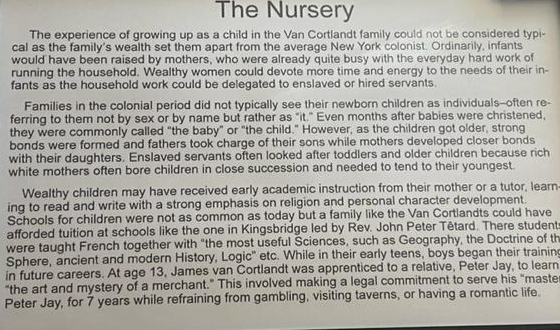
The nursery set up room:

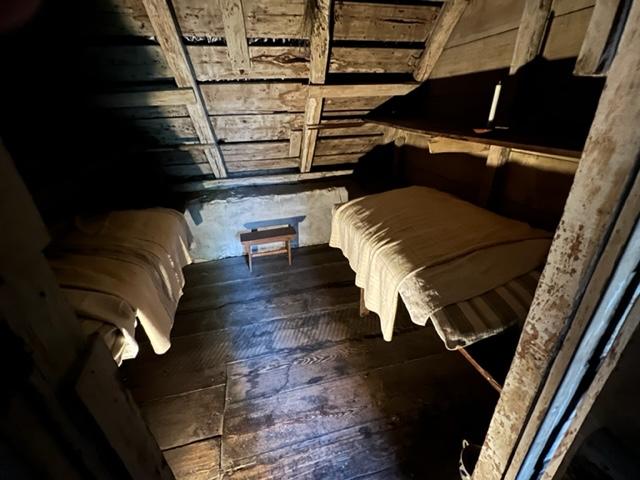
The servants quarters were to the back of the house and were not the most glamorous place to live in the house. There were drafty and not insulated. The amount of time a servant would be here would have been minimal.
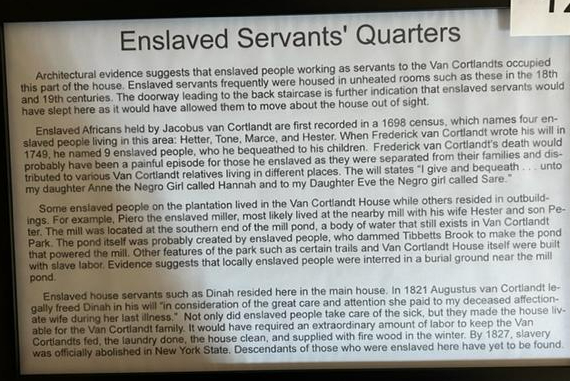
The servants quarters:

The servants quarters:
History of the Van Cortlandt’s:

The Van Cortlandt House Museum, also known as Fredrick Van Cortlandt House or Van Cortlandt House, is the oldest surviving building in New York City’s borough of The Bronx. The Georgian style house, begun in 1748, was build of fieldstone by Fredrick Van Cortlandt (1699-1749) on the plantation that had been owned and farmed by his family since 1691. Fredrick intended the house to be a home for him and his wife, Francis Jay and daughters, Anna Maria, 14 and Eve, 13. His sons, Augustus, 21 and Fredrick, 19, were not intended to be permanent residents of the house.

Sadly, Fredrick died before the new house was completed. In his will written in 1759, Fredrick left the house to his son, James Van Cortlandt (1726-1781) and a lifetime tenancy to his widow, Francis Jay Van Cortlandt (1701-1780).

Van Cortlandt House IV.jpg

The Van Cortlandt House gardens in the Summer

The Van Cortlandt’s were a mercantile family prominent in New York affairs. Fredrick’s father, Jacobus, established a thriving wheat growing and processing business on the plantation including a grist mill for processing the wheat into flour and a fleet of shallow draft boats to carry the flour from the south end his lake down Tibbet’s Brook and out to the Harlem and Hudson Rivers to market. During the Revolutionary War, the house was used by Rochambeau, Lafayette and Washington.

(From History of Van Cortlandt House and Museum)

In 1887, after 140 years of occupancy by the Van Cortlandt family and the community of plantation workers, the property was sold to the City of New York and made a public parkland. Before the house became a museum, it saw a variety of uses including as a temporary police precinct house and as a dormitory for ranch hands responsible for taking care of a herd of buffalo.

Van Cortlandt House historic marker

By 1895, The National Society of Colonial Dames in the State of New York expressed their interest in restoring the house as a museum open to the public. There was only one obstacle keeping the Colonial Dames from this important project, there was no provision in the New York State Law allowing the stewardship of a publicly owned building by a private organization. Undaunted, the first Society President, Mrs. Townsend, took the Society’s cause to Albany where on May 22, 1896 in the 199th session of the New York Legislature, Chapter 837 was approved by the governor and passed by a 3/5 majority to become law.

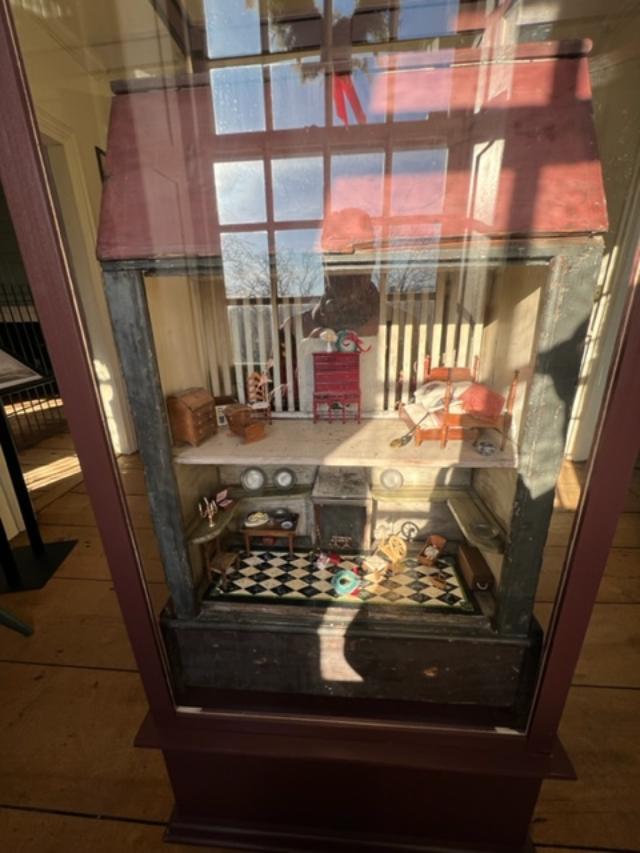
The Van Cortlandt House dollhouse
After nearly a year if repairs and restoration, Van Cortlandt House Museum was opened to great fanfare on May 25th of 1897. The original license agreement grained custody of the house to the National Society of Colonial Dames in the State of New York for a period of 25 years at a ‘peppercorn’ rent of $1.00 per year. Although the Society no longer pays the city rent, they remain, to this day as dedicated to Van Cortlandt House as they were in 1896.

Van Cortland Park.jpg

Van Cortlandt Park in the Summer Months

In 1967, Van Cortlandt House was added to the National Register of Historic Places and was designated a National Historic Landmark in 1967. The house was declared a New York City Landmark on March 15, 1966, recognizing the historic and architectural importance of both the exterior and interior.

(From the Van Cortlandt House Museum NSCDNY)

The Van Cortlandt House gardens during the winter of 2022
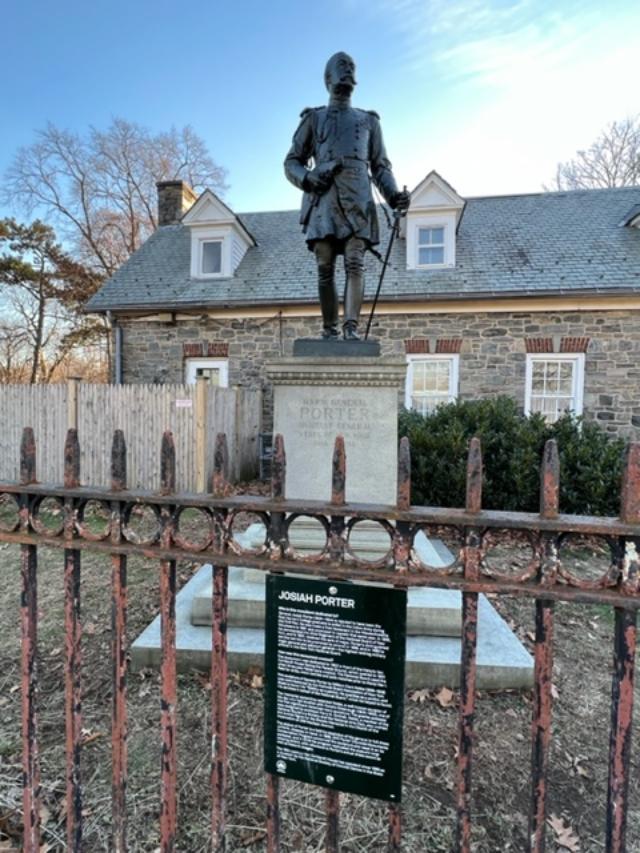
The General Porter Statute in front of the house
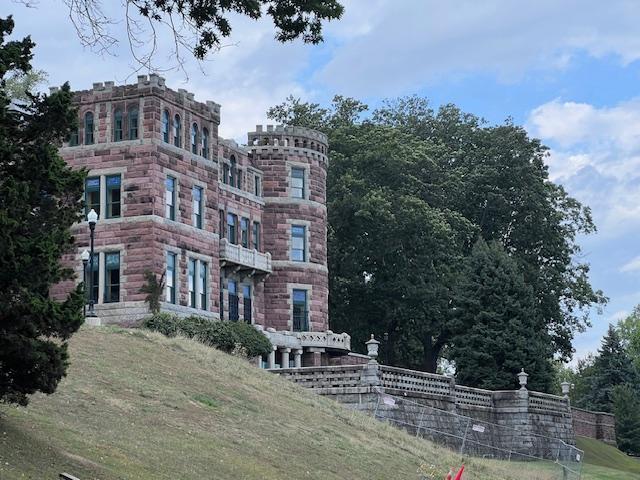
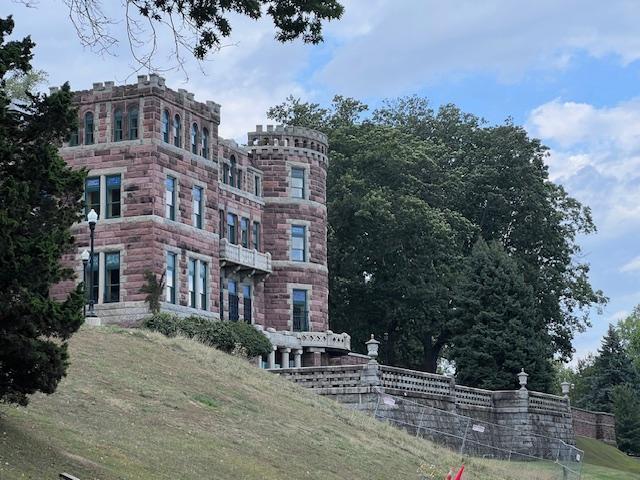
Lambert Castle/Passaic County Historical Society                   3 Valley Road                                                                                Paterson, NJ 07503

Lambert Castle/Passaic County Historical Society 3 Valley Road Paterson, NJ 07503

Lambert Castle/Passaic County Historical Society

3 Valley Road

Paterson, NJ  07503

Phone: (973) 247-0085

Fax: (973) 881-9434

info@lambertcastle.org

http://www.lambertcastle.org

https://lambertcastle.org

Hours:

Museum Wednesday-Sunday-1:00pm-4:00pm

The Castle closed for a five year renovation starting January 2020.

Library & Archives Wednesday-Friday-1:00pm-4:00pm/2nd and 4th Saturday of each month 1:00pm-4:00pm (Memorial Day through Labor Day: 12:00pm-4:00pm)

Admission: $5.00 Donation

My TripAdvisor Review:

https://www.tripadvisor.com/Attraction_Review-g46718-d1880569-Reviews-Lambert_Castle-Paterson_New_Jersey.html?m=19905

I have visited Lambert Castle a few times, most recently to see the Christmas decorations before they were taken down for the season. I found out from one of the director’s that they had not been put back up since their Holiday Bazaar back in November. I had seen them the year before and they had been very impressive.

Lambert Castle during the renovation in 2025

Right now the Castle is decorated for the Annual Christmas Craft Bazaar and it is just loaded with handmade crafts for the Christmas holidays. There are three floors of crafts and then on the third floor, there is a small restaurant to relax and look over the court of the house. After the bazaar in 2019, the Castle will close for a much needed five year renovation.

lambert-castle-vi.jpg

The Lambert Castle Christmas Bazaar 2019

I had a chance to visit the floors when they were not decorated for the holidays . The first floor is set up as if the family still lived there with the Billiards Room, Dining Room, Sitting Room, Music Room and Atrium still set as the family resided there. There is period furniture and decorations in all the first floor rooms to give a feel of what it must have been like to live there at that period.

lambert castle ii

The view of Lambert Castle from the second floor

The second floor galleries hold the collection of the Passaic County Historical Society with all sorts of objects, signs and historical items from all eras of the collection. You are able to see the footprint of the living quarters of the family.

Lambert Castle V.jpg

The stained glass windows

The third floor at the time I was there was dedicated to the work of an Italian stone worker and artist who migrated and lived and worked in Paterson.

It is a very interesting way to see life at the turn of the last century in Paterson and the home offers a beautiful view of the City of Paterson and New York in the distance. I have never seen the grounds in the Spring but I am sure that they are quite lovely.

The view alone is worth the visit.

Don’t miss this virtual tour of the Castle and await until the renovations are done to visit again.

Bergecco-Parc Consulting Inc. commercial on Lambert Castle in 2019.

Bergecco-Parc Consulting Inc. Project: “Take me back to Paterson, NJ”.

History of Lambert Castle:

Catholina Lambert and his Castle:

Catholina Lambert was born in 1834 in Goose Eye, England. In 1851 at the young age of 17, Lambert left home to seek his fortune in the “Land of Opportunity” that was America. After several successful ventures in the silk industry, Lambert decided to build a home that would be reminiscent of the castles he recalled from his boyhood in England. In 1892, he built his own castle on Garret Mountain in Paterson, NJ, then known as the “Silk, City of the New World.”

Catholina Lambert II

Catholina Lambert

Lambert’s home was built to showcase his elaborate art collection  of fine European and American paintings and sculpture. At one time, his collection was so vast that it was considered to be “the nucleus of an American Louvre.” In 1913, Lambert fell into debt and his fortune started to dwindle. As a result, he was forced to mortgage the Castle and eventually sell much of his art collection. The proceeds allowed him to live comfortably in the Castle until his death at age 89 in 1923.

After Lambert’s death, his son, Walter sold the Castle to the City of Paterson, which later sold it to the County of Passaic. Today the Castle is still owned by the County and  serves as the headquarters of the Passaic County Historical Society. The Society, a private not for profit organization, owns the historical artifacts and works of art.

Catholina Lambert

Catholina Lambert and Company

The home and the museum, exist as a reminder of a bygone era and as a tribute to the great accomplishment of  the Castle’s creator. Although most of the furnishings today are not original to the Lambert’s home, they represent period furnishings that would have been found in the Castle during the Lambert era.

For more information about the rooms and decor, visit The Lambert Castle Blog at:

https://lambertcastleweb.wordpress.com/museum

Passaic Historical Society:

The Society & Museum:

The Passaic County Historical Society is a private non-profit educational organization founded in 1926 and dedicated to cultivation of interest in the history and culture of Passaic County and former home of silk magnate Catholina Lambert was built in 1892. The Castle is owned by the County of Passaic and has been the home to the Society since 1934.

Library & Archives:

Located in the lower level of the Castle is the Elizabeth A. Beam Memorial Historical Research Library, operated by the Passaic County Historical Society. Here scholarly researchers, genealogists and historical enthusiasts may find books, manuscripts, maps, photographs, genealogy records and other information that reveals the history of Passaic County. Access to the library is included with regular admission to Lambert Castle.

Membership:

The Society depends upon the support of its membership as well as museum admission to sustain its important mission. Please consider becoming a member and helping to preserve the history of Passaic County.

The Second Floor Galleries:

The Castles’s second floor has several exhibition galleries, each presenting a different historical display from the Society’s collections. To the right of the fireplace on the walls of the second floor balcony is an exhibition of works by noted Paterson artist Julian Rix. On the opposite side are portraits of notable Passaic County residents and a collection of historic engravings of the Passaic Falls. Behind the fireplace are the Lambert’s private rooms. To the left, in the former sitting room and bedroom of Mr. Lambert, are the Curiosities and Local Folk Art galleries and the famous Brass Dog Sculpture that served for many years as an advertising sign for a tinsmith’s shop in nineteenth-century Paterson. In the adjacent room, the former bedroom of Mrs. Lambert, is the Local History Gallery which features historical images of prominent businesses and people.

The Third Floor Exhibition Gallery:

The Third floor of Lambert Castle is reserved for changing or seasonable exhibitions.

Disclaimer: This information comes directly from the Passaic County Historical Society & Museum pamphlet and I give them full credit of it. Rather than transcribing the whole pamphlet with the description of rooms, I attached their website and blog on WordPress.com for more detailed viewing.

The James Rose Center 506 East Ridgewood Avenue Ridgewood, NJ 07450

The James Rose Center

506 East Ridgewood Avenue

Ridgewood, NJ  07450

Phone: (201) 446-6017

Email: http://www.jamesrosecenter.org

Fee: Adults $8.00/Children $5.00

Open: Tuesday-Sunday-10:00am-4:00pm/Closed Mondays

TripAdvisor Review:

https://www.tripadvisor.com/Attraction_Review-g46772-d15190166-Reviews-James_Rose_Center-Ridgewood_New_Jersey.html?m=19905

Originally designed as his own home, today the James Rose Center serves as the headquarters of a non-profit educational foundation, the mission of which is to improve the environment through research, education, preservation and design.

I recently toured the James Rose House with members of the Ridgewood Historical Museum. We had a lecture on the house and James Rose’s work in the industry as an architect and the other projects he had worked on over the years before his death in 1991.

James Rose Center

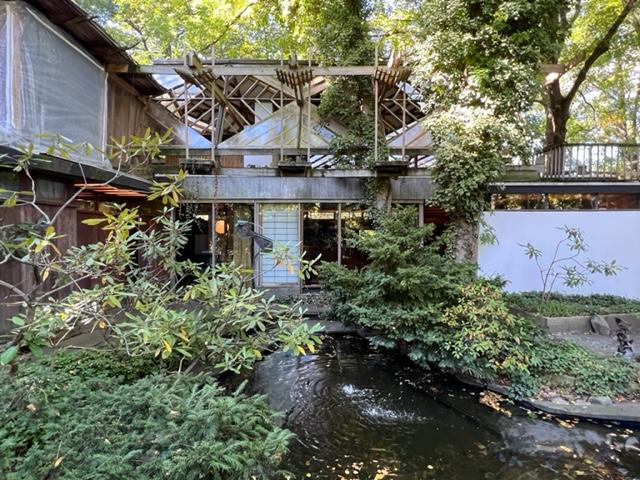
James Rose House at 506 East Ridgewood Avenue

http://jamesrosecenter.org/

The lecture was followed by a tour of the house with the group and then a small lecture and tour with the guide. We got to see the whole house, what he was trying to achieve in the design and the renovation work on the house as it is in pretty bad shape. The materials that were used to build the house were not the best quality and have rotted over the years. There is a lot of restoration work on the house that is needed.

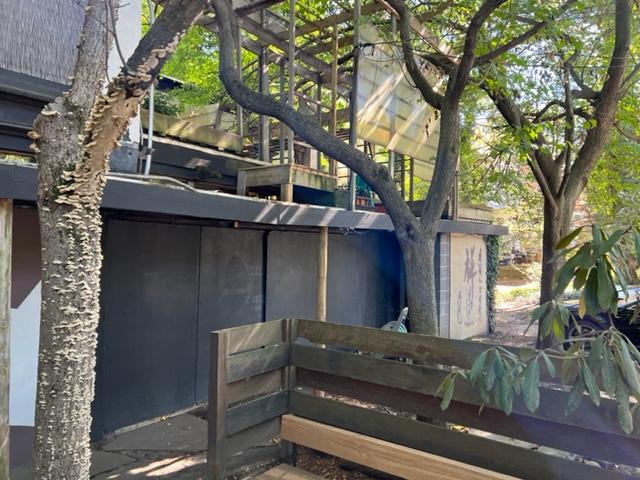
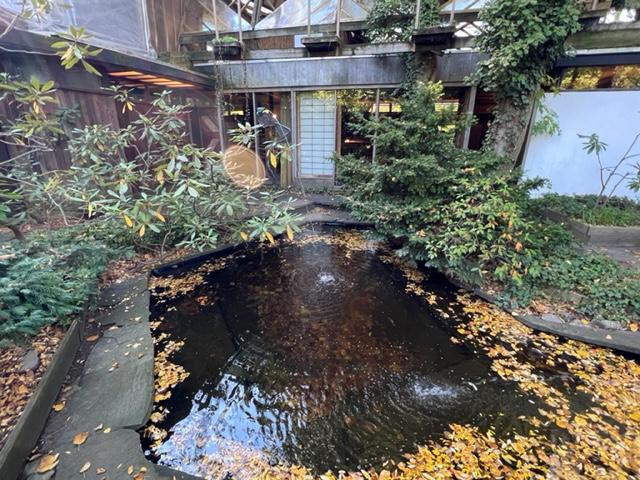
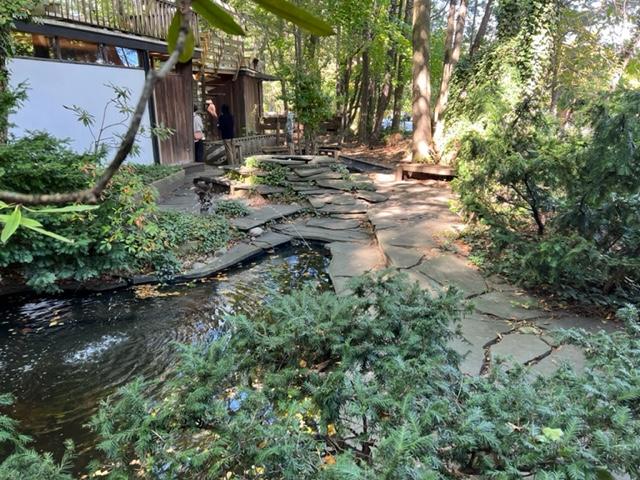
We were able to walk all around the house and what struck me was the use of nature in the design of the house. He used the trees and brook on the property to achieve the aesthetic of the design of the house but over the years it has been used against it as the trees have either grown too big around the house or have died, in which one did and caused thousands of dollars of damage on the house. Still, it was an interesting tour of how the house was used as a studio and a family home for him, his mother and unmarried sister.

History:

James Rose (1913-1991) was a maverick landscape architect whose rebellious nature caused one writer to refer him as the “James Dean of Landscape Architecture.” Here Rose created a unique work of art fusing modern sculpture, architecture and landscape into a single unified place for living.

(Information from the Center’s pamphlet)

For its unique modern spatial language, its expression of an alternative approach to conventional post war suburban residential development and as the constantly changing laboratory of one of landscape architecture’s most inventive minds, the Ridgewood home of James Rose is one of the twentieth century’s most important landscapes.

The Front of the house

The Vision:

Rose began  the design while in Okinawa during World War II with a model he made from scrapes found in construction battalion headquarters. “I wanted the spaces flowing easily from one to another, divided for privacy and for convenience.” Rose wrote in 1943. “I wanted the arrangement flexible and varied. Most of all, I wanted all this integrated with the site in a design that seemed to grow, to mature and to review itself as all living things do.”

The Reality:

Constructed in 1953, Rose described his home as a “tiny village” build on an area half the size of a tennis court. It was a composite of three buildings-a main house for his mother, a guesthouse for his sister and a studio for himself. This experimental landscape achieves a fusion of indoors and outdoors perhaps unequaled by other leading designers of this time. Rose later described it as “neither landscape nor architecture, but both; neither indoors, nor outdoors but both.”

The Metamorphosis:

It was conceived to accommodate rapid twentieth century charge. “I decided to go at the construction as you might a painting or sculpture.” Rose wrote. “I set the basic armature of walls and roofs and open spaces to establish their relationships but left it free in detail to allow for improvisation. In that way it would never be “finished,” but constantly evolving from one stage to the next-ametamorphosis,” Rose wrote, “such as we find commonly in nature.”

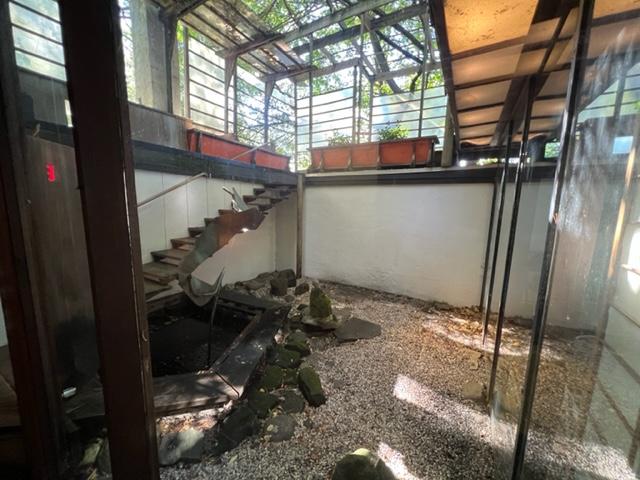
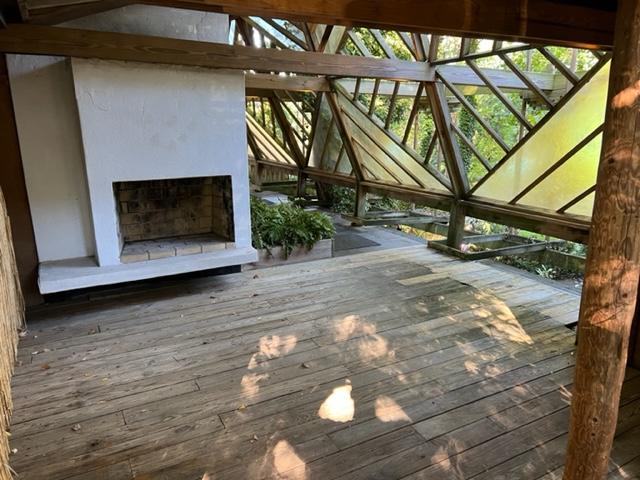
Consistent with this, the design changed dramatically during the almost forty years Rose lived here. From 1961, when Rose was invited by the Japanese government to participate in a World Design Conference (WoDeCo), he founded a mirror to his modern American design sensibility in the ancient culture of Japan. In changes such as the addition of the roof garden and zendo in the early 1970’s a fusion of ancient East and modern West is effected as Rose compares the filigrees of plant forms to the filigrees of structure. “In the bare architecture outline is a pattern of organic (rather than cosmetic) decoration and an inter division of space.”

The Reincarnation:

Unfortunately in the eighties this remarkable design, built to accommodate rapid growth went into rapid disrepair. Neglect, fire and water damage threatened complete destruction until a foundation was established by Rose, Dean Cardasis and a few of Rose’s close friends was formed just before Rose’s death in 1991. In 1993 the rehabilitation of this important property began and continues to this day. The site serves students, scholars and the general public in its new life as the James Rose Center for Landscape Architectural Research and Design.

The rehabilitation reversed rampant deterioration of the previous decade. Support systems were revamped.  Fire damage was repaired. The leaking roof was rebuilt and Rose’s roof garden was reconstructed. Salvageable wood was reconditioned and woven with new lumber. Garden pools were rebuilt and important planting edges re-established. Murals and other original artwork were reconditioned. Through the center’s ongoing efforts, Rose’s enduring creation has entered a new stage of its metamorphosis from which it will continue to evolve.

But it remains consistent with its origins as a important modern work and serves the same larger purpose it always had for Rose to pose for us elemental questions about the nature of design. “Change is the essence,” Rose observed. “To reveal what is always there is the trick. The metamorphosis is seen minute by minute, season by season, year by year. Through this looking glass, ‘finish’ is another word for death.”

(Ridgewood-James Rose Center History)

James Rose, landscape theorist, author and practitioner

Along with Garrett Eckbo and Dan Kiley, James C. Rose was one of the leaders of the modern movement in American landscape architecture. Rose was only five years old when his father died and with his mother and older sister, moved to New York City from rural Pennsylvania. He never graduated from high school (because he refused to take music and mechanical drafting) but nevertheless managed to enroll in architecture courses at Cornell University. A few years later he transferred as a special student to Harvard University to study landscape architecture. He was soon expelled from Harvard in 1937 for refusing to design landscapes in the Beaux Arts manner.

The design experiments for which he was expelled served as a basis for a series of provocative articles expounding modernism in landscape design, published in 1938 and 1939 in Pencil Points magazine (now Progressive Architecture). Subsequently Rose authored many other articles, including a series with Eckbo and Kiley as well as four books which advance both the theory and practice of landscape architecture in the twentieth century.

Rose was employed briefly in New York City in 1941 as a landscape architecture by Tuttle, Seelye, Place and Raymond where he worked on the design of a staging area to house thirty thousand men to Camp Kilmer, New Jersey. For a short time, Rose had a sizable practice of his own in New York City but he quickly decided that large-scale public and corporate work would impose too many restrictions on his creative freedom and devoted most of his post WWII career to the design of private gardens.

Fusion of indoor and outdoor space:

In 1953, he began building one of his most significant designs, the Rose residence in Ridgewood, New Jersey. Rose conceived of the design while stationed in Okinawa, Japan in 1943. He made the first model from scraps found in construction battalion headquarters. After construction, the design was published in the December 1954 issue of Progressive Architecture, juxtaposed to the design for a traditional Japanese house built in the garden of the Museum of Modern Art in New York City; the article cites Rose’s design for its spatial discipline. The design clearly expresses Rose’s idea of fusion between indoor and outdoor space as well as his notion that modern environmental design must be flexible between indoor and outdoor space as well as his notion that modern environmental design must be flexible to allow for changes in the environment as well as in the  in the lives of its users.

Practice based on improvisation:

From 1953 until his death, Rose based an active professional practice in his home. Like Thomas Church and many others. Rose practiced a form of design/build because it gave him control over the finished work and allowed him to spontaneously improvise with the sites of his gardens. As a result of this, most examples also exist in Connecticut, Florida, Maryland, California and abroad.

.

Establishment of a landscape research and design study center:

James C. Rose was one of the most colorful figures in twentieth century landscape design. While skeptical of most institutions during his lifetime he served as guest lecturer and visiting critic at numerous landscape architecture and architecture schools. Before he died he set in motion an idea which had been in his mind for forty years; the establishment of a landscape research and design study center and created a foundation to support the transformation of his Ridgewood residence for this purpose. Rose died in his home in 1991 of cancer.

(James Rose Foundation-James Rose Center)

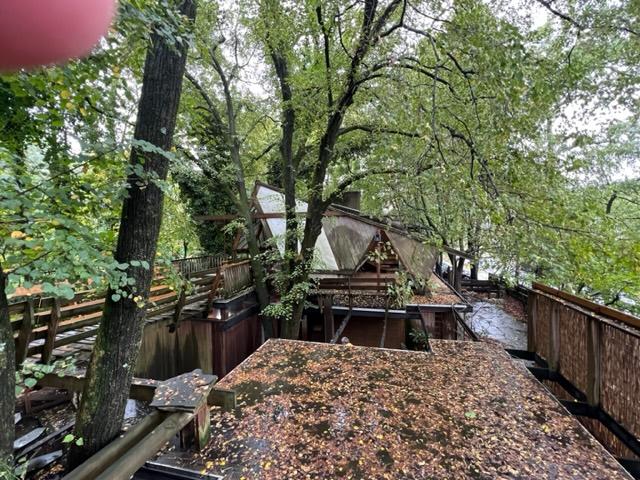
The upper part of the house.

The upper part of the house

The upper floors and garden

The upstairs near Ridgewood Avenue

The upstairs of the house.

Hereford Inlet Lighthouse                                              111 North Central Avenue                                         North Wildwood, NJ 08260
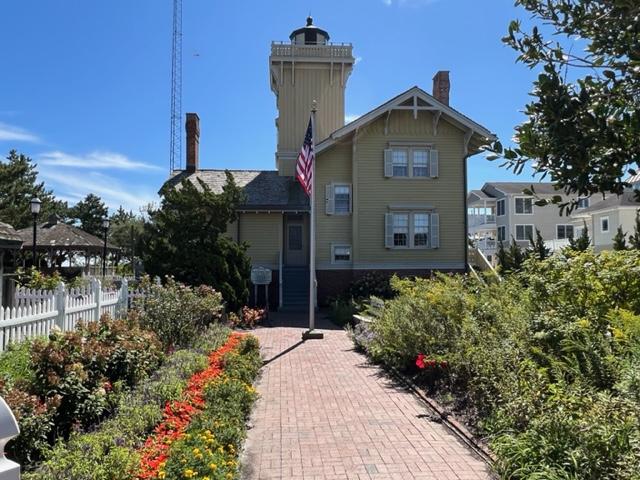
Hereford Inlet Lighthouse 111 North Central Avenue North Wildwood, NJ 08260
Hereford Inlet Lighthouse
111 North Central Avenue

North Wildwood, NJ  08260

(609) 522-4520

http://www.herefordlighthouse.org

Open:

Mid May through October-Seven days a week: 9:00am-5:00pm

November through mid-May: Thursday-Sunday: 10:00am-1:00pm

*Days and hours may change without notice during these off-season months. Please call ahead to check on updates.
TripAdvisor Review:

https://www.tripadvisor.com/Attraction_Review-g46686-d532246-Reviews-Hereford_Inlet_Lighthouse-North_Wildwood_Cape_May_County_New_Jersey.html?m=19905

The Hereford Lighthouse in the summer of 2023.

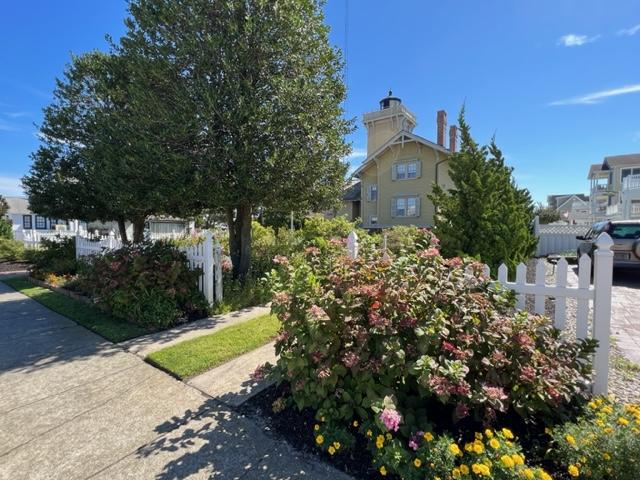
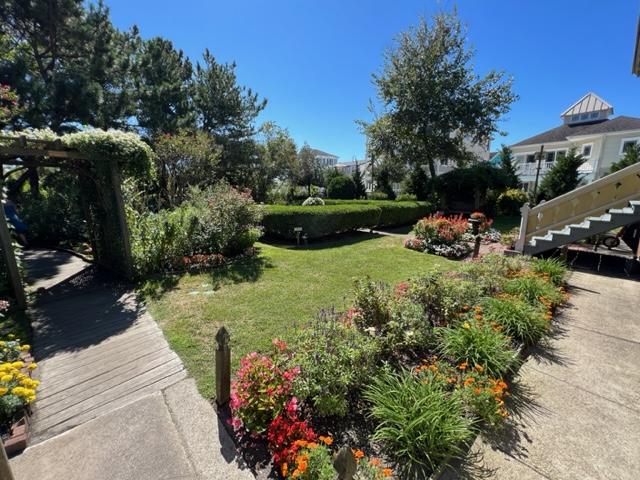
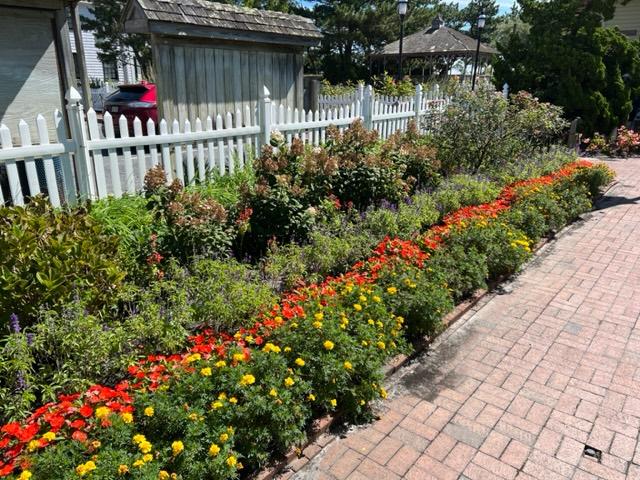
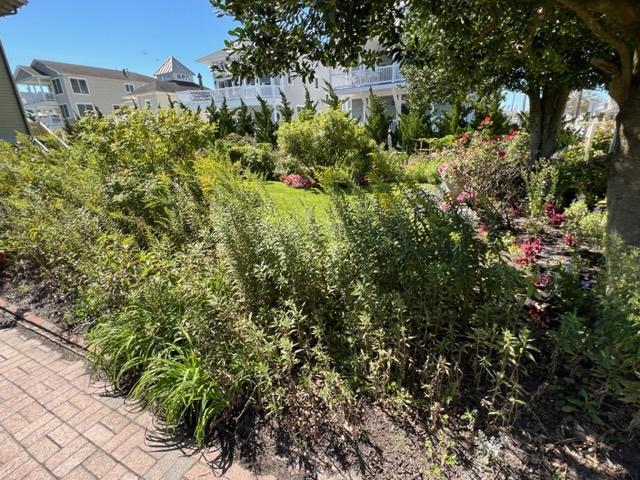
The front gardens of the lighthouse.

The front gardens of the lighthouse.

I visited the Hereford Lighthouse Museum recently (See my review on TripAdvisor) and toured the building and grounds. It was three floors of vintage furnishings, artifacts from the nautical era and the items from a working lighthouse, past and present.

The first floor meeting room.

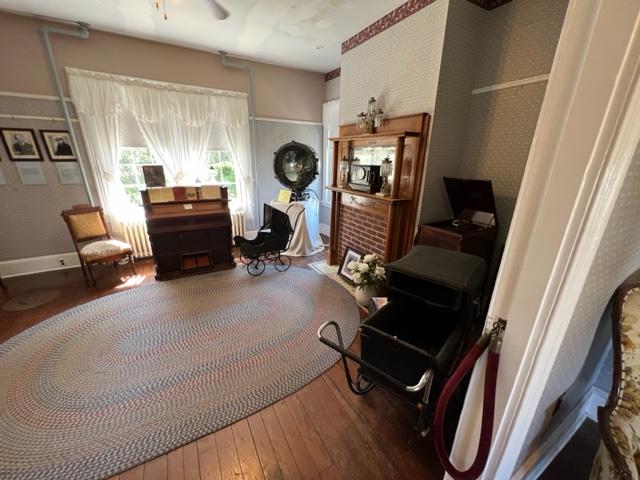
The Living Room of the Hereford Lighthouse.

The Living Room of the Hereford Lighthouse.

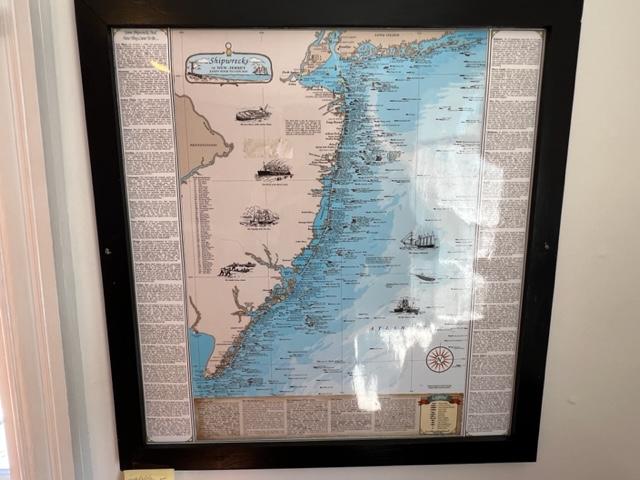
There was an interesting display of ship wrecks and their history, the role of lighthouses in New Jersey and their past and an interesting storyboard of the lighthouse keepers and the families that lived there at all stages of the history of the lighthouse.

The shipwrecks of the Jersey coastline

The shipwrecks off the coast of New Jersey.

The Hereford Victorian Lighthouse Museum and Gardens is a working lighthouse as well as a museum. Visitors will learn about the historic structure’s history and get a glimpse into the life of a lighthouse keeper in the late 19th and early 20th centuries (Hereford Lighthouse Museum).

The Children who lived in the Hereford Lighthouse.

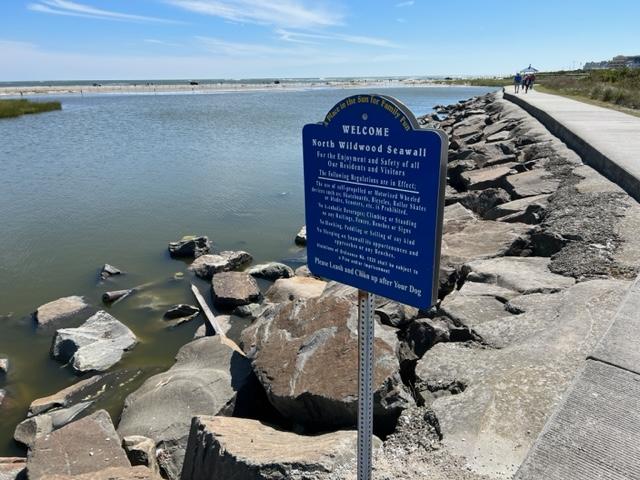
Nestled into one of the most scenic settings in the State, the lighthouse overlooks the picturesque Hereford Inlet and the Atlantic Ocean. A park surrounding the building overflows with numerous flower gardens that have won many awards. Benches, a gazebo and a seawall observation deck allow visitors to linger and take in all the beauty (Hereford Lighthouse Museum).

The seawall just outside the lighthouse.

There is a gift shop located on the first floor of the lighthouse.

History of the Lighthouse:

(from the museum website)

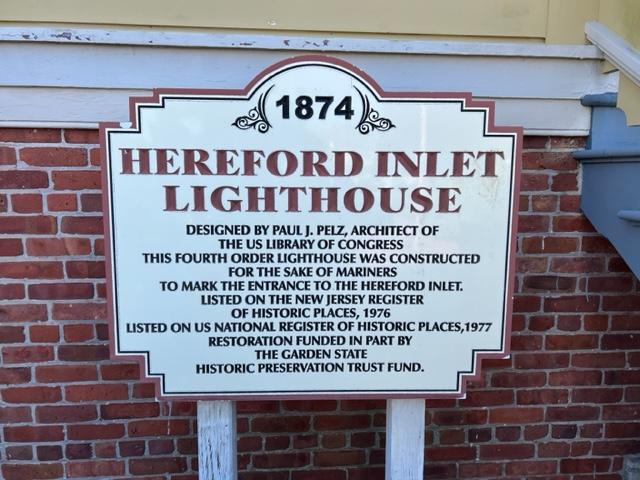
The Lighthouse sign welcomes you.

Historic and picturesque Hereford Inlet Lighthouse, a beacon of safety and assurance to the 19th century mariners, has become a cherished landmark for residents and visitors of this seashore resort community.

The Lighthouse is situated on the south side of the Hereford Inlet, which leads from the Atlantic Ocean to the famed Intra-Coastal Waterway linking Maine to Florida. First used by the 17th century whalers to haul in and butcher their catches, the Inlets use as a haven to mariners greatly increases as travel and shipping along the coast became more prevalent.

The front of the lighthouse and the front gardens.

Strong currents and shifting sandbars near the entrance to the Inlet caused frequent groundings and shipwrecks. Because of this, in 1849, a Life Saving Station was constructed along the south bank of the Hereford Inlet. A second, larger station replaced this in 1871, the time of the creation of the United States Life Saving Service. As the use of the Inlet and coastal shipping continued to increase, so did the number of shipwrecks. It became obvious that a Lighthouse was needed to mark the mouth of the Inlet.

On June 10th, 1872, Congress enacted legislation to finance the purchase of land and the construction of a fourth order Lighthouse. The site chosen held a prominent position on the dune area overlooking the approach to the Inlet.

The view from the top of the lighthouse.

Construction bean on the uninhabited barrier island on November 8, 1873 and was completed on March 30, 1874. This wood frame residential style Lighthouse was designed by the Lighthouse Boards Chief Draftsman, Paul J. Pelz. His Victorian era design is referred to as Swiss Carpenter Gothic and also Stick Style.

Hereford is the only Lighthouse like it on the East Coast although it had five sister lights on the West. Pelz designed Point Fermin, East Brother, Mare Island and Point Hueneme in California and Point Adams in Washington State. All of these were almost identical to Hereford and were built about the same time. Only Point Fermin and East Brother still exist. Paul Pelz would later garner world wide fame as the designer of the Library of Congress in Washington DC.

The view from the top of the lighthouse.

On May 11, 1874, a Notice to Mariners formally announced the start of operation of the Light. The fixed white light was located at latitude 39 degrees and longitude 74 degrees, 47 minutes. The tower height is 49 1/2 feet with the light elevation rising to 57 feet above sea level. The light is visible at a distance of 13 nautical miles.

John Marche was the first Lighthouse Keeper. He was in the post less than three months when he drowned when his boat capsized while returning to the mainland. He was replaced by a young man from Cape May Court House, Freeling Hysen Hewitt.

Freeling was a civil war veteran and a former merchant seaman. He would stay on as the keeper of the Light for the next 45 years. Freeling was considered a Pioneer of the island and among his many contributions, held the first formal religious services to occur in the Wildwood’s, in the Lighthouse parlor.

In 1888, a third larger Bibb#2 style Life Style Station was constructed three hundred feet Northwest of the Lighthouse. The Lighthouse Service and the Life Saving Service were both run by the Department of the Treasury but were separate organization. They were, however, both in the business of saving lives. The Lighthouse by warning and the Life Saving Service by rescue.

Hereford stood firm against the onslaught of the winds, rains and tides for 40 years at its original location. A severe storm in August of 1913 significantly damaged the foundation, requiring it to be moved westward 150 feet to where it sits today.

In 1915 the Coast Guard absorbed the duties of the U.S. Life Saving Service. A larger building was needed and in 1939 the modern Roosevelt Style Coast Guard Station was constructed. This Station also had a boathouse and a maintenance garage. These are the white buildings just north of the Lighthouse. 1939 was also the year that the Coast Guard took over control of the Lighthouse Service.

For the next 25 years the Hereford Lighthouse continue in operation. By the early 1960’s the Coast Guard began to automatize many of its many of its lighthouses. In 1964 this was the fate of Hereford when an automatic rotating modern optic was placed on an iron skeletal tower behind the Lighthouse. The Lighthouse was closed as was the Coast Guard Station next door. The entire property was transferred to the control of the New Jersey State Marine Police. The Police made use of the Coast Guard Buildings but the Lighthouse was boarded up and left to deteriorate for the next 18 years.

In 1982 through the long and painstaking efforts of Mayor Anthony Catanoso and his wife, Phyllis, a lease was signed Whereby the New Jersey Department of Environmental Protection turns over the stewardship of the Lighthouse to the City of North Wildwood.

The Children’s Room at the Hereford Lighthouse.

Restoration of the neglected building was immediately begun. After only ten months of intense work, on July 1, 1983, a portion of the restored building was opened to the public. Hundreds of public spirited citizens who helped raise funds for the restoration and contributed time, talent, energy and materials were on hand to celebrate the official reopening of the historic landmark for public use.

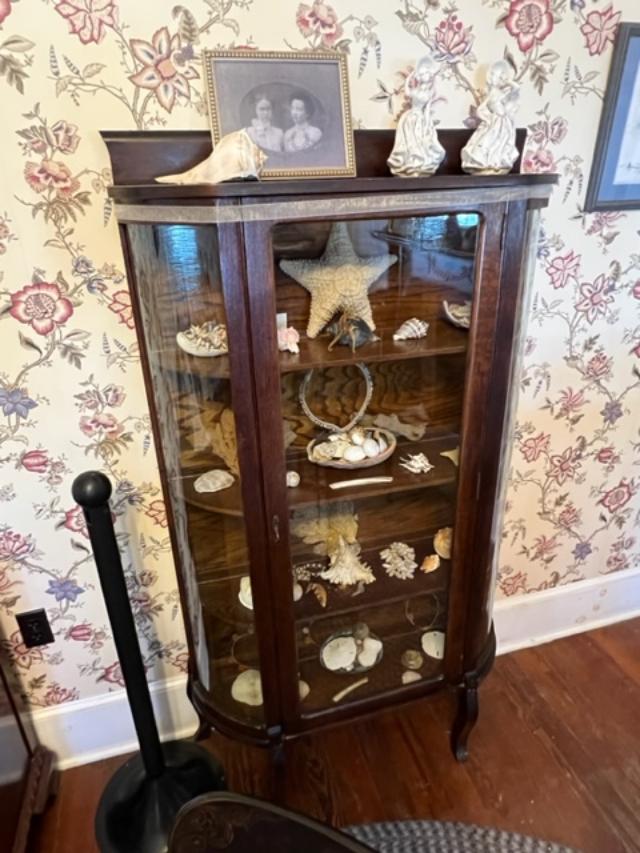
The Shell Collection in the Living Room of the Hereford Lighthouse.

In 1986, the modern automated light was removed from the iron tower and placed in the Lighthouse lantern room making it a fully functional aid to navigation once again.

Efforts were then begun to also create a museum in the Lighthouse. The interior of the building was furnished with period antiques, educational displays and lighthouse memorabilia. The 4th order Fresnel Lens was also restored and placed on display on the 2nd floor of the Lighthouse.

The Fresnel Lens at the Hereford Lighthouse

A project to improve the sandy, barren grounds into a park was undertaken by Superintendent of Parks Steve Murray, who designed the Park along with its many garden areas.

Finally an authentic restoration of the entire Lighthouse was begun in 1998 and as with many old, historic structures is always a work in progress. Grants awarded by the New Jersey Historic Trust and the N.J. Department of Transportation have helped finance this work.

The Hereford Lighthouse is listed on both the National and State Registers of Historic Places. It is also part of the New Jersey Coastal Heritage Trail.

The pictures of the Lighthouse Keepers over the years.

Keepers of The Hereford Inlet Lighthouse:

John Marche: 1874

John Nickerson: 1874

Freeling Hewitt: 1874-1919

William Hedges: 1919-1925

Laura Hedges: 1925-1926

Ferdinand Heizman: 1926-1939

Robert O’Neil: 1939-1942

George Baker: 1945-1955

Newman Bowden: 1955-1959

Bruce Bolon: 1960-1961

In the back of the Lighthouse is a wonderful set of gardens maintained by the local Garden Club.

The back gardens are beautifully maintained.

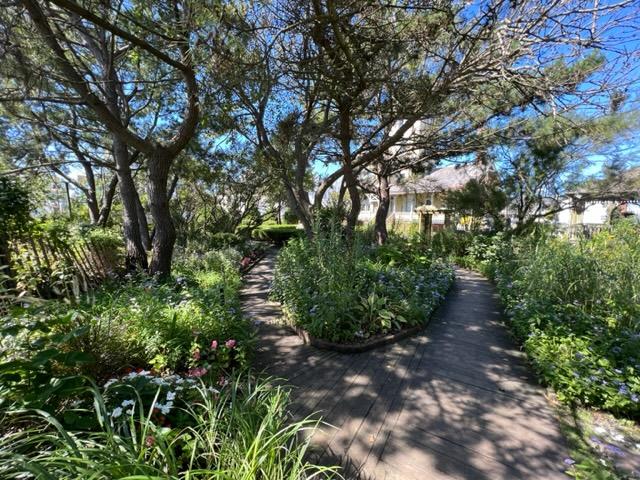
The back garden paths.

The back paths of the formal gardens in the back.

The paths leading to the seawall.

The lawns and gardens in the back of the lighthouse.

Disclaimer: This information was taken from the Hereford Lighthouse History website and I give the museum full credit for this information. Please call ahead before visiting in the off-season to see when the museum is open. It is a fascinating piece of New Jersey history.