Category: Historic School Houses in New Jersey

Montville Township Museum/Montville Historical Society                                                                              6 Taylortown Road                                                Montville, NJ 07045

Montville Township Museum/Montville Historical Society 6 Taylortown Road Montville, NJ 07045

Montville Township Museum/Montville Historical Society

6 Taylortown Road

Montville, NJ 07045

https://montvillenj.org/426/Montville-Museum

https://www.montvilletwphistoricalsociety.com/museums

https://www.montvilletwphistoricalsociety.com/

Open: The third Sunday of each month 1:00pm-4:00pm

My review on TripAdvisor:

https://www.tripadvisor.com/Attraction_Review-g46639-d27079954-Reviews-Montville_Township_Museum-Montville_Morris_County_New_Jersey.html

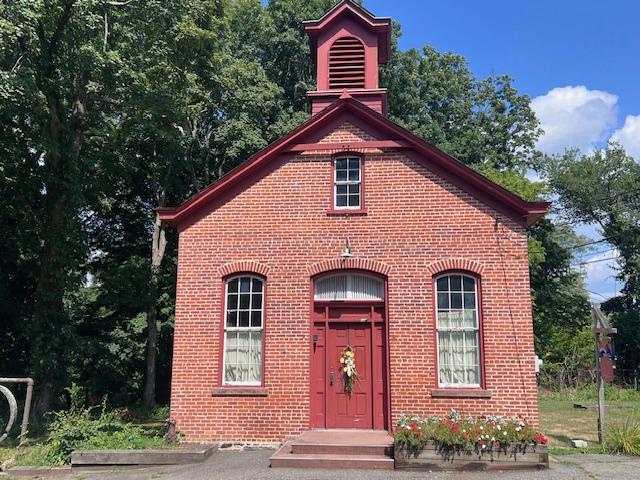
The front of the Montville Township Museum at 6 Taylortown Road

The front sign

I stopped at the Morris Township Museum on a busy Sunday afternoon. The museum, housed in a building that once served the community as a school, post office and a government center.

Each of the cases holds all sorts of artifacts that reflects the towns developments and growth. The first case line is filled with fossils found in the area and small artifacts from the Lenape Indians.

The next case was filled with accessories from Victorian objects from jewelry to household items. Lining the walls are objects from the high school, personal family records for people to search on their loved one’s genealogy. The docents are hand from the Historical Society to answer any questions about the museum.

The History of the Building:

(from the museum website)

The building was originally “Old Schoolhouse #10”.  It was built in 1867 and occupies the site of a former 1837 school.  One of the early superintendents of Morris Canal, Mr. William Hickson , was its builder.​

Located at 6 Taylortown Road just down the street from Route 202 is a red brick building with a sign out front proclaiming it the “Montville Township Historical Museum”. Within its walls are articles, pictures, tapes, and memories that will carry you back through the years to times long past.

The front of the museum

About the Building: The building was constructed following the Civil War, in the year 1867. It was one of the first one-room schools in the area. The land was donated by the eastern district superintendent of the then-thriving Morris Canal, one of the many waterways then in existence to help promote trade and travel in America. William Hixson gave the land to the town for public purposes, with the stipulation that it could be reclaimed if used for a purpose with which his family disagreed.

The historic sign of the school

Reconstruction: The building began serving Montville as a one-room school heated by a potbellied stove. It also served as an auxiliary to the local Methodist Church. It became the gathering place for the local temperance league in the 1890s, and was the scene of many temperance meetings in the town.

The gardens of the front the museum

The historical collection of the museum

The history of the property:

(from the Museum website)

Entrance: Today, as you enter the museum, you walk into an entrance foyer. Probably once used to hold the boots and coats of school children, it is now an entrance hallway. The door to the main room is straight ahead, and upon entering, you step into history.

Building Uses: Forty-four years after being erected, it changed from a school to the center of political activities as the town hall. It was the town hall until 1939, when it became the town’s post office. It served as such until 1961, when a post office was constructed close by (Taylortown Road and Route 202).

Making it a Museum: After the postmen moved out of the building, the township considered selling the property to a business concern but the original Hixson agreement was recalled, and the building remained unused – until the celebration of New Jersey’s 300th Anniversary.

At that time, a Tercentenary committee was founded in the Township to help celebrate the anniversary and the Committee decided to make the establishment of a museum its main project. Armed with donations from local residents, committee members renovated the building and reopened it in 1963 as a museum.

The inside of the museum

The part of the canal that exists around the museum

Around the corner from the museum is the corner from where the Morris Canal lock was located which was on display at the museum.$

The area around where the Morris Canal was located

https://en.wikipedia.org/wiki/Morris_Canal

https://www.morriscanalgreenway.org/

I traveled further down the road to see what is left as the canal that has since grown over. Before railroads and cars, the canal system is where goods and services from the interior of the state to the cities such as New York City and Newark.

The sign marking the site of the canal and the lock system

The lock location

The grown over canal system

It is an interesting museum whose artifacts represent the three communities in Montville township.

The Friendship School Museum                                       859 South Shore Road (Route 9)                         Palermo, NJ 08223

The Friendship School Museum 859 South Shore Road (Route 9) Palermo, NJ 08223

The Friendship School

859 South Shore Road (Route 9)

Palermo, NJ 08223

(609) 628-3303

http://uppertwphistory.org/Friendship-School.htm

https://hpsout.tripod.com/

https://capemaycountynj.gov/DocumentCenter/View/5497/CMC-Heritage-Brochure

Open: Please call for a appointment and special tour

My review on TripAdvisor:

The front of the schoolhouse

The entrance to the property

The historic marker

The outside sign

The Friendship School was an interesting look at early rural education where students of various ages would be educated together.

The hours would vary with the growing seasons and students would be educated in the basics to educate them to the next level.

During the school day, children would have various chores to do such as gather wood, collect water, mind the fire and watch the day’s lunch. It would be a full day for both the teacher and the students.

My tour guide confirmed that nothing was easy during the school day and children had a lot of responsibility for what went on in their lives.

The tour was an interesting look at the lives of children of that period of time and the education they received.

The history of the Friendship School:

(from the Museum’s website)

This historic property contains the circa 1930 Friendship School, a circa 1900 privy, and a circa 1917 coal storage shed.  The Friendship School was originally donated in 1976 by William Wells, grandson of Enoch Clouting to the Upper Township Bicentennial Committee during a time when Upper Township was particularly interested in its earliest buildings.

The historic plaques

The school’s hand pump

The committee, headed by the late Curtis T. Cordon, evolved to become the nucleus of the Historical Preservation Society of Upper Township (HPSUT) in 1977. Virginia M. Wilson was its’ first President.

 The history of the Friendship School begins when it was incorporated in May of 1831 with Jonathon Corson, Lewis Corson, and Seth Young as trustees. The students’ tuition was paid for by parents in 1830, but by 1869, public funding for schools was established. In the 1862-63 school year, 52 students crowded into this 15’x 20’ structure, and of those students in the teacher’s roll book, 24 were Corsons!

The grounds of the school grounds

The school itself is standing on its fourth known location! It was originally located 6 houses southeast of its present location. It was used for classes until it was replaced with a larger building in the 1860’s.

The abandoned school house later owned by resident, Lot Corson, became known as “Lot’s Temple” because church services were held there. Then, it was moved to Enoch Clouting’s farm where a corn crib was placed on one side. It is Enoch’s grandson who kindly donated the school.

 The barn on the grounds

The school building was in extreme disrepair when it was moved from the Clouting property to the corner of Ocean Ave. and Shore Road.  According to an undated news article, “mere fragments of the (original) building remained” although “some of the heavier corner posts were salvaged.”

The school’s outhouse (pricey)

The historic sign

Nevertheless, restoration of this Friendship School was researched and planned by Kyle Fleetwood of Tuckahoe and James Wilson of Marmora; with assistance from Matt Unsworth, Robert Entirkin, Curtis Corson III, Somers Corson, Marshall “Ted” Behr, Guy Himmelberger, Harry “Hap” Folger and other members of the Bicentennial Committee. It was completed in 1980.

 All replacement wood matched the original in size and material and great care was taken to restore it to its original appearance. Locally sourced materials for the restoration/reconstruction came from the Van Vorst sawmill in Petersburg, the Hess sawmill in South Seaville and the Brewer sawmill in Dennisville. Benches donated by Myra Clouting Biggs, were reproduced by Matt Unsworth.

The inside of the school house

The teacher’s desk is a reproduction also made by Matt Unsworth. Hardware for the building was hand-wrought by Robert Entrikin of Petersburg. Although it does not qualify for the State and National Registers listing because it retains little original historic building fabric, the building is important to the historical time line of Upper Township.

 The schoolbooks and school equipment

Also on this site are two old frame buildings: a circa 1900 privy donated from the property of the Seaville School on Kruk Drive and a circa 1917 coal/storage shed donated from the Palermo School on Route 9.  The coal storage shed, was donated by Wes and Doris Nickerson with Jim and Nancy Siegrist helping with its restoration. It was added to the property in 1993. Three three-seat privy (outhouse) from the old unused Seaville School was donated by Sharon Kruk in honor of her father, and was restored by Lewis Albrecht and Jim Siegrist. It is a work of art (with a French style roof), but is non-functional.

 The school room reproduction

A special item, the cedar flag pole, from which flew a U.S. flag that flew above the capitol in Washington, DC, was donated by former Deauville Inn owners, Walter and Gloria Carpenter in December of 1983. (Since replaced)

 The school bell and flag

The Friendship School was dedicated on September 10, 1983 by Virginia M. Wilson, President of the Historical Preservation Society of Upper Township, Upper Township Mayor Leonard Migliaccio, HPSUT members: Ebbie Unsworth and her son, Matt Unsworth, and guest speaker, New Jersey State Senator, James R. Hurley.

 The children would collect water and fire wood for the class room during the school day

The reproduction of the school

Upper Township continues to own and manage the property and the school, while HPSUT members manage the inside and its activities. Each Upper Township Kindergarten class is invited to the annual Kindergarten Day to learn what a student classroom life is like in a one room school house in the early

The outside of the school