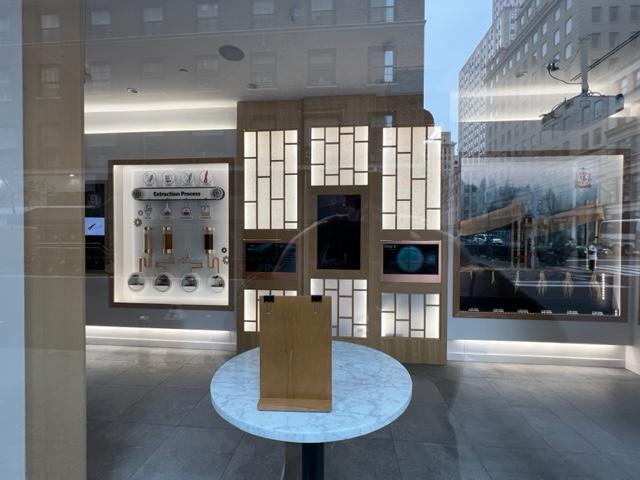
The Ginseng Museum Cafe by CheongKwanJang is a combination small museum of the development of the ginseng root for tea and its history, part cafe for tea and part store. This small store front is packed with information on the history and processing of ginseng.
The Ginseng Museum Cafe at 315 Fifth Avenue
To the right of the store, is the video history of the company and how they process and produce their product which is very interesting. The conditions that the ginseng is processed under may have advanced over the years but not by much. There is still a lot of care that is used to make the tea. There is also a display on the extractions.
The museum section of the store describes the process of producing ginseng
Next to it is the video history of the ginseng from its development to the processing and then the export and business of the product for trade from the 1800’s to today. It is impressive how the product is still very specialized and very expensive to produce and sell.
To the right of the store are all the products that the store sells from the extracts and teas to the roots themselves. Some of these items are worth several hundred dollars telling me that this is for a very particular customer.
The retail section of the Ginseng Museum Cafe
The combination store/museum tells the whole story of ginseng and a nice place to stop and not just sample the product but learn its story and history. There are also beautifully wrapped products for sale for all occasions.
It’s a beautiful little store in the heart of Koreatown in Manhattan.
In 2020, COVID had closed this unique little family orientated museum when I visited the NoMAD neighborhood earlier last year and it finally reopened for business right before the holidays. I could see the reasons why in that the museum is very interactive and there are a lot of activities and displays that warrant families touching objects and getting involved with the exhibitions.
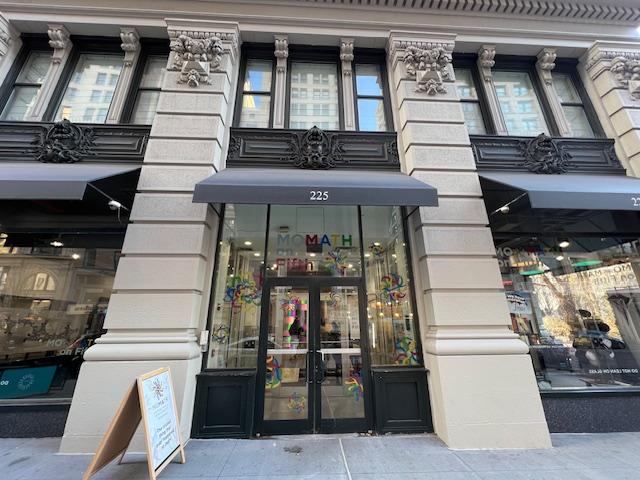
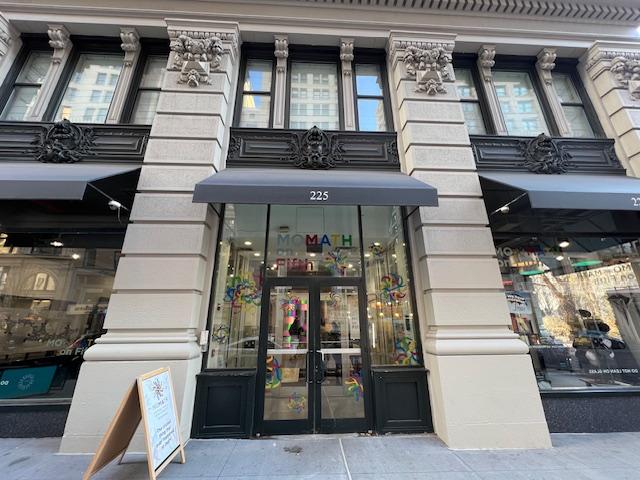
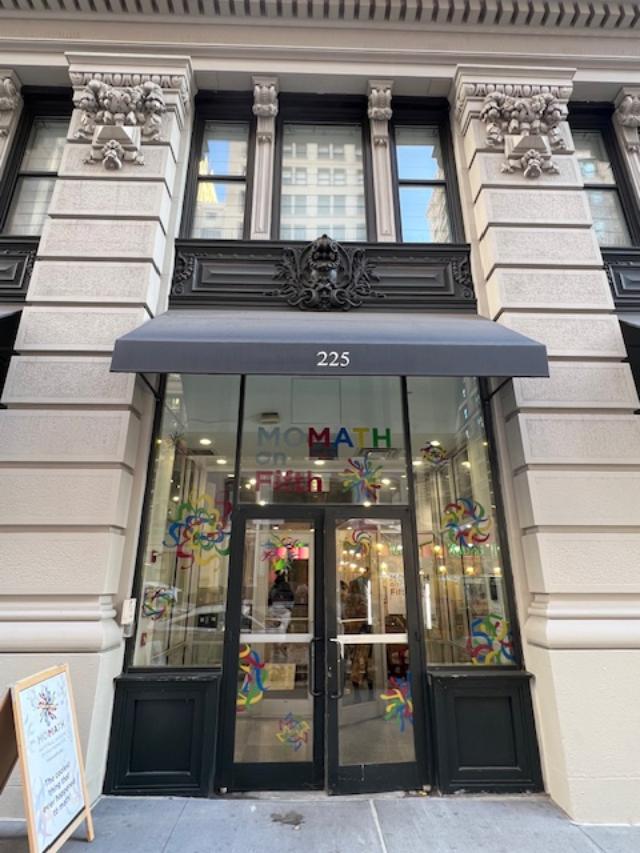
The entrance to the new museum at 225 Fifth Avenue
Like most museums in Manhattan, the MoMATH or the Museum of Mathematics is quite pricey at $25.00 ($26.00) for an adult and for students, children over 12 and seniors over 60 it is $20.00. While it may be lot for an average family, a trip there is an eye-opening experience at least to me it was that day.
The sign welcoming you on Fifth Avenue
In 2021 when it reopened, the museum was two full floors of exhibitions with a spiral staircase separating the floors and a gift shop at the entrance. On the main floor there are interesting interactive exhibitions such as the Shapes of Space that show how different shapes fit together on a curved surface. I was not too sure what the point of it was, but the kids seemed to enjoy it and it was interesting to see how they connected. The Square wheeled Trike was interesting as you rode a square wheeled type of bike on a bumpy surface to check velocity. The kids and young parents really liked this.
The “Shapes of Space” exhibition
In 2024, the museum was moved around the corner until the permanent location could be finished. The museum was on one floor with a art gallery in the front of the museum and the back of the museum was all the interactive activities.
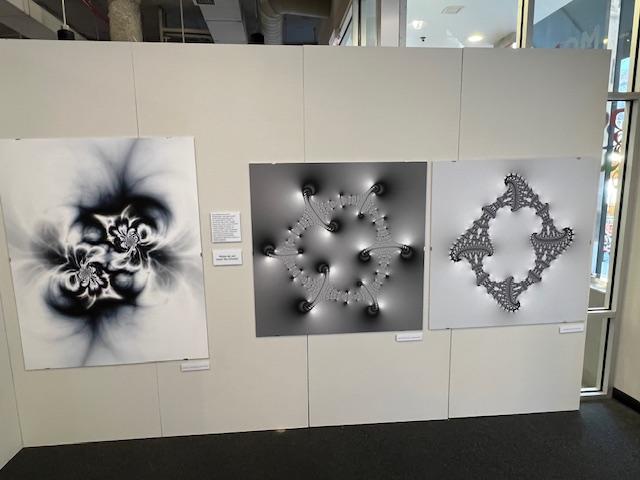
The Math “Fractorals” Gallery Exhibit at the Museum of Math
The “Fluids and Fractals” exhibition of artist Karl Sims
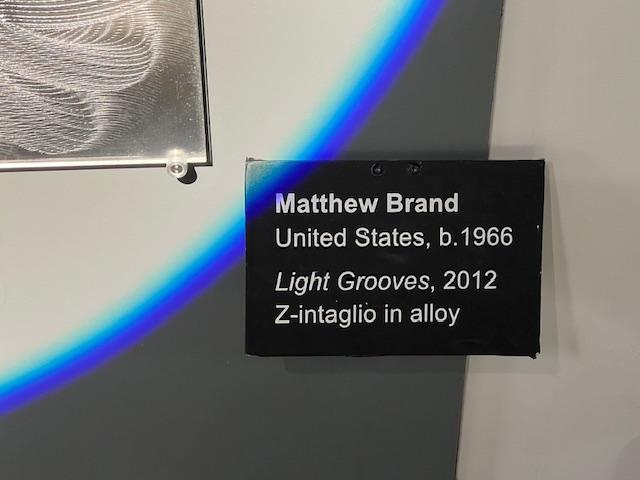
Matthew Brandt is an American born artist. Matthew Brandt received his BFA from Cooper Union and MFA from UCLA. Brandt has been the subject of institutional solo shows at the Newark Museum, the Columbus Museum of Art, Virginia Museum of Contemporary Art and SCAD Museum of Art, Savannah (Artist bio).
“Light Grooves”
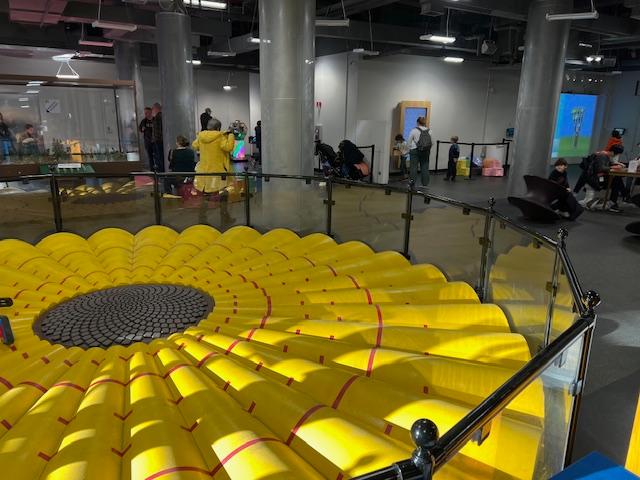
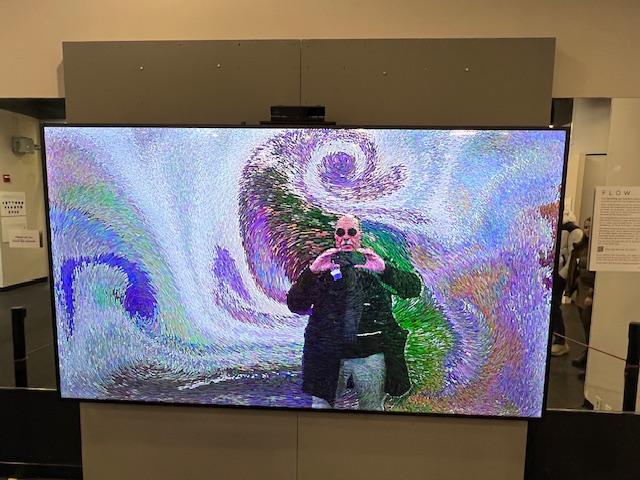
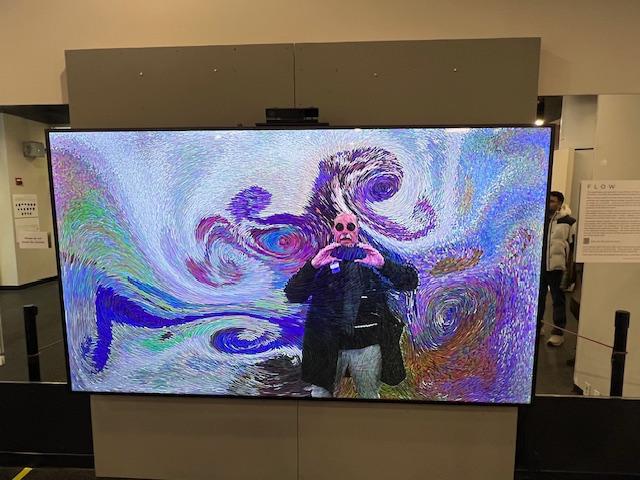
The interactive display
The displays I enjoyed in the old museum were Motionscape, where you had to walk as fast as you could on the track to check the relationship between velocity, your position and acceleration. It was interesting to see how your body movements when walking affects the way you react. The other display that was really popular was Hoop Curves which was always busy. The exhibit used statistics and a robot arm to shoot the basketball. The kids got a real kick out of this when trying to make a basket.
In 2021, the museum was two stories but in 2024, the museum moved to the new Fifth Avenue location and all the interactive displays were on the first floor, along with an explanation of the math along with the creators of the theory. I found that interesting because you could see who all the mathematicians were who the projects were based on or who had contributed to them.
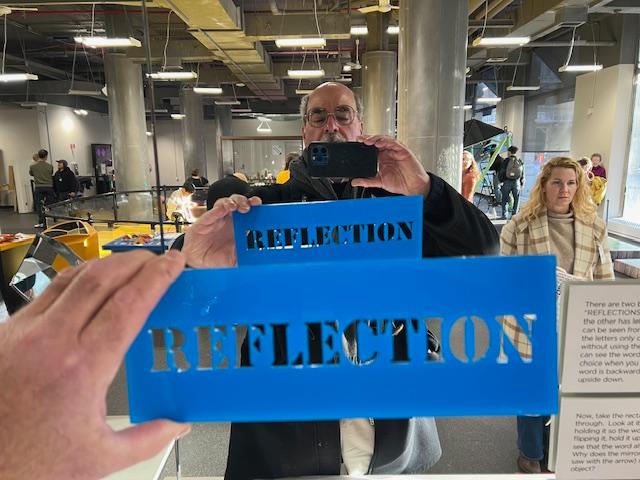
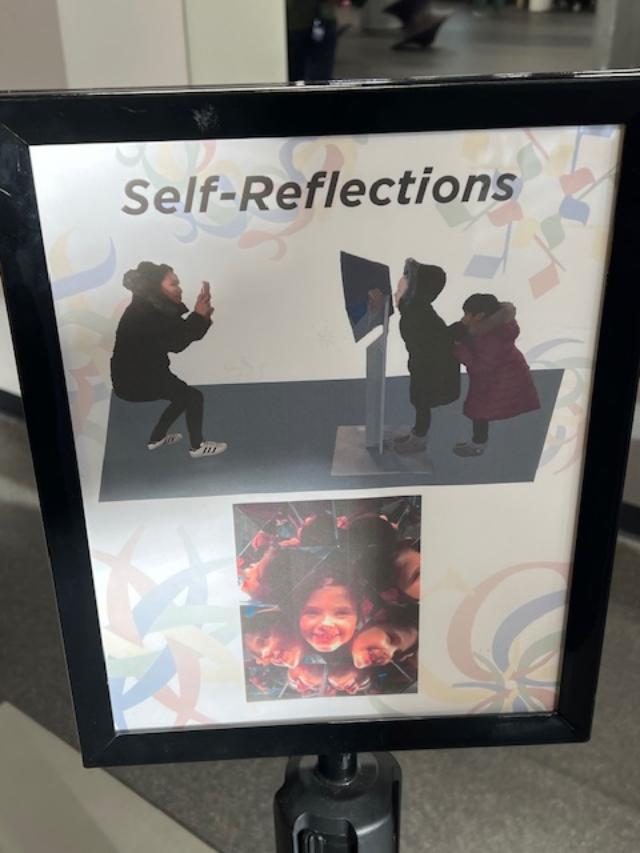
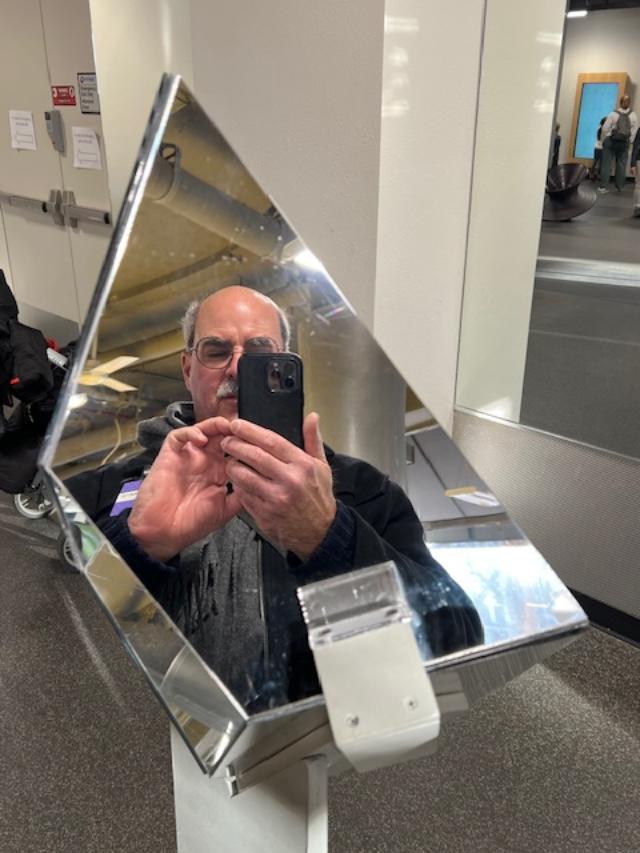
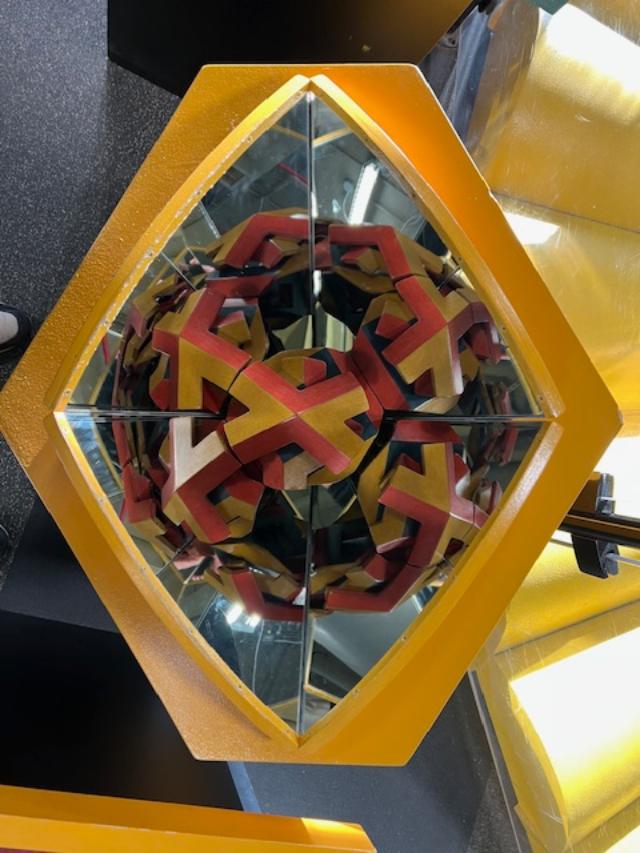
I started with the “Self-Reflections” exhibit where shapes and sizes mattered, and the use of symmetrical patterns shaped our faces and observations. I got to see how the shapes altered my reflection in the mirrors.
The use of mirrors and shapes
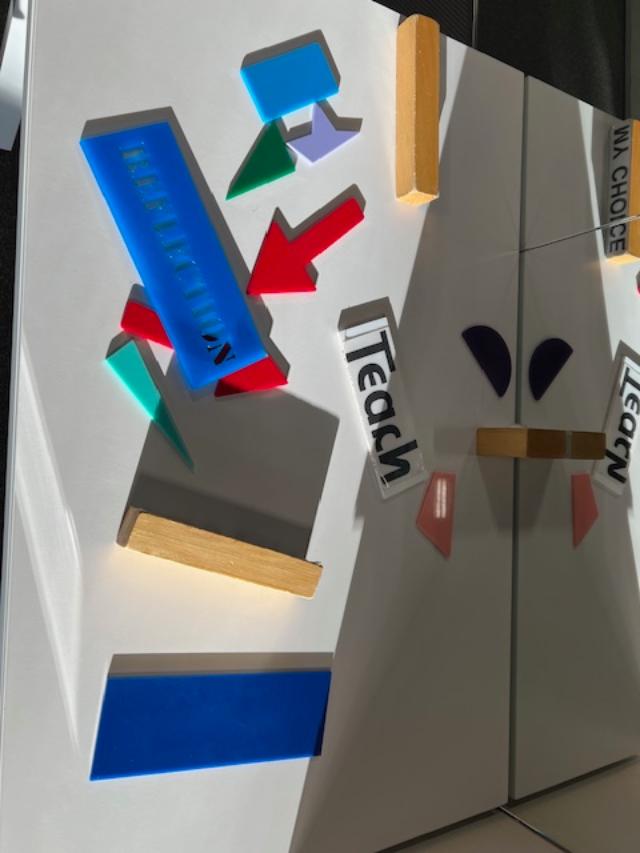
The use of shapes and colors in the experiment
The signage
How we look at ourselves in the mirror
Taking pictures in the ‘mirror’
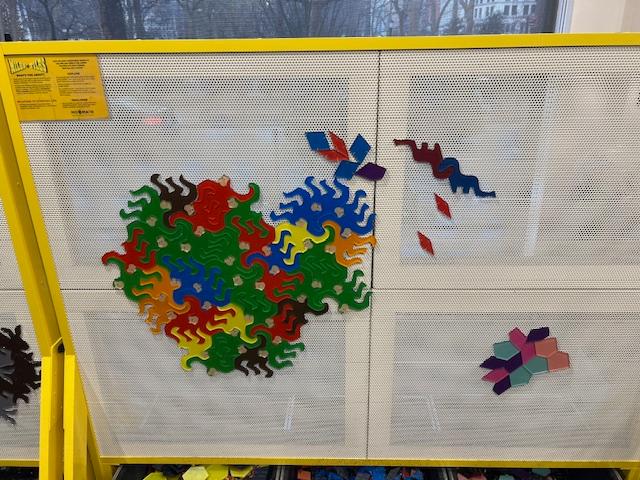
One of the first interactive displays that I enjoyed was the Tessellation Station, where you could create displays with magnetic tiles on a large board. Later I learned about Tessellation as a form of making shapes fit together in a pattern and then the theory behind that. It was a fun way to use your creativity. This exhibition was very popular in the old museum as well but had been a much bigger interactive display.
The “Tessellation Station” exhibition is a lot of fun
Another was the Tree of Life, where the computer copied the movements of myself and then used them to show the how I moved my arms and legs in a pattern. It was funny to see myself repeated over and over again like a tree with branches. It really did measure the movement of my body. This was a lot of fun because you got to see smaller versions of yourself attached to you.
Me playing with the Tree of Life
Me having fun by the Tree of Life exhibition
The Twist and Roll display showed how to put different shapes and sizes together and show their movement on the board.
The Twist and Roll hands on display
The one display that all the kids got a kick out of was the Math Board, where the colors and shapes of the section of the floor lit up when you walked on them and was controlled by the way you walked on them.
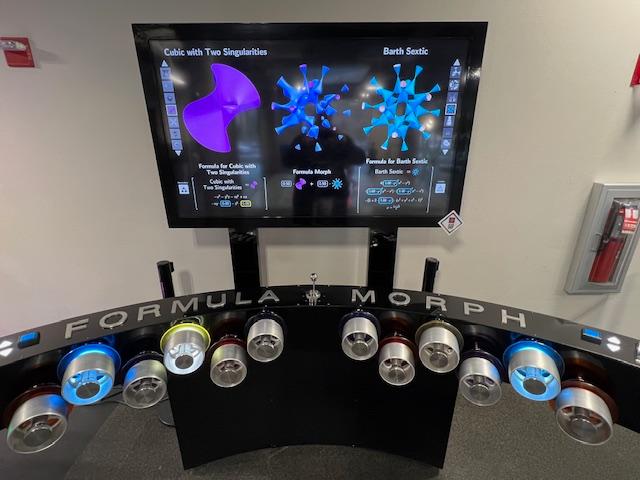
The “Math Morphing-Formula Morph” replaced the “Math Board”
The Museum of Mathematics is a great museum for younger children who want to get physical and have a good time and like the interaction. I learned a few things too about the fundamentals of math and some of its background theories.
The geometrics of the Museum of Mathematics
Still, it is a great museum for kids under the age of twelve and their younger parents. I think anything over that age would warrant a trip to the American Museum of Natural History or the Liberty Science Center with more exhibits that are age appropriate. It is a museum you should visit once or twice with small children who are at the learning stage and just want to have fun.
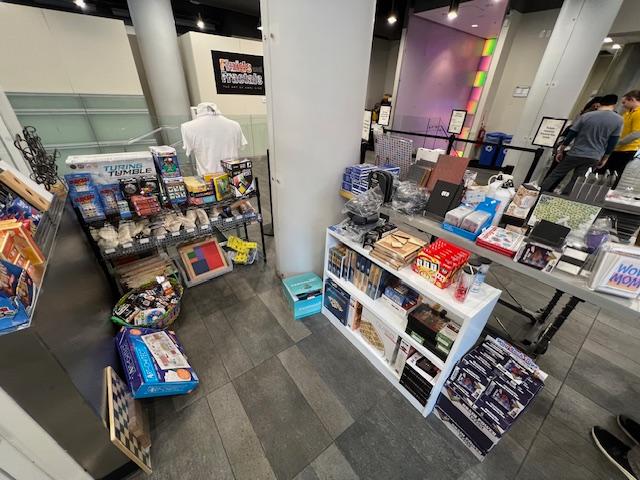
The Gift Shop
The Museum Gift Shop
The History of the National Museum of Mathematics:
(From the museum website)
The National Museum of Mathematics began in response to the closing of a small museum of mathematics on Long Island, the Goudreau Museum. A group of interested parties (the “working group”) met in August 2008 to explore the creation of a new museum of mathematics-one that would go well beyond the Goudreau in both its scope and methodology. The group quickly discovered that there was no museum of mathematics in the United States, and yet there was a incredible demand for hands0n math programming.
Interactive objects at the Museum of Mathematics
Accomplishments to date include: opening Manhattan’s only hands-on science center, welcoming more than one million visitors; creating the popular Math Midway exhibition, which has delighted millions of visitors at museums throughout the United States and internationally; leading math tours in various U.S. cities; running dozens of Math Encounters and Family Fridays events; delivering a broad array of diverse and engaging programs for students, teachers, and the public to increase appreciation of mathematics and creating the largest public outdoor demonstration of the Pythagorean Theorem ever.
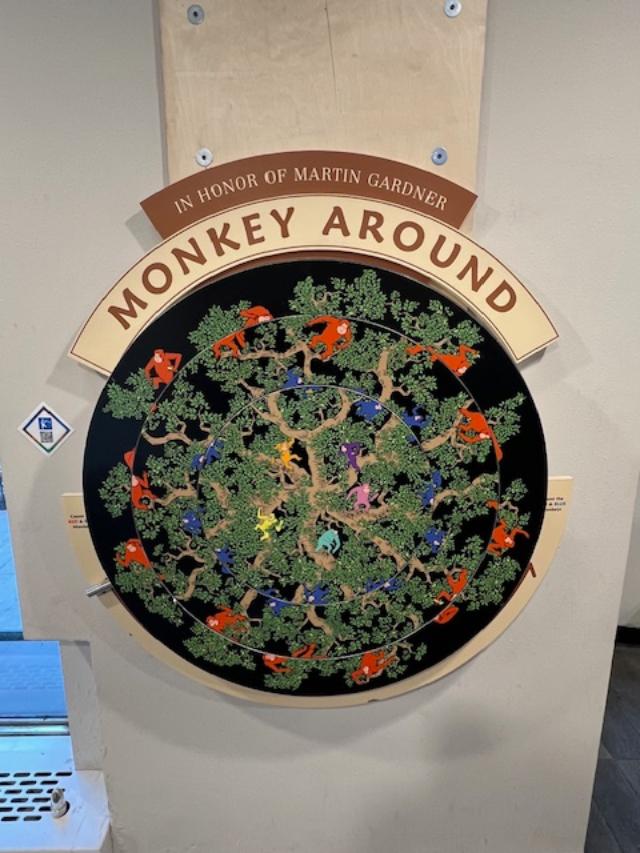
The “Monkeying Around” exhibition at the museum
The Museum Mission:
(From the Museum website)
Mathematics illuminates the patterns that abound in our world. The National Museum of Mathematics strives to enhance public understanding and perception of mathematics. Its dynamic exhibits and programs stimulate inquiry, spark curiosity and reveal the wonders of mathematics. The Museum’s activities lead a broad and diverse audience to understand the evolving, creative, human and aesthetic nature of mathematics.
The “Weights and Balances” exhibition at the museum
I put my walk of the Garment District on hold as many of the museums are having their Private Members nights before the holidays get into the full swing. It gives the members a chance to really enjoy the museums before the City gets crazy with tourists and people are beginning to return to the City.
My first event that I attended was “The Met After Hours” event. It was a well-attended event that members were able to explore the first floor at their own leisure for three hours.
It really was a wonderful night. First it was a warm and clear evening and you could see the stars because it gets dark at 5:00pm. We as members got to the museum before 5:00pm and waited in a long line by the Member’s Entrance on…
I have been to the South Street Seaport dozens of times over the years and can’t believe that I never noticed this memorial dedicated to those lost in the Titanic disaster. I was visiting the Seaport recently after finishing another walk down the length of Broadway for my blog, “MywalkinManhattan.com” and was walking past the Seaport on my way to Chinatown. Something about it this time caught my attention and I stopped to look at the dedication of this small lighthouse.
It was really touching to see that the people from the 1912 disaster were not forgotten in New York City, its ultimate destination. This was the work of Molly Brown, the ‘Unsinkable Molly Brown’ from the movie. She wanted to be sure that the people who survived were never forgotten. The small lighthouse structure sits at the entrance to the main part of the seaport on an island just off the cobblestone walkway into the complex.
The Memorial plaque on the lighthouse
The tower that it was originally placed a top of the Seamen’s Church Institute Building and it was put up for sale and demolished in 1965 and the small lighthouse memorial was donated to the South Street Seaport Museum. It was placed in its current location in 1976 (Friends of the Lighthouse).
The little lighthouse is a touching reminder of Manhattan’s connection to the event over 100 years ago. Try not to miss it when you are visiting the Seaport.
The history of the Titanic Memorial Lighthouse:
(This is from the Friends of the Titanic Memorial Lighthouse website)
On April 15th, 1913, one year after the sinking of the Titanic, the Titanic Memorial Lighthouse and Time Ball, mounted atop the Seamen’s Church Institute, were dedicated to honor the passengers, officers and crew who perished in the tragedy. The dedicatory service opened with a hymn and prayer and then Rt. Rev. David h Greer, Bishop of New York, read the following lines of dedication:
“To the glory of Almighty God and in loving memory of those passengers, officers and crew who lost their lives in the foundering of the steamship, Titanic, on April 15, 1912, I, David Hummell Greer, Bishop of New York and president of the Seamen’s Church Institute of New York, do solemnly dedicate the Titanic Memorial Lighthouse Tower. As its light by night shall guide pilgrims and seafaring men from every clime into this port, so may they follow Him who is the Light of Life across the waves of this troublesome world to everlasting life and looking at noon toward this place to note the time of day, may they remember that our days pass as the swift ships and in view of the shortness and uncertainty of human life, strive to fulfill their duty well as the beat preparation for Eternity. Amen.”
The Titanic Memorial Lighthouse exhibited a fixed green light that could be seen throughout New York harbor and down as far as Sandy Hook. Five minutes before noon each day, a time ball would be hoisted to the top of a steel rod mounted atop the lighthouse and dropped at the stroke of twelve as indicated over the wires from Washington DC. According to The Lookout, the magazine of the Seamen’s Church Institute, the Titanic Memorial Lighthouse would be a much needed daily reminder for ‘in a busy, carless city the average person so soon forgets’.
The Seamen’s Church Institute was established in 1834 and had announced plans for its new twelve story headquarters at South Street and Coenties Slip in Lower Manhattan several years before the loss of the Titanic. The Flemish style building was meant to reflect new York’s Dutch origins and was to be crowned by a tower whose beacon would welcome incoming seamen. The cornerstone for the building was laid one day after the sinking of the Titanic and a week later the institute announced the lighthouse atop their building would be a memorial to the victims of the tragedy.