Tag: Author Justin Watrel

Greater Shenandoah Area Historical Society Museum 201 South Main Street                   Shenandoah, PA 17976

Greater Shenandoah Area Historical Society Museum 201 South Main Street Shenandoah, PA 17976

Greater Shenandoah Area Historical Society Museum

201 South Main Street

Shenandoah, PA 17976

(570) 985-3337

https://www.facebook.com/shenandoahhistory/

https://www.schuylkill.org/listing/greater-shenandoah-area-historical-society/114/

Open: Sunday

Admission: Free but donations are accepted

My review on TripAdvisor:

https://www.tripadvisor.com/Profile/R4960NKjustinw/mediabatch/13476665?m=19905

The entrance to the museum at 201 south Main Street

The sign in the front of the old museum

The Mission Statement of the Museum:

(from the museum website)

The mission of the Greater Shenandoah Area Historical Society is to recognize and preserve the unique history of Shenandoah; the heritage of its people, its coal mining history, the architectural design of downtown buildings, and other aspects of what makes this community a unique, valuable and thriving part of Schuylkill County. 

The main gallery of the museum and upcoming Tricky-tray fundraiser

The back part of the museum was set up for a lecture

The Greater Shenandoah Area Historical Society History:

We promote the history and culture of Shenandoah, Pennsylvania through the preservation, presentation, and interpretation of historic objects, documents, and photographs. By focusing on the values, customs, and traditions of our diverse community, we hope to bring an understanding of the past and strengthen the connection for future generations

Then back part of the museum with the local hospital and miners displays

The Greater Shenandoah Area Historical Society Description:

We preserve the robust history of  Shenandoah, as well as the surrounding vicinity in Schuylkill County. Almost all artifacts on display throughout the museum were personal property, donated by members of our community and their descendants in order to help others remember and honor our past. Through these photographs, documents, and heirlooms, the history of the town inspires us.  

Explore the exhibit of our town’s coal mining industry, observe the richness of our cultural heritage, scan thousands of images, recognize the heroism and sacrifices of our armed forces, reminisce over school spirit, immerse yourself into the character of a small town, search family genealogy, and discover how history influences us today. Whether touring the museum or attending a presentation from one of our guest speakers, enjoy learning of the character of our people as they braved the challenges of the past.

The front gallery when you walk in

The costume dress collection

The ‘Shenandoah Centennial 1966’ event sign

Dresses from the Centennial event and the Town VIP

The display of dresses from the Centennial event

Local resident Darryl Ponicsan, a famous writer and screen writer had an interesting exhibition of books, scripts and posters in a separate room in the museum dedicated to his work.

The Darryl Ponicsan exhibition at the museum

https://en.wikipedia.org/wiki/Darryl_Ponicsan

The collection of scripts and posters in the museum

Literature and pictures in the collection

The town was much different in the boom years of the mines. There were blocks of stores, groceries, clothing and jewelry stores catering to a population that was more than double the current population. Items from these retail establishments were on display in and on the case lines.

Displays of business once located in Shenandoah’s downtown

Jewelry display from some of the twenty or more jewelry stores that lined the Main Street at one time

Items from merchants that once lined the downtown

Items from downtown merchants

Some of the local breweries in the area

What Shenandoah looked like at the time of the height of Mining success

The Mining exhibit and display of items used

The artifacts from the Shenandoah mines

The artifacts used in the mines

The bottling industry was a big part of the local economy

The next display was on the local hospital and its importance in the community.

Display on the hospital on the local economy

The items used in the hospitals

The models of the railroads, the mining industry and the working environment.

The models of the local industry

Models of the Mining Industry

Models of the Mining industry

The back part of the gallery shows how the engine of the economy of Shenandoah grew and prospered during the time when the mines were in full operation and the population grew.

The industrial economy of the past

The artifacts in the front part of the gallery

The local high school, Shenandoah High School Alumni donated a lot of memorabilia from both the past and the present, showing the changes in clothing and manner of dress.

The series of uniforms and spirit wear plus old school yearbooks and awards

Old school uniform and clothing

Shenandoah awards and pictures display from Alumni

The museum had an extensive collection of Military items both from members families and from the community. The display shows the pride in the armed forces in this community.

The Military exhibition

The main gallery set up for a lecture

One of the most impressive rooms in the museum was the Religious Room dedicated to the many churches that used to cater to the growing immigrant population in Shenandoah.

With its population once being double to the current population and groups not wanting to worship together, each ethnic group had their own church. Assimilation and time have since closed these churches and today only a handful still exist. As this trend continues, these artifacts have been donated to the museum and the collection has been beautifully been preserved and presented by the museum.

The Religion exhibition is extensive and very detailed

Pageantry costumes are a big part of the exhibition as old world traditions were brought to this country before WWI

Each piece is labeled so that it can be researched and admired

The costumes used in church services

The detailed outfits and religious items from church services

Items from St. Stephen’s Polish Catholic Church

Artifacts from the First Greek Catholic Church

Items from the former Greek Catholic Church

Costumes from the Greek Catholic Church

The display from the former Our Lady of Carmel church

The Religious/Church exhibition room is one of the most impressive displays of religious items outside some of the major city museums and really does tell an interesting story story of not just the religious faith of these residents of this community but of their traditions and pride they brought to this country.

Another look into the past is the museum’s display of life in the Mining community from the perspective of the Mining household and that of the Miners wives and daughters who ran the operation at home while the men worked in the mines. It was a rough life for everyone in these communities. As one of the curators explained to me is that “they may not have had a lot of money but there was an immense pride on how their houses looked and how they maintained their lifestyle. These women worked hard to make sure they had what they needed.”

The life of a housewife before indoor plumbing and electrical appliances made housework tedious in those years before WWII

The house included wash bastions, bathing items and all the kitchen supplies to keep the home running

As it was explained to me, these woman did not have that much money but these was still a lot of pride in their households and keeping things cleaned and well organized. They made a lot out of a little.

The wash basin men had to clean up in after coming out of the mines and before they entered the house to get the dust off

The handmade dollhouse shows the craftsmenship of the residents when catalog toys were out of reach for most people. This beautiful dollhouse was crafted by a local resident as well as all the furniture and accessories.

Tommy and Jimmy Dorsey were some of the famous residents to come out of Shenandoah and are the pride of the immigrant success of this community.

The Dorsey Brothers were born in this community and the exhibition shows the success of the brothers in the music industry

https://en.wikipedia.org/wiki/Tommy_Dorsey

Tommy Dorsey and his band

Jimmy Dorsey and his band

https://en.wikipedia.org/wiki/Jimmy_Dorsey

All the recordings, pamphlets and printed publicity over the years

The Dorsey Brothers historic marker in Downtown Shenandoah

As the mines closed or were downsized, women went to work in the clothing factories that were once a big part of manufacturing. The Union label and workforce meant something in this community.

The Ladies Garment Union and factories in the area

When local leaders went out and residents dressed for church and evenings out, there was a pride in appearance that seems to be lost today. When people went to dinner or to dinner or out with friends or for the holidays there was a formality to looking your best.

The ‘Flapper’ silk dress from the 1920’s

The furs, dresses and hats for a night on the town

The collection of formal wear and furs was very impressive for a small museum. The collection was so beautifully displayed.

For a small museum, it holds many treasures as the collection here is extensive and deep. The artifacts are so nicely displayed and beautifully curated.

The museum galleries

The museum galleries

Each section of the museum shows the pride of the past and the glimpse of the future of this community with innovation and creativity at its core. It is a museum that tells a fascinating story of the past.

When you leave the museum, you can see traces of a community in flux as buildings are finding new life and traces of that innovative past are returning. The town is in another state of transition.

The gentrifying downtown district that surrounds the museum

The welcoming sign of the town

The potential once again for a flourishing downtown

There is much potential in the downtown

After our visit to the museum, I took the gentleman who arranged all the tours of the cultural sites of the area for lunch at Francesca’s Ristorante and Gourmet Pizzeria at 10 North Main Street. He highly recommended it and the pizza and fried pierogis were excellent (see review on TripAdvisor).

The front of Francesco’s at 10 North Main Street in Downtown Shenandoah, PA

My review on TripAdvisor:

https://www.tripadvisor.com/ShowUserReviews-g53667-d870184-r1003259625-Francesco_s_Restaurant_Pizza-Shenandoah_Pennsylvania.html?m=19905

We had slices of their wonderful Cheese pizza for lunch and shared the Fried Pierogi that was from the Mrs. T’s company down the road. Their red sauce is amazing and spiced so well. I highly recommend lunch here after your visit to the museum.

The Cheese pizza and Fried Pierogi

The excellent Cheese pizza

The Fried Pierogi with red sauce were outstanding

After lunch, we headed back to Mahanoy City to visit the Mahanoy Area Historical Society museum. I took one last drive around and admired the museum building one more time. There is so much potential for an Arts District in this town.
The Shenandoah Area Historical Society Museum from across the street

What a hidden gem!

Day Three Hundred and Thirty-Six Walking through the Brooklyn Botanic Garden on the first warm day of Spring                                                         April 17th, 2025

Day Three Hundred and Thirty-Six Walking through the Brooklyn Botanic Garden on the first warm day of Spring April 17th, 2025

The beautiful Magnolia Trees in the Spring of 2025

The beautiful Cherry Blossoms in 2025

The Gardens were really crowded that day

Then I returned to see Daffodil Hill in full bloom at its finest peak. The hill was a sea of different hues of yellows and greens. It was amazing to look at on a warm aftrernoon.

Daffodil Hill

Daffodil Hill in full bloom

Daffodil Hill

A video tour of Daffodil Hill at its peak

Daffodil Hill in full bloom

Mahanoy Area Historical Society                                          1 West Center Street #5                                    Mahanoy City, PA 17948

Mahanoy Area Historical Society 1 West Center Street #5 Mahanoy City, PA 17948

Mahanoy Area Historical Society

1West Center Street#5

Mahanoy City, PA 17948

(570) 773-1295

https://www.mahanoyhistory.org/

https://www.facebook.com/p/Mahanoy-Area-Historical-Society-100063570881125/

Open: Sunday-Wednesday Closed/Thursday-Friday 12:00pm-3:00pm/Saturday Closed

Admission: Free but donations are accepted

My review on TripAdvisor:

https://www.tripadvisor.com/Profile/R4960NKjustinw/mediabatch/13476787?m=19905

The front of the Mahanoy Area Historical Society at 1 West Centre Street#5 in Mahanoy City, PA

(from the museum website)

The museum is located on the first floor of the James J. Rhoades Downtown Center at the corner of Main and Centre Streets in Mahanoy City.

A representation of the Coal Mining Industry in Mahanoy City

The inside of this interesting museum

The Mission of the Museum:

(From the museum pamphlet):

To preserve and protect the history of the Mahanoy Area and to work toward the restoration, revitalization and future of the community.

A glimpse into the areas contributions to the Mining industry

I took time on my visit to Mahanoy City, PA to visit the Mahanoy Area Historical Society and discovered an interesting little museum that tells the story of this small city, whose roots and founding are around the local mines. The displays show a tight knit and proud community even in the changes in the economy and the status of the mines.

There is a lot of memorabilia on the contributions of local residents to our armed forces

The pride of the community to our country

The characters of the movers and shakers of the community in The Mahanoy City Social Club, who once dominated the business scene in town.

The display of the Kaier Brewery, once a dominate business in town until the late 1960’s

https://en.wikipedia.org/wiki/Charles_D._Kaier_Company

https://www.thebeerprofessor.com/?tag=kaiers-beer

The knocking down of the old Brewery Building:

https://www.wnep.com/article/news/local/schuylkill-county/watch-the-old-kaier-brewery-come-crashing-down-in-mahanoy-city/523-f8ce5f7e-136f-4bff-806e-d5debcd86553

The former Kaier Mansion is right down the road from the old brewery is now a B & B

https://www.kaiermansion.com/

Review on TripAdvisor:

https://www.tripadvisor.com/Hotel_Review-g53087-d1517244-Reviews-Kaier_Mansion_Bed_Breakfast-Mahanoy_City_Pennsylvania.html?m=19905

The plaque on the old mansion down the road from the museum

The history of the Kaier Brewery family in the area

The local businesses in the downtown and the bottling plants that once dominated the area for beverages produced around Mahanoy City.

There were many individual bottlers in the area

The many companies that dominated the area

New York and Hollywood have their roots in the community too with the Dorsey Brothers, Tommy and Jimmy Dorsey raised around both here and Shenandoah.

The historical marker in Shenandoah

https://en.wikipedia.org/wiki/Tommy_Dorsey

The other being Victor Schertzinger, who was a director and composer, who won the Academy Award for best original music for the film ‘One Night of Love’.

The marker near the Historical Society

https://en.wikipedia.org/wiki/Victor_Schertzinger

The Clip from “One Night of Love”

His Oscar was donated to the museum by his family

A big part of the museum is the collection from the Mahanoy City and the Mahanoy Township school systems. There is a big history of sports and with school pride in this area.

The display of school memorabilia at the museum

The high school memorabilia from Mahanoy City schools

High School memoribilia

High school pride

School uniforms and clothing

Awards, plaques and yearbooks

The school and local band equipment

The para-Military is prominent in the collection with many families donating their family items. Items from the Police and Fire departments are prominently on display.

Display cases of local items

Civic items in the collection

More historical items from around the community

Local artifacts from the community

There were many businesses that were created in the area when innovation and technology were changing between the wars.

The clothing and beauty industries were founded and thriving businesses in the community.

Items from the mining industry are prominently displayed in the front of the museum.

The front of the museum

The museum shows the creation, growth and pride in this and the surrounding communities. Innovation and creation were once prominent in Mahanoy City now waiting for another generation to discover it and keep this tradition alive.
The Church community

After the visit to the museum, I walked around the downtown to see the before and after effects of the mines and the industries that have closed down over the years.
Downtown Mahanoy City, PA

https://www.mahanoycity.org/

While it does look depressed in some ways, you can still the spark of a community that needs to be discovered again. Somewhere buried in this community is the next new business or innovative idea that will once again showcase it again. There is a lot of pride still here and it shows in the history in this museum.

Exploring the downtown area

The Nagel/Auryansen Cemetery                                                    42-50 Susan Drive                                                                       Closter, NJ 07624

The Nagel/Auryansen Cemetery 42-50 Susan Drive Closter, NJ 07624

The Nagel/Auryansen Cemetery

42-50 Susan Drive

Closter, NJ 07624

https://closterhistory.com/properties/cemetary/index.html

https://www.findagrave.com/cemetery/2445456/nagel-auryansen-cemetery

https://www.hmdb.org/m.asp?m=63546

Open: Sunday-Saturday Open 24 hours during twilight hours

My review on TripAdvisor:

The Metropolitan Farm at 119 Hickory Lane in Closter, NJ:

https://www.metropolitanfarm.com/

https://www.facebook.com/MetropolitanFarm/

My review on TripAdvisor:

https://www.tripadvisor.com/Attraction_Review-g46367-d33075565-Reviews-Nagel_auryansen-Closter_New_Jersey.html

The entrance to the Nagel/Auryansen Cemetery in Closter, NJ

The historic marker sign

The History of the Cemetery:

(From the Boro of Closter, NJ website)

The Naugle/Auryansen Cemetery is significant in the early settlement period of Closter’s history. Documented burials date to circa 1722 and include Dutch pioneer families with names like Vervalen, Naugle (Nagle), DeClark, Ferdon, Parsells, Auryansen, Demarest, Haring, Cole, Kearney, Montague and Bogert. Seven Soldiers, Closter farmers, who served in the Bergen County Militia during the Revolutionary war and one veteran from the War of 1812 are known to be among the interred.

The cemetery once known only as the “Burying Place,” was part of the original lands purchased in 1710 by the Naugle brothers, Barent and Resolvent. They divided their lands in 1748 and the division stones carved with their initials (“BN” and “RN”) are still visible in the middle of the cemetery.

Later, the place became known as the Auryansen Grave Yard because this family took title to the land upon which it sits. Many of the sandstone and frame houses built by these families and their descendants are still standing in the Borough today.

The description sign of the cemeteries plot locations

The plot location sign

The Historical Maintenance and care of the cemetery in the modern era:

(from the Boro of Closter, NJ website)

In 1996, the Closter Historical Society undertook a three year project to restore the 19th century sandstone gravemarkers. At that time a complete survey was done of the tombstones in the Cemetery and Tim Adriance is in the process of preparing this information for publication.

In 1961 Ralph Heaton of the American Legion obtained official granite plaques from the Veterans Administration and placed them at the foot of five Revolutionary soldiers’ graves.

Various caretakers have helped maintain and clean the cemetery through the years. Presently, Tim Adriance, the Auryansen family historian is the caretaker. This is still an active cemetery. From: 1999 “Revisions and Update” of the Historic Sites Survey, by Pat Morillo for the Closter Historic Preservation Commission – attached to the Bergen County Historic Sites Survey: Borough of Closter dated 1981-1982.

Recent work on the cemetery grounds has been overseen by the Closter Historic Preservation Commission and undertaken by the Closter DPW, as well as local Eagle Scouts. The cemetery now has an attractive rustic wooden fence and gate at the Susan Drive entrance, a newly refurbished flagpole with an historic American flag, new fencing along the perimeter, and other improvements to the Susan Drive entrance.

In 2010, the Bergen County Historical Society erected an historic blue marker describing the site. This marker is located at the Susan Drive entrance.

The Cemetery is open to the public through the new gate at the entrance on Susan Drive, between house numbers 42 and 50 Susan Drive, off Ruckman Road. This gate is unlocked, though the gate off the Hickory Lane entrance remains padlocked to prevent damage from off-road vehicles passing through the cemetery.

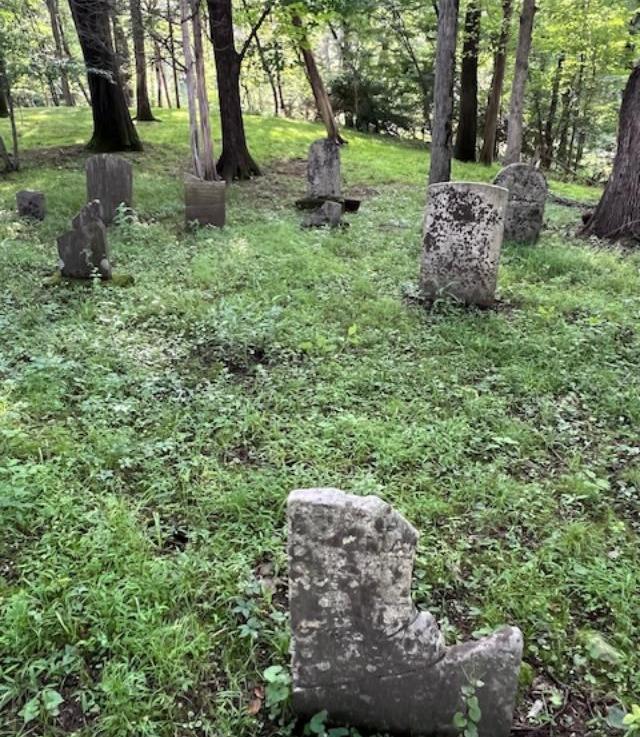
The inside of the cemetery on s gloomy afternoon

The Nagel family plot inside the cemetery

I visited the Nagel-Auryansen Cemetery one gloomy afternoon. This small cemetery is one of about a half dozen in Bergen County, NJ that were once part of family homesteads that are long gone.

These once important family farms started to disappear after the Civil War and with the coming of income tax, smaller families and automation of farming, these farms disappeared. These small cemeteries are what remains of these families legacies.

The grave of resident Abraham Auryansen

The Auryansen family plot inside the cemetery

The Nagel family plot inside the cemetery

The Auryansen family plot inside the cemetery towards the back

The Nagel and Haring family gravestones

The gravestones closer to the entrance of the cemetery

On the next block over, the original family farmhouse along with the Metropolitan farm still exists. The family farmhouse and nursery are still part of the community. It is the oldest continuous farms in the State of New Jersey.

The Metropolitan Farm is home to the Resolvert Nagel Farmhouse and farm

The historic marker to the home

The entrance to the Metropolitan Farm at 119 Hickory Lane in Closter, NJ

https://www.metropolitanfarm.com/

My review on TripAdvisor:

History of the Farm:

(from the Metropolitan Farm website)

Started in 2012, our farm is located on the property which is the oldest working farm in the State of New Jersey. Every year, we are improving our ability to help you and make it more convenient to access our 70.000 perennials.

​Our perennial growers have been working with perennials in Northern New Jersey for over 30 years. In that time, they have discovered what works the best and what thrives in our hot summers and survives our bitter cold winters. We overwinter all our perennials that we carry and our products are ready to be planted and enjoyed wherever you may place them.

The original section of the Nagel family farmhouse

The History of the farmhouse:

(from the Metropolitan Farm website)

The Stone Farmhouse dates back to the early 1700’s. The Auryansen/Naugle family lived here for generations and owned over 1000 acres from the hudson river to the farm. (Currently parts of Alpine and Closter). It was sold to several other families and was put into the Historic Commission in 1980. The house was sold to the current owners in 2012 along with the rest of the property and was renovated to restore some of its original beauty and architecture. Part of the current family lives there now.

The modern farmhouse today with modern addition

The Metropolitan Farm and Nursery

The outside plants at the farm

The outside plant and shrubs

The perennials for sale on the farm

The greenhouse flowers

The greenhouse flowers and plants

The inside of the farm store

Inside the farm store

The beautiful flowers on sale at the store

The outside grounds and the property left of this historical farm in Closter, NJ

It is interesting to see how the legacy of this family still lives on in the Twentieth century as a nursery farm but it shows how it has matured and adapted to today’s population.

Some of the descendants of these families still call Bergen County home and are also names we see on streets, towns and schools in the area.