Category: Exploring Lower Manhattan

One World Trade Observatory 285 Fulton Street New York, NY 10007

One World Trade Observatory 285 Fulton Street New York, NY 10007

One World Trade Center Observatory

285 Fulton Street

New York, NY 10007

(844) 696-1776

Open: Sunday-Saturday 9:00am-9:00pm (hours change seasonally)

Admission: See the website for prices depending on individual and group prices seasonally

My review on TripAdvisor:

https://www.tripadvisor.com/Attraction_Review-g60763-d8072300-Reviews-One_World_Observatory-New_York_City_New_York.html

Though it is not a museum, it is a view of the world. I had been to the original World Trade Center three times before 9/11 and the views were just amazing. There is nothing like it as the Empire State Building’s are a bit different.
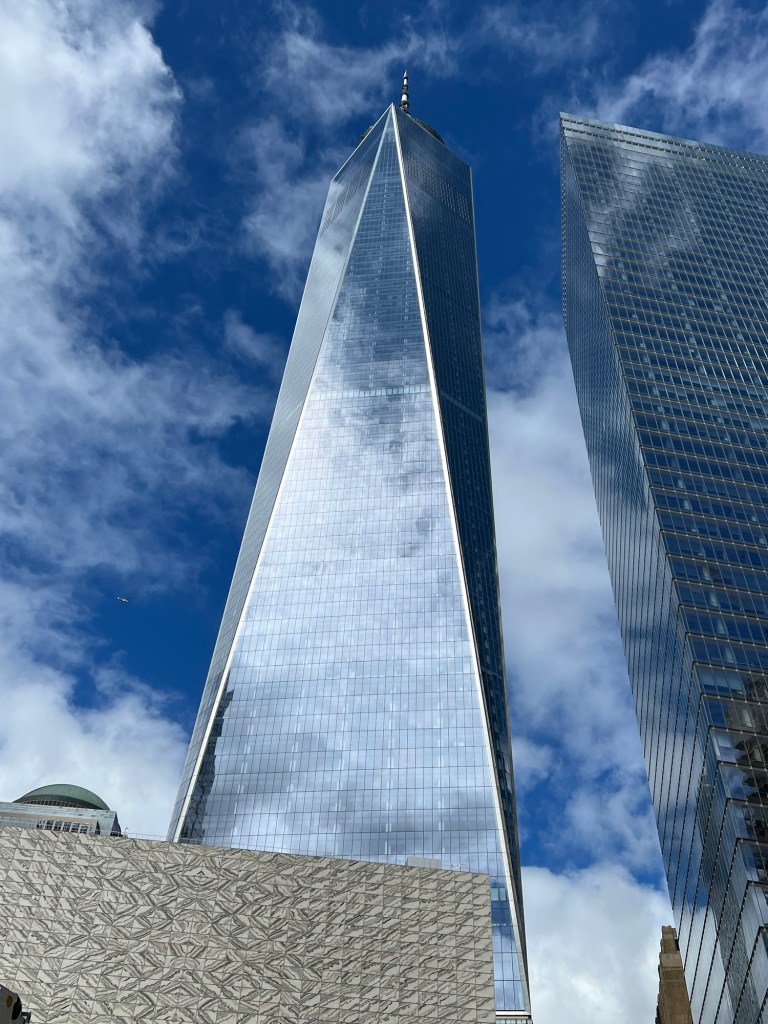
One World Trade-The former Freedom Tower

https://www.officialworldtradecenter.com/en/local/things-to-do/one-world-observatory.html

The building itself is very impressive to visit (quite frankly I would NEVER want to work here) but with its past leery of anything else. Too many people died on this site and I would not want to work in an office here no matter what company. I would want a parachute in my office at all times. Still this was going to be my second trip to the top of the building since 2015 when I visited with my best friend, Kris.

I had won two tickets to the Observatory from a contest at NYU and had set VIP tickets to skip the line to go to the top. At 10:00am in the morning, there was no line to skip. I went right to the top with not that many people there at that time. If you get there early in the morning in the off season, there are no crowds.
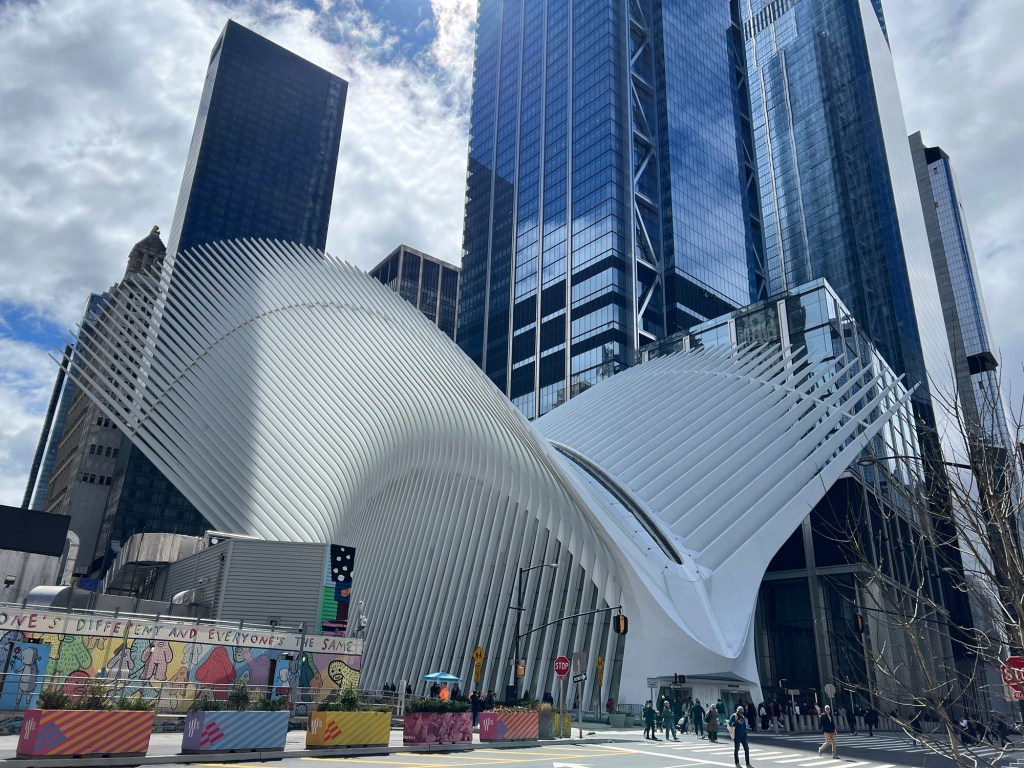
The site is still so impressive. This is the Occulus right by the Tower.

One World Observatory is at the top of the tallest building in the Western Hemisphere, One World Trade Center. The Observatory is located on the 100th, 101st, and 102nd floors encompassing over 125,000 square feet. You’ll take an incredible Sky Pod Elevator ride to the top. Once aloft guests can explore three levels of the Observatory filled with innovation and inspiration. One World Observatory offers views of New York City’s iconic sights, surrounding waters, and iconic skyline – amazing 360 views for up to 45 miles in every direction (One World Trade Center website).
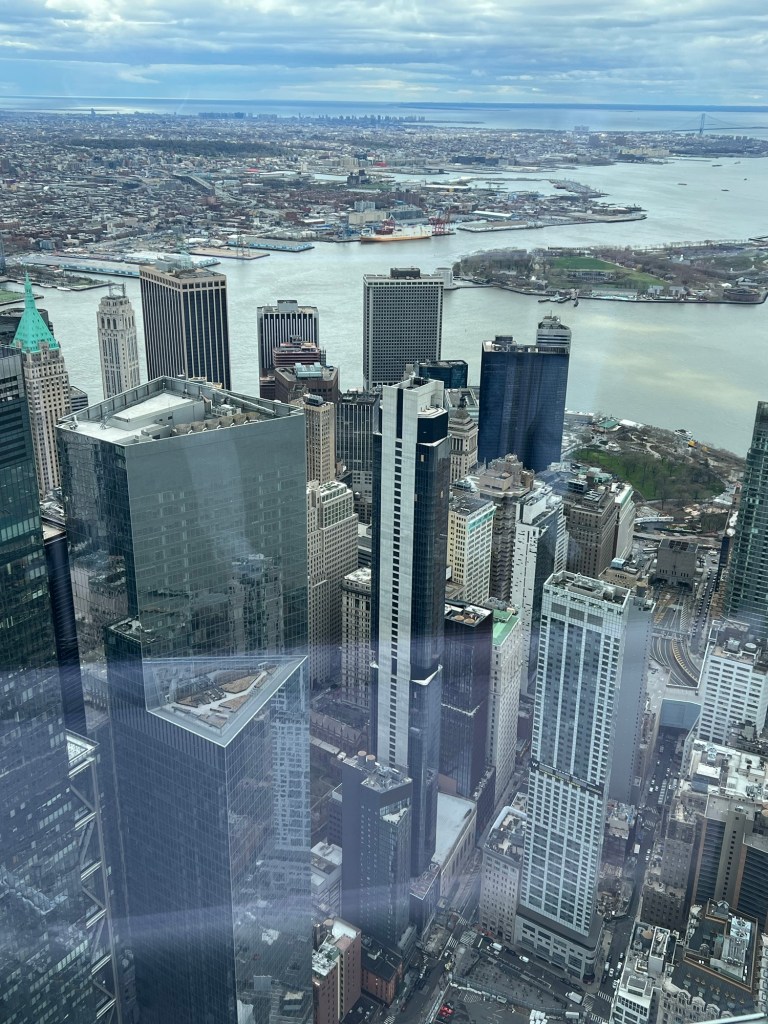
The views from the top are so impressive of downtown and Governors Island.
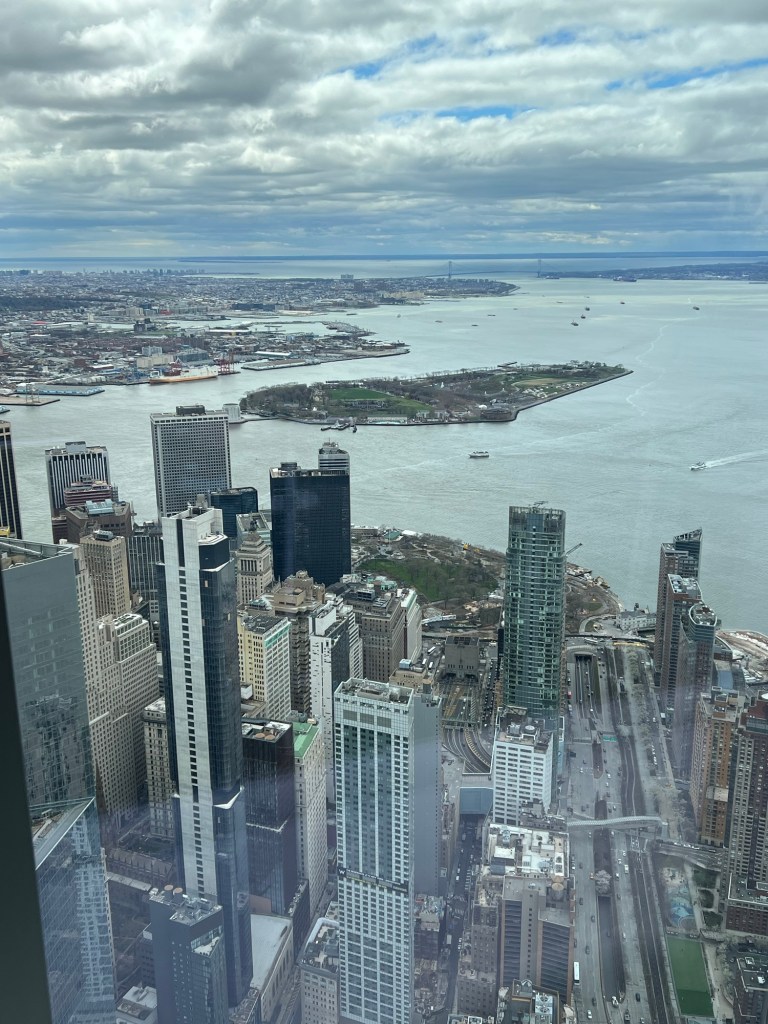
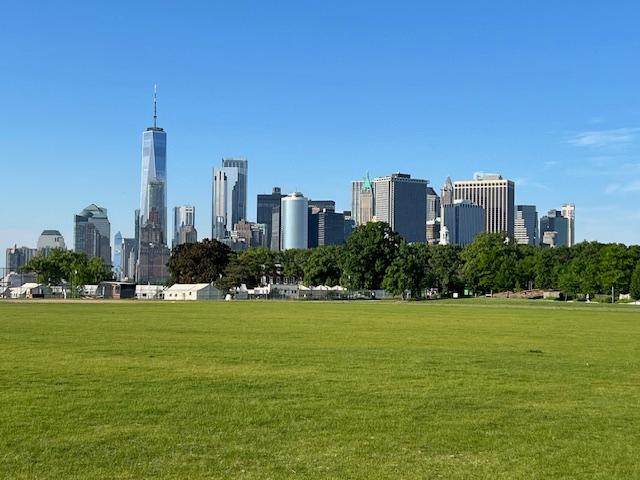
Governors Island in the foreground and lower Manhattan. This is the original colony.
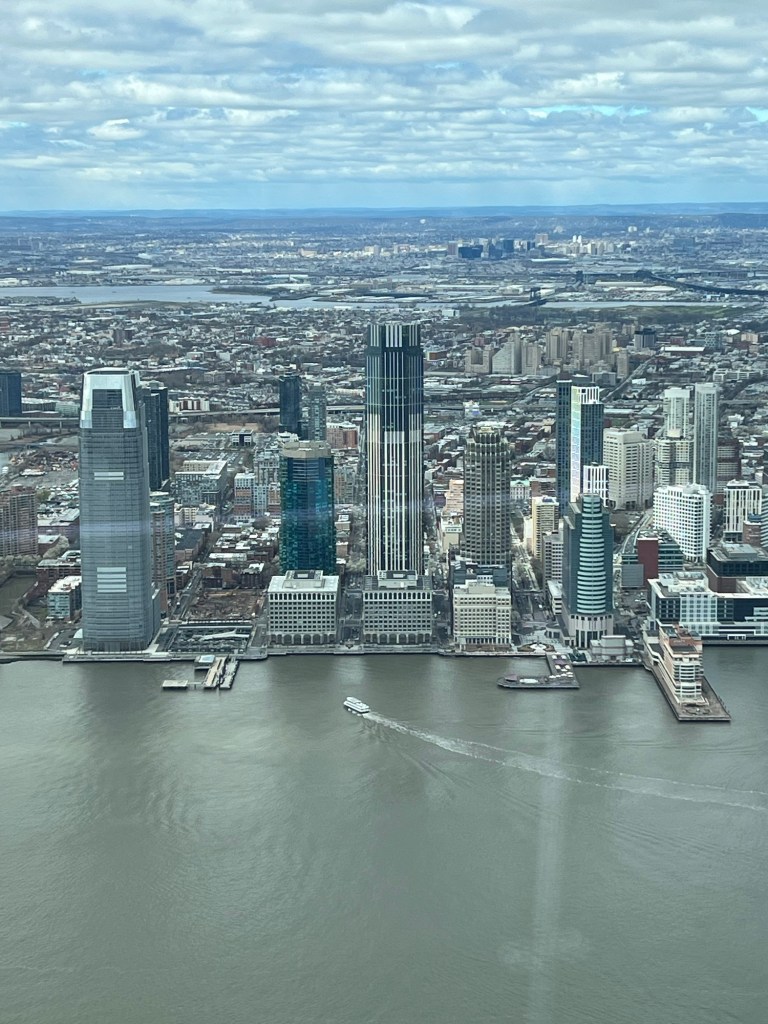
The views of Downtown Jersey City and the Waterfront are so spectacular.

The Statue of Liberty seemed so close.

The views of Downtown Brooklyn were amazing.
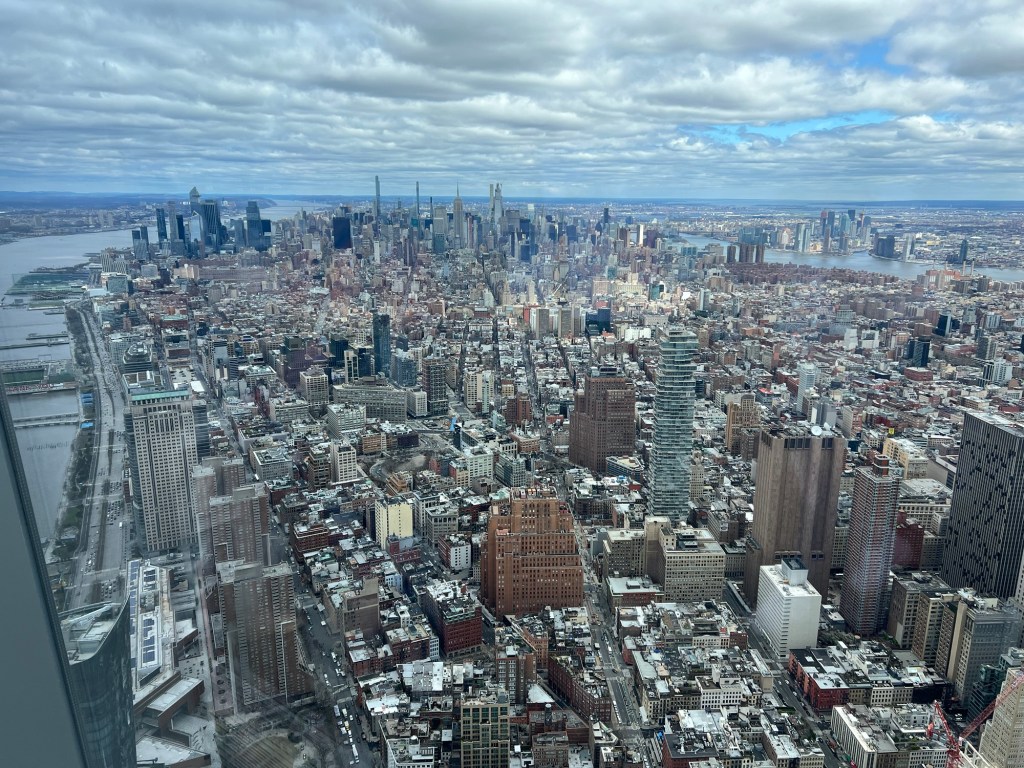
Midtown was so impressive on a clear day. You can see all the way up to Central Park.

Even the Battery was so impressive from this vantage point along the Hudson River.
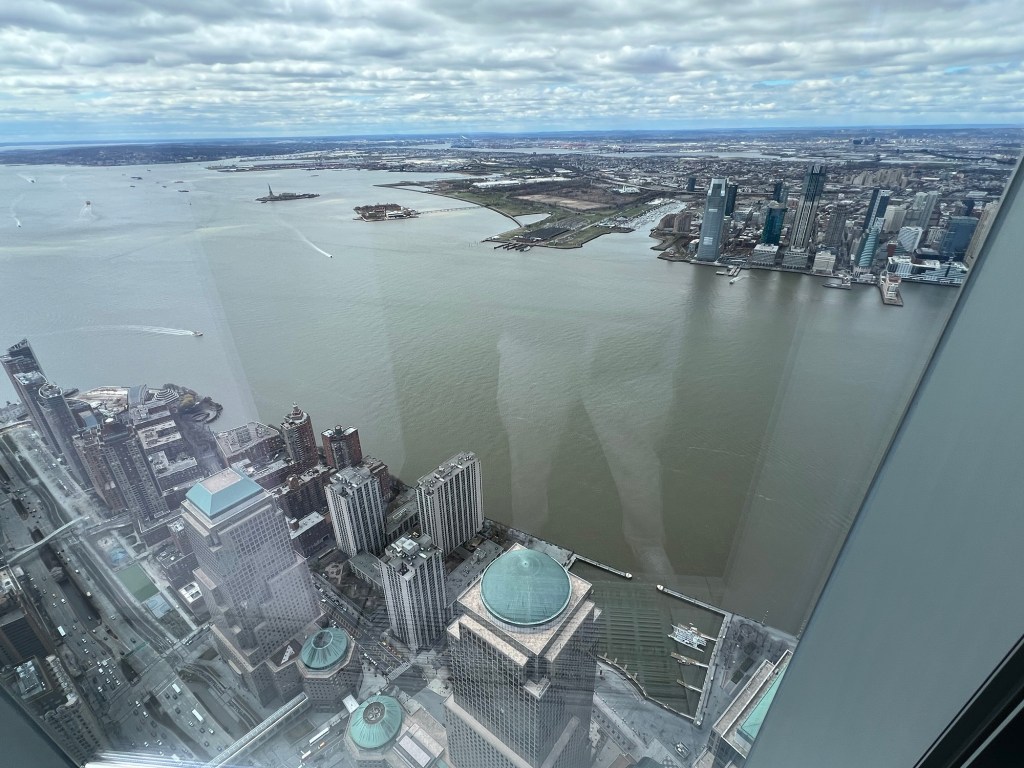
Another shot of the Battery and Jersey City.
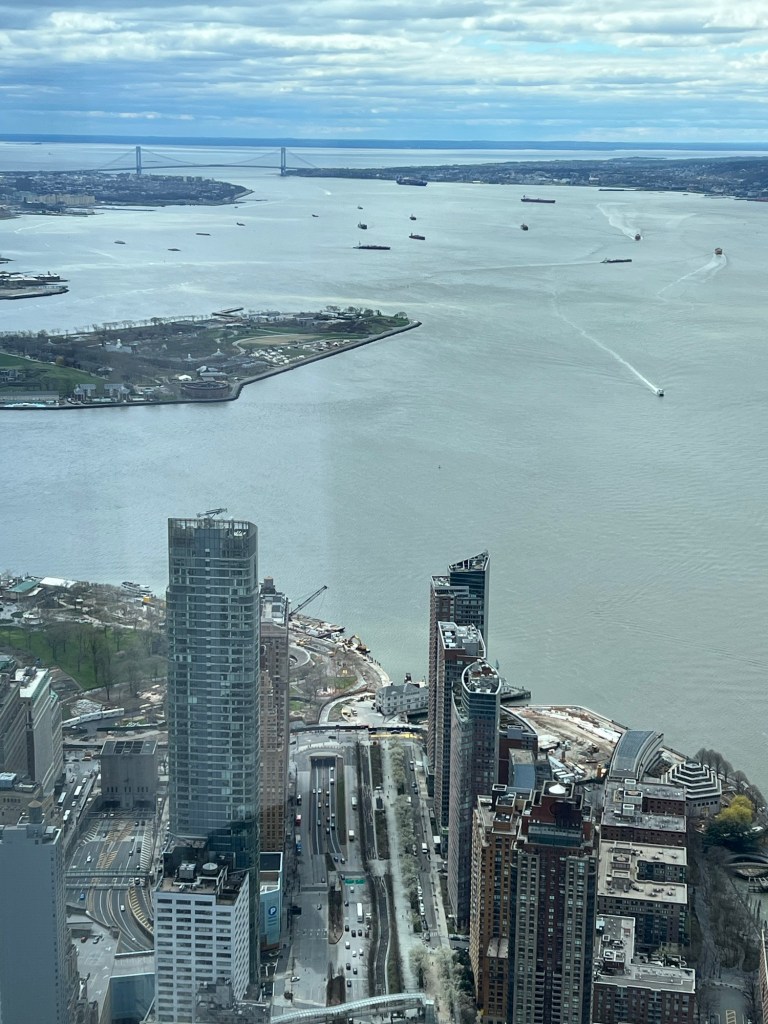
The views of New York Harbor are spectacular.

The Oculus and the Memorial Pools of the 9/11 Memorial from the top of the Observatory.
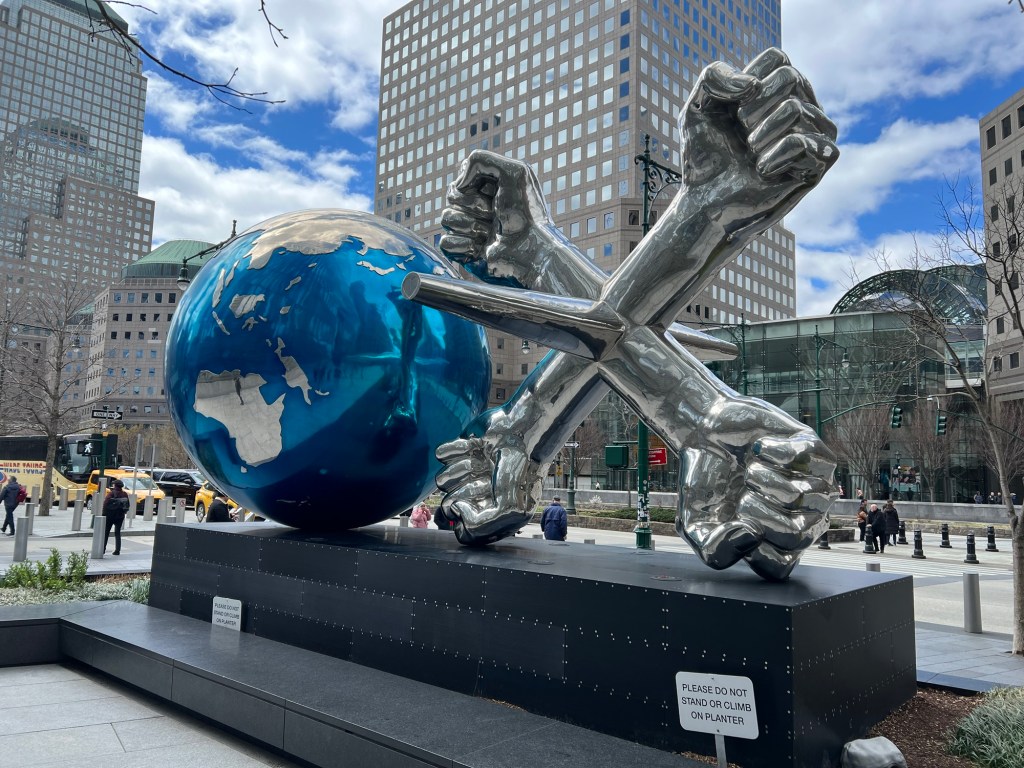
This interesting sculpture, XO World Project, is at the entrance when you leave the building.

https://www.officialworldtradecenter.com/en/local/things-to-do/events/xo-world-project.html#:~:text=The%20XO%20WORLD%20PROJECT%2C%20created,and%20love%20around%20the%20world.

The XO World Project was created by artist Daniel Anderson, features two sculptures, “XO PLAY” and “XO WORLD,” that encourage peace and love around the world. “XO PLAY,” on display in the Oculus, depicts children playing a game of jacks, symbolizing childhood innocence and harmony with the world. “XO WORLD,” on display just outside One World Trade Center at West Plaza, features a 12-foot “Jack” from the game of Jacks with an “X” representing “love” in universal sign language and “O” representing the world (World Trade Center website).

Artist Daniel Anderson

https://www.danielandersonart.com/

Contemporary abstract sculptor and painter Daniel Anderson was born and raised in Pompton Plains, New Jersey. His interest and passion for art began at an early age and led him to be recruited and to receive a scholarship to attend the College of Visual & Performing Arts at Syracuse University in New York. He continued his formal education in Florence, Italy, and was the sole artist from New York City selected to participate in an annual residency program in Melbourne, Australia (Artist’s website).

The sculpture is a visual expression of the powerful message of equality, unity, peace, and love. This use of iconography and symbolism is meant to connect with the hearts and minds of the masses as it is intended to motivate, activate, and further progress humanity (Artist’s website). 

“As our society faces unprecedented challenges stemming from a global pandemic, economic recovery, racial inequity, and territorial conflicts, World Peace Day offers the perfect backdrop to unveil these two inspiring sculptures intended to bring people together,” said Anderson (Business Wire.com)

The view from the bottom when you leave.

The view from the 9/11 Memorial Park.
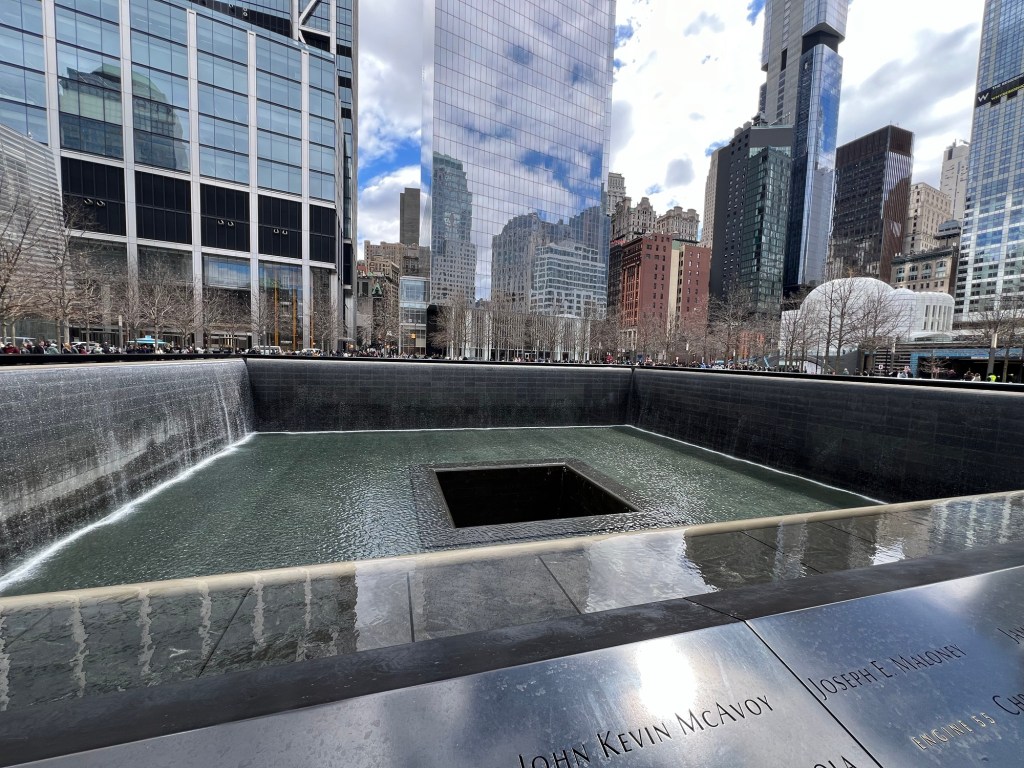
The 9/11 Memorial Pools which are the footprint of the original Trade Center Buildings.

https://www.911memorial.org/visit/memorial/about-memorial

This memorial still gets me choked up with what happened here over twenty years ago. I still see flags and flowers of near loved ones names along the edges of the pools. It is nice that family members still remember their family here.
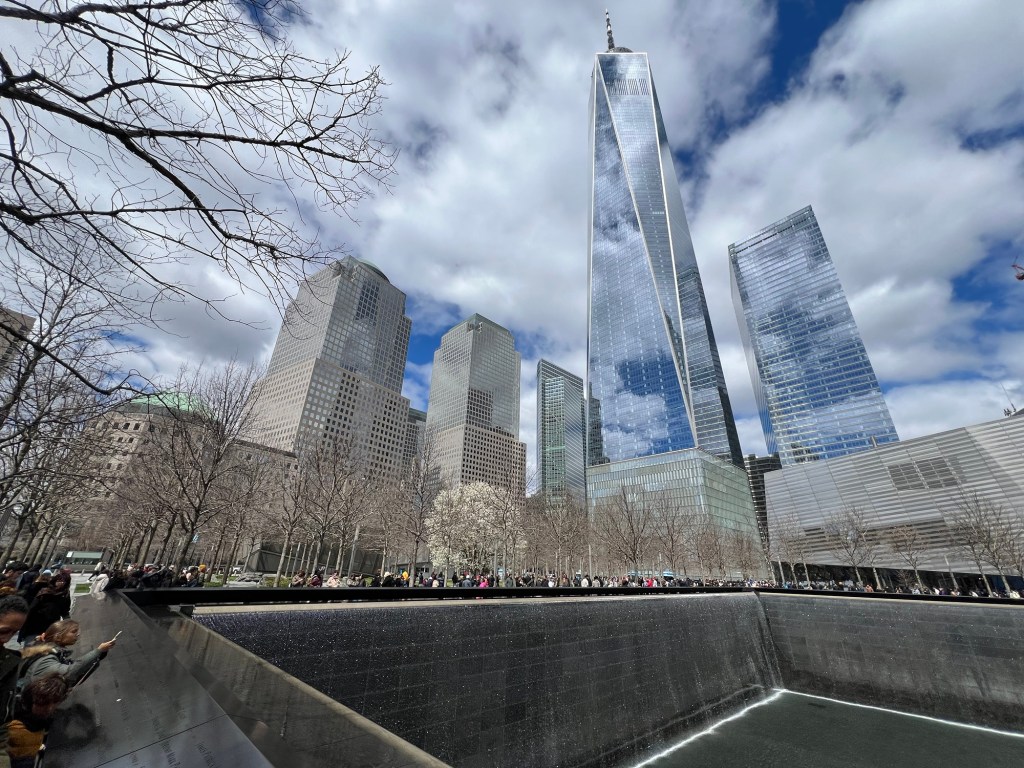
The skyline of the park from the Memorial pools.

The pools are reminder of time when the world went mad. Those feelings are still simmering under the surface of society today.
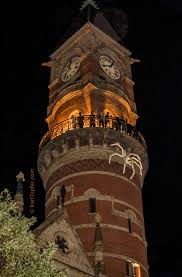
Day Two Hundred and Four: Halloween Returns Part I: The Gotham City Ghost Tour/Michigan vs Michigan State Game                                   October 30th, 2021 — mywalkinmanhattan.com

Day Two Hundred and Four: Halloween Returns Part I: The Gotham City Ghost Tour/Michigan vs Michigan State Game October 30th, 2021 — mywalkinmanhattan.com

I had a busy Halloween weekend with the Michigan State versus Michigan game and a Gotham City Ghost tour in the afternoon. Halloween searching for ghosts.

Day Two Hundred and Four: Halloween Returns Part I: The Gotham City Ghost Tour/Michigan vs Michigan State Game October 30th, 2021 — mywalkinmanhattan

Please print this guide to haunted sites of Lower Manhattan and have a nice afternoon walking around. It is a nice tour!

Titanic Memorial Lighthouse                            Pearl Street/South Street Seaport                     New York, NY 10038

Titanic Memorial Lighthouse Pearl Street/South Street Seaport New York, NY 10038

Titanic Memorial Lighthouse

Pearl Street/South Street Seaport

New York, NY 10038

(212) 830-7700

https://www.lighthousefriends.com/light.asp?ID=585

https://en.wikipedia.org/wiki/Titanic_Memorial_(New_York_City)

Open: Sunday-Saturday 24 Hours

My review on TripAdvisor:

https://www.tripadvisor.com/Attraction_Review-g60763-d7738946-Reviews-Titanic_Memorial_Park-New_York_City_New_York.html

The Titanic Memorial Lighthouse

I have been to the South Street Seaport dozens of times over the years and can’t believe that I never noticed this memorial dedicated to those lost in the Titanic disaster. I was visiting the Seaport recently after finishing another walk down the length of Broadway for my blog, “MywalkinManhattan.com” and was walking past the Seaport on my way to Chinatown. Something about it this time caught my attention and I stopped to look at the dedication of this small lighthouse.

It was really touching to see that the people from the 1912 disaster were not forgotten in New York City, its ultimate destination. This was the work of Molly Brown, the ‘Unsinkable Molly Brown’ from the movie. She wanted to be sure that the people who survived were never forgotten. The small lighthouse structure sits at the entrance to the main part of the seaport on an island just off the cobblestone walkway into the complex.

The Memorial plaque on the lighthouse

The tower that it was originally placed a top of the Seamen’s Church Institute Building and it was put up for sale and demolished in 1965 and the small lighthouse memorial was donated to the South Street Seaport Museum. It was placed in its current location in 1976 (Friends of the Lighthouse).

The little lighthouse is a touching reminder of Manhattan’s connection to the event over 100 years ago. Try not to miss it when you are visiting the Seaport.

The history of the Titanic Memorial Lighthouse:

(This is from the Friends of the Titanic Memorial Lighthouse website)

On April 15th, 1913, one year after the sinking of the Titanic, the Titanic Memorial Lighthouse and Time Ball, mounted atop the Seamen’s Church Institute, were dedicated to honor the passengers, officers and crew who perished in the tragedy. The dedicatory service opened with a hymn and prayer and then Rt. Rev. David h Greer, Bishop of New York, read the following lines of dedication:

“To the glory of Almighty God and in loving memory of those passengers, officers and crew who lost their lives in the foundering of the steamship, Titanic, on April 15, 1912, I, David Hummell Greer, Bishop of New York and president of the Seamen’s Church Institute of New York, do solemnly dedicate the Titanic Memorial Lighthouse Tower. As its light by night shall guide pilgrims and seafaring men from every clime into this port, so may they follow Him who is the Light of Life across the waves of this troublesome world to everlasting life and looking at noon toward this place to note the time of day, may they remember that our days pass as the swift ships and in view of the shortness and uncertainty of human life, strive to fulfill their duty well as the beat preparation for Eternity. Amen.”

The Titanic Memorial Lighthouse exhibited a fixed green light that could be seen throughout New York harbor and down as far as Sandy Hook. Five minutes before noon each day, a time ball would be hoisted to the top of a steel rod mounted atop the lighthouse and dropped at the stroke of twelve as indicated over the wires from Washington DC. According to The Lookout, the magazine of the Seamen’s Church Institute, the Titanic Memorial Lighthouse would be a much needed daily reminder for ‘in a busy, carless city the average person so soon forgets’.

The Seamen’s Church Institute was established in 1834 and had announced plans for its new twelve story headquarters at South Street and Coenties Slip in Lower Manhattan several years before the loss of the Titanic. The Flemish style building was meant to reflect new York’s Dutch origins and was to be crowned by a tower whose beacon would welcome incoming seamen. The cornerstone for the building was laid one day after the sinking of the Titanic and a week later the institute announced the lighthouse atop their building would be a memorial to the victims of the tragedy.

Fort Jay                                                       Governors Island                                                 New York City, NY 10004

Fort Jay Governors Island New York City, NY 10004

Fort Jay

Governors Island

New York, NY 10004

My review on TripAdvisor:

https://www.tripadvisor.com/Attraction_Review-g60763-d136072-Reviews-Governors_Island_National_Monument-New_York_City_New_York.html?m=19905

My review on MywalkinManhattan.com in 2018 and 2024:

https://wordpress.com/post/mywalkinmanhattan.com/7658

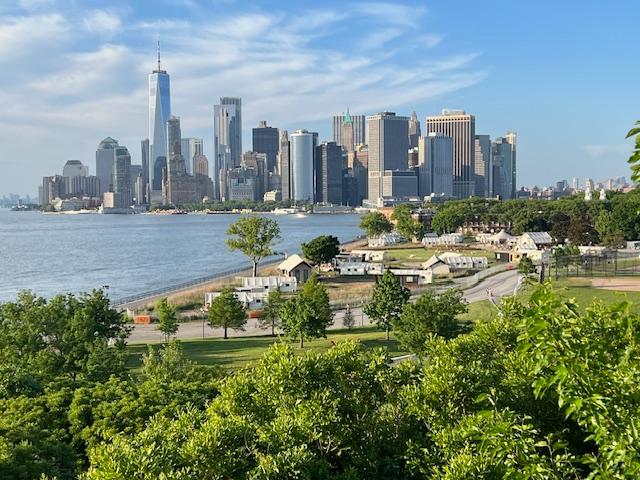
The view from the top of the hill on Governor’s Island.

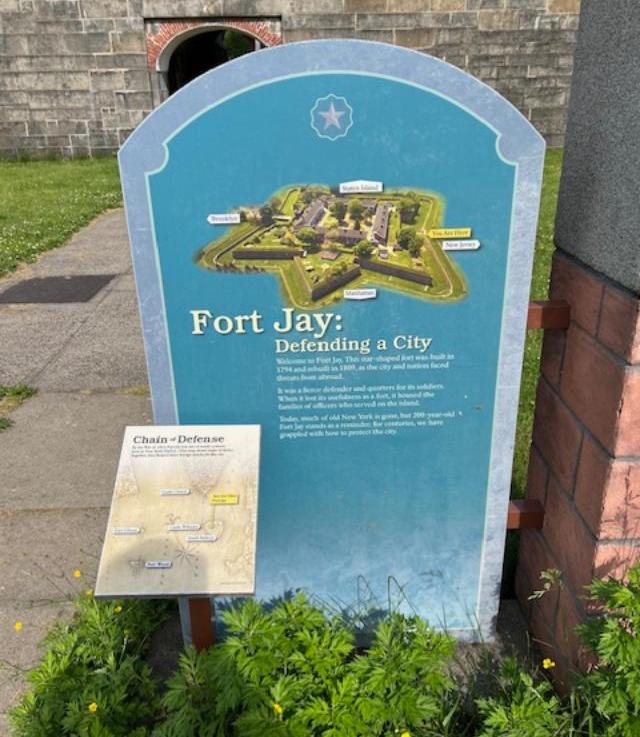
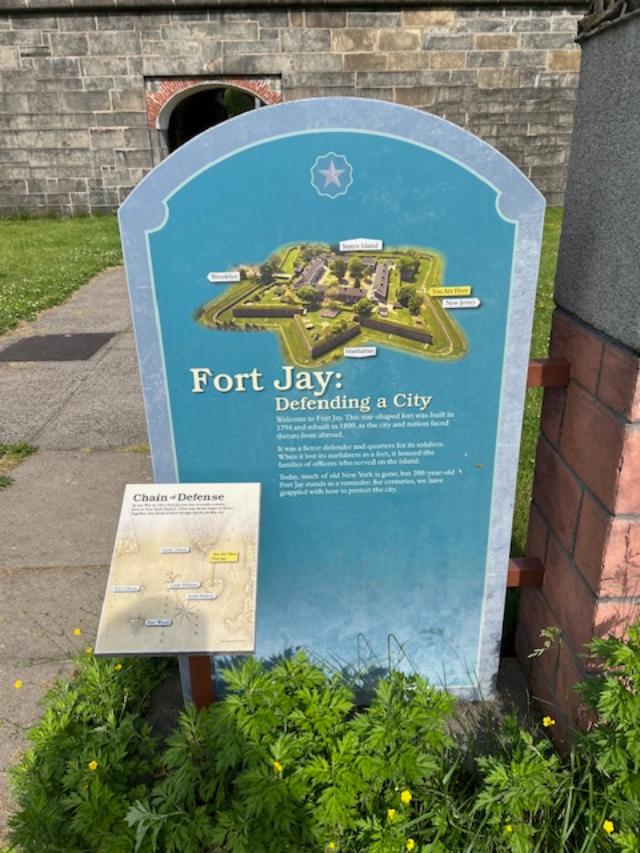
When I was touring Governors Island for my blog, “MywalkinManhattan.com”, I explored the Fort Jay complex which is located on the northern end of the island just past Castle Williams. This fort is mostly in a state of ruin and is currently being restored at various stages all around the complex. The decorative entrance with its statuary is being cleaned and the entrance fixed on one side of the fort and the walls and some of the interior space is being repaired inside the fort.

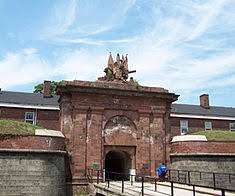
The main entrance to Fort Jay (currently under restoration)

This fort and Castle Williams were built to protect the City of New York between the Revolutionary War and the War of 1812. After that these forts fell out of use as the times and technology changed .

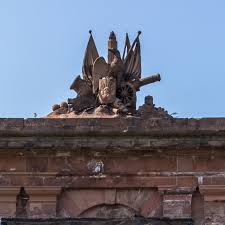
The decorative statuary is being repaired on the fort (currently under restoration)

Now the fort is used for art exhibitions in some of the interior hallways and grass has grown over most of the walkways. Still it is interesting to walk along the pathways near the walls of the fort and see how they were once used. It is interesting to see how far we have progressed in warfare.

The entrance to Fort Jay

The History of Fort Jay:

Fort Jay is located on Governors Island in New York Harbor, one half-mile from the southern tip of Manhattan. No defensive works are known to have been erected on the island during its early history. Defensive earthen works were first erected on the highest point of Governors Island by Continental troops in 1775-76. The island and its fort were occupied by the British during the American Revolution until 1783, when it surrendered, along with several buildings to the Governor of New York.

More than ten years passed before renewed tensions with Great Britain resulted in funding from both the New York Legislature and the United States Congress in 1794 to reconstruct the works on Governors Island. This part of a larger national effort to fortify ports that later became known as the First American System of coastal fortifications.

Design of the New York Harbor defenses was assigned to French engineer Charles Vincent. The works on Governors Island had been completed by 1796, described in January of that year by the Secretary of War as “a fort made of earth and two batteries under its protection, partly lined with brick masonry, two air furnaces, a large powder magazine and a barrack for the garrison.”

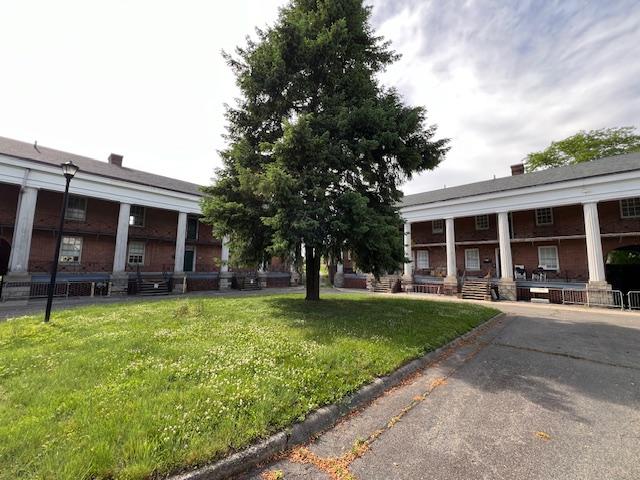
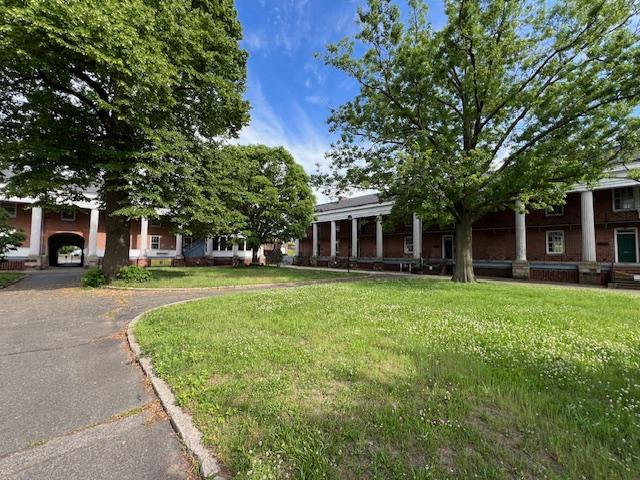
The inside of Fort Jay.

Fears of a French invasion in 1797 resulted in a second phase effort funded by additional appropriations to complete and enhance the coastal fortifications, including those on Governors Island. The fort is said to have acquired the name “Fort Jay” in 1798 for John Jay, then the Governor of New York State. Governors Island and its fort were conveyed to the federal government two years later in 1800, by an Act of the New York State Legislature.

The inside of Fort Jay

A plan of the fort as it existed that year shows it as a four-bastioned form surrounded by a ditch with a parapet having 51 embrasures, a gate and bridge on the east side and a large magazine in the northeast bastion. The fort was still incomplete and incapable of defense in 1802 according to a written report, although it was then equipped with a “handsome Gateway with a Corps de Garde” or guardhouse, that survives today.

Fort Jay had fallen into ruinous condition by 1806 when a second national campaign to strengthen the coastal defenses of the country, now known as the Second American System of fortifications, was implemented. This effort differed from the first by employing American engineers and using more durable masonry construction.

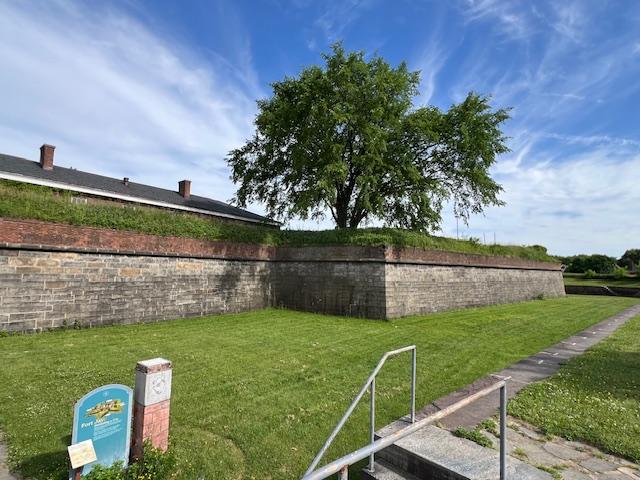
The outside wall of the fort.

The engineer chosen to design and oversee the defenses of New York Harbor was Colonel Jonathan Williams, Chief Engineer of the Corps of Engineers and first Superintendent of the Military Academy at West Point. Reconstruction of Fort Jay, renamed Fort Columbus about this time, began in July 1806 and was completed by December 1809. The only components of the old fort judged worth saving were “the walled Counterscarp, the Gate, the Magazine and the Barracks,” according to Colonel Williams in a report dated November 1808.

The completed fort was described in a later report to Congress as “an enclosed pentagonal work, with four bastions of masonry, calculated for one hundred guns, fifty-five mounted with brick barracks for two hundred and thirty men, including officers. The earliest known plan of the completed fort is a plan by Joseph Mangin drawn in 1813.

The walkway between the forts.

The first significant repairs and alterations were made to Fort Columbus in the 1830’s, resulting in the overall appearance of the fort as it exists today. The stone retaining walls were extensively rebuilt at this time, including the scarp that was faced with granite and topped with a new brickwork parapet. The old magazine in the northeast bastion was demolished and replaced by four new magazines erected in the north ravelin. Finally, the four existing brick were replaced by four new barracks with flanking triangular structures and outdoor courtyards.

Later changes have been made to the barracks by the U.S. Army over the years, including interior remodeling and replacement of the flat roofs with hipped roofs in 1855-57, incorporated of five of the triangular buildings as additions in the 1860’s and 1898-99 and reconfiguration of the buildings as officers’ apartments in 1921-22 and again in the 1930’s. Paint was stripped from the exterior brick buildings in the 1930’s, the sodded glacis of the fort was converted to recreational use as a golf course by 1940 and the flagstaff was moved from the northwest bastion to the north ravelin by 1953.

The lawn on Governor’s Island overlooking Lower Manhattan.

Jurisdiction of Governors Island passed from the U.S. Army to the U.S. Coastguard in 1966. Improvements made by the Coast Guard to Fort Jay, whose name was officially reinstated in 1904, included expansion of the golf course; remodeling of the barracks with new kitchens, bathrooms, heating and electrical systems and storm windows and doors and erection of chain-link fencing on the glacis. Fort Jay sat vacant with minimal upkeep since the closure of the Coast Guard in 1997.

Fort Jay was recorded by the Historic American Buildings survey in 1934 and in 1982-83. The fort was individually listed in the National Register of Historic Places in 1974. It was included in a National Historic Landmark District designated in 1985 and a New York Historic District designated in 1996. The fort is also located within the boundaries of the Governors Island National Monument, established by Presidential Proclamations in 2001 and 2003.

(This information I credit to the National Park System-Division of Culture website)