One thing you should add to your bucket list is visiting Punxsutawney to see the groundhog ceremony once. It is an experience. I visited in 2015 when it was 54 degrees so that was great. I visited Staten Island Chuck the last two years at the Staten Island Zoo.
I returned to Punxsutawney, PA in the Winter of 2024 and it was a much bigger festival than before, More places for breakfast, more places open and much more events over the weekend. I think the town learned a few things over the last eight years.
Downtown Punxsutawney, PA on Groundhog’s Day morning
Downtown Punxsutawney, PA on Groundhog’s Day
Phil statues are all over the downtown
The Governor of Pennsylvania introducing Phil at Groundhog’s Day 2024
I was working on a new project for the Lodi Memorial Library to have a Groundhog’s Day celebration but try to find a groundhog in New Jersey. No zoo or natural group had one so we revamped the event for the first day of Spring and will have a rabbit (See Lodi Larry comes to the Library Day: Day Forty MywalkinManhattan). When the event fell through and all this talk of Groundhog’s Day I decided to go to the source and off I went to celebrate Groundhog’s Day in Punxsutawney, Pennsylvania.
Punxsutawney is about five hours from my house so it was not the quickest trip but it is all straight highway down Route 80 until you get to Route 219 and then a turn off onto Route 119 South where you twist and turn until you get to Punxsutawney, a sleepy little former coal mining and coke town.
I had planned to go out to Punxsutawney, PA again for Groundhog’s Day but the weather really turned this year. There was an Arctic Vortex (or whatever they are calling it this week) and the weather plunged in Pennsylvania. It was going to be 20 degrees on Groundhog’s Day (that meant 0 degrees that night) and raining when I would drive home on Sunday and I thought that would be over doing it for me.
I later saw that it did go up to 38 degrees that day in Punxsutawney, higher than expected but the overnight Friday night into Saturday was 4 degrees and sorry but the thought of standing in Gobbler’s Knob for five and a half hours in that weather was too much. I did that in 2016 in 30 degrees and that was bad enough. I will wait until next year.
Bergen County Department of Parks, Division of Cultural and Historic Affairs
Court Plaza South
21 Main Street, Room 203 W
Hackensack, N.J. 07601-7000
Survey of the Early Stone Houses of Bergen County:
One of the most important early American building types is that of the pre-1840 stone house built in areas with Dutch Cultural affiliation. Bergen County is unique in the abundance, variety and architectural quality of these early stone houses, although adjacent areas of New Jersey and New York have some of the type.
Materials and methods remained constant but the house which were built from the time of Dutch colonization in the 17th century vary in size, plan and stylistic detail. Bergen County’s surviving early stone houses many located along major thoroughfares, provide county residents with tangible links to the formation years of the County, State and Nation.
The Campbell-Christi House at New Bridge Landing/Bergen County Historical Society
The Survey of Early Stone Houses of Bergen County conducted in 1978-79 identified and recorded 230 of these early houses. Of these, 208 retained sufficient architectural integrity to be placed as a thematic group on the New Jersey Register of Historic Places in 1983, 1984 and 1985. A clear recognition of the houses importance is given by inclusion on these Registers, which are the State’s and Nation’s official lists of cultural resources worthy of preservation.
For inclusion in the Stone House Survey a building has to have at least two first story walls of pre-1840 stonework. The stone used in constructing the houses varies according to what as locally available. Many of the houses have reddish-brown sandstone walls but in the north-western section of the county rougher local fieldstone was utilized. Some houses have exterior walls of various types of stone and in some brick or frame exterior walls appear with stone ones. Frequently front facades display finer masonry work than do sides and rear. Usually the houses are 1 1/2 stories in height and have gable or gambrel roofs, sometimes with sweeping overhangs. Often there are side wings.
Wortendyke Barn in Oakland, NJ
The Wortendyke Homestead across the street from the barn.
Examples of the house-type are commonly called “Dutch Colonial.” This name most frequently applied to gambrel-roofed houses is a misnomer. Most of the houses were erected in the early 19th century, long after New Jersey passed from Dutch control in 1664. They date to a time when Anglo-American culture was being assimilated into Bergen’s Dutch cultural base. The typical stone house of the Colonial Period in Bergen County is a simple gable-roofed building.
Because they have been continuous use since they were constructed, many early stone houses have been modified and embellished. Often these changes in themselves have architectural distinction and are important to Bergen’s 19th and 20th century architectural history. Even when altered, the basic form and fabric of the original stone dwellings are usually recognizable and the houses are part of the county’s earliest architectural heritage.
Cadmus House in Fairlawn, NJ
The Stone House survey was sponsored by the Bergen County Board of Chosen Freeholders, the Bergen County Historic Sites Advisory Board and the Division of Cultural and Historic Affairs. It was prepared by the Office of Albin H. Rothe, A.I.A. Claire K. Tholl did the field survey. The survey was made possible by a grant-in-aid from the Office of New Jersey Heritage, Division of Parks and Forestry, N.J. Department of Environmental Protection and matched by funds from the Bergen County Board of Chosen Freeholders.
The report for the Survey of the Early Stone Houses, with background text and inventory forms for houses, may be consulted at the Division of Cultural and Historic Affairs between 9:00am and 4:30pm weekdays.
Hopper House in Upper Saddle River, NJ
The Banta-Coe House on the Fairleigh Dickinson University campus
The Banta-Coe House prominently faces the Hackensack River
Disclaimer: This information was taken directly from the Bergen County Department of Parks, Division of Cultural and Historic Affairs pamphlet and I give them full credit for this information. Please contact the Department for more information on the subject.
The entrance to Mesier Park where the Homestead is located
The plaque outside the home
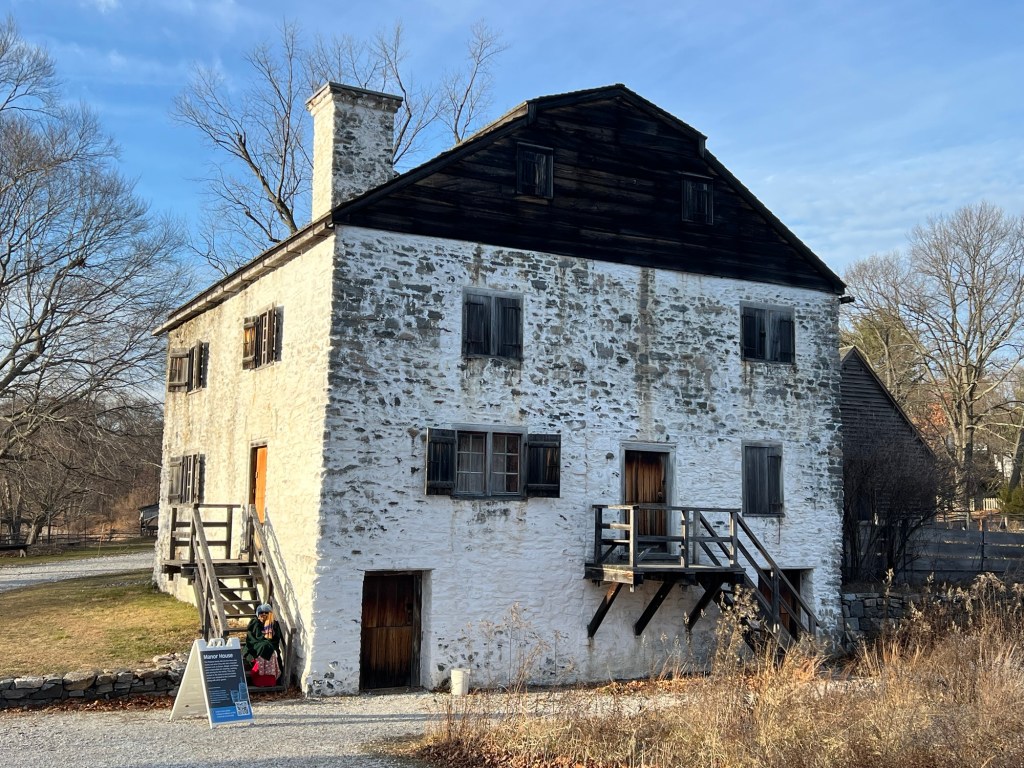
I visited the Mesier Homestead recently and toured the home with a local docent. Home to four generations of the Mesier family, the house has been added onto since it was built in the mid-1700’s. The rooms are decorated with furnishings from the Victorian era and shows life as it may have been in the late 1880’s at the height of the Victorian era.
The Mesier Homestead in the summer months
The tour of the rooms shows how the home was added onto to meet the increased demands of a growing family and one of increasing affluence. The original home was added onto from the back to add service areas and work areas for the household.
The entrance to the Mesier Homestead
A portrait of Mrs. Mesier in the hallway
When you enter the foyer from the front door, there are reproductions of family portraits hallway that had served as the parlor of the original house. As the house expanded, this area became the formal entrance to the home. To the right of the foyer, there is the Living Room, where the Historical Society has uncovered one of the two fireplaces from the original home that once heated the rooms.
The reproductions of Mr. and Mrs. Mesier in the Living Room
During the late 1800’s, the son of the owner heightened the ceilings to get rid of the railroad ties that once decorated the ceiling. This gave the room a more modern look and showed the affluence of the family that could heat a home with heigh ceilings.
The Mesier Homestead Living Room
Another view of the Living Room
The room furnishings included family paintings, a then modern Victrola, ornated furniture and diagram of the family tree. The small steps led to a small office off the Living Room that was added onto with more family objects.
The Library and Office off the Living Room at the Mesier Homestead
When you entered the room from the kitchen and the Butler’s Pantry where food was finished and readied to be served, a formally set Dining Room for dinner showed the family’s status in the community.
The Dining Room at the Mesier Homestead
The sideboard and the Dining Room table
An ornate china set from England enhanced the table with fine linens that the family would have owned. A newly opened fireplace that had once heated the dining room was shown by a heating unit that would have been used in the Victorian age. All sorts of fine decorative objects lined the tables and shelves.
The Dining Room table is set for a fine dinner at the Mesier home
By the amount of space available for living and entertaining with the separate rooms for use in the home it showed how times were changing with the affluence of that time. The family would show off their fine things to show their status in the community.
The Fan Collection from Victorian times
The second-floor tour is a view of the slave/then servants’ quarters and the two-family bedrooms. What I thought was interesting on the tour is how the family had to co-mingle in the bedrooms because of the number of children in the family and how mom and dad were not always alone. The rooms had to be expanded so that there was plenty of room for the growing family.
The Children’s bedroom on the second floor
The Adult’s bedroom on the second floor
There were many family items in the house like clothing, children’s toys and playthings and items for recreation like bikes, ice skates and musical instruments of a time before TV, movies and radio. There were also items for spinning and making clothes.
Children’s toys during the Victorian Age reflected imagination and preparation for adulthood with blocks, dolls, kitchen items and other playthings to stimulate the mind.
Bicycles and Native American art on the second floor
During Victorian times, the way people shopped and carried themselves changed after the Civil War with the rise of department stores and the merchant class. Instead of making your clothes, you bought them at the store and there was protocol on how Victorians behaved and handled themselves in society regardless of class.
The care of grooming a Victorian woman had in her bedroom
Clothes in a Victorian bedroomClothing and accessories for the Victorian woman for dressing for the day
One of the rooms was also set up like a small school with original children’s desks and blackboards. There is even a Civil War era flag that was found in one of the local homes hanging in the room.
The tour guide also noted the drafts in the house before insulation was put in and the conditions of the time with weather effecting living conditions inside with drafts in the winter and heat in the summer through the roof plyboards. This was modern living at the time. The heat would radiate from the lower level of the house and the Dutch doors would let fresh air in the warmer months. These were modern in comparison to our modern homes. This was the interesting part of the home.
When I asked why the back rooms had not been renovated like the front of the house, our tour guide explained that the Meiser’s were a very devout family and even though they were affluent for the times, they were restrained and not showy like you would see in places like the Vanderbilt mansion. They would not have entertained like that on a grand scale. It was an interesting perspective that those things did not mean that much to these older families.
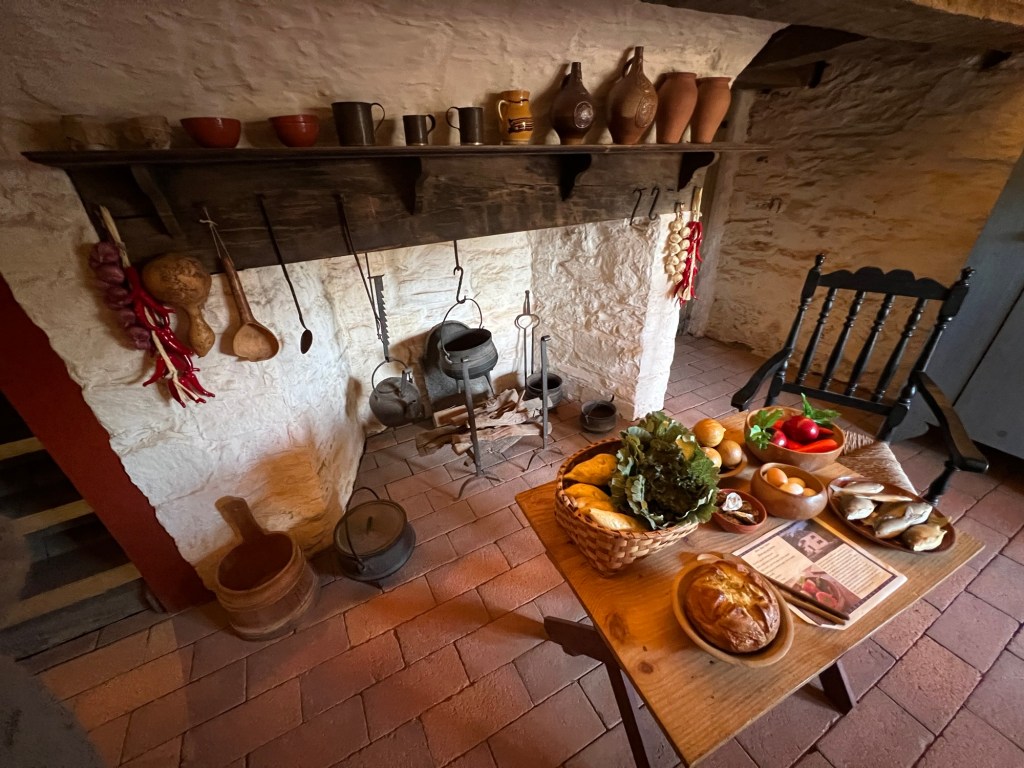
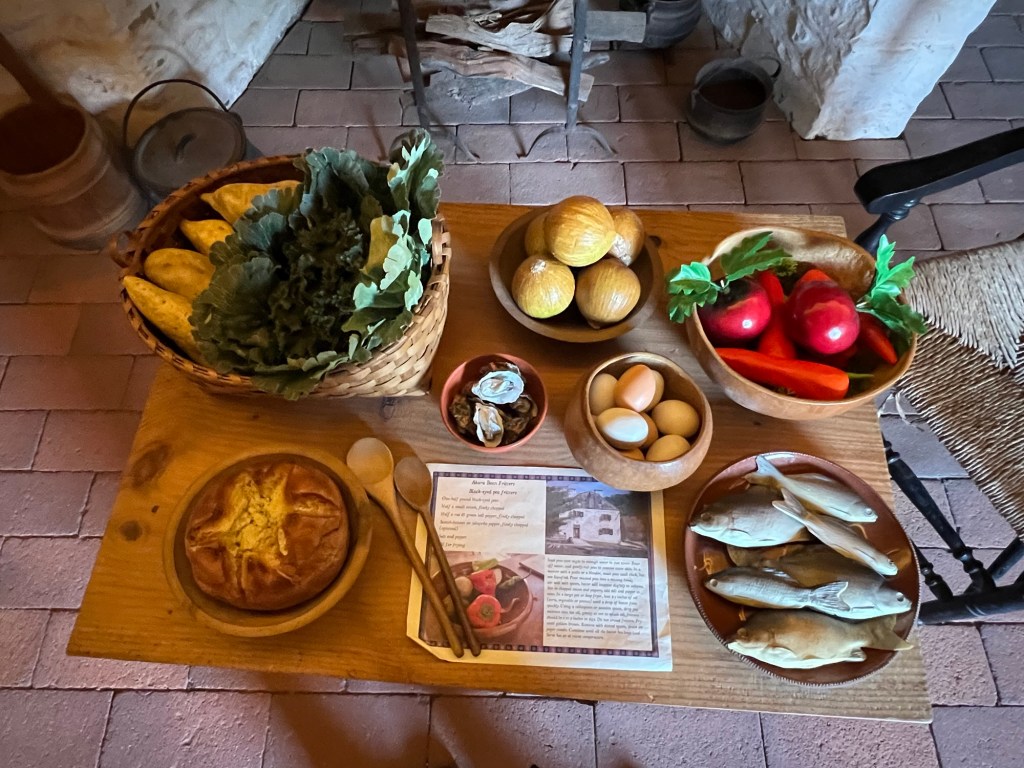
The original section of the homestead from 1742 is currently being renovated. This is the original hearth and oven of the kitchen.
The tour takes about an hour and is a fascinating step back in history of the way these families lived.
Recently the house was decorated for the Christmas holidays with garland, holly and fragrant oranges that once masked the household smells. They also gave the house a festive fragrance. These popular tours last through the holiday season.
Please check their website for a list of their activities.
The History of the Mesier Homestead:
The Mesier Homestead and surrounding property was sold to the Village of Wappinger’s Falls in 1891 with the understanding that it forever be known as Mesier Homestead and Mesier Park. The Wappinger’s Historical Society acquired full custodianship of the Homestead in 2007 and through ongoing fundraising efforts has been able to restore the Homestead to its present appearance.
The Mesier Homestead at Christmastime:
Christmas time at the Mesier Homestead is a festive and elegant affair of decorations and the home being set for a Christmas in the Revolutionary War era. The only difference is the the home has a Christmas tree which did not come into existence until the Victorian era.
the outside of the home decorated with wreaths and garland
The Front Porch
The front door with wreaths and garland
Entering the main hallway of the Mesier Home
The other end of the Hallway
Even the doors were festive with wreaths
The family portraits in the hallway were adorned with garland
The Living Room was the centerpoint of the house on Christmas morning with children coming downstairs to see what Santa had left them in the later part of the 1890’s into the early 1900’s. The tree would have been the centerpiece of the room sparkling in Christmas morning and a place for the family to gather for the day. Nothing has changed in this tradition except electronics.
The Living Room was decorated for both a Victorian and Revolutionary Christmas
The Victorian Christmas tree was lit brightly for the holidays and added a festive touch to the room
The rest of the Living Room was set with flowers and garland
The Library was set with flowers and wreaths and made for a very welcoming environment. This would have been a quiet place on Christmas morning for the family with festivities all through the house.
The Library was simple decorated and elegant
The comfortable Library
Even so, the house was beautifully set with garland all over the mantels and doorways and the Dining Room was set for a formal Christmas lunch which would have been eaten after church. The concept of gift giving on the holidays also did not come about until the Victorian era as well. Still Christmas lunch had been part of the holiday tradition for years.
The Dining Room was set for an elegant Victorian Christmas lunch
Victorian china adorns the festive Christmas dinner table
The mantel in the Dining Room was adorned with garland and oranges which gave the room a wonderful fragrance of pine and citrus
The family portrait in the Dining Room got special attention
Mesier Homestead decorated for the Christmas holiday season
The Wappinger’s Falls Christmas tree is just outside the house
The bandstand outside the house was decorated to the hilt.
The History of the house:
The house itself is part of the ‘Rombout Patent’ of land that had been bought by the Dutch from the local Indian tribes by three prominent Dutch families. This section of the property was bought by Nicholas and Adolphus Brewer and contained 750 acres of land around the Falls area, and they built the first stone house in the village near present Mill Street. In 1742, the Brewers built a mill on the east side of Wappinger Creek.
Nicholas Brewer built the Mesier Homestead in 1741, which he sold in 1777 to Matthew Van Benschoten who in turn sold it to Peter Mesier, a merchant from New York City. In May 1777, soldiers and local residents attacked Peter Meiser’s house in Wappinger’s Falls, disputing the price of tea for sale in a small store inside the home. Mesier was a merchant from New York City and a Loyalist. The angry mob struck Mesier, beat his slaves and drank wine stored in the cellar. They also took the tea and left a small amount of money behind. The house was in the possession of the family for the next four generations (Wiki).
The organization’s goal for 2020 and beyond is to restore the original 1741 building so it can be a showcase of our Colonial history. Your membership, gifts and in-kind donations will help us maintain and restore this jewel of Wappinger’s Falls.
The Wappingers Historical Society Native American Collection:
The Wappingers Historical Society is the curator of an extensive collection of Native American artifacts, many of which stem from the Stoneco/Clinton Point and Bowdoin Park area in the vicinity of the Town of Wappinger. This collection of artifacts was once considered to be the largest private collection in New York State.
Victorian Hair art of the dead
It consists of over 2000 objects, many of which are projectile points (arrowheads and spear points). Some of these have been found to date back 8,500 years. Also included are tools such as scrapers, knives, axes and hatchets. A small portion of approximately 100 pieces of the collection is on display at the Mesier Homestead and can be seen as part of our guided tours.
The Native American collection is extensive at the Meiser House
The Mission of the Wappinger’s Falls Historical Society:
The Wappinger’s Historical is dedicated to preserving and promoting the history of the Town of Wappinger, the Village of Wappinger’s Falls and neighboring communities and to maintain the custodianship of the Mesier Homestead.
The beauty of Downtown Wappinger’s Falls, NY
When you are a member of the Wappinger’s Historical Society, you help:
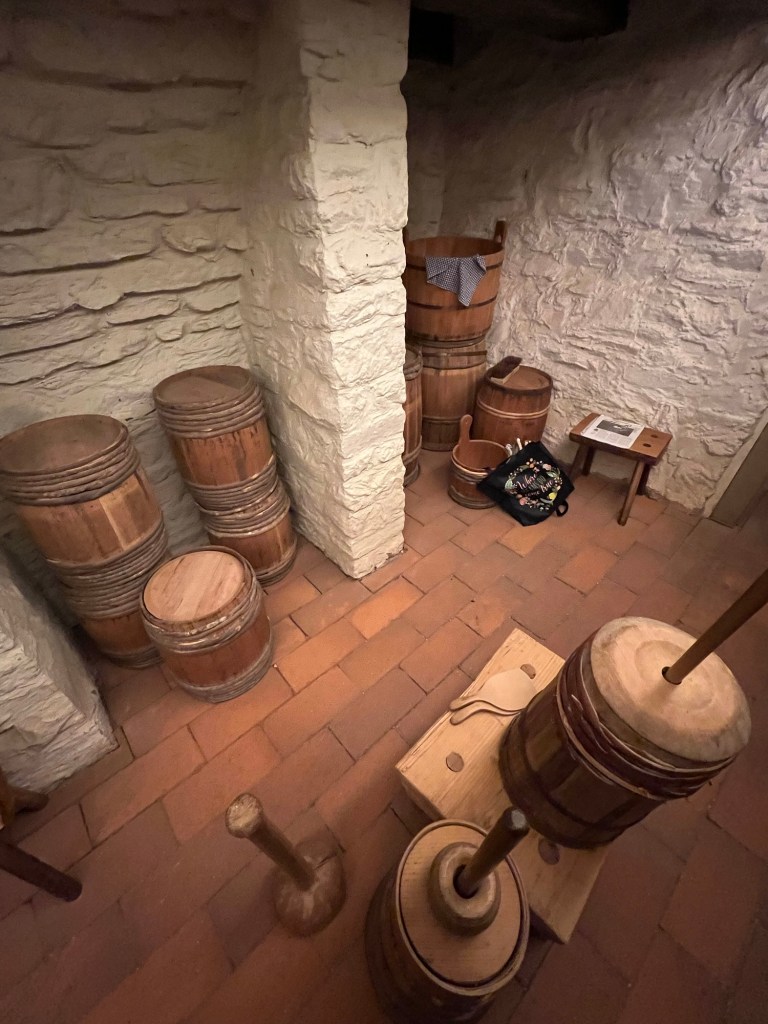
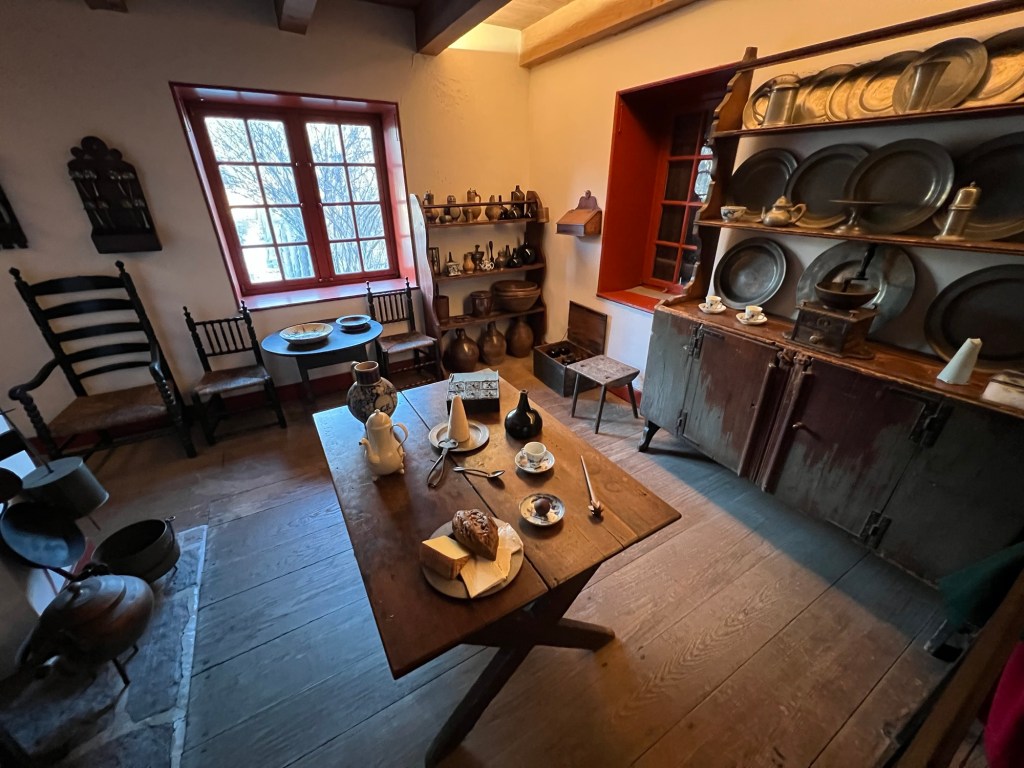
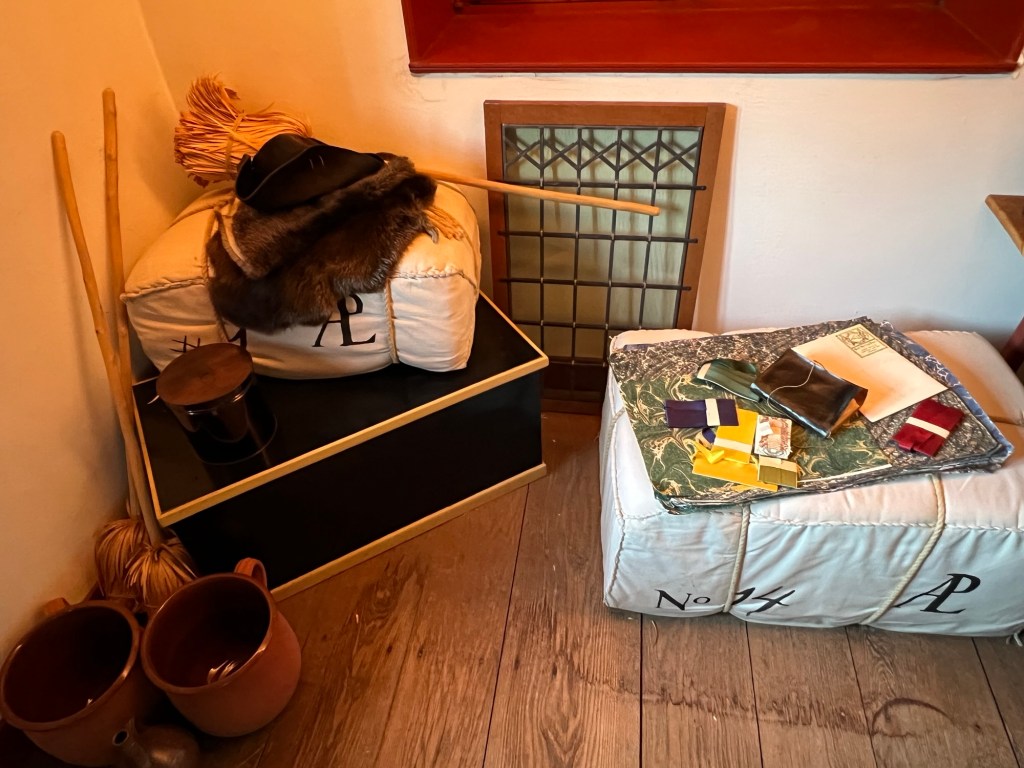
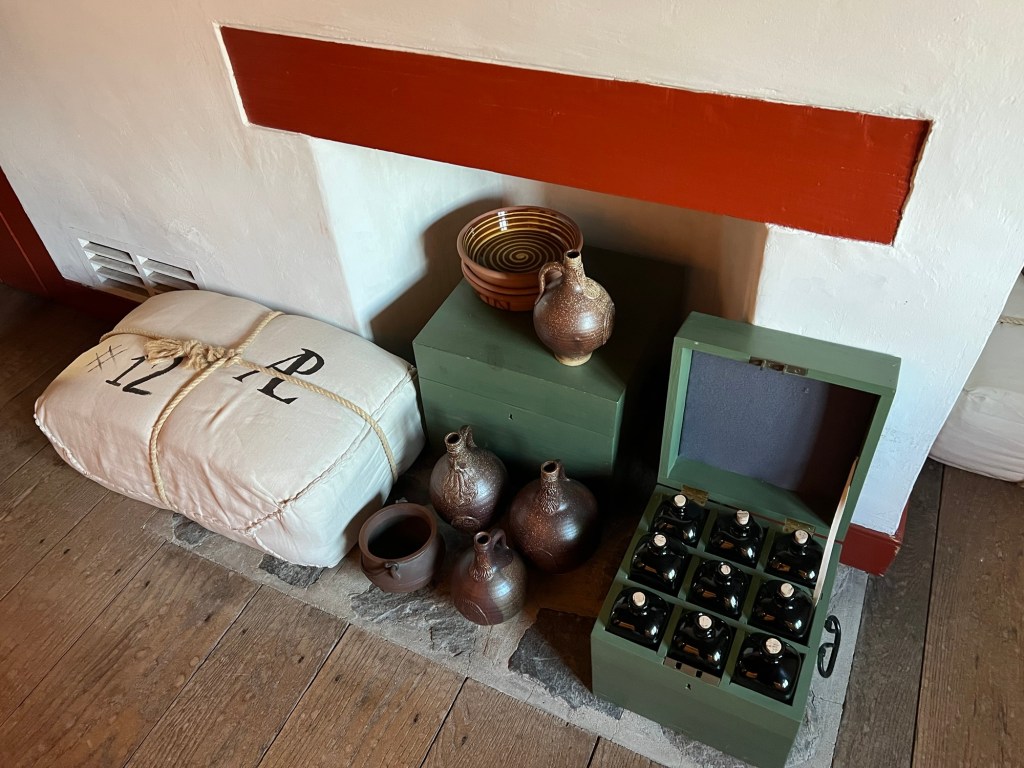
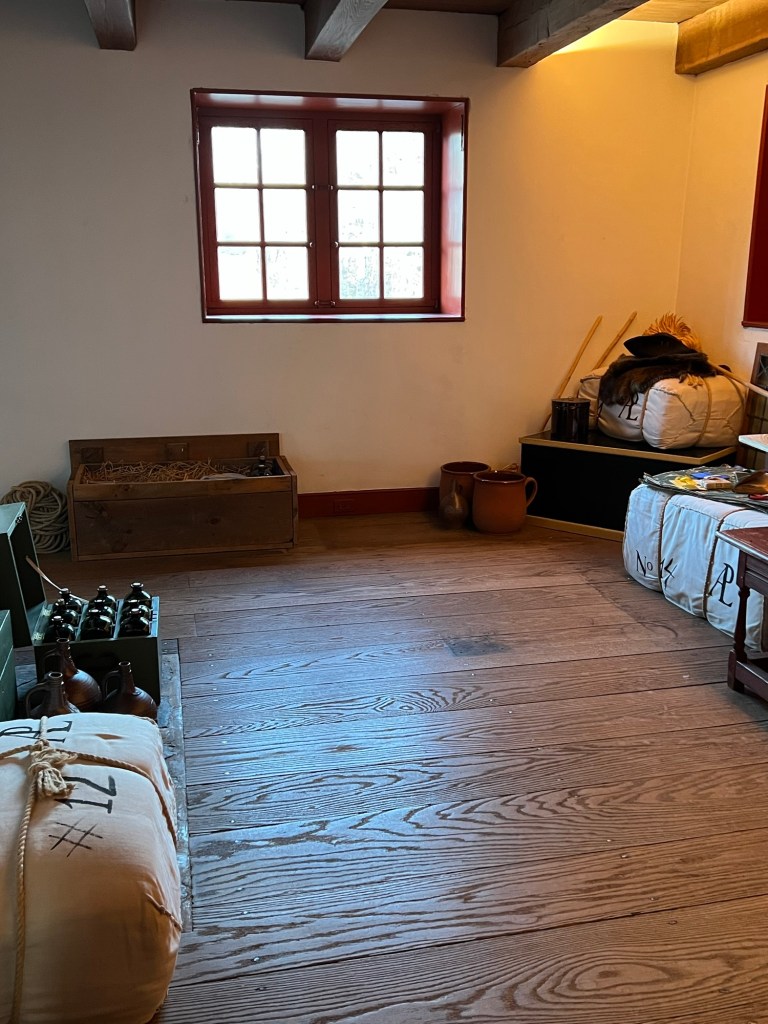
Storage area of the house
*Preserve and expand our archives, collections and library to actively chronicle the life of our hamlets, village and town for future generations.
*Develop and implement programs and exhibits so that people of all ages can better understand their connection to history.
*Safeguard our architectural heritage of the 1741 Mesier Homestead.
(This information was taken from the Wappinger’s Falls pamphlet, and I give them full credit for it)
The Mesier Homestead in the summer months
Their wonderful gift shop that should not be missed