Category: VisitingaMuseum.com

Sherman Creek Park                                           3725 Tenth Avenue                                              New York, NY 10034

Sherman Creek Park 3725 Tenth Avenue New York, NY 10034

Sherman Creek Park

3725 Tenth Avenue

New York, NY 10034

(212) 720-3480

https://www.nycgovparks.org/parks/sherman-creek-park

Open: Sunday-Saturday 24 hours

My review on TripAdvisor:

When I was recently walking around Washington Heights for the “Great Saunter” perimeter walk around the coast line of Manhattan over the summer, I revisited this little park that is tucked away inside Highbridge Park that lines the eastern side of Upper Manhattan. This is the Sherman Creek Park and Swindler Cove. I just thought it was a small extension of the park but it is way more.

The is a once dumping ground for garbage and waste that has been reclaimed and given a rebirth as a ecologically created watershed that is not only helping clean the East River with its plantings but also a sanctuary for birds, butterfly’s and other small creatures when they are migrating.

The paths are well landscaped and offer a sense of quiet and relaxation from the noise of the neighborhood especially in the summer when families are barbecuing and having parties in the small strip of part that is Highbridge Park. Small streams, a waterfall and river plantings plus a boathouse for canoes and Kayaks gives a different more relaxing view of the park.
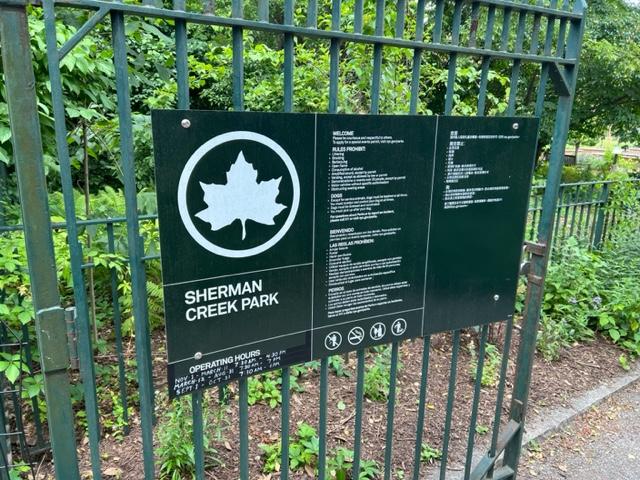
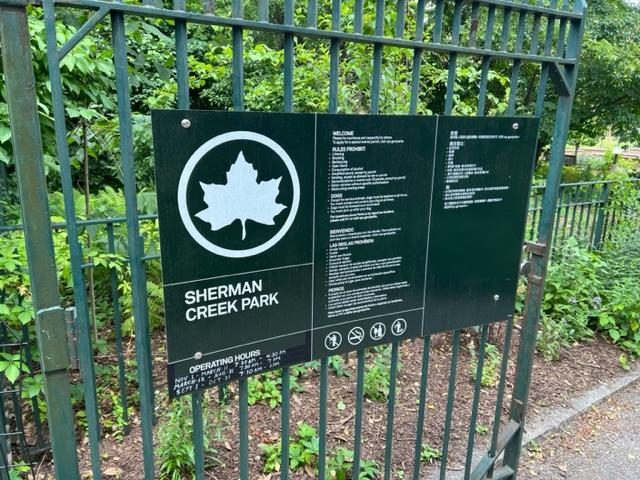
The entrance to Sherman Creek Park.

Sherman Creek Park

(from the park website)

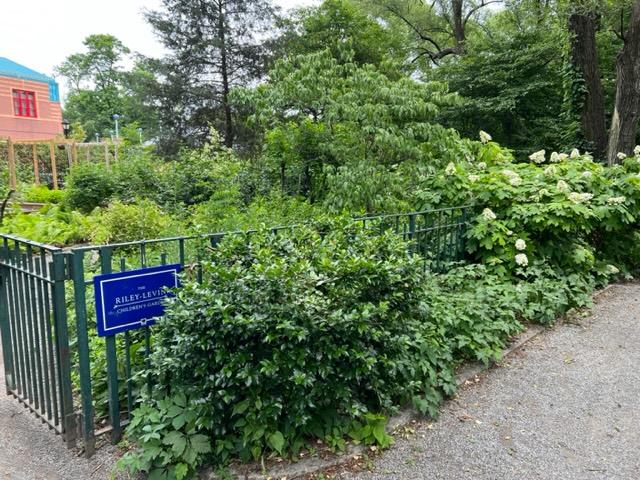
Sherman Creek Park, a former illegal dumping site, began as a shore cleanup and now encompasses 15 beautifully reclaimed acres along the Harlem River including Swindler Cove, Riley-Levin Children’s Garden, and a living shoreline installation. The neighboring Harlem River Greenway includes a sprawling esplanade, bike path, and a cherry tree planting framing the Harlem River Drive.
The pathways in Sherman Creek Park.

The park serves to demonstrate sustainable management of public lands in an underserved neighborhood, from hosting a major community green space in Northern Manhattan, to implementing organic gardening techniques and best horticultural practices on a daily basis.

The waterfall in Sherman Creek Park

NYRP’s work in Sherman Creek and the surrounding landscape recognizes the remarkable value of natural resources found in Northern Manhattan and works to improve and support public access to Manhattan’s largest remaining wetland complex.

The pathways through Swindler Cove Park.

SWINDLER COVE

(from the park website)

NYRP is responsible for conceiving, developing, executing and maintaining the vibrant and versatile Swindler Cove at Sherman Creek Park, a former illegal dumping site transformed by NYRP into a gorgeous green space. The 5-acre space is home to the Riley-Levin Children’s Garden.

Swindler Cove represents the crown jewel of New York Restoration Project’s public park projects. Opened to the public in August 2003, Swindler Cove represents the full spectrum of NYRP’s mission to restore open space as a catalyst for community revitalization and environmental conservation.

The restoration of the Manhattan coastline.

In 1999, in partnership with the State of New York Department of Transportation and acclaimed landscape designer Billie Cohen, NYRP transformed the land into an oasis of native natural habitats with a lush array of restored woodlands, wetlands, native plantings and a freshwater pond, accented by a gracious pathway.

LIVING SHORELINE

(from the park website)

Sherman Creek Park is threatened by climate change-induced erosion and sea level rise and in 2020 we introduced an ecosystem-based solution called a living shoreline.

Replanting and renovating the coastline.

Integrating native plantings and an artificial oyster reef, our living shoreline design aims to not only attenuate waves that wash away sediment but also enhance the native wetland habitat—one of the last of its kind in all of Manhattan. By stacking specialized concrete blocks called Oyster Castles, its design helps build new habitat for marine species that, over time, could transform the dynamics of a park that we might otherwise lose.

We continue to monitor the shoreline’s evolution to better understand and quantify the ecosystem services that urban wetland restoration projects like ours might offer. “We know that, acre per acre, wetlands are better than forests at fighting climate change,” says Director of Northern Manhattan Parks Jason Smith. “It just requires shifting our relationship with the landscape and realizing it’s not about building a big project and walking away; it’s about staying engaged, stewarding it, and learning from it.”

Video on the New York Restoration Project: Rebuilding parks and gardens.

The John DuBois Maritime Museum                   949 Ye Greate Street                                Greenwich, NJ 08323

The John DuBois Maritime Museum 949 Ye Greate Street Greenwich, NJ 08323

The John DuBois Maritime Museum

949 Ye Greate Street

Greenwich, NJ 08323

(609) 444-1774

https://www.americanheritage.com/content/john-dubois-maritime-museum

Open: Sunday 12:00pm-4:00pm/Monday-Friday Closed/Saturday 12:00pm-4:00pm

Admission: Free but donations are accepted.

My review on TripAdvisor:

https://www.tripadvisor.com/Profile/R4960NKjustinw/mediabatch/12221179?m=19905

The Museum:

The John DuBois Maritime Museum at 949 Ye Greate Street in Greenwich, NJ.

I visited the John DuBois Maritime Museum when I was visiting the Gibbon House and the Carman Prehistoric Museum when I was visiting Greenwich, NJ. What a nice little museum explaining the maritime history of not just New Jersey but the local area as well.

The museum is one large gallery broken down into sections of the history of the area. The main gallery is well organized by section to explain the shipping history of the region.

The decoys and rafts that are part of the collection.

The nautical instruments to guide your way through the stars. These were part of the long voyage.

The Shipping display

The sign for the Oyster Dredge display

The Oyster Dredge display

The Oyster Dredge display explores the important of the oyster industry in the area’s waters and what an important source of food they were to the local population. It also showed their role in keeping the waterways clean and the water well circulated.

The Ship Building display

Ship building and the creation of the shipping industry’s planning on future boat was another important part of the economy before the Civil War.

The Ship’s Mascot greets all of her guests at the front of the museum.

The History of the Museum:

The John DuBois Maritime Museum houses a large collection of Southern New Jersey Maritime related items from the 19th and early 20th centuries. A large and unique collection of builders models of local craft, show the plans used to build a new ship from the model itself.

The anchor outside the museum

Exhibited are tools used to carve ribs, planking, masts and booms. Also displayed are many blocks, ‘deadlines’ and ‘rigging’. The museum is proud to have one of the largest collections on the East Coast of caulking tools. Videos are available to view by the New Jersey network on oyster schooners including an interview with John DuBois who donated most of the artifacts in the museum.

Also exhibited are early maritime engine parts, most from the Hettinger’s of Bridgeton, one of the first manufacturers in America of marine motors.

The Shipping displays in the heart of the collection.

Stony Point Battlefield State Historic Park            44 Battlefield Road                                           Stony Point, NY 10980

Stony Point Battlefield State Historic Park 44 Battlefield Road Stony Point, NY 10980

Stony Point Battlefield State Historic Park

44 Battlefield Road

Stony Point, NY 10980

(845) 786-2521

https://parks.ny.gov/historic-sites/stonypointbattlefield/maps.aspx

https://en.wikipedia.org/wiki/Stony_Point_Battlefield

Open: Sunday (Grounds) 12:00pm-5:00pm (Museum) 12:00pm-4:30pm /Monday-Tuesday Closed/Wednesday-Saturday (Grounds) 9:00am-5:00pm/(Museum) 10:00am-4:30pm

Admission: Free but donations are accepted. Groups, Scouts and Organizations are $5.00 individuals per person and $7.00 for special events per person. Please call to make arrangements on this.

My review on TripAdvisor:

https://www.tripadvisor.com/Attraction_Review-g48694-d263715-Reviews-The_Stony_Point_Battlefield_Lighthouse-Stony_Point_New_York.html

The Stony Point Battlefield Museum

The General’s tent on the battlefield.

We visited the Stony Point Battlefield one afternoon and it is a very interesting and historical fort in the Hudson River Valley. We were able to tour the battle site and explore the grounds of this historical site. Then we toured the museum which gave us a view of the battle and what happened that night through a series of displays of the artifacts.

The Gallery

The Gallery

The gallery was filled with all sorts of weaponry and items needed by the troops for battle.

The battlefield site.

The museum has displays of the weapons used, the structure of the fort, utensils used the time that the troops were defending this area and what life was like on a day-to-day basis. The museum also offers a glimpse of artifacts of both the fort and of the battle with docents assisting you in telling the story of what happened at that time and after the battle and the war were over.

The Stoney Point Battlefield tent set up.

Outside the fort, there was a set-up of tents to show what the troops life was like in battle as well as General Wallace’s tent that he lived in and used during the battle. At the end of the day, the park does a demonstration of lighting the cannon that would have been used in battle. That was interesting. It was a lot more work than people think.

The cannon set up.

There is lot to do and see along the pathways of the fort and its grounds with amazing views of the Hudson River.

The story of the battle.

The History of the park and battlegrounds:

(from the NYS Parks Division website)

Visit the site of the Battle of Stony Point, one of the last Revolutionary War battles in the northeastern colonies. This is where Brigadier General Anthony Wayne led his corps of Continental Light Infantry in a daring midnight attack on the British, seizing the site’s fortifications and taking the soldiers and camp followers at the British garrison as prisoners on July 16, 1779.

The map of the fort at Stony Point, NY.

By May 1779 the war had been raging for four years and both sides were eager for a conclusion. Sir Henry Clinton, Commander-In-Chief of the British forces in America, attempted to coerce General George Washington into one decisive battle to control the Hudson River. As part of his strategy, Clinton fortified Stony Point. Washington devised a plan for Wayne to lead an attack on the garrison. Armed with bayonets only, the infantry captured the fort in short order, ending British control of the river.

The weapons of battle on display at the museum.

The Stony Point Lighthouse, built in 1826, is the oldest lighthouse on the Hudson River. De-commissioned in 1925, it now stands as a historical reminder of the importance of lighthouses to commerce on the Hudson River. The opening of the Erie Canal in 1825 unleashed a surge of commercial navigation along the Hudson River, by linking New York city to America’s heartland.

Within a year, the first of the Hudson’s fourteen lights shone at Stony Point and others soon followed, designed to safely guide maritime travel along the river. Many light keepers, including several remarkable women such as Nancy and Melinda Rose at Stony Point, made their homes in the lighthouse complexes, and ensured that these important navigational signals never failed to shine.

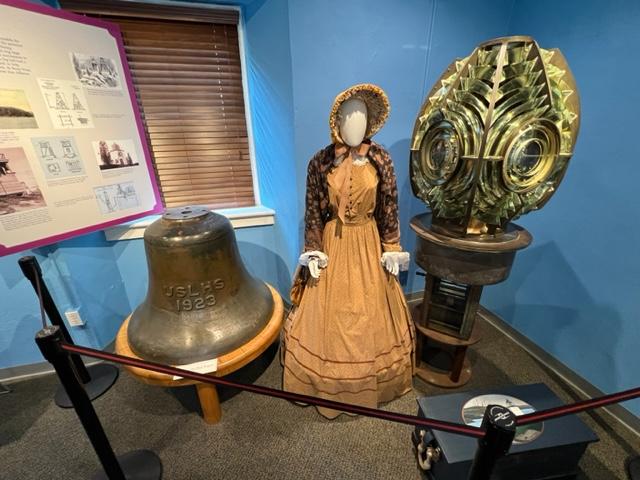
The lighthouse light on display at the museum.

The site features a museum, which offers exhibits on the battle and the Stony Point Lighthouse, as well as interpretive programs, such as reenactments highlighting 18th century military life, cannon and musket firings, cooking demonstrations, and children’s activities and blacksmith demonstrations.

The cannon demonstration that we saw at the end of our visit to the battlefields.

Wawarsing Historical Society and Knife Museum  3 Irish Cape Road                                      Napanoch, NY 12458

Wawarsing Historical Society and Knife Museum 3 Irish Cape Road Napanoch, NY 12458

Wawarsing Historical Society and Knife Museum

3 Irish Cape Road

Napanoch, NY 12458

(845) 626-5028

https://www.facebook.com/theknifemuseum/

Open: Sunday 12:00pm-4:00pm/Monday-Friday Closed/Saturday 10:00am-4:00pm (Seasonal)

Admission: Free but donations are accepted

My review on TripAdvisor

I visited the Wawarsing Historical Society and Knife Museum on a whim the other week when I was visiting museums in the region. What I found was a very interesting local museum dedicated to history and marketing of the former Knife industry of the region. I had never realized that this was the major industry of the region.

The Mission Statement of the Museum:

Our mission is to develop a museum to serve as both a repository of artifacts and informational conservatory as well as a place where memorabilia and examples may be accessed so that this rich heritage and a viable segment of American History will not be lost.

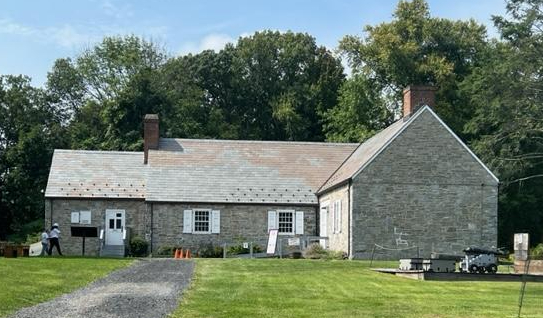
The front of the museum.

The History of the Museum

The Founder of the museum