Category: Exploring the Bronx

Bronx Museum of the Arts                                   1040 Grand Concourse                                        The Bronx, NY 10456

Bronx Museum of the Arts 1040 Grand Concourse The Bronx, NY 10456

The Bronx Museum of the Arts

1040 Grand Concourse

The Bronx, NY  10456

(718) 681-600

http://www.bronxmuseum.org/

Open: Sunday 11:00am-6:00pm/Monday & Tuesday Closed/Wednesday-Saturday 11:00am-6:00pm

Fee: Free

My review on Tripadvisor:

https://www.tripadvisor.com/Attraction_Review-g47369-d312012-Reviews-Bronx_Museum_of_the_Arts-Bronx_New_York.html?m=19905


I recently had some time to visit the Bronx Museum of the Arts when I was visiting Yankee Stadium recently for a football game. The museum is right down the road on the Grand Concourse. It is an impressive little museum.

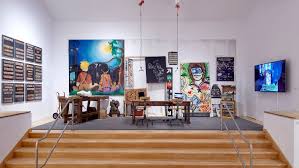
I had wanted to see the exhibit “Art Versus Transit: 1977-1987” by artist Henry Chalfant who had recorded the graffiti art on the subway cars during the late 70’s into the early 1980’s. This is before the subway investing in the new subway cars that could be cleaned by hosing them off.

Bronx Museum II.jpg

“Art versus Transit: 1977-1987”

The art was interesting as it was an expression of the times just when Hip-Hop was becoming popular and the City was going through the financial crisis. The artist did a good job capturing the times. Not only do we see the art but the music and dance as well of the time.
Bronx Museum III.jpg

Subway Art

The other exhibition that I saw was “The Life and Times of Alvin Baltrop” which displayed the artist’s interpreted that Gay Community and the beginnings of the AIDS crisis. It was an another interesting perspective of the times of New York City.

Mission and Background:

The Bronx Museum of the Arts is a contemporary art museum that connects diverse audience to the urban experience through its permanent collection, special exhibitions and education programs. Reflecting the borough’s dynamic communities. The Museum is the crossroad where artists, local residents, national and international visitors meet.

Today an internationally recognized cultural destination. The Bronx Museum of the Arts is committed to presenting new ideas and voices in a global context and making contemporary art a vital, relevant experience. For the past four decades, the Bronx Museum has presented hundreds of changing exhibitions featuring works by culturally diverse and under-represented artists from a spectrum of levels. Exhibition have investigated themes of special interest to the Bronx community while exploring the interplay between contemporary art and popular culture.

A permanent collection of over 2000 artworks in all visual media preserves and documents artists who are not typically represented within traditional museum collections by showcasing work by artists of African, Asian and Latin American ancestry, as well as artists for who the Bronx has been critical to their development. The Museum provides direct support to artists through Artist in the Marketplace, which nurtures the work of 35  emerging artists each year and providers professional development seminars culminating in a multi-site biennial exhibition and catalog.

The Museum’s education department empowers students from grades K-12 by offering a variety of programs that inspire academic proficiency visual literacy and critical thinking. Through the Group Visits Program, students are exposed to the Museum’s works during single-session tours lead by teaching artists. Through In-School Partnerships. Museum educators work with school teachers to encourage scholastic excellence through the application of arts education techniques in addition, the Museum’s Teen Council Program helps Bronx high-school students build applied arts and media skills as they create a variety of visual and text-based materials.

(Bronx Museum of the Arts Mission-Website)

History:

The Museum opened on May 11, 1971, in a partnership between the Bronx Council on the Arts, which was founded in 1961 and the Metropolitan Museum of Art. The opening coincided with a borough-wide “Bronx Day” event. The first exhibit consisted of 28 paintings from the Met’s collection. The Museum was first housed in the first floor rotunda of the Bronx County Courthouse. Additional galleries were located in the Bronx’s Co-op City, Bedford Park and Allerton neighborhoods. In its first 12 years of operation, the museum held over 350 exhibitions.

In 1982, the city purchased a vacant synagogue at 165th Street and the Grand Concourse as a new location for the museum. The new location opened to the public in May 1983 in conjunction with “Bronx Week”, which succeeded “Bronx Day”. The new space was inaugurated with an exhibition of twentieth artwork. It consisted of paintings, photographs and prints borrowed from the Met.

In February 2004, construction began on a $19 million expansion project that doubled the museum’s size 33.000 square feet. The expansion opened in October 2006. In 2008, a arts center was added to accommodate educational programs for local schoolchildren and their families. The Museum no longer charges fees since 2012.

Bronx Museum

The Bronx Museum of Art and its additions

The original design was by Simon B. Zelnick in 1961 and the extensions were designed by Castro-Blanco, Piscioneri & Feder in 1988 and a second addition in 2006 by Arquitectonica.

(The Bronx Museum WIKI)


Van Cortlandt House Museum in Van Cortlandt Park at Broadway & West 246 Street                                              Bronx, NY 10471

Van Cortlandt House Museum in Van Cortlandt Park at Broadway & West 246 Street Bronx, NY 10471

Van Cortlandt House Museum

Van Cortlandt Park at Broadway & West 246 Street

Bronx, NY  10471

(718) 543-3344

infor@vchm.org

Open: Tuesday-Friday 10:00am-4:00pm/Saturday & Sunday 11:00am-4:00pm

Admission: $5.00 for Adults/$3.00 for Seniors & Students/Children under 12 are free/General Admission is free on Wednesdays. Guided and group tours are available.

Review on TripAdvisor:

https://www.tripadvisor.com/Attraction_Review-g47369-d103501-Reviews-Van_Cortlandt_House-Bronx_New_York.html?m=19905

The Van Cortlandt House:

Welcome:

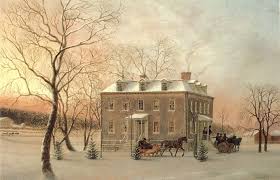
Van Cortlandt House during Christmas time

The entrance of the Van Cortlandt House decorated for the Revolutionary era Christmas

I visited the Van Cortlandt House Museum for the their Annual Christmas Decorated House event. The mansion was decorated for Christmas in the 1700’s so it was not overdone as it would during the Victorian times. The front of the house entrance was done with sprays of holly, mistletoe above the door and garlands of pine around the banister and fireplaces. The windows had candles in them and the dining room was set for Christmas luncheon in post-Revolutionary War era.

Van Cortlandt House VI.jpg

Van Cortlandt House for Christmas is Post-Revolutionary War in 2019

The entrance hall welcomes you to a Revolutionary era holiday season

While most of the house is represented during the Dutch era with floors with no rugs, vintage furniture and decorations and the second and third floors are set for family entertainment. The first floor is set for entertaining for the holidays with the formal dining room, family parlor and the formal living room for games and dancing. The formal dining room was the only room decorated post-Revolutionary War era.

van cortlandt mansion xmas ii

Van Cortlandt Mansion at Christmas 1800’s

The current entrance to the house from the back of the building

Until the Victorian era, Christmas was a more religious affair with church service in the morning and luncheon in the afternoon. Things were formal and less elaborate. The acts of gift giving, sleigh rides, tree decorating and card giving came during the affluence of Queen Victoria’s reign in the post Civil-War era. This is the reason why the house is decorated so simply and elegantly.

Dining Room set for Christmas lunch circa 1780’s

In 2019, the site celebrated the holidays with a Sinterklaas, a Dutch Christmas celebration, a candlelight tour and a reading from Santa Claus. Please check their website for more information on future events. The house was closed for most of the COVID years and nothing had been planned. The house was open in December of 2022 for touring again for the holidays but was not decorated as much as in the past.

In 2022, when the house reopened after a long period of COVID, the self-guided tours were back and you could tour the house at your own pace ($5.00 donation) and tour the three floors of furnished rooms. You can see how the family lived from the three generations that lived in the residence.

The tour starts at the front hallway where guests would be received for formal affairs and for business meetings with the head of the household.

You would be greeted by servants at the entrance of the home

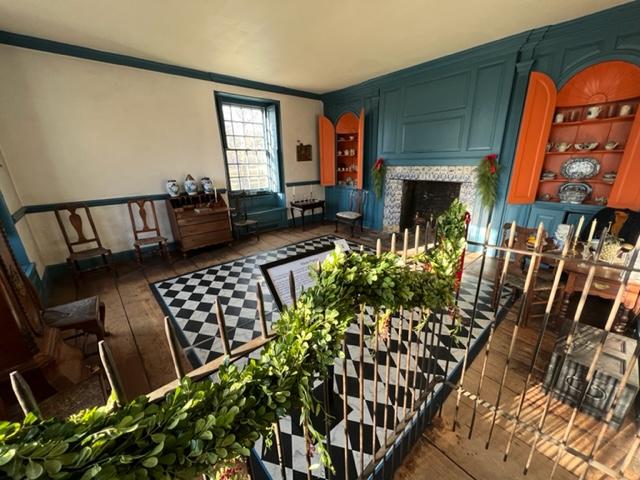
On either side of the front hallway is the East and West Parlors where you would be directed where the family would receive you. The West Parlor would have been used for business calls and more informal meetings when meeting with the Van Cortlandt family. The family’s wealth would be on display with fine furniture, china and bric-a-brac that would show off the family’s merchant roots and business.

The West Parlor

The West Parlor decorated for Christmas

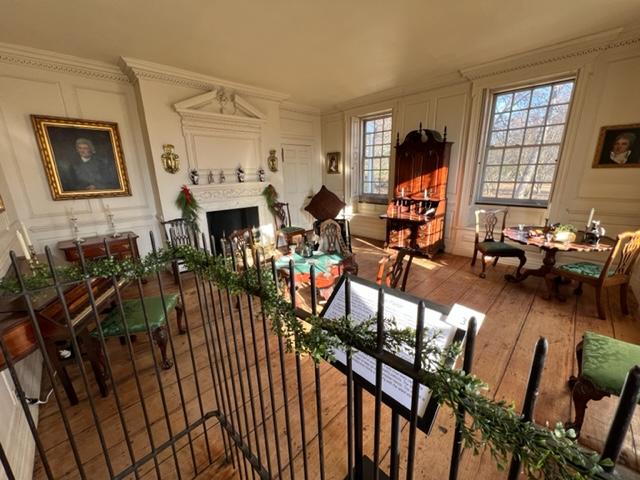
The East Parlor on the other side of the entranceway would have been used for more formal affairs. The East Parlor is where the family would formally entertain guests with dancing, music and card playing. This is where long evenings of entertaining would take place and the family would enjoy their holiday celebrations.

The East Parlor

The East Parlor decorated for the Christmas holidays

The Dining Room was toward the back of the hallway and was decorated in the Empire Design of the late 1700’s to early 1800’s. The look is very similar to styles used today and the wallpaper is a copy from one of the styles used by the family that was imported in from France. The table was set for Christmas luncheon circa the late 1780’s.

The Dining Room

The Dining Room at the Van Cortlandt House

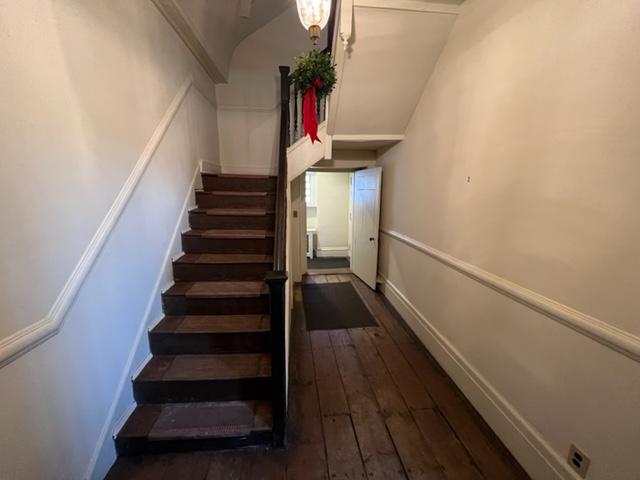
There are two sets of stairs to the second level of the house where the family bedrooms were located. There was the formal stairs and then there was the stairs that the servants used to go from floor to floor so that they would not be seen.

The steps upstairs to the second floor

On the second floor of the home are the bed chambers of the family. The main bedrooms for the family were located here and then the nursery and servants quarters were located on the Third floor of the home.

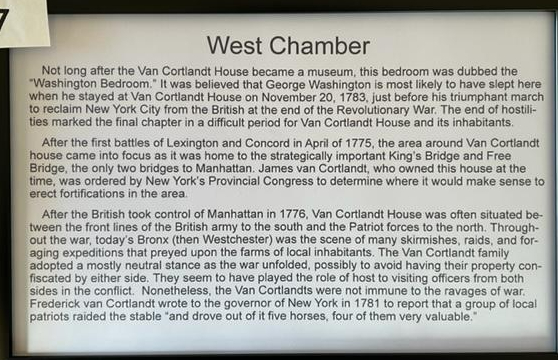
The West Chamber:

The bedroom

The ‘Washington Bedroom’ in the Van Cortlandt House

The East Chamber Bedroom:

The Bedroom:

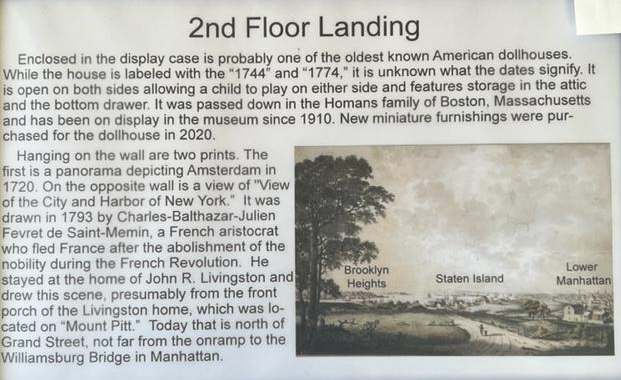
The Landing of the stairs to the third floor lead to the Nursery, an additional guest room and the enslaved servants quarters. These were kept out of site from the other members of the household. It is a reminder of the pecking order of the household and the conditions that people lived under at this time.

The Second Floor Landing leads to the nursery and servants quarters

The Dutch Chamber was formerly a guest room that is used to show life in early Colonial New York City:

The Dutch Chamber:

The Dutch Chamber shows early life in Colonial America

The Second Floor Setup:

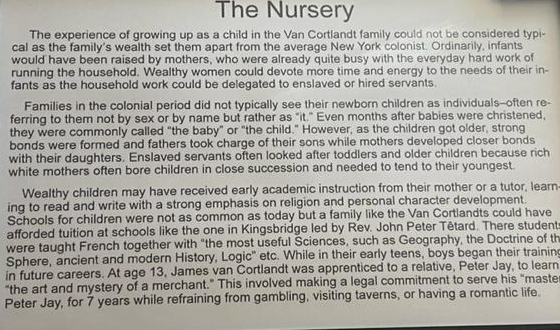
The Nursery:

The nursery set up room:

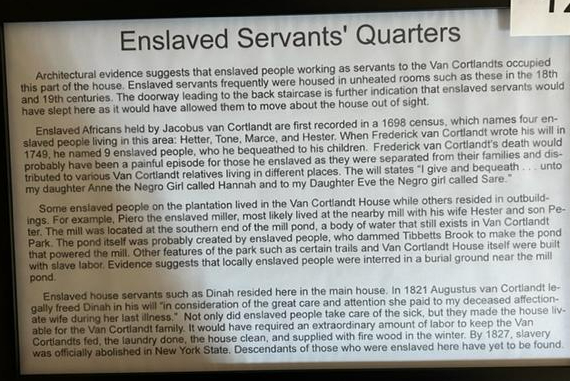
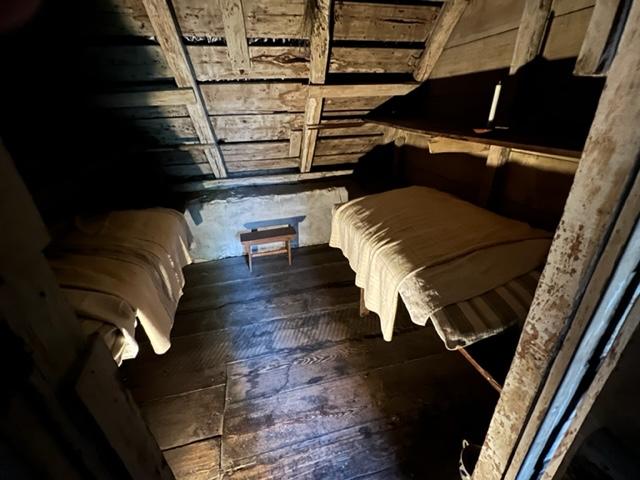
The servants quarters were to the back of the house and were not the most glamorous place to live in the house. There were drafty and not insulated. The amount of time a servant would be here would have been minimal.

The servants quarters:

The servants quarters:

History of the Van Cortlandt’s:

The Van Cortlandt House Museum, also known as Fredrick Van Cortlandt House or Van Cortlandt House, is the oldest surviving building in New York City’s borough of The Bronx. The Georgian style house, begun in 1748, was build of fieldstone by Fredrick Van Cortlandt (1699-1749) on the plantation that had been owned and farmed by his family since 1691. Fredrick intended the house to be a home for him and his wife, Francis Jay and daughters, Anna Maria, 14 and Eve, 13. His sons, Augustus, 21 and Fredrick, 19, were not intended to be permanent residents of the house.

Sadly, Fredrick died before the new house was completed. In his will written in 1759, Fredrick left the house to his son, James Van Cortlandt (1726-1781) and a lifetime tenancy to his widow, Francis Jay Van Cortlandt (1701-1780).

Van Cortlandt House IV.jpg

The Van Cortlandt House gardens in the Summer

The Van Cortlandt’s were a mercantile family prominent in New York affairs. Fredrick’s father, Jacobus, established a thriving wheat growing and processing business on the plantation including a grist mill for processing the wheat into flour and a fleet of shallow draft boats to carry the flour from the south end his lake down Tibbet’s Brook and out to the Harlem and Hudson Rivers to market. During the Revolutionary War, the house was used by Rochambeau, Lafayette and Washington.

(From History of Van Cortlandt House and Museum)

In 1887, after 140 years of occupancy by the Van Cortlandt family and the community of plantation workers, the property was sold to the City of New York and made a public parkland. Before the house became a museum, it saw a variety of uses including as a temporary police precinct house and as a dormitory for ranch hands responsible for taking care of a herd of buffalo.

Van Cortlandt House historic marker

By 1895, The National Society of Colonial Dames in the State of New York expressed their interest in restoring the house as a museum open to the public. There was only one obstacle keeping the Colonial Dames from this important project, there was no provision in the New York State Law allowing the stewardship of a publicly owned building by a private organization. Undaunted, the first Society President, Mrs. Townsend, took the Society’s cause to Albany where on May 22, 1896 in the 199th session of the New York Legislature, Chapter 837 was approved by the governor and passed by a 3/5 majority to become law.

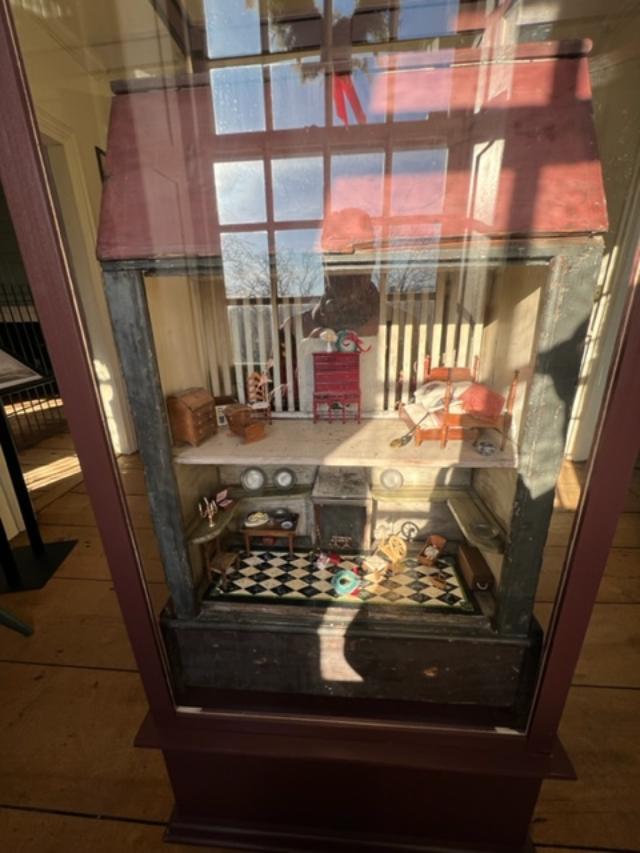
The Van Cortlandt House dollhouse

After nearly a year if repairs and restoration, Van Cortlandt House Museum was opened to great fanfare on May 25th of 1897. The original license agreement grained custody of the house to the National Society of Colonial Dames in the State of New York for a period of 25 years at a ‘peppercorn’ rent of $1.00 per year. Although the Society no longer pays the city rent, they remain, to this day as dedicated to Van Cortlandt House as they were in 1896.

Van Cortland Park.jpg

Van Cortlandt Park in the Summer Months

In 1967, Van Cortlandt House was added to the National Register of Historic Places and was designated a National Historic Landmark in 1967. The house was declared a New York City Landmark on March 15, 1966, recognizing the historic and architectural importance of both the exterior and interior.

(From the Van Cortlandt House Museum NSCDNY)

The Van Cortlandt House gardens during the winter of 2022

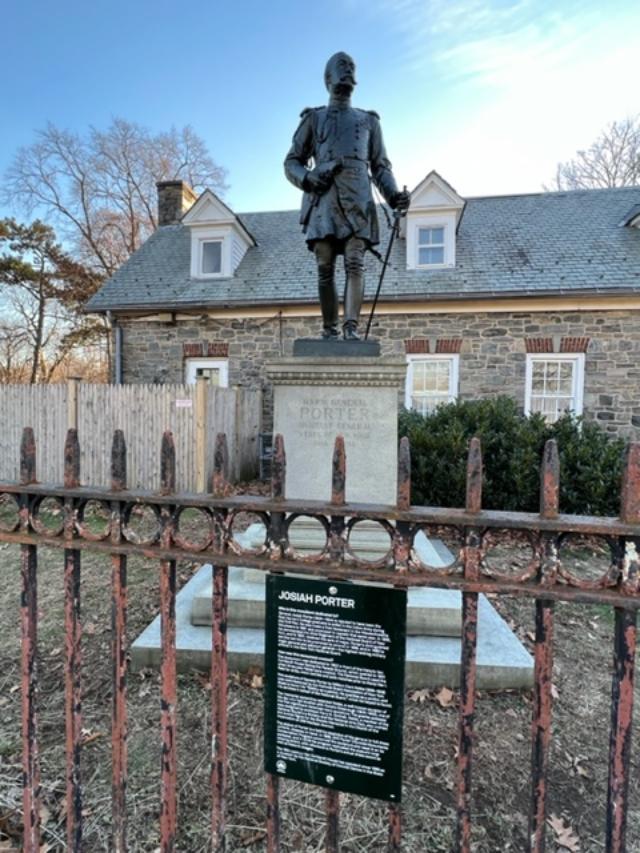
The General Porter Statute in front of the house