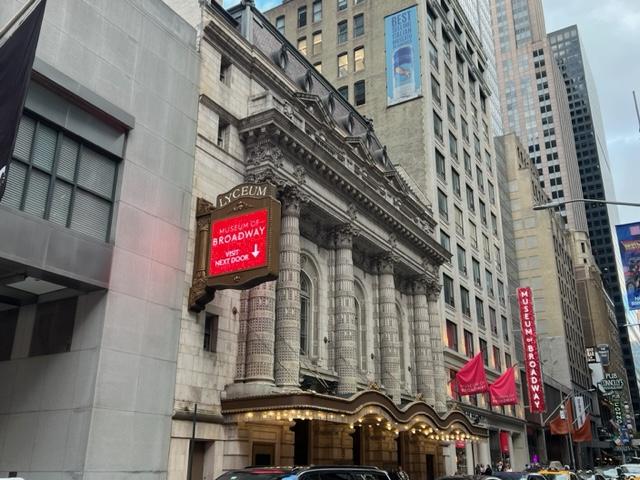
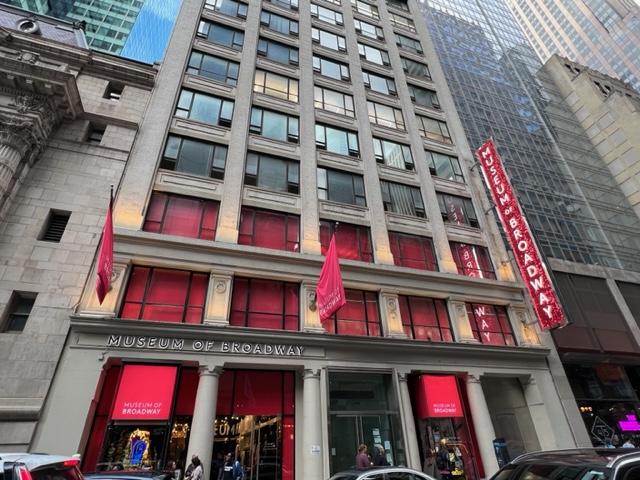
The entrance to the Museum of Broadway at 145 West 45th Street
The front of the Museum of Broadway
I visited the newly opened Museum of Broadway recently and what a nice surprise the museum is with a great depth in the collection. There was the history of the theater in New York City and how it progressed from small theaters downtown to the theater’s progression uptown to it home now in the core of Times Square.
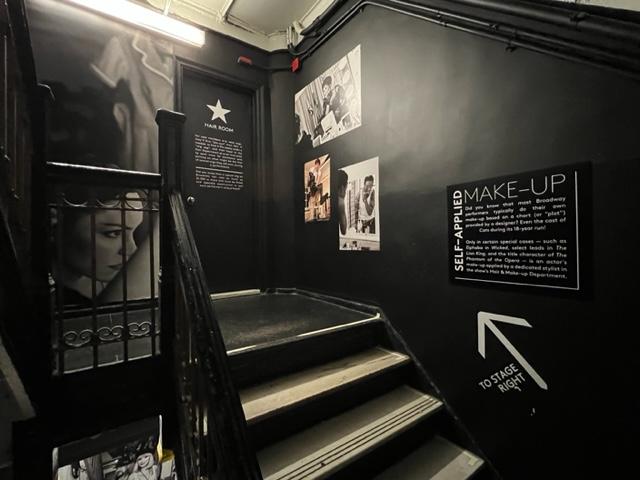
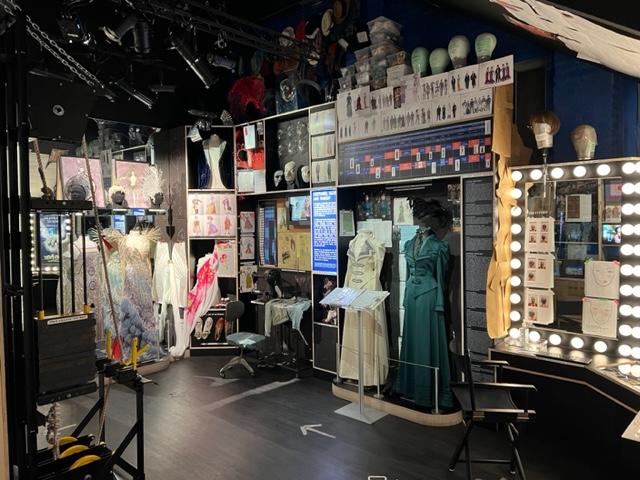
The Make-Up Room on the way up the stairs.
The Call Board display.
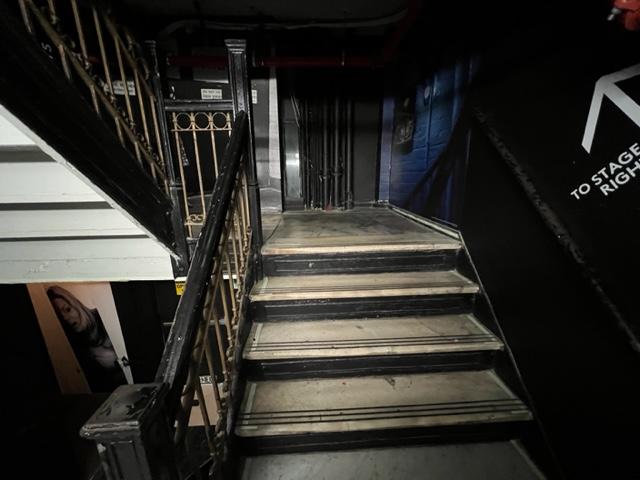
The museum is very interesting in that when you enter the back of the museum you feel that you are going backstage at a theater and preparing for a show. You head up the stairs past make up rooms, wardrobe rooms and the star’s rooms. The you head out the door like you are going out on stage. You feel that rush of the stage.
The Stage Door stairs.
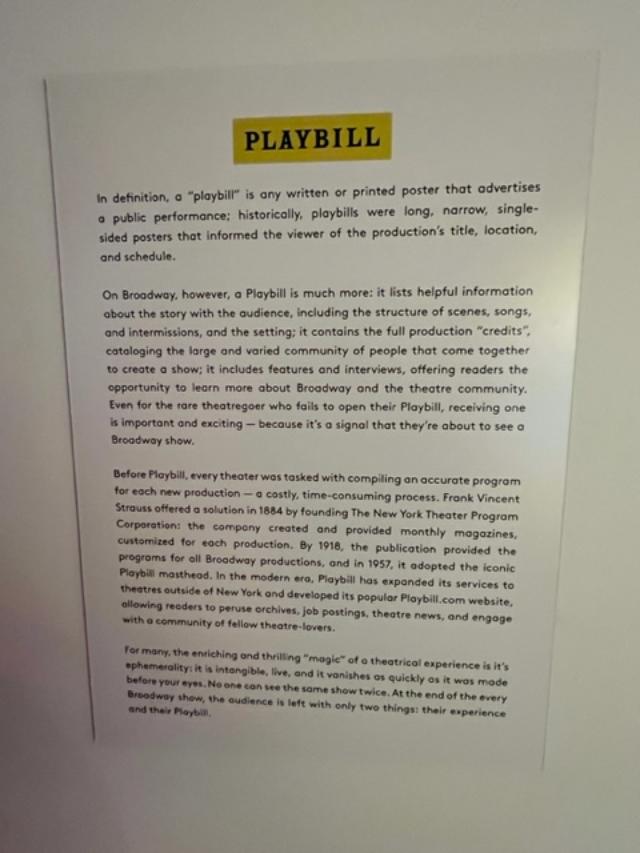
The Broadway Playbill Room exhibit
The Playbill Room display
As you head up the stairs to the exhibition the museum makes you feel like an actor on opening night. The sounds of the stage and the noises of the crew in the background make you feel like you are part of the show. The Playbill Room displays some of the popular shows from the past and present.
The Props of the backstage.
Then you open the door, and you enter the main museum with displays on the history of the theater. As you progress through the museum, you will see displays on popular shows through the years from Flo Ziegfield and the Ziegfield Follies to the modern shows on Broadway.
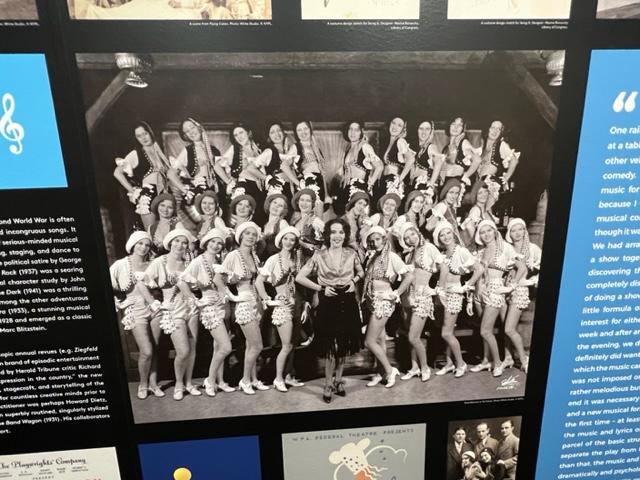
The Ziegfield Room
The Ziegfield Room
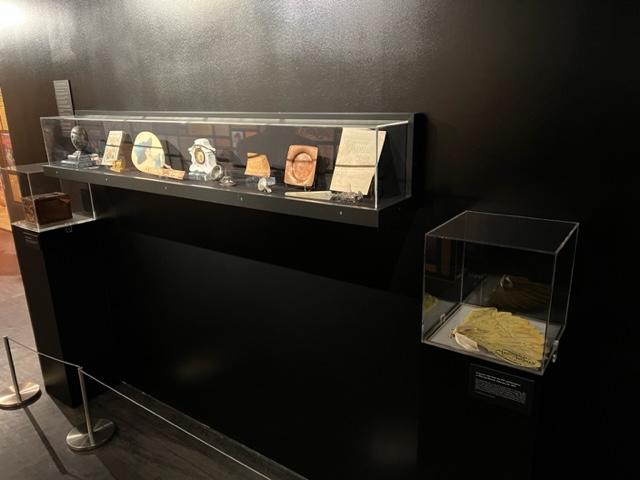
Costumes that were found in a box in the attic of the theater.
Ethel Merman in “Anything Goes” when she first started her career. She was so young. I pulled the movie that featured a lot of the Broadway cast. Ethel Merman never lost her touch throughout her career.
“Anything Goes” from the movie.
From there, I explored the museum and many of the most famous shows on Broadway had their own displays with props, scripts, pictures and costumes from the shows. Not just the revivals but the original shows as well. It was interesting to see what the original stars wore in the shows as well as these costumes still existed after all this time. I kept the pictures in order as I toured through the displays of the Broadways most popular productions.
The Oklahoma! exhibit with costumes and scenery from the show.
The Oklahoma set props from the recent revival
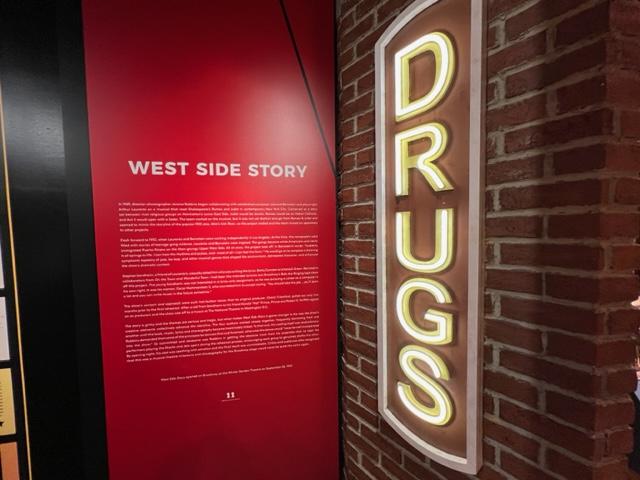
The West Side Story set
The West Side Story set from the recent revival
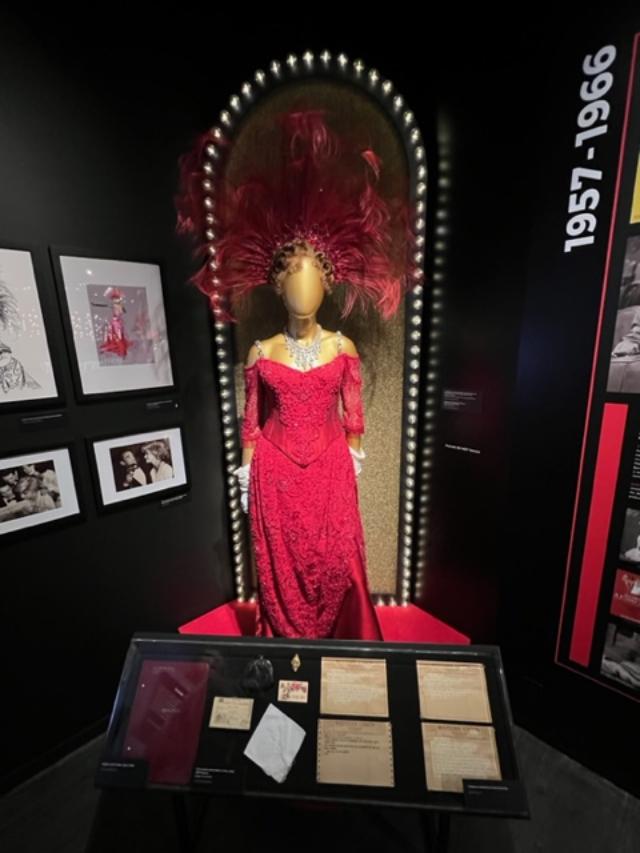
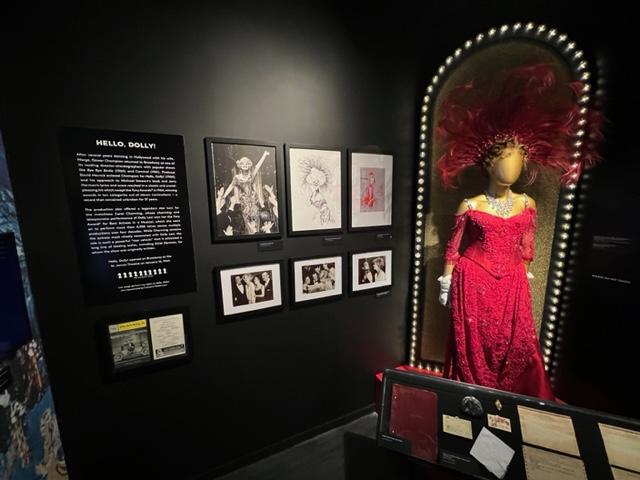
When the original “Hello Dolly” came out in the 1960’s, it made a huge star of Carol Channing, who owned the role until the day she died. I had seen her revival production in the early 1990’s and I will tell you that even in her 80’s, she had more pep and vitality than any one person had. She went on tour with the company after the show closed in New York to China and all over Asia. When you hear her sing “Hello Dolly”, you knew it was her.
“Hello Dolly” with Carol Channing’s original outfit from the show.
The display on the original show “Hello Dolly” with Carol Channing.
The video from London’s West End
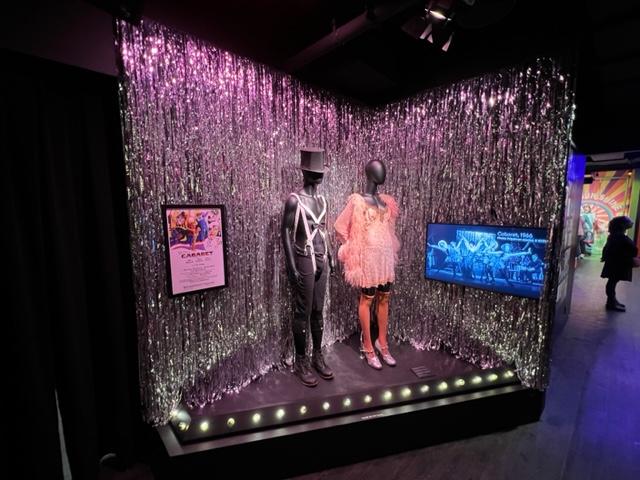
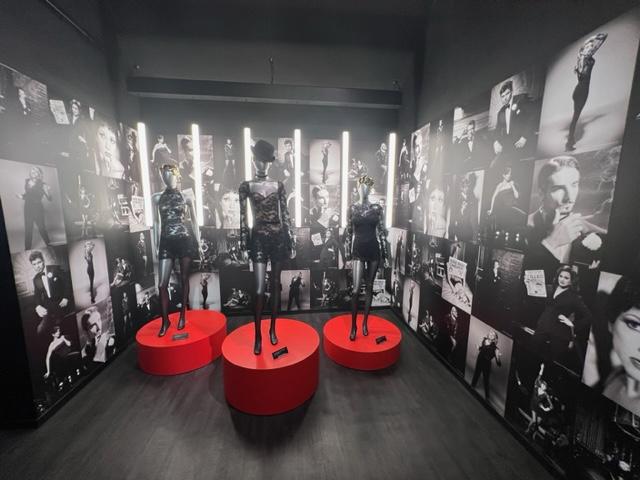
The original show “Cabaret”
The costumes from “Cabaret”
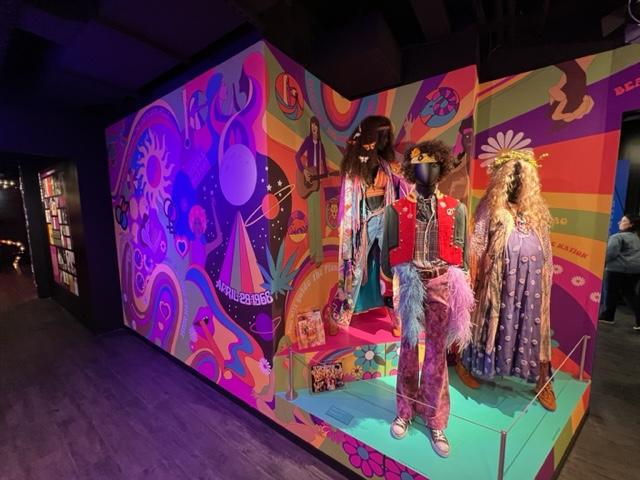
The costumes from the show “Hair”
There was a large display to the late and great Stephen Sondheim:
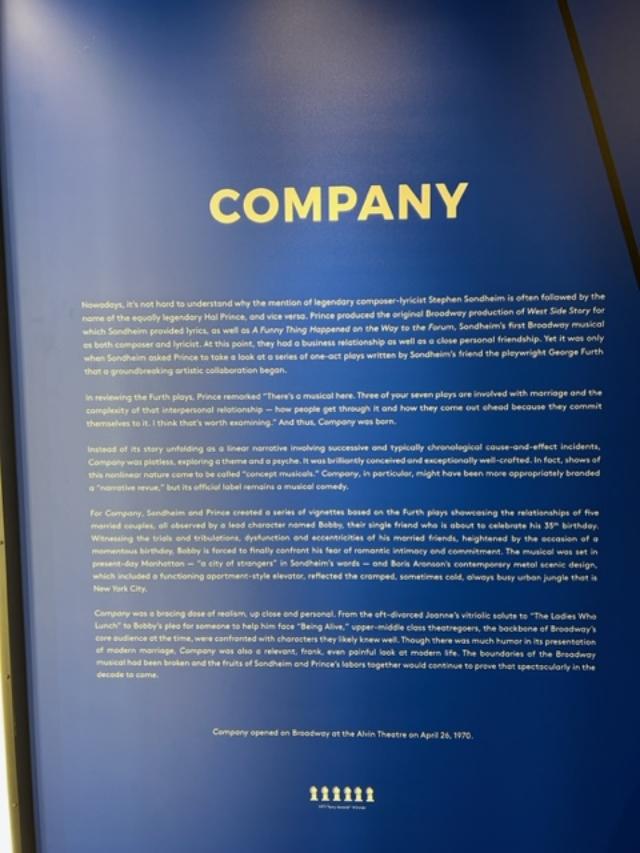
There was a large display of props, scripts, costumes and pictures from all of his show especially the groundbreaking show “Company”. Today it might not seem so unusual for a thirty year old not to be married but in 1970 when the show came out, it was rare. Since the passing of Mr. Sondheim, there has been more interest in his life and his productions that he created. I have seen so many of his show especially his last show “Bounce”, when I was seeing his retrospect at the Kennedy Center in Washington DC.
The groundbreaking show “Company”
“Company” is an excellent show.
The original cast of Company in the 1993 revival.
The revival of company with the production that my father and I saw in 2010.
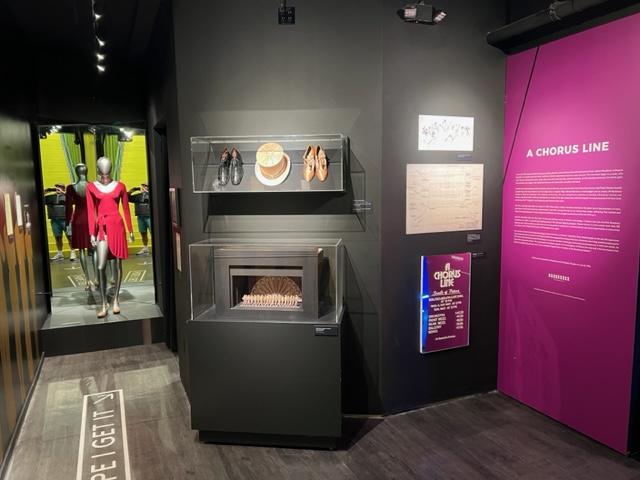
The “A Chorus Line” display
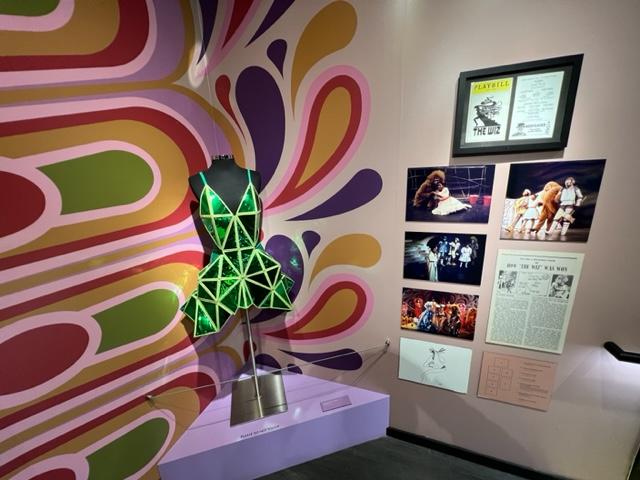
“The Wiz” display
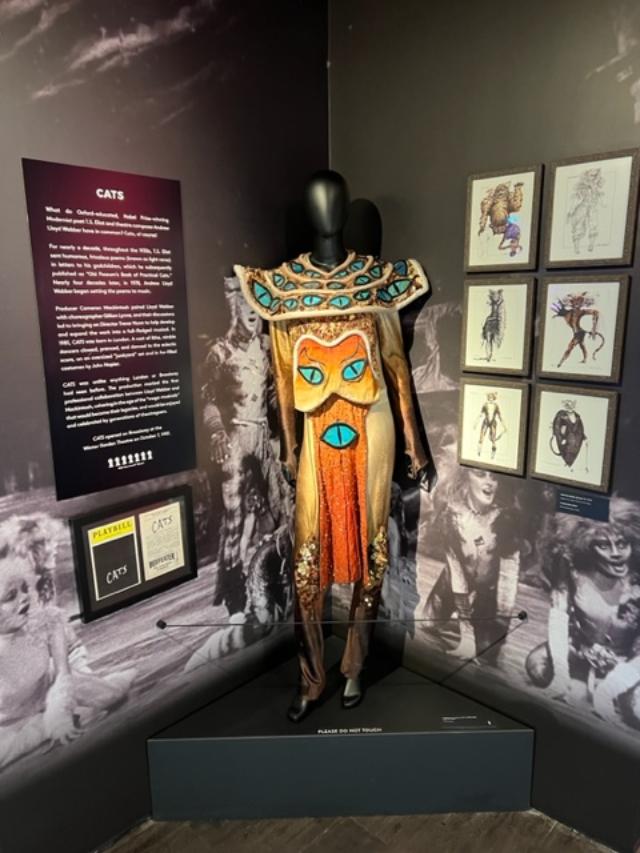
The “Cats” display and costumes
The Broadway Timeline
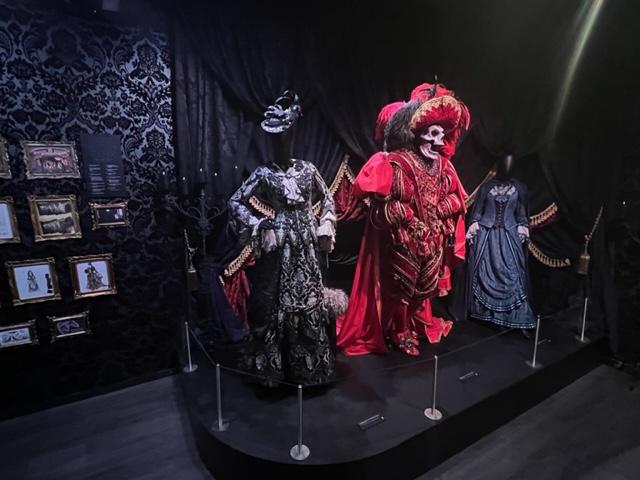
Phantom of the Opera
Phantom of the Opera
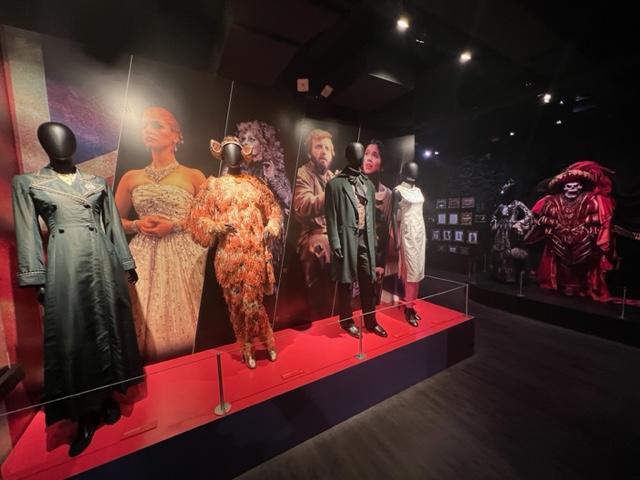
The Costumes for Evita and Phantom of the Opera
Me in the Hallway of Mirrors
“The Producers” display
The “Avenue Q” display
The ‘Making of a Broadway Show’
The costumes of a Broadway show
The “Chicago” display was the last show display before I got to the gift shop.
The museum progresses room by room and display by display showing the costumes and props of some of the most popular shows on Broadway and shows from the past. The collection has an extensive selection of memorabilia from productions of the past through today and showcases them in such an interesting way.
The Museum of Broadway is such an engaging museum from start to finish and I can see more shows of the future will be displayed here as well. The staff is available to answer any questions you might have and they also have an extensive gift shop in the front of the museum.
When I was recently walking around Washington Heights for the “Great Saunter” perimeter walk around the coast line of Manhattan over the summer, I revisited this little park that is tucked away inside Highbridge Park that lines the eastern side of Upper Manhattan. This is the Sherman Creek Park and Swindler Cove. I just thought it was a small extension of the park but it is way more.
The is a once dumping ground for garbage and waste that has been reclaimed and given a rebirth as a ecologically created watershed that is not only helping clean the East River with its plantings but also a sanctuary for birds, butterfly’s and other small creatures when they are migrating.
The paths are well landscaped and offer a sense of quiet and relaxation from the noise of the neighborhood especially in the summer when families are barbecuing and having parties in the small strip of part that is Highbridge Park. Small streams, a waterfall and river plantings plus a boathouse for canoes and Kayaks gives a different more relaxing view of the park.
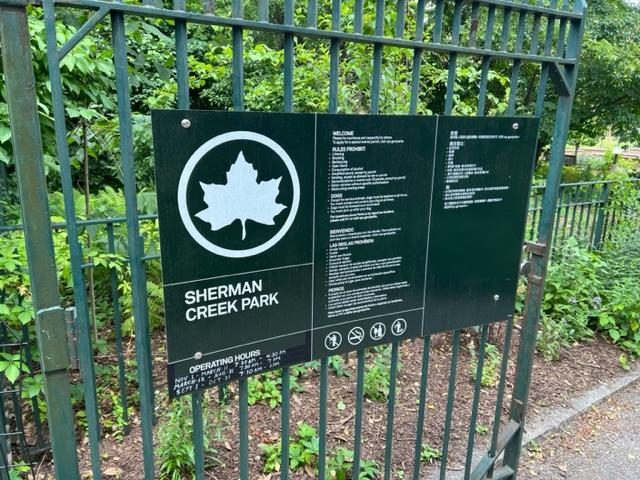
The entrance to Sherman Creek Park.
Sherman Creek Park
(from the park website)
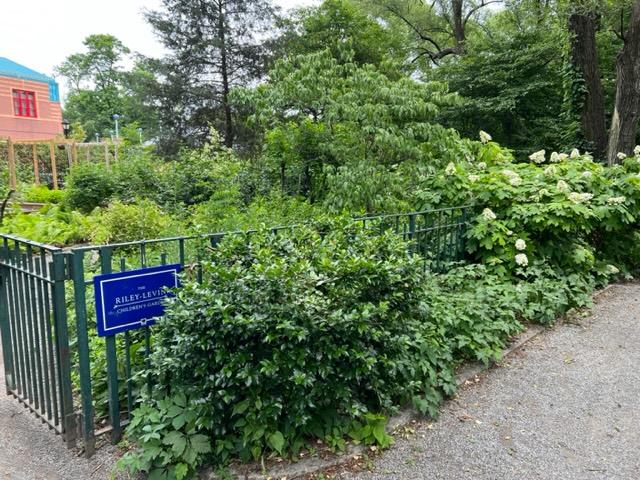
Sherman Creek Park, a former illegal dumping site, began as a shore cleanup and now encompasses 15 beautifully reclaimed acres along the Harlem River including Swindler Cove, Riley-Levin Children’s Garden, and a living shoreline installation. The neighboring Harlem River Greenway includes a sprawling esplanade, bike path, and a cherry tree planting framing the Harlem River Drive.
The pathways in Sherman Creek Park.
The park serves to demonstrate sustainable management of public lands in an underserved neighborhood, from hosting a major community green space in Northern Manhattan, to implementing organic gardening techniques and best horticultural practices on a daily basis.
The waterfall in Sherman Creek Park
NYRP’s work in Sherman Creek and the surrounding landscape recognizes the remarkable value of natural resources found in Northern Manhattan and works to improve and support public access to Manhattan’s largest remaining wetland complex.
The pathways through Swindler Cove Park.
SWINDLER COVE
(from the park website)
NYRP is responsible for conceiving, developing, executing and maintaining the vibrant and versatile Swindler Cove at Sherman Creek Park, a former illegal dumping site transformed by NYRP into a gorgeous green space. The 5-acre space is home to the Riley-Levin Children’s Garden.
Swindler Cove represents the crown jewel of New York Restoration Project’s public park projects. Opened to the public in August 2003, Swindler Cove represents the full spectrum of NYRP’s mission to restore open space as a catalyst for community revitalization and environmental conservation.
The restoration of the Manhattan coastline.
In 1999, in partnership with the State of New York Department of Transportation and acclaimed landscape designer Billie Cohen, NYRP transformed the land into an oasis of native natural habitats with a lush array of restored woodlands, wetlands, native plantings and a freshwater pond, accented by a gracious pathway.
LIVING SHORELINE
(from the park website)
Sherman Creek Park is threatened by climate change-induced erosion and sea level rise and in 2020 we introduced an ecosystem-based solution called a living shoreline.
Replanting and renovating the coastline.
Integrating native plantings and an artificial oyster reef, our living shoreline design aims to not only attenuate waves that wash away sediment but also enhance the native wetland habitat—one of the last of its kind in all of Manhattan. By stacking specialized concrete blocks called Oyster Castles, its design helps build new habitat for marine species that, over time, could transform the dynamics of a park that we might otherwise lose.
We continue to monitor the shoreline’s evolution to better understand and quantify the ecosystem services that urban wetland restoration projects like ours might offer. “We know that, acre per acre, wetlands are better than forests at fighting climate change,” says Director of Northern Manhattan Parks Jason Smith. “It just requires shifting our relationship with the landscape and realizing it’s not about building a big project and walking away; it’s about staying engaged, stewarding it, and learning from it.”
Video on the New York Restoration Project: Rebuilding parks and gardens.
Open: Sunday 1:00pm-4:00pm/Monday-Friday Closed/Saturday 1:00pm-4:00pm/Walking tour of the historical Town of Hurley on the fourth Sunday of each month from May to October.
The Hurley Heritage Society and Museum at 52 Main Street.
The sign that welcomes you to the museum.
The first thing you will notice is the section of the blue stone road that is displayed in the museum’s yard.
You can still see the grooves in the road that were left by the stone wagons that once traveled through the town.
The Front Hall has an exhibition of Revolutionary items and Native American everyday objects.
The showcase of Native American artifacts, located in the upstairs hall, features a timeline of projectile points(spearheads) from the earliest prehistoric times to 1350 AD. Many early tools and stone tools used by the River Indian Tribes are displayed with explanations and documented dates. The history of early pottery tells how and why the Indian settlers crafted utensils from local clay pits and kilns (from the museum website).
Hurley played a pivotal role in the American Revolution. Following the burning of Kingston (then New York State’s Capital) by British troops on October 16, 1777, General George Clinton made Hurley’s Main Street a military outpost. Immediately after the burning of Kingston, the Capital was moved to Marbletown until November 18, when it was relocated to Hurley. The Safety Council (which represented the combined legislative and executive functions of the state government) met in the Van Deusen House (from the museum website).
The Dutch Room:
The Dutch Room showcases how a living area might have looked in the Dutch and Colonial period in the 17th and 18th centuries. All curated items—Dutch bible, antique chairs, tables and cupboards, baby cradle, canvas floor cloth, butter churn, Dutch oven, pewter and china dishes—are typical of ones used by Hurley’s early Dutch settlers (from the museum website).
The Dutch Room
The inside of the museum offers you a glimpse of the past of the town of Hurley and in the time of the Dutch settlers.
The front Hallway Gallery is the old Dining Room.
The old Dining Room of the home has a wood burning fireplace for cooking with an old-fashioned toaster and pots for making stew. To the side is a butter churner and a spinning wheel for making clothes.
Off to one side of the room shows life at that time.
The historic kitchen with wooden shoes and a sausage machine next to the butter churner. The armoire is filled with linens.
The kitchen utensils and cooking materials.
The table had a cake mold and a cabbage shredder. The cabinet was filled with pewter and dishes. Home life in a Dutch home was a lot of work.
On display was a Dutch Bible and a felt hat and other items of Dutch life in the Hudson River Valley.
The History of Post Offices:
In the other room has an exhibition of post offices of the local area and their history and development.
The museum was able to replicate old post office of Hurley by saving pieces of it and brought them to the museum. This if the old front of the Hurley Post Office.
This is the original sorting station from the of post office.
The history of the Hurley Post Office.
Visitors entering the exhibition room are transported into the reconstructed interior of a vintage post office. A dozen display panels circling the room guide the visitor through the seven (yes, seven) iterations of the hamlet of Hurley post offices and through the upheaval caused by reservoir construction of the Ashton, West Hurley, Glenford, and Spillway post offices (from the museum website).
The artist Winslow Homer’s Hurley-An Arist’s View art exhibition:
The pieces of his work are shown took place when the artist lived in the area.
Winslow Homer, one of America’s greatest painters and illustrators, visited Hurley, NY, during summers of the 1870s to sketch and paint views of American pastoral life. It has been a not-so-well-kept secret that that Homer’s famed Snap the Whip is a Hurley scene. Now, recent research has unearthed a trove of his artworks that were inspired by Hurley homes and landscapes (from the museum’s website).
The exhibition on the Eagle’s Nest Community:
EAGLE’S NEST: EXPLORING THE MYTHS AND REALITY explores the history and lore of the Eagle’s Nest, a multi-racial community that resided on Hurley Mountain dating to the 19th century. The Eagle’s Nest exhibit looks at who settled and lived on Eagle’s Nest – not just the myth and hearsay, but a look at the archival records and documentation.
The Walking tour of the town every forth Sunday:
Every last Saturday, the museum has a walking tour of its historic downtown. The town is steeped in history and played a role after the burning of Kingston, NY by the British. It seemed that people escaped to Hurley to get away from the ruin.
The docents run an hour tour of the downtown historical area and give the history of the businesses and buildings that made up this historical town. With the threat of rain and dark clouds above us, our tour guide, Michael, took us on a modified version of the longer tour that was very interesting.
Two different docents gave two different approaches towards the tour and both were excellent. Try not to miss this when it happens at the end of each month from May to October.
The Start of the tour with our tour guide Richard:
The video:
Now a quiet picturesque town, the tour takes you past the historic houses, the Dutch Reformed Church and through their old Dutch cemetery where the remains of many of the first families of the area now reside.
The start of the walking tour
It is an hour-long tour packed with information and interesting stops along the way.
The Van Deusen House when it was the temporary Capital of New York State
The Van Deusen House-the former headquarters of New York State after the burning of the Captial of New York State-Kingston, NY.
The Pietrus Crispell house has served as the Parsonage since 1839.
The Dutch Reformed Church and the Parsonage.
The tour continued
Talking more about the historic downtown
We toured the Hurley Dutch Reformed Church and the parthage next door. We got to see the inside of the church and the pews of the main room. There were dedications to former ministers along the walls. The services are said to be interesting and engaging.
The Dutch Reformed Church of Hurley, NY at 11 Main Street.
The pews inside the Dutch Reformed Church of Hurley, NY
The Rooster Weathervane of the Dutch Reformed Church.
The Rooster Weathervane is a tradition of the church. The tour guide said that it was replaced by a cross which is a more Christian symbol of the church.
One of the older houses of Downtown Hurley. Built in 1715 it operated as the Half Moon Tavern in the18th century.
The Old Guard House
The Guard House where a British spy was held until his hanging in retaliation for the Nathan Hale hanging in New York City. It seems that a British spy did the same type of treason as the British felt Nathan Hale had done and hung him in the town the same way as retaliation for his crime.
The Old Burying Ground sign
Touring the Historical Cemetery in Hurley, NY:
The Video of the Tour
The sign at the entrance of the Old Burial Ground in Hurley, NY.
The Old Burial Grounds was the most beautiful part of the tour. The cemetery sits on a bluff overlooking the Catskill Mountains and offers the most beautiful view on a sunny blue day. It makes you less afraid of cemeteries after touring this well-kept burial ground. The tombstones are well maintained for their age, and you can see the family plots of the first families of the area.
The Old Burial Ground with a view of the Catskill Mountains in the background.
The family plots in the cemetery.
The cemetery after it received a lawn cut from the town.
The view from the burial grounds with the Catskills in the background.
Revolutionary War Hero Colonial Charles DeWitt gravesite.
The dogs that will greet you when you exit the cemetery.
These two friendly dogs wanted to join the tour with us by the cemetery.
The house that General George Washington was given a reception during the war.
The General was entertained at this spot during the war with people grateful for his service.
The house General George Washington visited when he was in Hurley NY. This is is Abe Houghtaling House, where a reception was held for General George Washington when he visited Hurley on 1782.
The side view of the house.
The “Stone Road” pieces outside the museum.
There are two sets of street tracks to see at the museum.
The “Blue Stone Road” pieces outside the museum.
We finished the tour outside the museum with a talk about the museum. I highly recommend going to the museum on the fourth Sunday of the month from May to October (must be nice when the leave change colors) while the tours are still running and take this very interesting historical tour of this small town. it is packed with information and interesting sites to see.
Frankenstein and his bride from the recent Scarecrow Festival at the museum.
Christmas time in Hurley and at the society are really charming. I stopped by the society (it is closed for the season) to see how they decorated the building and the whole town was decorated for the Christmas holidays with garland, wreaths and decorated trees. The local church was decked out in wreaths and lights and the whole town looked like a wood carving from Currier & Ives.
The outside of the Hurley Historical Society at Christmas time.
The Society at Christmas time all decked out with decorations.
I decided to take the same walking tour as above on my own to see the town of Hurley during Christmas time.
I started at the sign at the Historical Society sign.
The Old Guard House at Christmas time.
The Reformed Church at Christmas time.
Downtown Hurley at Christmas time.
The Gazebo decorated for the holidays.
I doubled back and walked to the other side of the downtown towards the cemetery. The historic homes in the downtown were decked out with garland and wreaths and the downtown looked very picturesque.
One of the historic homes in Downtown Hurley.
Another one of the historic homes in the downtown area.
Another home on the tour route.
Before I left Downtown Hurley, the Hurley Fire Department added to the festive environment by having their fire truck drive by for their “Santa Around Town” event. It was kind of sad considering there was only myself and another person walking around, and their first stop was a grocery store down the road with two cars in the driveway. Maybe more people were planning on showing up later that afternoon.
The Hurley Fire Department at “Santa Around Town” in Downtown Hurley.
It was a relaxing afternoon in Hurley before I moved on to other parts of the Hudson River Valley for the afternoon.
The 2025 Tootsie Exhibition (in conjunction with the Hurley Public Library):
The Official Trailer to the film
When I visited the museum in August of 2025, the museum in conjunction with the Hurley Public Library was honoring the filming of the movie ‘Tootsie’, which had been filmed at an historic farmhouse just down the road from the museum along with the Hurley Mountain House sports bar just down the road from the museum. Dustin Hoffman, Jessica Lange and Charles Durning were in Hurley for three weeks filming the Upstate New York scene.
The ‘Tootsie’ exhibition
The display
The pictures and articles from the filming
The articles from the filming
Pictures from the day of the film shooting from locals Cindy Gill Lapp, who was a teenager when she visited the set (pictures above with Mr. Hoffman) and Viola Opdahl, who owned the historic house.
After the tour of the museum, there was a special screening of the movie ‘Tootsie’ at the Hurley Public Library with local resident, Cindy Gill Lapp who talked about her times visiting the set with her friends from high school.
Cindy Gill Lapp talking about visiting the set of ‘Tootsie’ in 1981
Ms. Gill Lapp with Dustin Hoffman on the set
Then a group of twenty of us stayed to watch the movie at the back room of the library. It was a really nice special event.
After the movie was over, I stopped down at Stewart’s Shops at 6 Main Street, down the street from the museum for a snack. It is one of only three places near the museum to eat.
The Madam Brett Homestead at 50 Van Nydeck Avenue in Beacon, NY.
The Brett Homestead marker
The sign that welcomes visitors
I recently visited the Madam Brett Homestead on a walking tour and discovered that the family had a lot to do with the growth of not just Dutchess County but New York State as well. The house was the homestead for five generations of family members each who added to the home.
The homestead’s historic plaque
Since the family practiced thrift in the home and decor, we get to see the house with period furniture that has been donated back to the house from the family. Also, period pieces have been donated by other members of the community to show the home at different periods of time. It gave us a look into the home life of a prosperous farming and milling family.
The entrance of the Brett Homestead
The tour starts with a short video on the family and how Madam Brett got her inheritance from her father and built on the wealth that he had created. She leased out land with water and mineral rights thus adding to her wealth and had a grist mill that was the only one on the patent, so everyone had to go through her for grain processing.
The china cabinet with family related items.
The homestead was built by Roger Brett and Catherine Rombout Brett on land inherited by her father, which was part of the Rombout Patent (which covered much of lower Dutchess County). The couple had been married in 1703 and had originally moved in with her mother in the family’s manor home in Manhattan. Upon the death of her mother, Catherine inherited the land and the manor house in Manhattan. Land rich and cash poor, she and her husband mortgaged the manor house in Manhattan and built a small home and gristmill. They moved into their Dutch style home on Christmas Day 1709. The house was expanded in 1715. The home was later added on again in the 1800’s to the present house (Brett Homestead Pamphlet).
In the hallway on display is the original Rombout Patent, which everyone on our tour thought was very impressive. It had been found and was given back to the house. It shows the land deal that the settlers made with the Native Americans.
A copy of the Rombout Patent
We next headed to the Dining Room, where the family entertained guests. The room is full of period furniture and silver both family owned and donated to the homestead. The formality of entertaining is shown in the room set up.
The Dining Room at the Brett Homestead
Hannah Brett’s (Madam Brett’s granddaughter) bridesmaid dress was on display as well. This had been worn when she danced the Minuet with Marquis de Lafayette. I thought this was interesting in that she had this altered for the occasion and that it had lasted all these years. She had worn this for the wedding of Cornelia DePeyster, whose wedding dress in the New York Historical Society (Brett Homestead pamphlet). It was donated back to the house by the family descendants for display.
Hannah Brett-Schenck’s bridesmaid dress
Period furniture and decorations adorn the Brett Homestead
The decorative pieces in the Dining Room
The Dining Room fireplace
The kitchen was very interesting because when you walk through it you will see the modern kitchen in the front of the room that was put in around the late 1950’s and early 1960’s compared to the other side of the room which has the original fireplace and kitchen equipment. It shows the contrast in cooking and entertaining over the last two centuries.
The old versus the new in the Brett Homestead kitchen.
The house was constructed in three sections. The original section of the house from 1709, the addition in 1715 and then the grander addition in the 1800’s that gives the house the look it has now. You can see how the house evolved from a small residence to a grand showplace and you can see this in the way it was designed.
The upstairs hallway shows the contrast between the old home and the additions.
Each of the rooms were decorated with period pieces and some of the rooms has themes to them such as one was a Children’s Room, another was the family office and one contained farm equipment. All the items represented a different time in the home’s history.
The Children’s Room with a collection of dolls that creeped visitors out.
The upstairs bedrooms
The period farm equipment display.
The other bedrooms showed guest rooms for visitors to the area, the office where the Brett’s would have conducted business and rooms would have housed many family members.
The Master Bedroom with canopy bed and bedwarmer
The Guest Bedroom
The home office of the family.
The house stayed in the family until the death of Alice Sutcliffe Crary at 85 in 1953. The Melzingah Chapter of the Daughters of the American Revolution purchase the homestead to save it from becoming a supermarket. They have been lovingly restoring and holding events at the homestead as well as contributing to the community at large and promoting Historic Preservation, Education and Patriotism (Madam Brett Homestead pamphlet).
I recently visited the house with a group of people on a tour and we visited the house for Christmas and the local garden club had decorated part of the house for holidays with garland on the bannisters and on some of the mantels. The outside of the house was quite festive.
The house during the holiday season.
The house adorned with wreaths and garland on the holiday tour.
The welcoming entrance to the house during the holiday season.
The docent tours are very interesting and really give you a view of what life was like in the house for the families that lived here. They only take place on the second Saturday of the month so you need to plan ahead.
















 Visiting a Museum: The Unique, Unusual, Obscure and Historical