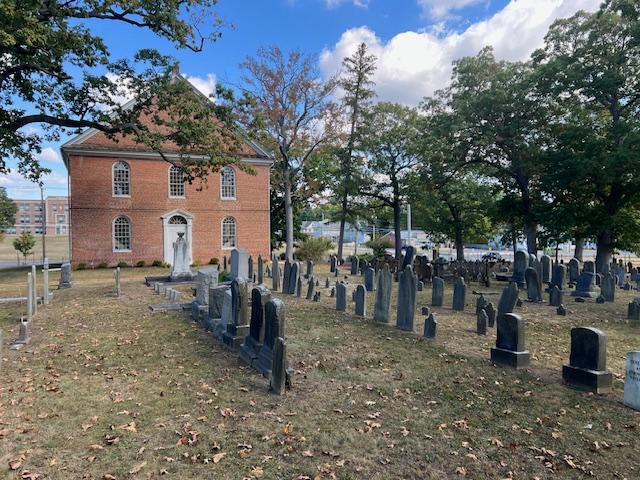
The Old Broad Street Presbyterian Church in its glory in the entrance to the historic cemetery
The Church and its historic cemetery.
When I was traveling to Salem and Cumberland Counties to visit historical sites, this was the last one on my list the first day of exploring. The Old Broad Street Presbyterian Church sits in the middle of a declining downtown in Bridgeton, NJ like a ghost of its former self. This graceful and elegant church is not used much anymore and sits like a majestic building overlooking a city that has passed it by.
The Church and its historic cemetery.
The church was built in 1792 for the growing Presbyterian congregation who was living in Bridgetown as it was called at the time. The brick walls and roof were completed but it would take another three years for the interior to be finished (Cumberland History.org).
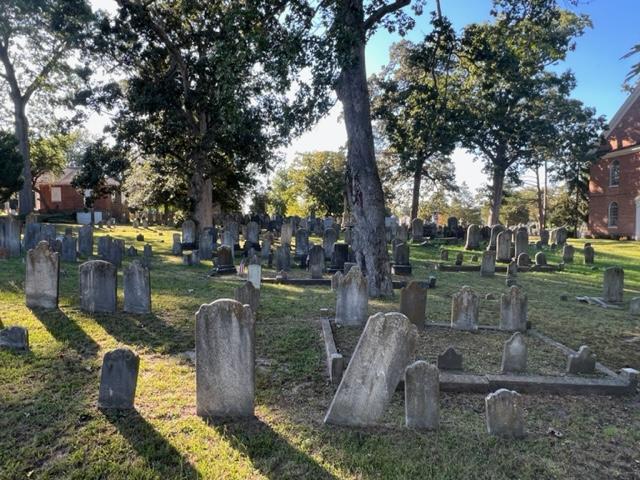
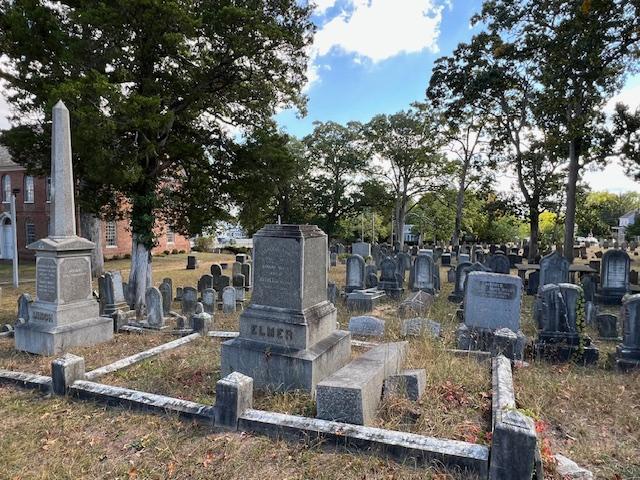
The historic family cemetery
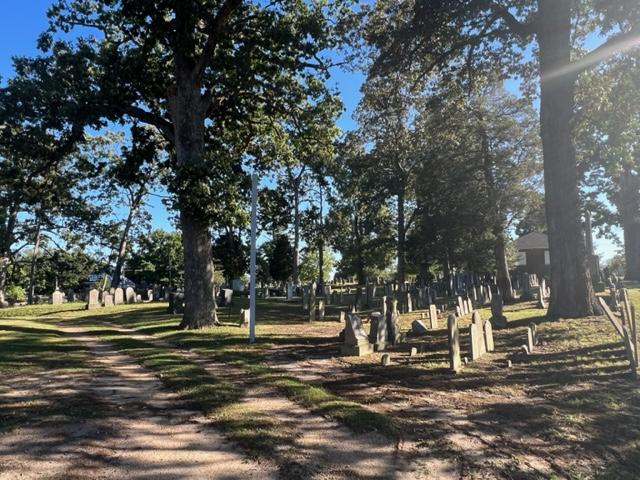
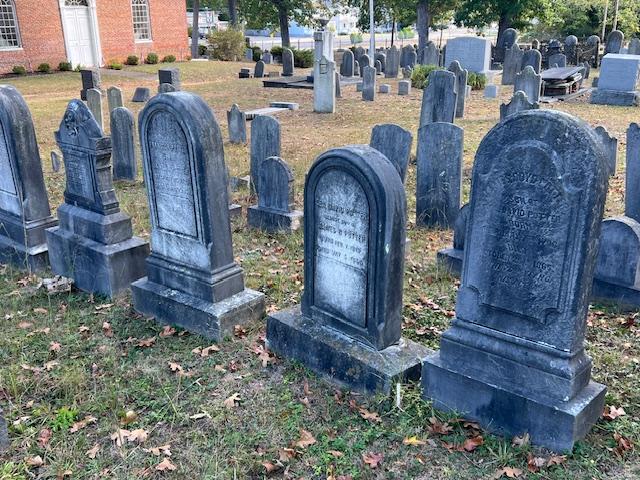
The cemetery is extremely interesting as you visit the historic tombstones and the family plots and try to figure out the connections. The biggest problem with the cemetery is that is has gotten very overgrown in parts of it. It needs a good mowing and the gravestones need to be cleaned as they are wearing away with the elements. It was hard to follow the historical listing but many famous residents and leaders of the community are buried here as well as members of the armed forces from the Revolutionary and Civil Wars and earlier.
The family plots at the cemetery
In some cases, when the families were buried together, it almost told the story of what happened within the family. I saw grave sites where the son or daughter either died in child birth or a disease or in battle and then the devastated parents followed a few years later which was a sad narrative. I saw this many times in the family plots. How many children died of diseases that today are solved by a pill.
The family plots
Some of the notable people buried in the cemetery are Ebenezer Elmer, who represented New Jersey in the United States House of Representatives from 1801-1807 and Jonathan Elmer, who represented New Jersey in the United States Senate from 1789-1791. Lucius Elmer, who represented New Jersey’s First congressional district from 1843-1845. Eilas Seeley, who was the Eleventh Governor of New Jersey serving in 1833. William G. Whiteley, who represented Delaware in the United States House of Representative from 1857 to 1861. Joseph Archibald Clark and Clement Waters Shoemaker, who were two of the founders of Cumberland Glass Manufacturing Company (Wiki).
The David Potter tomb
The history of the Broad Street Presbyterian Church and its cemetery:
(From Cumberland NJ Art.org)
For much of the 18th century in Bridgetown, which will eventually change its name to Bridgeton, there existed no church for Presbyterians, who were a large and growing segment of the local population. For church services, they were forced to conduct services in the Courthouse or travel to churches in Greenwich, Fairfield or Deerfield several miles away.
Family plots and crips
In 1792, about two acres of land were donated along King’s Highway, which was the main road from Bridgeton to Greenwich and ran along the south end of the church construction site. In 1800, this main route was relocated to the north and is today Broad Street (Route 49).
The cemetery grounds on a late summer afternoon.
The basic design of the Broad Street Presbyterian Church was set by it congregation and organizers who requested a masonry building with dimensions of at least forty by fifty feet. By December 1792, the brick walls and roof has been completed but it would take another three years for the interior to be finished.
The church in the early Fall of 2024
The design of the Broad Street Presbyterian Church is that of a meeting house, almost square in proportion. In the 17th and early 18th centuries, many American houses of worship were built in the meeting house form. This design was in contrast to the more formal churches of the period, which were more rectangular than square with an alter and/or communion table and pulpit approached by a long nave and often divided from the congregation by a railing. Broad Street Presbyterian Church has a tall pulpit, accessed by a winding stair and surrounded on three sides by pews so as many congregations as possible could attend and sit as close as possible to the preacher.
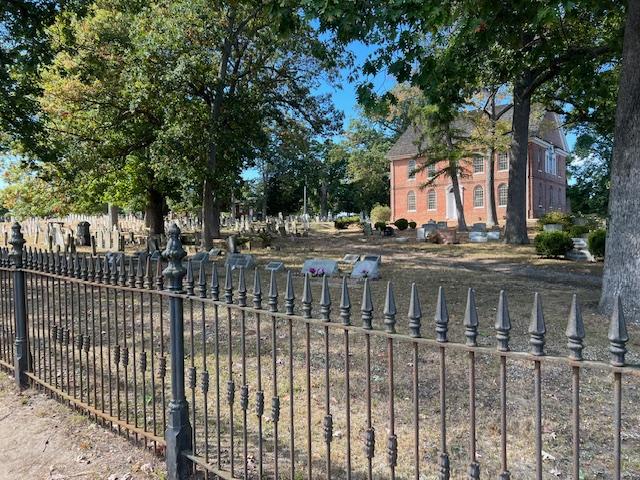
The beautifully designed church behind the fence
Above the pulpit is one of the most significant architectural features of the church, the Palladian window with its central window and semicircular arch flanked on each side by smaller windows and all unified by an entablature supported by columns. The name “Palladian” comes from the Venetian architect who originated the design, Andrea Palladio, who worked in 16th century.
The Elmer Family plot
Architects in the 17th and 18th centuries would travel from other parts of Europe to Italy to study architecture and they brought the Palladian style back to England and the American Colonies. Thomas Jefferson acquired an intense appreciation of Palladian architecture and used it extensively in his design for Monticello.
By 1835, the congregation had erected a new church but because the Broad Street church was surrounded by the cemetery, the congregation did not abandon or sell it but rather maintained it exactly as they left it, which is why today it is identified as one of the most pristine and unaltered examples of 18th century church architecture in the United States.
Today the Broad Street Presbyterian Church is used for special services and opened to the pubic by appointment. It is carefully maintained by the Presbyterian congregation of First Presbyterian Church located on Commerce Street in Bridgeton, NJ.
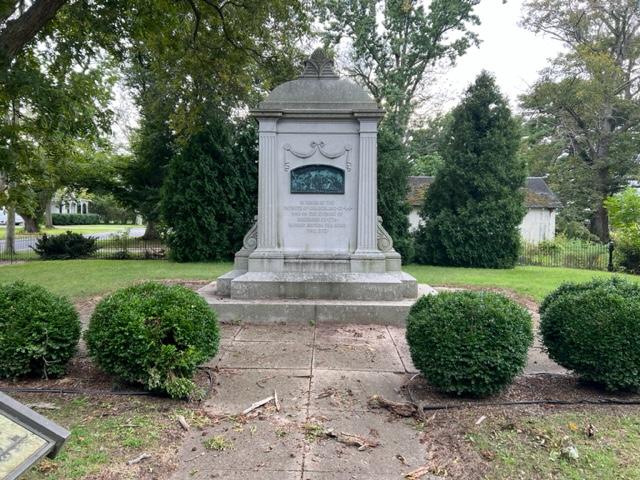
The Greenwich Tea Burning Monument in Greenwich, NJ
I am a firm believer in that you learn something new everyday and on a recent trip to visit historical sites of Southern New Jersey I came across this one in a guide book. I never even knew this monument existed let alone that we had our own version of the Boston Tea Party right here in New Jersey. It really showed me the significance of the Revolutionary War and how people from the past fought for the freedoms that we have today.
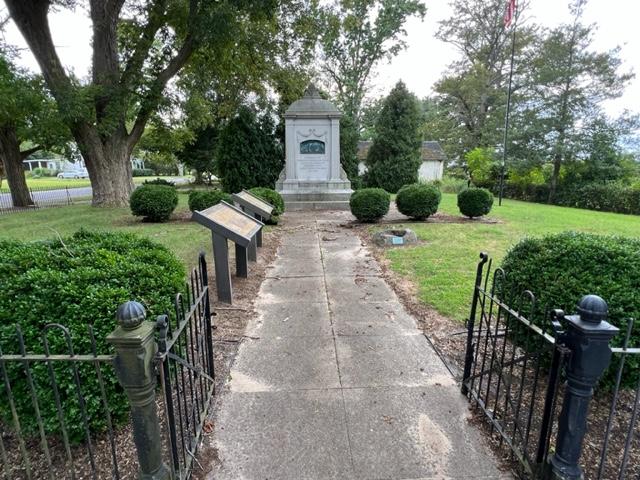
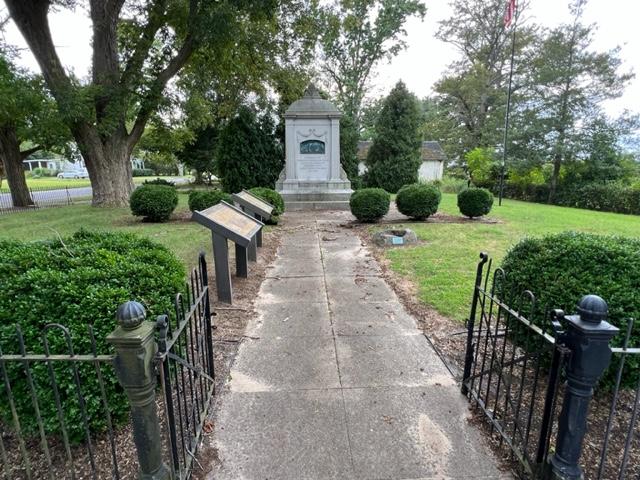
The monument in its glory.
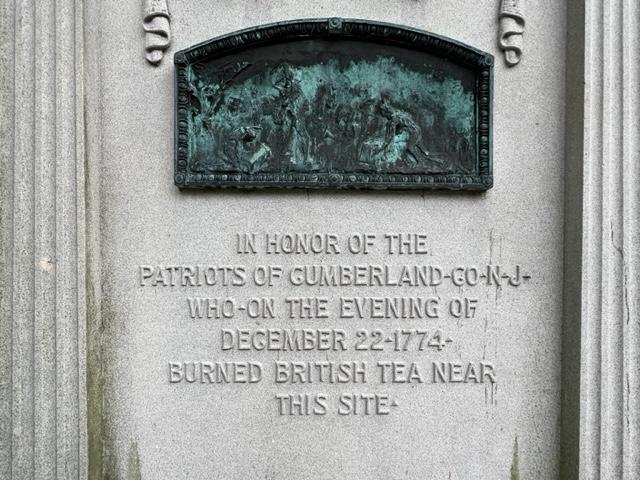
On the night of December 22nd, 1774 forty people from the community took possession of tea chests and piling them together burnt them in protest of the Tea Tax that had been imposed on the residents of New Jersey. This act of defiance was a reaction to the actions of the British Rule.
The monument honorarium.
This beautiful and graceful monument lies now at the end of a sleepy country road in Greenwich, NJ which is still surrounded by farmland. It is hard to miss the monument in its location in the middle of a small park surrounded by a small fence. The monument was dedicated in 1908 and then again in 2008 there was a second ceremony to honor the 100th anniversary of the monument (Wiki).
The moument sits down the road from the Museum of Prehistoric History and from the Gibbon House so there are many things to see in Greenwich, NJ on this quiet country road.
The History of the Greenwich Tea Burning in 1774:
(From the Cumberland County, NJ website):
Liberty was not cradled in Philadelphia alone. The spirit was also alive in the inhabitants of Cumberland County when they destroyed a cargo of tea in 1774.
On the evening of Thursday, December 22nd, 1774, a company of about forty young Whigs, disguised as Indians, entered the cellar of Bowen’s house. They took possession of the whole cargo, conveyed the tea chests from the cellar into an adjoining field and piling them together, burnt them in one general conflagration. Forty miles from Philadelphia, was (and still is) the little town of Greenwich, the principal settlement of Cumberland County in 1774.
The Greenwich Tea Burning of 1774 (NJ Historical Society)
It was founded in 1675 by John Fenwick and is older than Philadelphia, which was not founded until 1682. The hand of time has hardly touched Greenwich. It is much the same today as it was three hundred years ago, when the British flag flew high over it. Today you will still find a wide street, which they still call “Ye Greate Street.” It was laid out in 1684 and its course has never been changed.
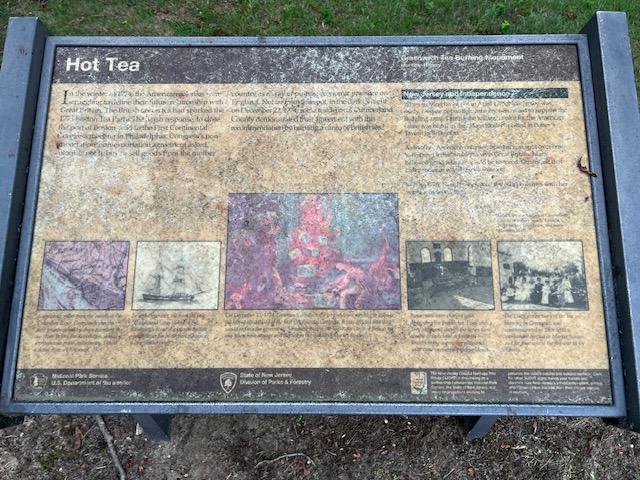
The storyboard on the event.
The Cohansey Creek is a navigable stream of some size running through the county of Cumberland and emptying into the Delaware Bay. In the autumn of 1774, the quiet inhabitants along the banks of the creek were startled by the appearance of a British brig called called the “Greyhound.” Sailing about four miles up the Cohansey, the brig stopped at the village of Greenwich, which was the first landing from its mouth.
She was laden with a cargo of tea sent out by the East India Tea Company, which was undoubtedly under the impression that the conservative feelings and principals of the people of New Jersey would induce them to submit quietly to a small tax. The result showed that the temper of the people was little understood by the East India Tea Company (Similar to the Toilet Paper Tax of the Governor Florio in the 1990’s).
The storyboard on the event.
Having found an English sympathizer, a Tory, as they were called, one Daniel Bowen, the Greyhound’s crew secretly stored the cargo of tea in the cellar of his house. However, this unusual procedure was noted by the citizens who immediately appointed a temporary committee of five to look after the matter until a county committee might be appointed.
A general committee of thirty-five was later appointed with representatives from Greenwich, Deerfield, Jericho, Shiloh, Bridgeton, Fairfield and perhaps other places.
Greenwich Tea Burning Monument News of the Boston Tea Party had already reached Greenwich and the defiant example was regarded by many of the local settlers as worthy of their own contempt for the British. Fate now presented them with a ready-made opportunity to duplicate the act.
On the evening of Thursday, December 22nd, 1774, a company of about forty young Whigs, disguised as Indians, entered the cellar of Bowen’s house. They took possession of the whole cargo, conveyed the tea chests from the cellar into an adjoining field and piling them together, burnt them in one general conflagration.
Thus, the patriots of Cumberland County living in Greenwich expressed their discontent by reacting to oppressive governmental measures. They had clearly taken a stand for independence and democracy.
Greenwich has been granted the distinction of being one of the five tea-party towns in America, the others being Charlestown, Annapolis, Princeton and Boston. In 1908, the monument seen above was erected in the old market place on Ye Greate Street to commorate the burning of a cargo of British tea on December 22nd, 1774.
The Museum of the City of New York at 1220 Fifth Avenue
I have been a member of the Museum of the City of New York for almost twenty years and what I love about the museum is that its concentration is to be everything about New York City and what makes the City so great. Its development from a Dutch Colony to the Modern Metropolis that it is today. It covers the history so well that they created a permanent display entitled “New York at its Core”, an extensive history of the City from its start as being colonized by the Lenape Indians as a fishing and hunting set of villages on the island.
The “New York at its Core” exhibition (MCNY)
Each display takes you through a different point in the history of the development of the City and how each era brought dramatic changes to the fabric of the City from immigration over the years to the fires that leveled the original City and the raise of Wall Street and the Arts to make New York City the Capital of the World. The almost bankruptcy of the City in 1975 to the attacks on 9/11 have really shaped the direction and change in the City to the COVID-19 pandemic reshaping it again. We see how New York City continues to survive. The exhibition is now updated to add the COVID pandemic to the fabric of what is happening in New York City now. This exhibition will continue to evolve over the coming years.
The entrance to “Timescapes”
The film “Timescapes” in the basement theater again tackles the issues of a changing City since its development and the City continues to morph over time. The movie narrated by Stanley Tucci tells the story of New York from the time of the Dutch settlement to the attacks of 9/11 and like “New York at its Core” the issues that come about after every event. The film is shown five times a day and do take the time to see it when visiting the museum.
A tiny clip of “Timescapes” from the Museum of the City of New York
Just recently I attended a special event at the Museum to honor the Founding Members of the “Talking Heads” Chris Frantz and Tina Weymouth and their groundbreaking film “Stop Making Sense”. I was lucky to get tickets because the second I saw this on the museum listing I bought the tickets immediately. The event sold out quickly.
‘Talking Heads’ founders Chris Frantz and Tina Weymouth
The event was discussion with the creators of the group and how the Talking Heads emerged as a popular group through the 1980’s and 90’s. I have to admit that the two of them have not changed much but looking a bit older. They enchanted the audience with their time with the group and some new things they have in the works. After a quick Q & A, we watched their popular concert film “Stop Making Sense”.
We had such a good time at the event, the I wrote about it for my blog, “MywalkinManhattan.com”:
Day Two Hundred and Eight: Private Members nights at the New York Museums:
On another recent trip, I visited the exhibition “New York New Music 1980-1986” which was an exhibition on the development of the music scene after the Disco era was over and the rise of MTV. You had a combination of Club Music, Hip Hop, New Wave and the English Wave from Australia and New Zealand coming into the United States plus a resurgence of Rock and Roll after years of the “Disco Duck”. The exhibition highlighted the music of Debbie Harry and Blondie, Run DMC, Cyndi Lauper and Madonna and the rise of music videos. The exhibition brought me back to my last years of high school and my college years as I remembered all these groups.
The “New York-New Music 1980-1986” exhibition
Over the years I have seen exhibitions on everything from the Bankruptcy exhibition of New York City and the rise of crime, the Gilded Era with Alice Claypoole Vanderbilt’s “Electric Light” dress that she wore to Alva Vanderbilt’s famous ball and the wonderful toy exhibitions of early playthings. I have also been to many lectures at the museum with guests such as former Brooklyn President Marky Markowitz.
In 2023, I visited the museum for the first time in months and was able to see the “Gingerbread House Bakeoff” exhibition of well-known and amateur bakers in New York City. The exhibition was a hold over from Christmas and it was interesting to see the detailed gingerbread houses that were on display.
There two that I really liked. One was of Madison Square Park at Christmas time and looked like the pictures I had just taken of the park.
Bryant Park at Christmas time in gingerbread
Christmas scene in New York City
The next exhibition I wanted to see before it closed was the “Food in New York” exhibition. It could have been a little more detailed than what I saw. I thought it was going to have more of the development and history of food in New York and how it pertains to today. It was more artwork related to modern food industry trends. It was interesting but not what I thought it was going to be.
‘Food in New York’ exhibition
Some of the artwork really stood out on the display. I like the Hispanic Ice Carts which you see all over Washington Heights and East Harlem during the warmer months.
Ice Cart “Pimp My Piragua” byt artist Miguel Luciano
Artist Miguel Luciano
“Twilight” by artist Suzanne Anker
The effects of pollination of crops and the loss of bees shown here.
Artist Suzanne Anker
The latest exhibition that I visited on a Members walking tour was the “New York Now: Home” exhibition that opened in the Spring of 2023. The exhibition is based on what the photographers perspective of what a ‘home’ is and how you live through it. There were photos of family events, life outside the home, what a family is, is it your birth family or friends that have become family? There were also some great shots of people taken during the COVID lockdown and how the home became the center point of their lives and sanity. Each photographer gave a different way of looking at these points.
‘New York Now: Home: A Photography Triennial’
The exhibition write up
There were many terrific artists displayed in the exhibition but these are the five that I thought stood out the most:
Photographer and Artist Anders Jones work on the loss of bodegas in his neighborhood due to gentrification.
Artist Anders Jones work at the Museum of the City of New York
I think the museum was looking for a more political and environmental view of food in New York City as opposed to the history and development. It still was an important issue. It also showed all the urban, community and roof gardens that are becoming part of the urban landscape. It is interesting how people are using space to grow food for the benefit of everyone. It was an interesting perspective.
The museum is really all things New York.
The museum also has a series of talks in movies shot around or about New York City. On a recent trip to the museum I attended the retrospect of director Walt Stillman and his 1998 film “The Last Days of Disco”, which had been a huge hit when it came out. The director talked about the change in times from the 1970’s to the 1980’s and the shift in behavior of the population. There was a moment of time when “Disco was King” and going out was all the rage after years of Vietnam era. Studio 54 led this charge and when it closed in 1980, the party was over.
In conversation with director Walt Stillman the night of the retrospect.
The original trailer for the film.
The Q & A at Lincoln Center for the 20th anniversary of the film.
The series of films deal with the subject matter of New York City and what makes it a special place.
I recently went to see the new Art Deco City-New York exhibition on a private tour. The curator for the show toured us through the era after WWI and during the Depression. Things got more simplistic and cleaner.
You had a youth revolution that wanted to get away from Victorian values and with the lack of resources and money during the Depression, everything became more clean lines, less embellishment and more modern looking.
The exhibit ‘Art Deco City New York’
The bulk of the exhibition came from the collection of Cosmetic owner, Ronald Lauder, who contributed his Art Deco post card collection. Years of collecting showed all of us the changes not just in architecture but attitudes in travel and living. Gone were the bulky and elaborate in was simplistic and clean designs with a fresh approach.
The main gallery with Art Deco post cards
This perspective was shown in the 1939 World’s Fair, where a look to the future showed optimism and a look at new possibilities.
The 1939 World’s Fair
The outfits of that era also represented women and their freedoms from the Victorian era and the excesses. Gone were the days of corsets and bustles and in was the freedom of movement to the modern working woman who have to work to support her family. This reflected in the social life too.
Dresses from the 1930’s
Rockefeller Center and the Empire State Building were the big projects of that era. It showed the optimism and show of the possibilities of the modern era during the Depression and kept people working.
Models of Rockefeller Center
The exhibition was very interesting and informative and shows up in the modern era today.
The latest exhibition I attended was “Songs of New York”, a tribute to the rich music scene of the five boroughs through the ages.
The Exhibition sign for “Songs of New York”
The exhibition delves into the rich history of everything from New Wave to Hip Hop to Rock and Jazz. The interactive exhibition has you stepping on a Borough symbol and you hear its rich history of music.
The interactive display on the third floor
The opening remarks from the curator at the opening night
The reception with drinks and snacks for members
Pictures from ‘Look Magazine’ from the collection
Photographs from Allan Tannenbaum
The career of Allan Tannenbaum
The photos of Janette Beckmann of the ‘Hip Hop’ scene with the start of the careers of LL Cool J and Run DMC
The exhibition packs a lot of information into a small space where the members were able to enjoy the music of New York City.
I went to an Educator’s Night for the new ‘Above Ground’ exhibition on the street art collection of Artist Matin Wong. The artist collected the street art of the 1980’s after the Crash of 1987 slowed the demand for this art.
The ‘Above Ground’ exhibition
The sign from the exhibition
The works in the exhibition
The work ‘Futura’
The sign for ‘Futura’
The works by artist Keith Haring
The works in the galleries were creative and colorful. These artists sending a message with their works.
The art of the exhibition
The art of the exhibition
The gallery displaying the works
The work by artist Quik
The artist’s write up
The exhibition works were from the period of the mid to late 1980’s and these works Martin Wong bought after the Crash of 1987 to help sustain his artist friends whose sales dried for street art. The collection was donated to the museum after the artist’s passing in 1994 (Museum pamphlet).
I recently returned to the museum for a special evening event for photographer Ebet Roberts
The special event for music photographer Ebet Roberts
The evening was a discussion of the artist’s works from the 1970’s and 80’s. What I thought was interesting is how she seemed to fall into it as an artist with newspapers interested in seeing her photographs.
The photographer, Ebet Roberts with the museum curator
The photographer discussing her work
One of her well known works of a musician couple from the 1970’s
The talk was very interesting as she fell into the profession of just taking pictures of bands while attending the events as reporting. Then the papers wanted to see what pictures she had taken. Liking how she captured the groups in a more human fashion, she continued to take more pictures. This led to private sessions and behind the scenes works, capturing the events before and after a concert. It was a very interesting talk.
These are the types of events that make the museum unique and special.
The History of the Museum of the City of New York:
(From the Museum of the City of New York website/Wiki):
The Museum of the City of New York is a history and art museum that was founded in 1923 by Henry Collins Brown. The red brick building with marble trim was built between 1929-30 and was designed by architect Joseph H. Freedlander in the neo-Georgian style with statues of Alexander Hamilton and DeWitt Clinton by sculptor Adolph Alexander Weinman, which face Central Park from niches in the facade (Wiki).
The museum was originally located in Gracie Mansion, where available space was limited. One of the first exhibitions was “Old New York” in 1926. This took place in the Fine Arts Building on West 57th Street. The success of the project led to a search for a new, permanent headquarters for the museum (Wiki).
A design competition was held between five invited architects and the Colonial Revival design by Joseph H. Freelander was chosen. The City donated the site on Fifth Avenue and the funds for the construction of the museum was raised by public subscription. The original plans for the museum’s building were scaled back as a result of the Wall Street Crash of 1929. The building was finished and dedicated in 1932.
In 2000, there was talk by then Mayor Rudy Giuliani to move the museum to the historic Tweed Courthouse near City Hall but that was over-turned by the incoming Mayor, Michael Bloomberg. In protect the museum director, Robert R. McDonald resigned.
In coming new museum director, Susan Henshaw Jones, planned an extension to the museum and it was completed in 2008. The extension including renovating the existing gallery spaces and adding a new pavilion. New displays and a remounting of valuable artifacts were done to give the museum a refreshed look. In 2011, the Museum of the City of New York temporarily took over operation of the South Street Seaport Museum which itself reopened in 2012 (Wiki).
The museum has a collection of over 1.5 million objects including many items from the 19th and early 20th centuries including paintings, prints, costumes, decorative objects, furniture and an extensive collection of toys. There are also extensive collections of police and fire items as well as shop models, rare books and manuscripts (Wiki).
The Museum of the City of New York in the early Spring
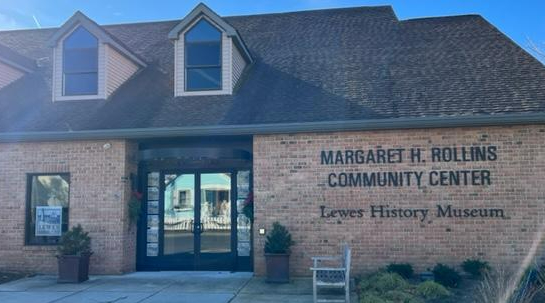
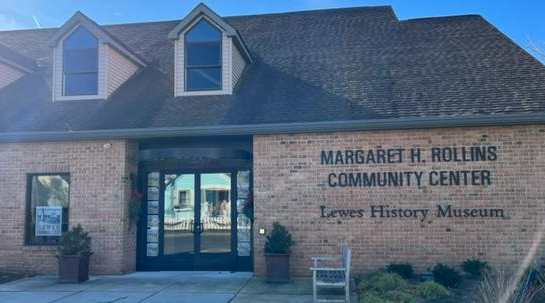
When I was visiting Rehoboth Beach, DE recently the museum I had wanted to visit in Rehoboth was closed for the day, so I remembered that there were a few museums in Lewes, DE, a small town right down the highway so I headed there and found the Lewes History Museum at 101 Adams Avenue. The museum was the old library which has since moved across the street.
The entrance to the museum
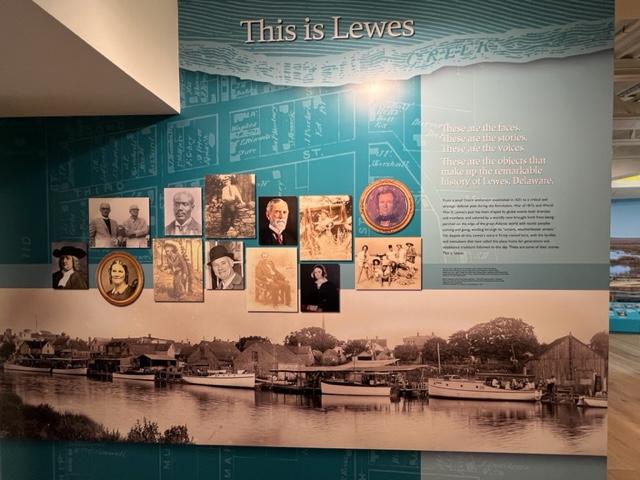
The museum is very interesting and well set up. The museum is one big room that is broken down in different sections which helps explain the history of the town. Each display moves you through the museum in a chorological order of how the town developed.
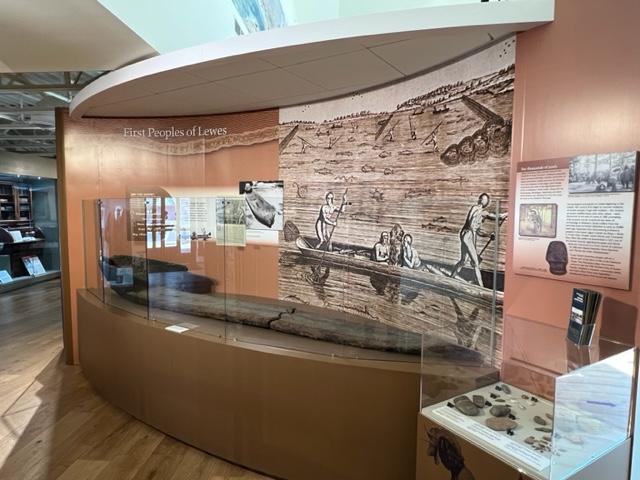
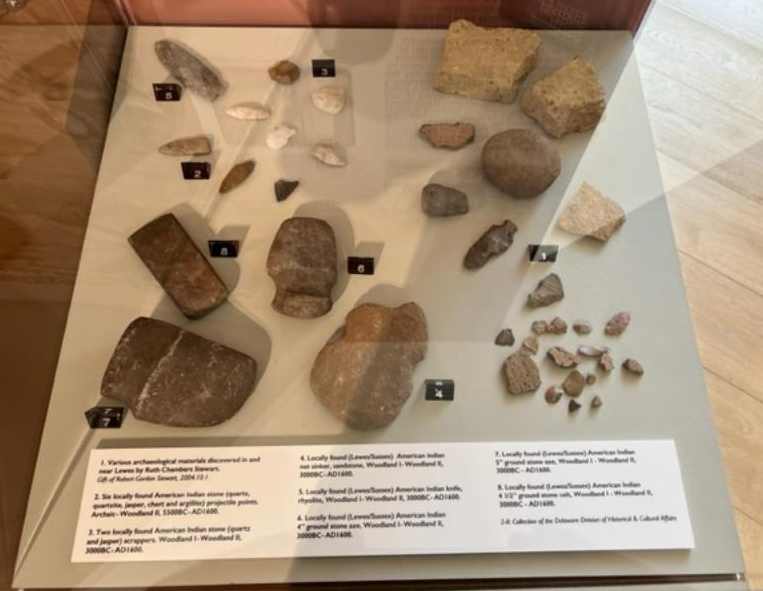
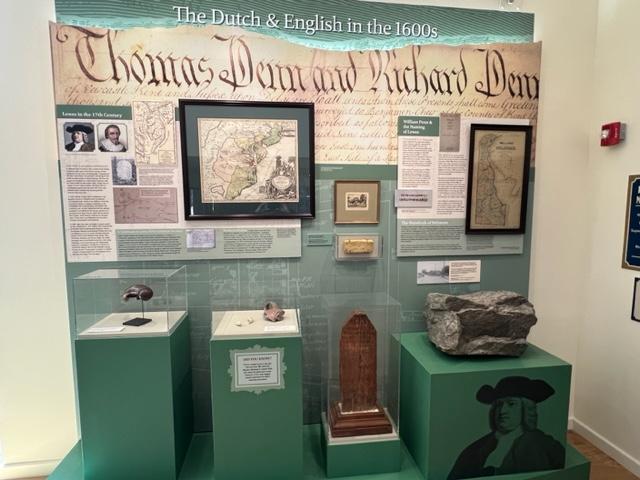
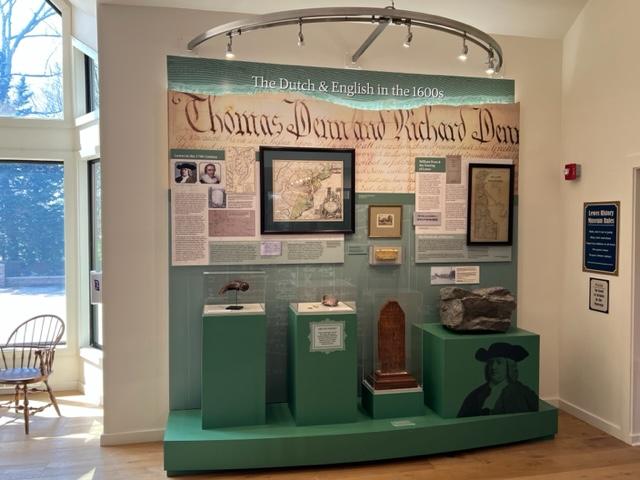
The museum starts with a display on early Native American history which then moves to the colonization of the Dutch and British in the area. There are all sorts of interesting artifacts that tell the story of the Revolutionary War by way of the residents.
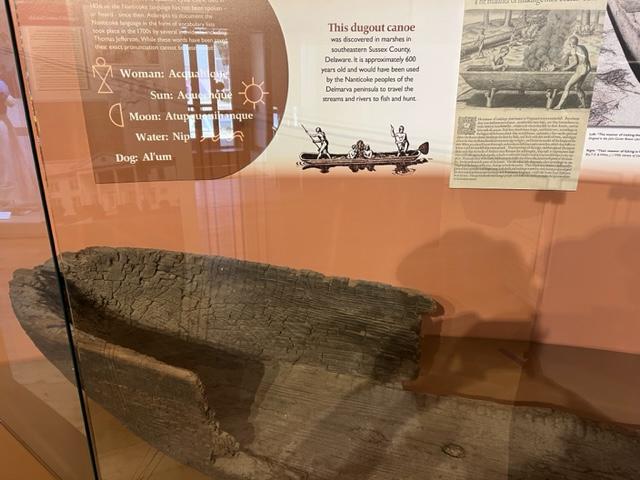
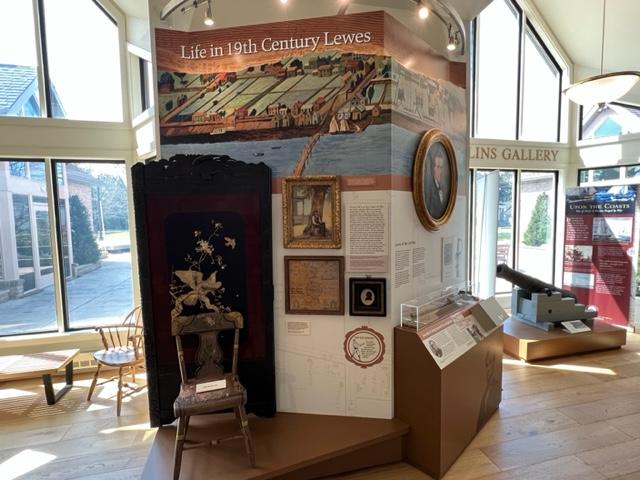
There are displays on the way homes were designed and decorated as well as the role that Lewes played during the war. There have been a lot of soldiers who had died in the war with their stories being told by the museum. There are also discussions about the interaction between the Native population with the colonists. The Native American collections featured the lives of the tribes that lived in the area of Lewes. They had found this canoe when dredging the area.
The Lewes History Museum’s displays are informative
Life in the Dutch colony was featured after the Native American display as the next group took over this area from the Native Americans. Delaware had been part of the original Dutch colony. When we were taking a tour and the guide said that technically Delaware was part of Maryland but the Dutch stood strong against the British at that time, the area stayed independent but not for long.
The Dutch Colony
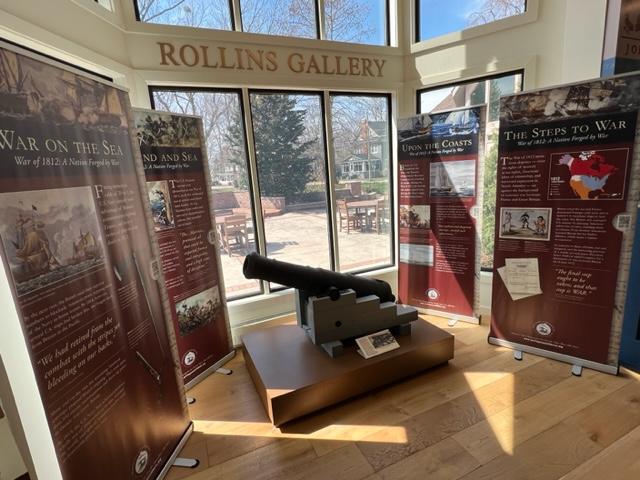
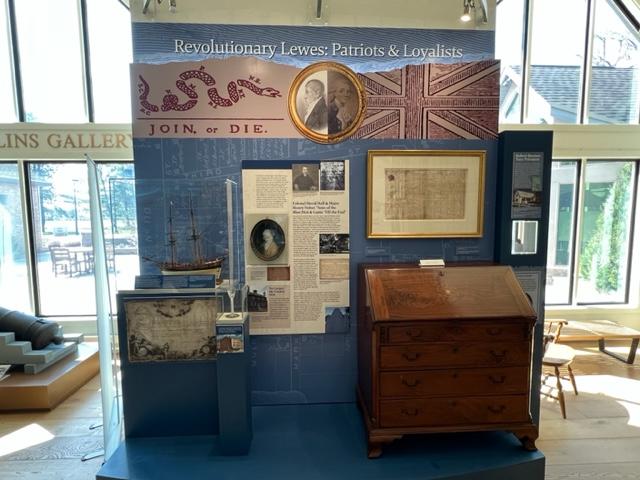
The Revolutionary War came to Delaware but it never saw the fighting that the other colonies saw. Still the state had to be on guard at all times and there were British War ships off the coast of Lewes that did do some damage.
Revolutionary War display
The displays held some interesting artifacts including a ‘toasting glass’ from the evening in Fraunces Tavern where George Washington said farewell to his troops. The docent said that he had kept the glass all those years and it was passed down from generation to generation until it made its way to the museum as a donation.
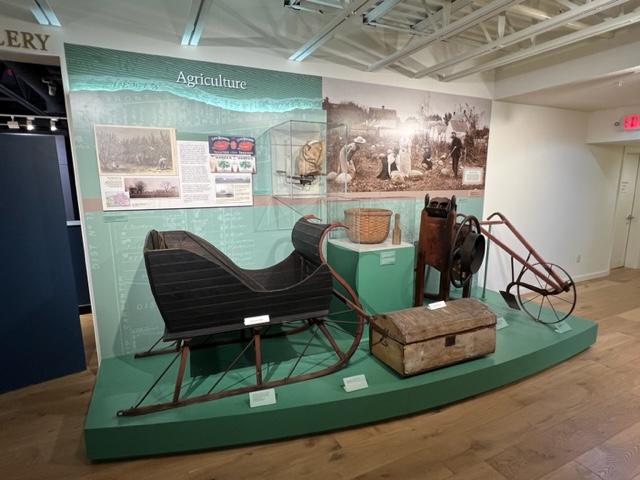
The Farming and Dairy industries played a role in Delaware’s history but because of the type of soil that Lewes had it was not meant for many crops. Wheat, some vegetables and the dairy industry played a role in the business of Lewes.
The Dairy and Agriculture industries of Lewes
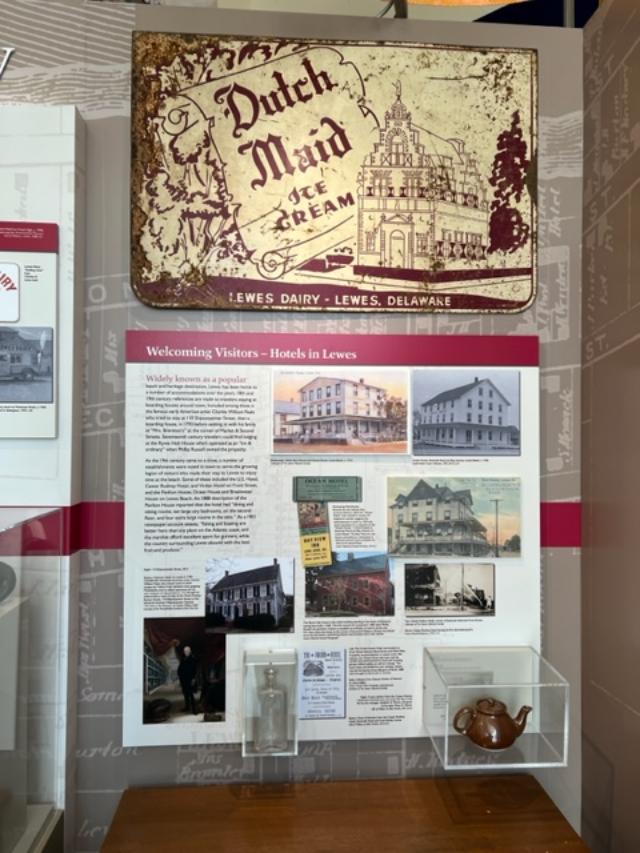
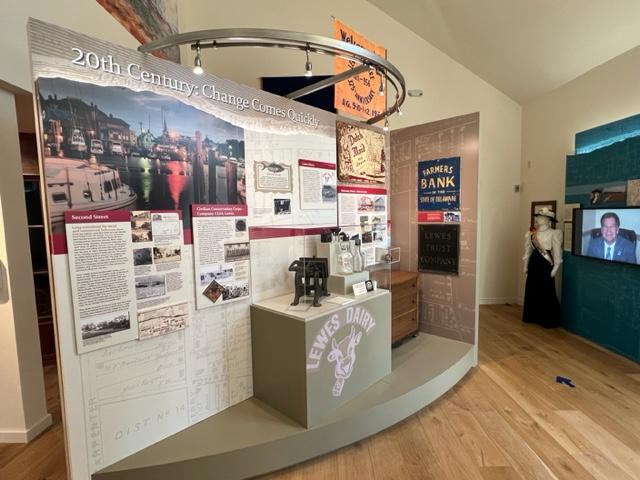
There is a section on the development of businesses and Lewes as a resort town. The section on Lewes developing as a resort town was interesting with the advent of ocean swimming, boating and beach recreation. There is also a section on 19th and 20th century business in Lewes that kept up with the times.
20th Century Business
19th Century Business
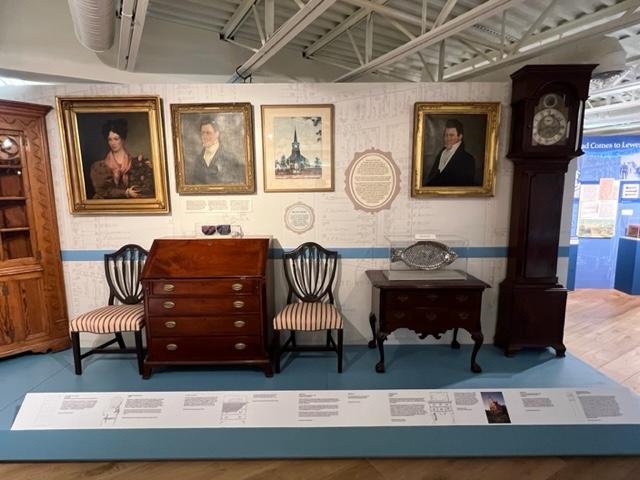
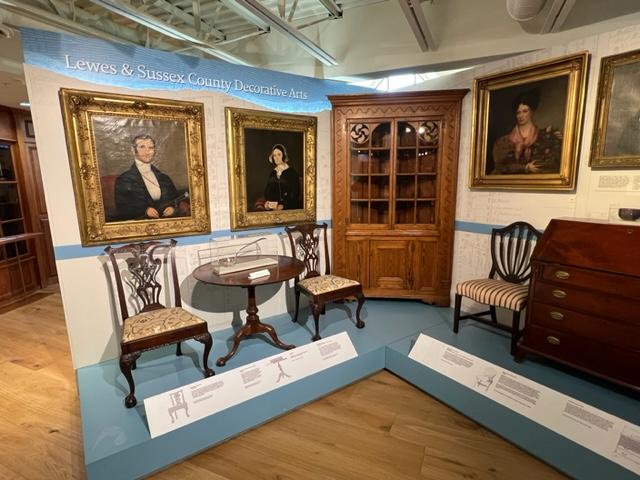
There was an interesting display on Victorian furniture and decorating for the home. The decorative arts section showed how Victorian families set up their homes and how status symbols like fine furniture and family portraits played an important role in society.
Display on Decorative Arts of the Home
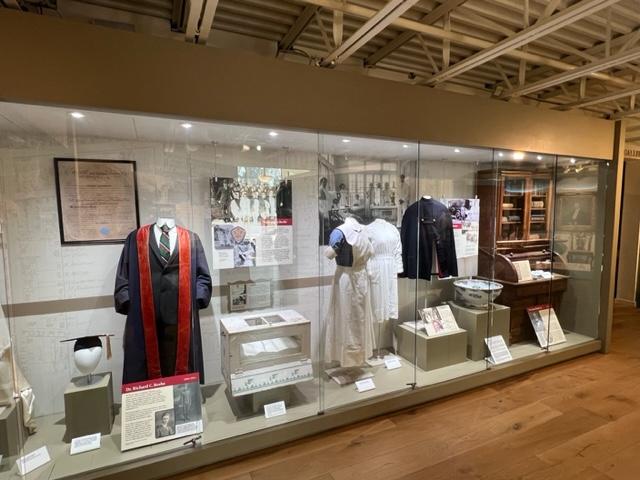
There was a detailed display on the Beebe family and the growth of their well-known hospital. The family started with three beds in a home to the giant hospital that it is today. You can read about the family members contributions both to the hospital and the community.
The history of the Beebe Hospital Family and the growth of the hospital
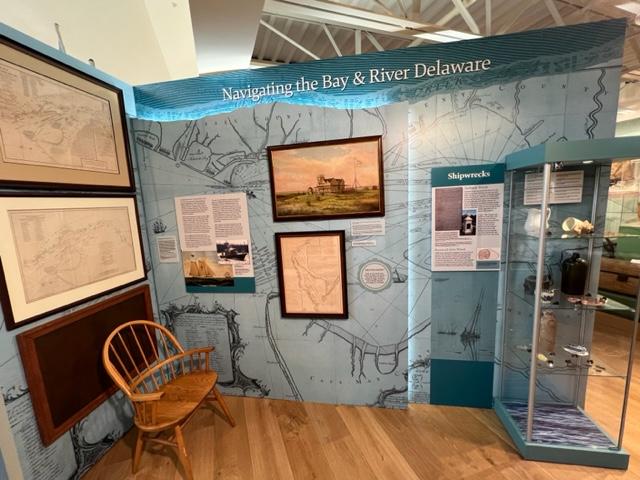
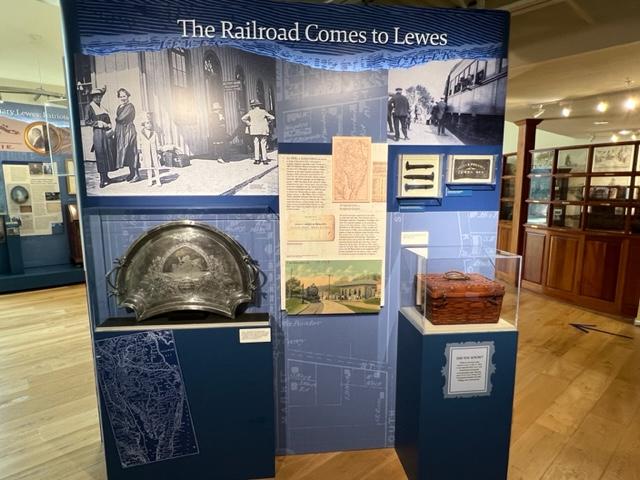
The area developed and entered the modern era with displays on Public Service, The shipping industry and the growth of the railroads in the area that helped open Lewes up as a resort. As the modes of transportation changed so did Lewes with each step.
The Shipping Industry
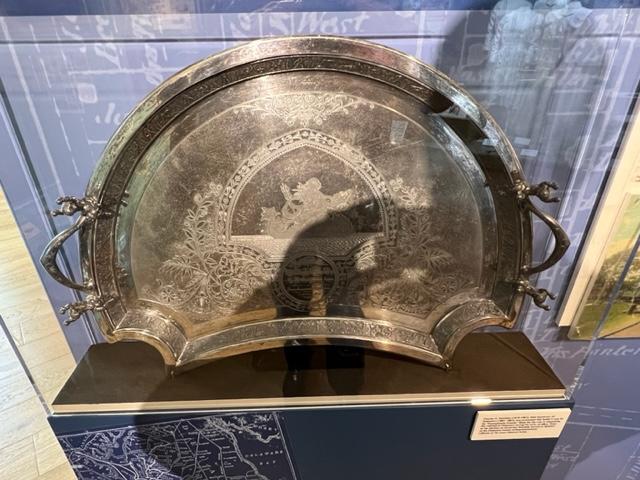
The presentation plate as part of the railroad display
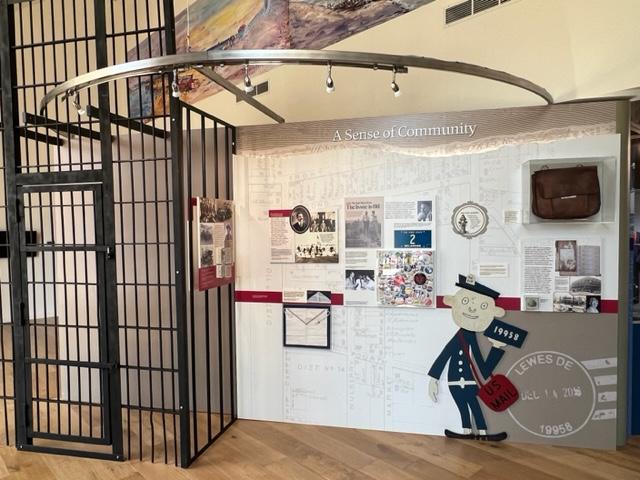
Public Service and a sense of community
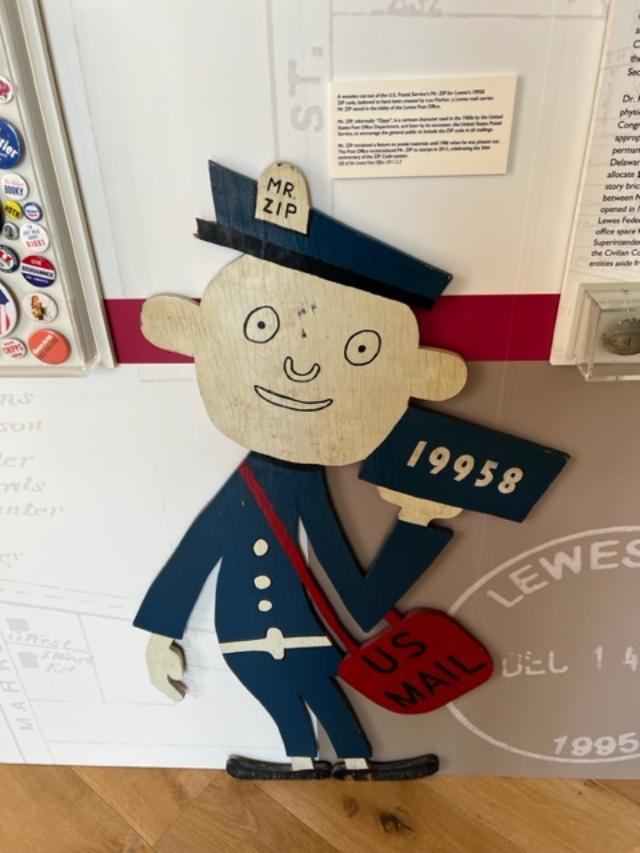
Zippy
The museum will take about an hour to comfortably walk through. It is a interesting and fun way to know the history of Lewes, De. The detail and interesting artifacts makes it a very engaging museum. The docents are really nice and helpful in explaining the displays.
The History of the Lewes History Museum:
(From the Museum website):
The Lewes History Museum is located in the Margarat H. Rollins Community Center at 101 Adams Avenue in Lewes, DE. For 54 years, The Lewes Historical Society has collected and preserved tens of thousands of historic artifacts, artwork, documents, maps and photos. Now it the support from the City of Lewes, a gift of $500,000 from the Ma-Ran Foundation and generous donations, this incredible collection is on continuous display at the Lewes History Museum.
The museum serves as the primary source of information about Lewes for visitors, researchers, students and residents. Enjoy ongoing exhibits featuring Lewe’ maritime history, decorative arts and artists, famous families of Lewes and how our region is seen through environmental change. The museum provides ongoing seminars, symposia and presentations along with a wing for community non-profit gatherings.
The popular Children’s Discovery Center is house inside the museum and is currently closed at this time. The Discovery Center offers an interactive, fun and educational experience for children of all ages. At the Center, children can experience 19th century Delaware by interacting in a replica general store and post office, playing around a scaled model of Cape Henlopen Lighthouse with a Morse code station, foghorn and reflecting lights. The Center also houses a Delaware River Pilots’ simulation module, a electronic table-top boat-building area and a lighthouse “keepers cottage”.
The community center is the centerpiece of the cultural campus in Lewes, including 18 miles of trails, a concert stage, parks, a children’s garden and the Lewes Public Library.









 Visiting a Museum: The Unique, Unusual, Obscure and Historical