Tag: Exploring Upstate New York

The Hill-Hold House Museum                                                             128 NY 416                                                                                       Campbell Hall, NY 10916

The Hill-Hold House Museum 128 NY 416 Campbell Hall, NY 10916

The Hill-Hold House Museum

128 NY 416

Campbell Hall, NY 10916

(845) 291-2404

https://www.orangecountyny.gov/1477/Hill-Hold-Museum

https://en.wikipedia.org/wiki/Bull-Jackson_House

Open: Sunday 12:00pm-4:00pm/Monday-Friday Closed/Saturday 12:00pm-4:00pm Seasonal Tours from May to August.

Admission: Adults $5.00/Children $3.00/Group Tours $4.00-Group Tours for over 20 people have to arranged in advance.

My review on TripAdvisor:

https://www.tripadvisor.com/ShowUserReviews-g47402-d27087686-r1070368379-Hill_Hold_Museum-Campbell_Hall_New_York.html?m=19905

I had never heard of the Hill-Hold Museum and I happened to come across it when I saw a sign on the local highway that the museum was open that day. I thought it was a very interesting home and grounds with historical homes and buildings. Some came from other parts of Orange County, NY.

There are group tours on the hour with the last tour at 3:00pm. I took the last tour by myself with the tour guide and got a one on one tour of the house and grounds. The tour takes you into a step back in time to an agricultural society that no longer exists and times were slower and more structured.

The Hill-Hold Museum

The estate in the background

The Hill-Hold Museum:

A Farm for Two Centuries. This stone farmhouse was built in 1769. This museum reflects the life of the Bull-Jackson family spanning over 200 years. Hill-Hold Museum has circa 1830 Furnishings,  a one room School House, a historic 1870 barn, Goosetown Gift Shop, picnic benches, and parking (Museum website).

The house on the estate grounds

The Mission Statement:

(From the museum website)

The Friends of Hill-Hold and Brick House Museums serve to preserve and enhance the preservation of history in Orange County, by maintaining, furnishing and operating programs at both these exemplary 18th century houses. These museums include portraits, memorabilia, photographs, and furnishings pertinent to them, the county and the past ages that touched each house (Museum website).

The front of the Hill-Hold Museum at the start of the tour

History of the Hill-Hold house museum:

(From the museum website)

Visit Hill-Hold museum and see what life was like on a Hudson Valley farm in the 1830s. This was still the era of candlelight, fireplace heat, homegrown food, and homespun clothing. The stone farmhouse was built in 1769 with wide plank floors, handsome paneling, and huge fireplaces (Museum website).

It was the home of a prosperous farmer, Thomas Bull, and his family. Original furnishings range from a prized old mahogany sideboard to made-on-the-farm pieces. Most of the rural family’s needs – food, clothing, fuel came directly from the farm. The property was gifted to the County in 1968 by Eleanor Jackson and the house went through an extensive restoration in the 1970’s to return it to how it appeared when it was originally built in the 18th century. (Museum website).

The Hill-Hold farm served the Bull-Jackson family for more than two hundred years. Now visitors are welcome to tour the farm. As we wander through Orange County, reveling in its rolling farmland scenery, we can go back to when the early Americans brought the gracious living and energetic husbandry to this unique part of the Hudson Valley (Museum website).

The Parlor-sitting room on the first floor was once a bedroom

We started the tour in the formal parlor, which the tour guide told me was once a bedroom along with the Living Room before the house was expanded. The house is filled with Bull family heirlooms that were donated back to the house by distance family members.

The family portrait’s in the Parlor-sitting room with the family piano that was used in the evening for entertainment

The portrait below is of the last member of the Bull family to live in the house before it was donated to the State of New York.

A portrait of the last family member to live in the house

The room was used by the family for entertainment, relaxation and for every evening activities. The room was used for pursuits such a sewing, needlepoint, conversation and with a piano in the room, evening activities with the family. With so much going on the farm, people retired in the evening early as the morning brought a lot of work on this working farm.

The spinning wheel by the fireplace

The Dining Room again was a former bedroom that was expanded for a formal eating as the both the house was expanded as well as the family. Breakfast and a late lunch/supper were served in this room. The Dining Room table, chairs, sideboards and china were pieces that part of the house donated back by the family.

The family dining room

The family China in the sideboard cub-bard in the Dining Room

The complete formal china set was displayed in the china closet as if ready to be used for a formal dinner party.

The sitting area in the Dining Room

The upstairs bedroom

We toured the master bedroom on the second floor of the home. Each of the rooms had fireplaces to keep them warm in the long winter nights with a canopy bed to keep the warmth inside. I could not believe how small people were at this time. This would have barely held one person today.

The canopy bed in the upstairs bedroom

The other bedroom would have been used by the children of the family. Now it contains sewing and weaving machines as well as spinning wheel to create the family clothing.

The second bedroom

The Sewing Room on the second floor with the oven/heater and family spinning wheels

Fabric and clothing was created in the home. Whether flax and wool, material was spun on the farm and the family wardrobe was created here.

The family spinning wheels

The sitting area on the second floor

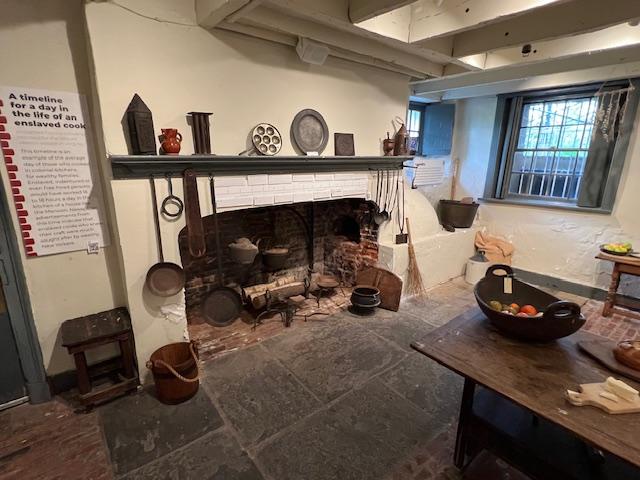
The last part of the house tour was of the family kitchen in the main house. The Summer kitchen was on the other side of the garden outside. The main kitchen inside the house had the fireplace, cooking materials, the family pewter and everything you would need to cook a complete meal.

The family kitchen

The family table set for cooking

Items for bread and dessert baking, butter making, roasting and stewing and all the items needed to cook three meals a day. The bounty of the Spring, Summer and Fall had to supply the long winters when there was no grocery shopping available.

The equipment for washing clothes and other household chores

Wash Day was a whole day reserved for sorting, boiling, scrubbing and hanging clothing to dry. Until the more modern machines were invented in the 1920’s after WWII, this was the weekly ritual for the farm housewife or the staff.

The open hearth and cooking equipment

The cooking equipment

The family pewter set

After we finished the house tour, we explored the outer buildings which included a Summer Kitchen, a smoke house, the vegetable and flower gardens. These buildings were spread around the main house.

The Summer Kitchen

The inside of the Summer kitchen

This Summer Kitchen came from a different property but the use is still the same. As the warmer months of the Summer were upon them, cooking was done in a separate building to keep the house cooler.

Some of the cooking and baking equipment

The flower beds on the side of the house

The flower and vegetable beds on the side of the property and the smoke house

Outside the main house were the vegetable, fruit and flower gardens. Items used in the household for meals, decorations and entertaining.

The barn, the outhouse and the smoke house in the distance

The inside of the smoke house where meats once hung used for family meals

All the family meats were placed in here for cooking and smoking for the family meals. The process took much longer than it does today.

The well in the middle of the property

They also moved an old school house to the property and it was furnished as a complete turn of the last century school house. It was used until 1936.

The schoolhouse on the property

The inside of the school room

The classrooms of the 1700’s and 1800’s to today have not changed much. With the exception of modern heating and air conditioning, the class room set up has not changed much. There is still a board in the front of the room, chairs facing the teacher, who is in charge and books lining the walls.

The teachers desk and the furnace that kept the room warm in the cold months

Games and amusements that were used in recess

Wheels and bikes were part of the games children played at the turn of the last century

Before modern electronics took over starting in the 1970’s, bicycles, hoops and games such as tag and hopscotch were part of playground activities. Playing outside has not changed much throughout the centuries.

Looking over the grounds at the end of the tour

Before I left for the afternoon, I was able to tour the gift shop before the museum closed for the day.

The Goosetown gift shop at the museum entrance at the end of the tour

The Goosetown Gift Shop at Hill-Hold features books, gifts, toys, craft items, and souvenirs. The shop is operated by the Friends of Hill-Hold, Inc., a not-for-profit organization, which aids in the operation of Hill-Hold and Brick House museums (The Museum website).

It really is an interesting tour and a step back in time for a glimpse into the life of a Upper Middle Class farming family.
The Donald & Barbara Tober Exhibit Room/Conrad N. Hilton Library-The Culinary Institute of America Campus 1946 Campus Drive                                                               Hyde Park, NY 12538

The Donald & Barbara Tober Exhibit Room/Conrad N. Hilton Library-The Culinary Institute of America Campus 1946 Campus Drive Hyde Park, NY 12538

The Donald & Barbara Tober Exhibition Room/Conrad N. Hilton Library-The Culinary Institute of America Campus

1946 Campus Drive

Hyde Park, NY 12538

(845) 452-9600

https://library.culinary.edu/ciaexhibits

Open: When the library is open. Please check the website.

Admission: Free

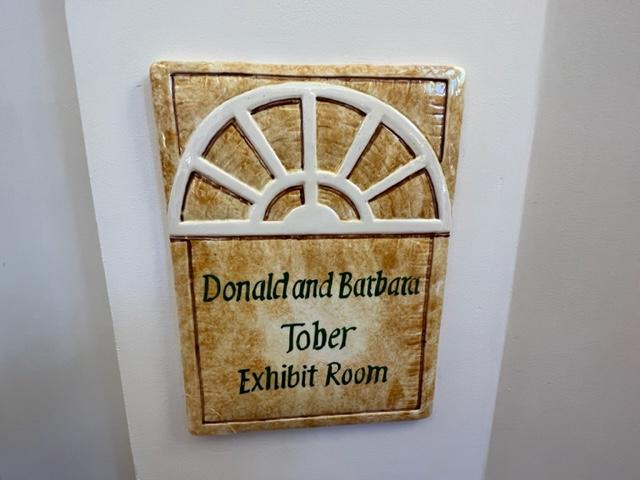
The Donald & Barbara Tober Exhibit Room plaque inside the Conrad N. Hilton Library hallway

The Donald and Barbara Tober Exhibit Room is on the main floor of the Conrad N. Hilton Library. The exhibit room is open to the CIA community and to the public. The exhibition room has ongoing displays of culinary themed exhibits that cover topics involving the culinary world and food service. This is run by both the college and by students. It is not quite a museum but more of a display room of artifacts that are held by the Conrad N. Hilton Library and its archives.

The Hallway exhibition

The Hallway exhibition

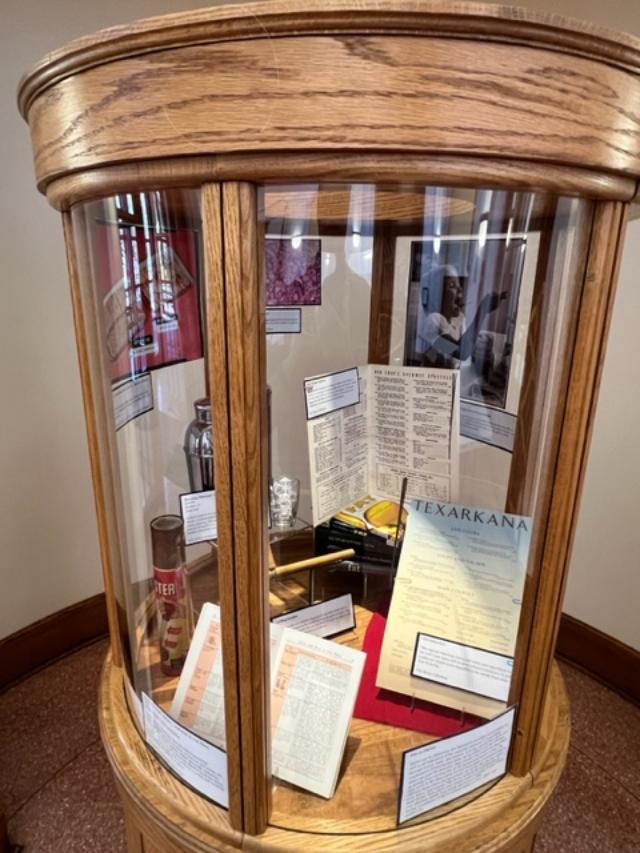
The two display cases are in the main entrance of the Conrad N. Hilton Library and hold more of the exhibition. These are displays of industry pamphlets and flyers plus menus and equipment.

The library exhibition of China pieces

The Menu Collection:

The Tober Room Exhibition space

The CIA’s menu collection began in the small library at the New Haven campus and was used as a reference tool by the culinary students.  By 1978, then in Hyde Park, the library had amassed a file of over 3,000 menus which were openly available to students and used regularly in their studies.  These menus still remain in the collection and are known as the “Original CIA Menu Collection.” They provided the foundation for the growing menu collection that was later added to by many prominent menu collectors and friends of the CIA.

Seth Bradford and Edward S. Dewey Menu Collection

Roland Chenus Menu Collection

Craig Claiborne Menu Collection

Roy Andries de Groot Menu Collection

This collection of nearly 800 menus, acquired by the CIA in 1984, were collected by the culinary writer and critic, Baron Roy Andries de Groot (1910-1983), during the course of editing his column, “A Moveable Feast,” for Esquire Magazine. The menus date primarily from the 1960s and 1970s and are from major U.S. cities (many from New York City), as well as Canada, France, Belgium, Spain, Puerto Rico, Hong Kong, and Thailand. Some menus include supplemental materials, as well as annotations by de Groot or his staff noting the date of visit, names of other guests, the chef’s name, and his evaluations and/or ratings.

Herbert Ernest Menu Collection

In 1987, Herbert Ernest donated to the CIA over 300 menus collected by his father, Semy Ernest. The menus date from 1889-1977 and include menus from restaurants and clubs in New York City, Boston, Indianapolis, Los Angeles, and San Francisco; international menus from France and Germany; and several menus from on board the Santa Magdalena ocean liner. This collection is rich in pre-1920 menus.

Greenebaum Menu Collection

The Greenebaum Menu Collection was donated to the CIA by Henry Greenebaum in 1989.  Greenebaum’s father, Michael H. Greenebaum, started the collection and it was continued by his two sons, Henry and Richard. It includes menus from 1905-1988, many international and many from railroads and ships.  Several menus are signed by the chef or proprietor.

Auguste Guyet Menu Collection

Donated to the CIA in 1989, this personal menu collection from Chef Auguste Guyet includes over 200 menus, mostly from France. The earliest are a Restaurant Julien special event menu and a Waldorf-Astoria wine list for the 27th annual banquet of the Hotel Association of New York City, both from 1906.

Bruce P. Jeffer Menu Collection

Bruce P. Jeffer donated his collection of 2,500 menus to the CIA in 2013. Jeffer, a California lawyer and wine connoisseur, began collecting menus during his travels as a child. The menus date from 1950s-1990s. Much of the collection is international menus from over 70 countries on 6 continents. A selection of these were featured in an exhibit in the Conrad N. Hilton Library in August 2013.

George Lang Menu Collection

George Lang, restaurateur and author, donated his personal collection of over 3,000 menus to the CIA in 1989. Many of these menus are international, including often under-represented countries such as Australia, Cuba, Hong Kong, Hungary and the Philippines. Although most menus date from 1950s-1970s, the earliest two menus are from Hotel Knickerbocker in New York City, 1907.

Vinnie Oakes Menu Collection

In 2000, Vinne Oakes donated his collection of over 200 menus to the CIA. The collection is strong in menus from restaurants in Nevada, as well as ship menus from the 1960s.

John Edward Oxley Menu Collection

Chapman S. Root Menu Collection

The Chapman S. Root Menu Collection of nearly 10,000 menus was donated by The Root Company in 2000. The largest collection recieved so far, it includes menus from almost every state (strongest in California, Florida and Nevada), and several foreign countries. The bulk of the menus date from 1960s-1980s, although the earliest are from 1878. Over 3,000 U.S. Railroad menus are an important highlight of the collection.

Chapman S. Root’s grandfather, Chapman J. Root, designed the classic green, ridged Coca-Cola bottle in 1915. At his grandfather’s death in 1945, Chapman S. Root inherited Associated Coca-Cola Bottling Plants, Inc. He traveled a great deal, mostly by car or train, and amassed an enormous menu collection. Friends, knowing of his interest, also contributed to his collection.

Jacob Rosenthal Menu Collection

Jacob Rosenthal, former president of the Culinary Institute of America, donated nearly 500 menus to the CIA menu collection. The bulk of these menus are from food and wine societies in the 1960s-1970s, including Confrerie des Chevaliers du Tastevin, Confrerie de la Chaine des Rotisseurs, and the International Food & Wine Society.  Also of note are several international menus from the 1930s-1950s.

Smiley Family Menu Collection

The Smiley Family Menu Collection was donated to the CIA in 1982 and 1993, a gift of Mohonk Mountain House. (The Smiley family are the founders and proprieters of the Mohonk Mountain House in upstate New York.) Three generations of Smileys traveled the world, by land and by sea, and collected menus along the way. This collection is rich in pre-1920 menus; menus from historically world-renowned resorts including Laurel-in-the-Pines (Lakewood, N.J.), Haverford Court (Pennsylvania) and Hotel Colonial and Royal Vicotoria Hotel (Nassau, Bahamas); beautifully-illustrated ship menus; and a selection of early menus from Mohonk Mountain House.

Lois Westfall Menu Collection

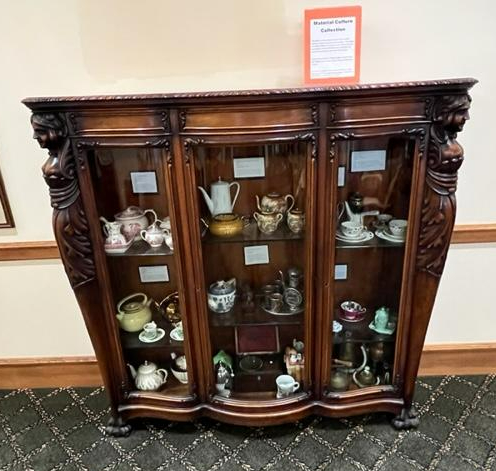
The display case in the main library showcases the collection of China and Silverware and decorative objects that are in the collection.

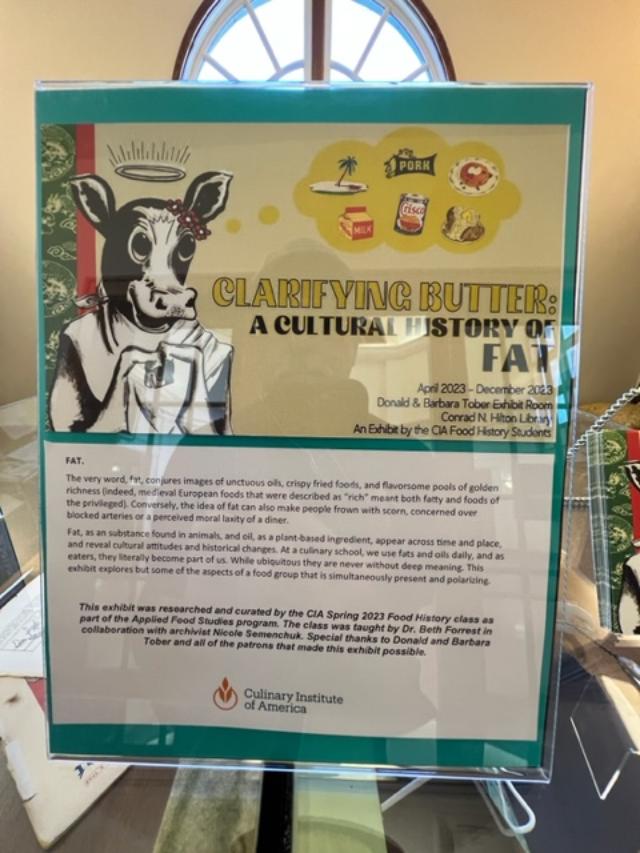
The Tober Room exhibition on “Fat” at the Conrad N. Hilton Library on the CIA campus

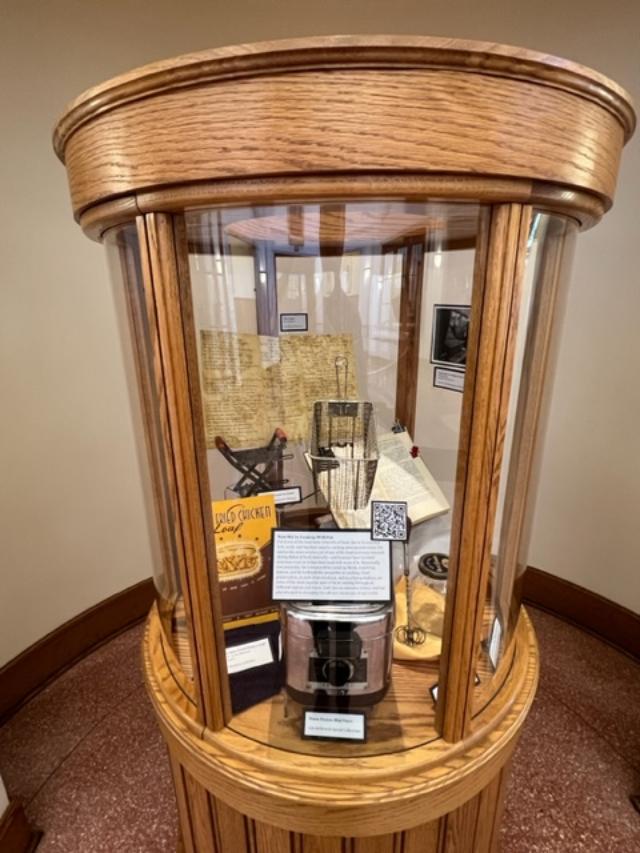
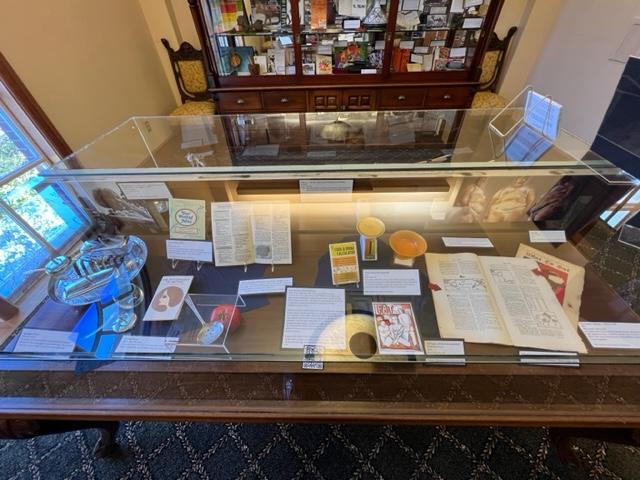
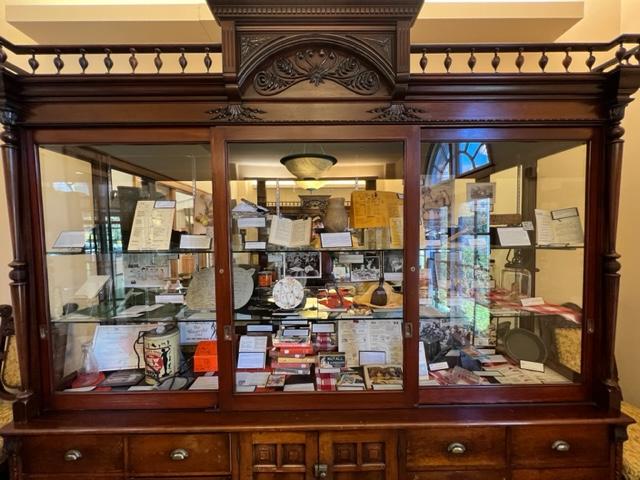
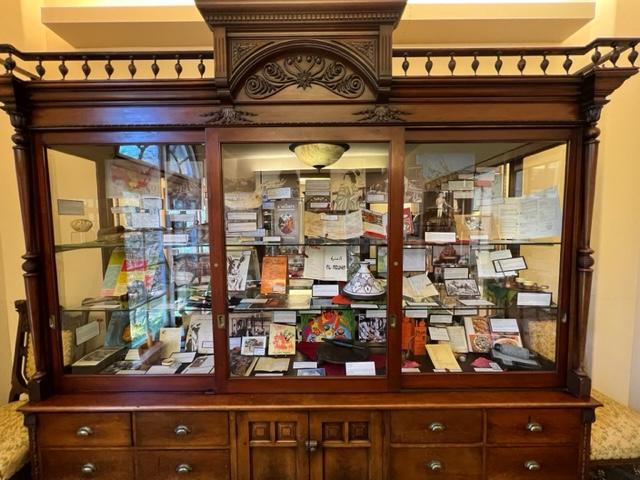
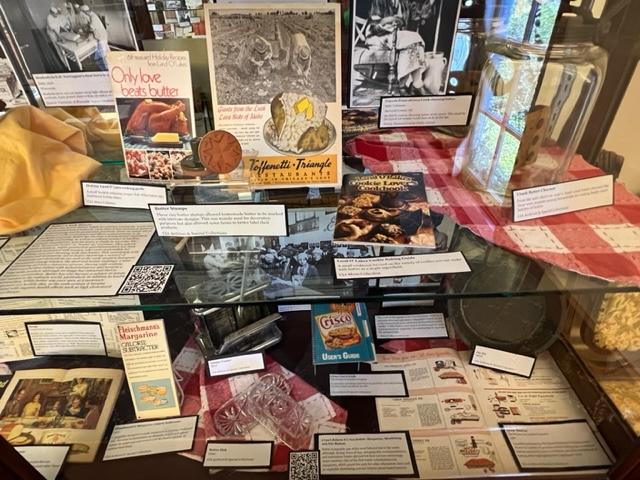
The exhibition that they were showing when I came up to visit was “Clarifying Butter: A Cultural History of Fat”. There were a lot of recipes, objects and equipment to make butter, understand the use of fats in cooking, recipes, menus and corporate information.

The description of the exhibition:

FAT. The very word, fat, conjures images of unctuous oils, crispy fried foods and flavorsome pools of golden richness (indeed, medieval European foods that were described as “rich” meant both fatty and foods of the privileged). Conversely, the idea of fat can also make people frown with scorn, concerned over blocked arteries or a perceived moral laxity of a diner.

Fat. as an substance found in animals and oil, as a plant based ingredient, appear across time and place and reveal cultural attitudes and historical changes. At a culinary school, we use fats and oils daily and as eaters, they literally become part of us. While ubiquitous they are never without deep meaning. This exhibit explores but some of the aspects of a food group that is simultaneously present and polarizing.

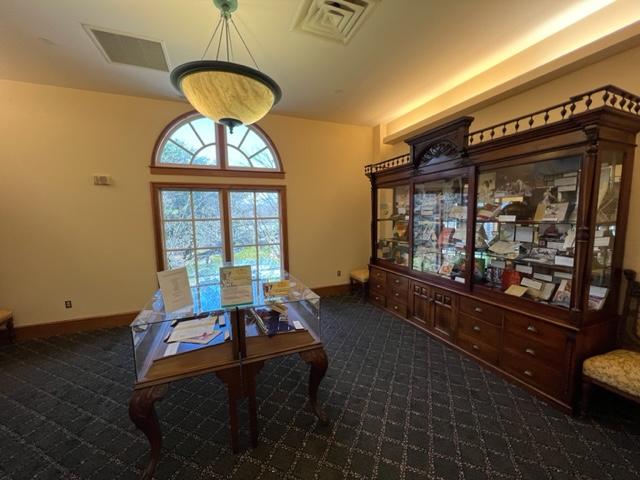
Both the two display cases and the middle display case were set with all sorts of information through the ages of the subject of fat, fried foods and items used to produce and make them.

The Display Cases in the Tober Room

The Display Cases in the Tober Room

The exhibitions here are very detailed and display over a hundred years of culinary arts research. The displays are revolving every quarter. The room is off to the right of the entrance to the library and is open for free to the public. It is a wonderful way to learn the aspects of food than in one of the best culinary libraries in the world.

A close up shot of the display case.