

Dia: Beacon
3 Beekman Street
Beacon, NY 12508
(845) 440-0100
https://www.diaart.org/visit/visit/diabeacon-beacon-united-states
https://www.diaart.org/visit/visit
Open: Sunday & Monday 11:00am-6:00pm/ Closed Tuesday & Wednesday/Thursday-Saturday 11:00am-6:00pm
Fee: General Admission $20.00/Seniors $18.00/Students $12.00/Children 11-5 $5.00/Free to Children under 12
My review on TripAdvisor:
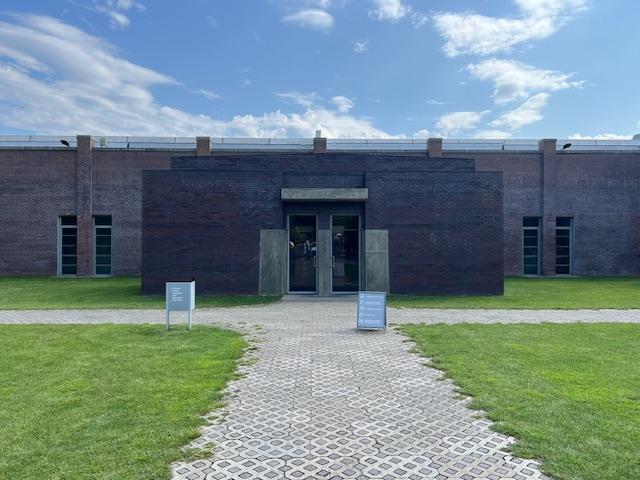
The front of the Dia: Beacon
I visited the Dia: Beacon in Beacon, NY many times and I have to say that is an interesting space to display art and the pieces themselves make a statement. The museum is sited on thirty-one acres on the banks of the Hudson River and is adjacent to ninety acres of riverfront parkland. The museum is located in a former printing plant built in 1929 by Nabisco (National Biscuit Company) (Wiki). The space square footage gives the museum the opportunity to display larger statement pieces of well known artists.
The history of the Dia: Beacon:
(from the museum website)
The Dia: Beacon presents Dia Art Foundation’s collection of art from the 1960’s to the present as well as special exhibitions, performances and public programs. The Dia invited artist Robert Irwin to conceive the master plan for a twenty-century museum that retained the original character of the factory’s interior spaces, Irwin also designed seasonally changing garden throughout the surrounding landscape. Following the renovation, the Dia: Beacon was added to the National Register of Historic Places (Dia: Beacon Museum).
Dia Art Foundation:
(from the museum website)
Founded in 1974, Dia Art Foundation is committed to advancing, realizing and preserving the vision of artists. In addition to Dia: Beacon, Dia maintains a constellation of iconic, permanent artworks and installations in New York City, the American West and Germany (Dia Museum).
Each of the galleries are devoted one artist’s work and these galleries make their own statements. There is also a really nice bookstore and gift shop on the extension of the museum and small restaurant.
It is nice to just walk around in your own time and visit each of the galleries. Plan about two hours to see the whole museum. It is an interesting place to see contemporary art in a gallery that is devoted to one artist at a time. The outside grounds of the museum and the parking lot makes it own statement. There is not much parking so plan on getting there early or later in the afternoon.

The museum has clean lines and big halls and a minimalist landscaping
The one thing about the Dia is that the works are quite large and pack a bold statement. The museum uses a combination of both American and Foreign artists and their works make a bold statement. The museums galleries are large and airy and can show larger works of art. The museum shows many of the artists largest pieces of work.

The inside of the Dia: Beacon’s large galleries
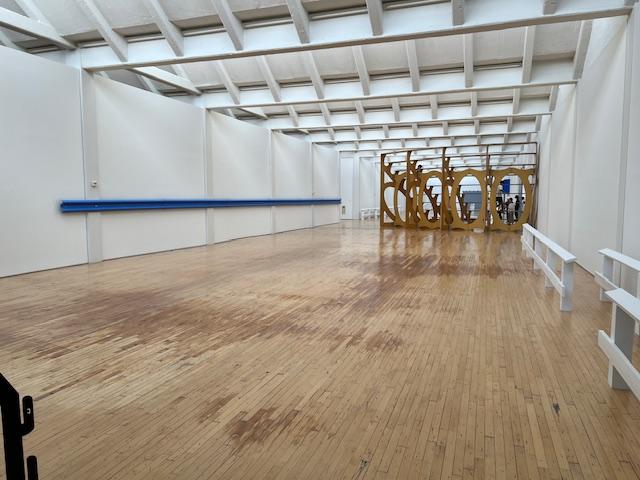
These larger pieces were interactive
Inside the museum, many contemporary artists are featured each season. Many of their larger works were featured in their galleries. While the shows rotate collections of many artists, these were the pieces that stood out to me on my visits to the museum over the years.
The Artists I most admired and their works that most stood out to me:
Artist Louise Bourgeois has displayed some interesting sculptures that dominate the upper floors. One of the most fascinating pieces was that of a large spider that dominates the corner of the floor.
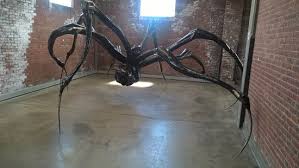
This Louise Bourgeois work is a rather creepy piece of art like something out of the movie “It”.
https://en.wikipedia.org/wiki/Louise_Bourgeois
https://diaart.org/collection/collection/bourgeois-louise-crouching-spider-2003-l-2007-012
In Bourgeois’s works on view in these galleries, organic formations fuse with the inorganic materiality of the media in which they are rendered, be it marble, wood, or bronze. The artist’s repertoire of materials spans traditional media and new textures, such as latex and synthetic resin. In her work, representation often entails the creation of a surrogate for the body and its suffering organs (Dia: Beacon museum website).
Artist Dan Flavin has some interesting light sculptures on display along the walls and floors of the gallery. Things are made of long fluorescent lights of various colors.

Artist Dan Flavin’s light sculptures
https://en.wikipedia.org/wiki/Dan_Flavin
After 1963 Flavin’s work was composed almost entirely of light, in the form of commercially available fluorescent tubes in ten colors (blue, green, pink, red, yellow, ultraviolet, and four whites) and five shapes (one circular and four straight fixtures of different lengths). Initially arranging these fixtures in varying autonomous configurations, Flavin increasingly made work in relation to architecture, such as his monumental barriers that physically block a passageway or segment of a space with light (The Dia: Beacon museum website).
In the main gallery as you walk in are the large geometric shapes of artist Charlotte Posenenske who created these pieces in various colors and shapes. These pieces line the floors and walls.

The geometric shapes of Artist Charlotte Posenenske
https://en.wikipedia.org/wiki/Charlotte_Posenenske
https://www.diaart.org/exhibition/exhibitions-projects/charlotte-posenenske-exhibition
Embracing reductive geometry, repetition, and industrial fabrication, she developed a form of mass-produced sculptural Minimalism that addressed the pressing socioeconomic concerns of the decade by circumventing the art market and rejecting established formal and cultural hierarchies. Posenenske employed playful conceptual devices to oppose compositional hierarchy and invite the collaborative engagement of the public in the continual reconfiguration of her variable sculptures (The Dia: Beacon website).
Artist Andy Warhol has one of his largest works displayed in the main gallery on the first floor.

The artist Andy Warhol gallery
https://en.wikipedia.org/wiki/Andy_Warhol
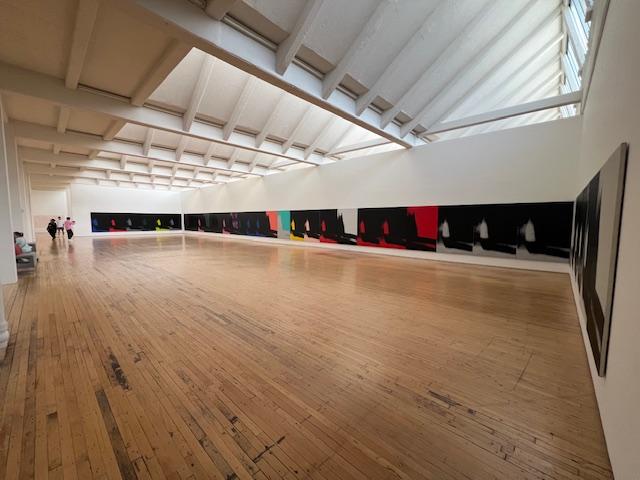
The large Andy Warhol piece
What I loved about the work by Warhol was the continuous colorful pattern of the work and the way it wrapped around the room. The pattern took form in many colors and showed consistency and balance.
A single painting in multiple parts, Shadows is one of Warhol’s most abstract works, yet one that cohesively synthesizes key elements of his practice, including film, painting, photography, and screen-printing. Originally commissioned by Dia and acquired in 1979 for a solo exhibition at 393 West Broadway in New York, Shadows includes a total of 102 canvases; the final number of canvases on view in each installation is determined by the dimensions of an existing exhibition space (The Dia: Beacon museum website).

Artist Senga Nengudi Gallery
American artist Senga Nengudi had a some interesting works on display, one resembling melted ‘freeze pops’, which I thought was rather clever. Her large works took liquid forms and were colorful and spontaneous. These large works had lots of color and looked whimsical and fun.

One of Artist Senga Nengudi works

I thought this was a large ‘freeze pop’

One of her non-liquid works
Made of everyday materials such as vinyl, water, nylon, sand, dry-cleaning bags, lint, paper, and tape, Nengudi’s installations are at once proxies for bodies and sites for performance. The works accommodate a variety of cultural references from African, Japanese, and South Asian rites to Western avant-garde art. Characteristic of her openness to multiplicity, the artist, born Sue Ellen Irons, has assumed pseudonyms that inflect her creative identities as sculptor (Senga Nengudi), painter (Harriet Chin), photographer (Propecia Leigh), and writer (Lily Bea Moor) (The Dia: Beacon museum website).
Some of the other works that I liked as I walked around the museum:

Displayed on the first floor of the Dia: Beacon

Another interesting work on the first floor

The large galleries and open air space give patrons a chance to walk around the works and really get a feel for what the artists are trying to express. You really get to see the art up close and that is why I like the way they display their art. We can engage with each piece and develop our own meaning from it.
The grounds and the proximity to the river gives the museum a picturesque spot. It is nice to walk around the lawn on a warm day and enjoy the paths around the museum. The museum also has a very interesting gift shop featuring many books and gifts. The small restaurant can be pricey but offers a place for a light lunch or a quick snack.
 Visiting a Museum: The Unique, Unusual, Obscure and Historical