The one thing I refuse to do on Father’s Day is to spend the day at the cemetery. I know that is some people’s idea of honoring one’s family members but it is not mine. I went on Friday and paid my respects to my father (whom this blog is dedicated to) and spent time remembering some of the good times we had in past. I dropped some cut flowers from our gardens (some of which he planted) and said a small prayer. Then I left.
My idea of honoring my father and spending Father’s Day with him is to do something that we would have shared together. We were always running around somewhere and exploring something new and doing something fun. That is how I wanted to honor him. By being active and giving him a toast at Sunday dinner.
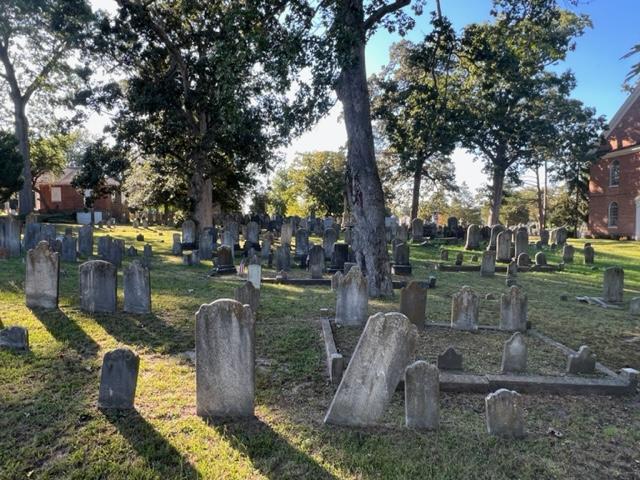
There is a true beauty to a historical cemetery with its old tombstones, its interesting artwork on the grave sites and the history behind the famous families who are buried there whose homes we tour and roads and parks that are named after them. The cemetery is located right in Downtown Salem, which serves as the County Seat for the County of Salem.
It was also home to one of the oldest oak trees in the country which fell in 2019. The over 500 year old oak tree has been part of the original virgin forest and is said to where town founder, John Fenwick, met with the Lenape Indians for the establishment of a settlement and for peaceful negotiations.
The family plots at the Salem Oak Cemetery
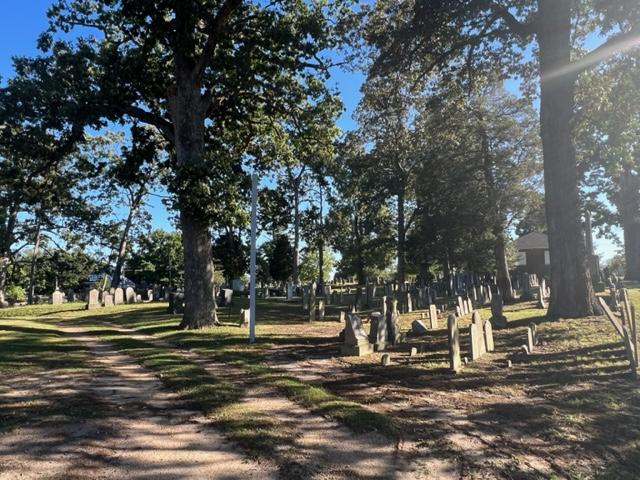
All that is left of the tree now is the rotting stump but three of its saplings still exist on the grounds and they look about two hundred years old. They grow majestically amongst the gravesites.
The family plots line the aisles at the cemetery
Inside the cemetery, the graves bear the names of founding fathers of the Town of Salem and prominent families who once made up the population with names such as Thompson, Reeves, Abbott, Wister, Bacon, Griscom, Waddington, Sickler, Lippencott, Goodwin, Bullock, Woodnutt and Bassett.
You will see these names on artifacts in the Salem Historical Society such as clothes, business document and household items. There names and influence still hold a position in the community.
The Salem Oak in the Friends Burial Ground before it fell in 2019 (Salem County Historical Society)
This is the spot where founder John Fenwick met with the Lenape Indians in 1675.
Take time to walk amongst the family plots and pay your respects to these important families who were once the founding members of both the community and of the great State of New Jersey.
The Friends Burial Ground plaque
The cemetery’s spot in Downtown Salem, NJ
The Salem Oak Cemetery in Downtown Salem, NJ
The cemetery is part of the Women’s Heritage Trail
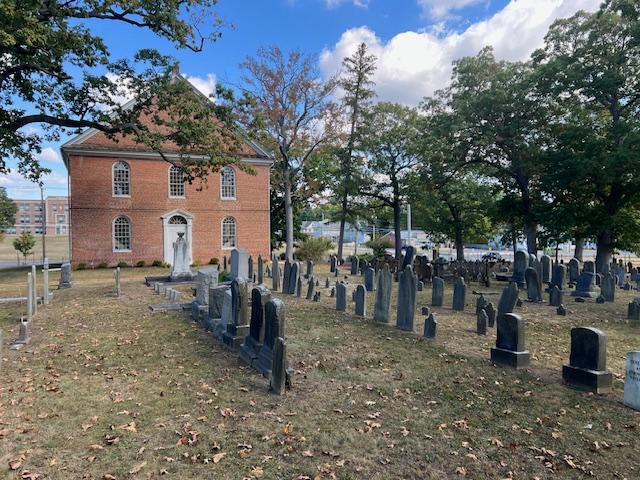
The Old Broad Street Presbyterian Church in its glory in the entrance to the historic cemetery
The Church and its historic cemetery.
When I was traveling to Salem and Cumberland Counties to visit historical sites, this was the last one on my list the first day of exploring. The Old Broad Street Presbyterian Church sits in the middle of a declining downtown in Bridgeton, NJ like a ghost of its former self. This graceful and elegant church is not used much anymore and sits like a majestic building overlooking a city that has passed it by.
The Church and its historic cemetery.
The church was built in 1792 for the growing Presbyterian congregation who was living in Bridgetown as it was called at the time. The brick walls and roof were completed but it would take another three years for the interior to be finished (Cumberland History.org).
The historic family cemetery
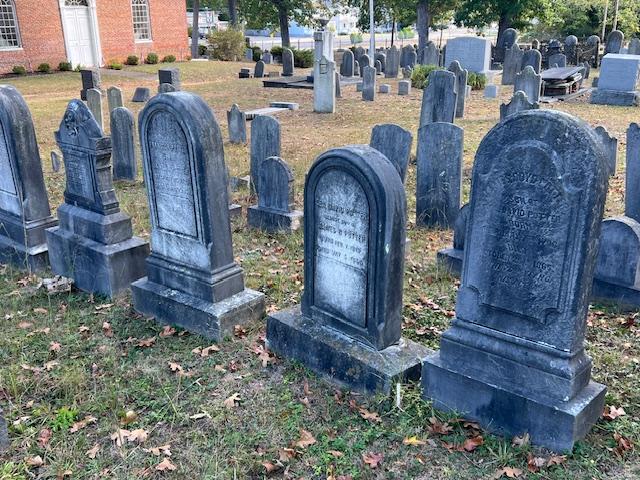
The cemetery is extremely interesting as you visit the historic tombstones and the family plots and try to figure out the connections. The biggest problem with the cemetery is that is has gotten very overgrown in parts of it. It needs a good mowing and the gravestones need to be cleaned as they are wearing away with the elements. It was hard to follow the historical listing but many famous residents and leaders of the community are buried here as well as members of the armed forces from the Revolutionary and Civil Wars and earlier.
The family plots at the cemetery
In some cases, when the families were buried together, it almost told the story of what happened within the family. I saw grave sites where the son or daughter either died in child birth or a disease or in battle and then the devastated parents followed a few years later which was a sad narrative. I saw this many times in the family plots. How many children died of diseases that today are solved by a pill.
The family plots
Some of the notable people buried in the cemetery are Ebenezer Elmer, who represented New Jersey in the United States House of Representatives from 1801-1807 and Jonathan Elmer, who represented New Jersey in the United States Senate from 1789-1791. Lucius Elmer, who represented New Jersey’s First congressional district from 1843-1845. Eilas Seeley, who was the Eleventh Governor of New Jersey serving in 1833. William G. Whiteley, who represented Delaware in the United States House of Representative from 1857 to 1861. Joseph Archibald Clark and Clement Waters Shoemaker, who were two of the founders of Cumberland Glass Manufacturing Company (Wiki).
The David Potter tomb
The history of the Broad Street Presbyterian Church and its cemetery:
(From Cumberland NJ Art.org)
For much of the 18th century in Bridgetown, which will eventually change its name to Bridgeton, there existed no church for Presbyterians, who were a large and growing segment of the local population. For church services, they were forced to conduct services in the Courthouse or travel to churches in Greenwich, Fairfield or Deerfield several miles away.
Family plots and crips
In 1792, about two acres of land were donated along King’s Highway, which was the main road from Bridgeton to Greenwich and ran along the south end of the church construction site. In 1800, this main route was relocated to the north and is today Broad Street (Route 49).
The cemetery grounds on a late summer afternoon.
The basic design of the Broad Street Presbyterian Church was set by it congregation and organizers who requested a masonry building with dimensions of at least forty by fifty feet. By December 1792, the brick walls and roof has been completed but it would take another three years for the interior to be finished.
The church in the early Fall of 2024
The design of the Broad Street Presbyterian Church is that of a meeting house, almost square in proportion. In the 17th and early 18th centuries, many American houses of worship were built in the meeting house form. This design was in contrast to the more formal churches of the period, which were more rectangular than square with an alter and/or communion table and pulpit approached by a long nave and often divided from the congregation by a railing. Broad Street Presbyterian Church has a tall pulpit, accessed by a winding stair and surrounded on three sides by pews so as many congregations as possible could attend and sit as close as possible to the preacher.
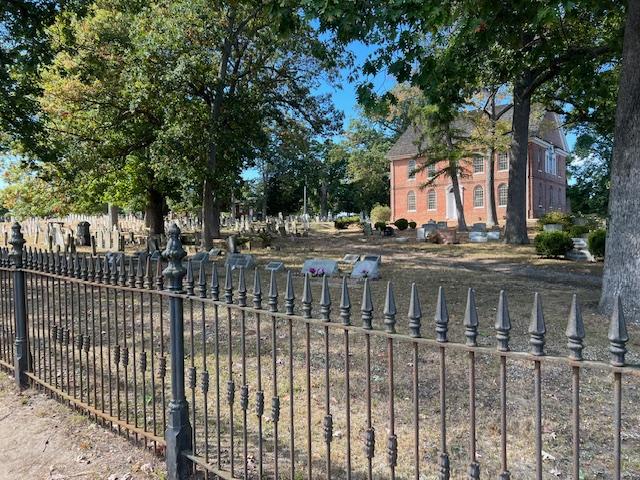
The beautifully designed church behind the fence
Above the pulpit is one of the most significant architectural features of the church, the Palladian window with its central window and semicircular arch flanked on each side by smaller windows and all unified by an entablature supported by columns. The name “Palladian” comes from the Venetian architect who originated the design, Andrea Palladio, who worked in 16th century.
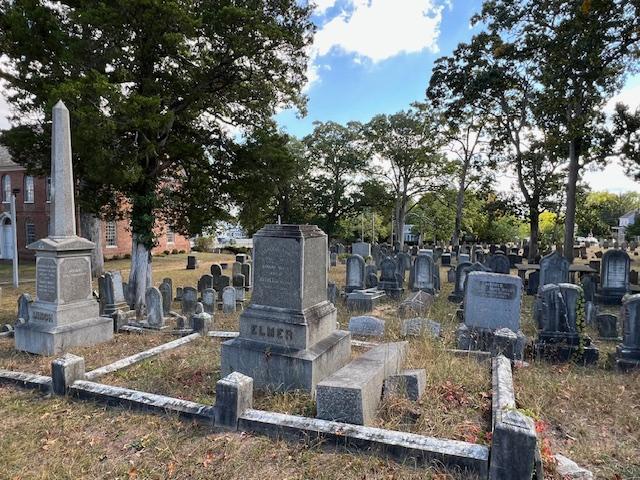
The Elmer Family plot
Architects in the 17th and 18th centuries would travel from other parts of Europe to Italy to study architecture and they brought the Palladian style back to England and the American Colonies. Thomas Jefferson acquired an intense appreciation of Palladian architecture and used it extensively in his design for Monticello.
By 1835, the congregation had erected a new church but because the Broad Street church was surrounded by the cemetery, the congregation did not abandon or sell it but rather maintained it exactly as they left it, which is why today it is identified as one of the most pristine and unaltered examples of 18th century church architecture in the United States.
Today the Broad Street Presbyterian Church is used for special services and opened to the pubic by appointment. It is carefully maintained by the Presbyterian congregation of First Presbyterian Church located on Commerce Street in Bridgeton, NJ.
The Greenwich Tea Burning Monument in Greenwich, NJ
I am a firm believer in that you learn something new everyday and on a recent trip to visit historical sites of Southern New Jersey I came across this one in a guide book. I never even knew this monument existed let alone that we had our own version of the Boston Tea Party right here in New Jersey. It really showed me the significance of the Revolutionary War and how people from the past fought for the freedoms that we have today.
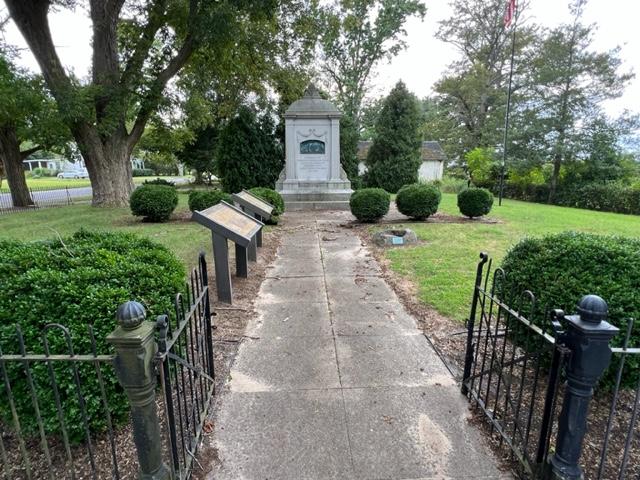
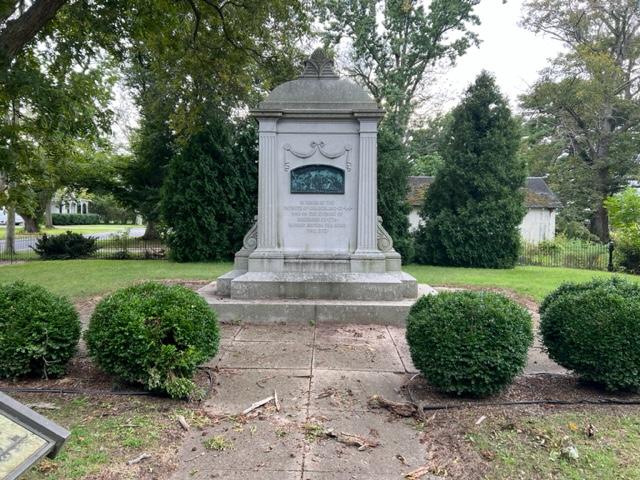
The monument in its glory.
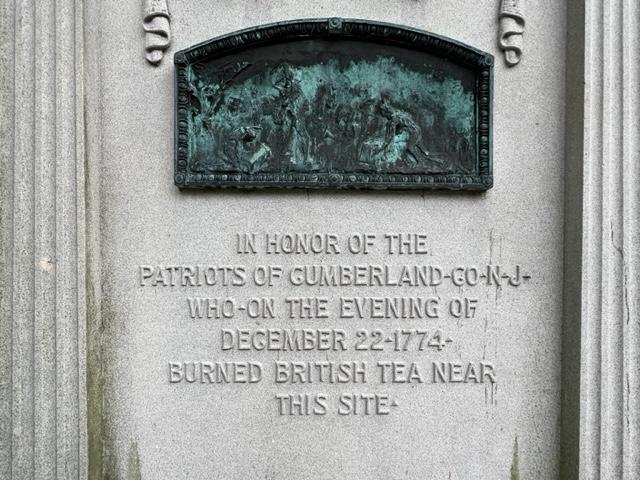
On the night of December 22nd, 1774 forty people from the community took possession of tea chests and piling them together burnt them in protest of the Tea Tax that had been imposed on the residents of New Jersey. This act of defiance was a reaction to the actions of the British Rule.
The monument honorarium.
This beautiful and graceful monument lies now at the end of a sleepy country road in Greenwich, NJ which is still surrounded by farmland. It is hard to miss the monument in its location in the middle of a small park surrounded by a small fence. The monument was dedicated in 1908 and then again in 2008 there was a second ceremony to honor the 100th anniversary of the monument (Wiki).
The moument sits down the road from the Museum of Prehistoric History and from the Gibbon House so there are many things to see in Greenwich, NJ on this quiet country road.
The History of the Greenwich Tea Burning in 1774:
(From the Cumberland County, NJ website):
Liberty was not cradled in Philadelphia alone. The spirit was also alive in the inhabitants of Cumberland County when they destroyed a cargo of tea in 1774.
On the evening of Thursday, December 22nd, 1774, a company of about forty young Whigs, disguised as Indians, entered the cellar of Bowen’s house. They took possession of the whole cargo, conveyed the tea chests from the cellar into an adjoining field and piling them together, burnt them in one general conflagration. Forty miles from Philadelphia, was (and still is) the little town of Greenwich, the principal settlement of Cumberland County in 1774.
The Greenwich Tea Burning of 1774 (NJ Historical Society)
It was founded in 1675 by John Fenwick and is older than Philadelphia, which was not founded until 1682. The hand of time has hardly touched Greenwich. It is much the same today as it was three hundred years ago, when the British flag flew high over it. Today you will still find a wide street, which they still call “Ye Greate Street.” It was laid out in 1684 and its course has never been changed.
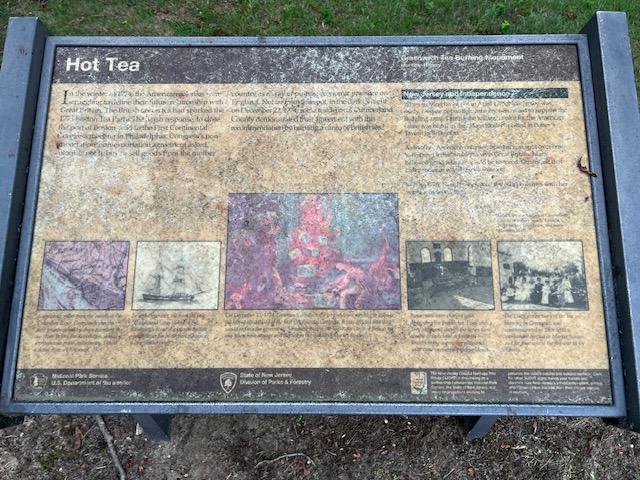
The storyboard on the event.
The Cohansey Creek is a navigable stream of some size running through the county of Cumberland and emptying into the Delaware Bay. In the autumn of 1774, the quiet inhabitants along the banks of the creek were startled by the appearance of a British brig called called the “Greyhound.” Sailing about four miles up the Cohansey, the brig stopped at the village of Greenwich, which was the first landing from its mouth.
She was laden with a cargo of tea sent out by the East India Tea Company, which was undoubtedly under the impression that the conservative feelings and principals of the people of New Jersey would induce them to submit quietly to a small tax. The result showed that the temper of the people was little understood by the East India Tea Company (Similar to the Toilet Paper Tax of the Governor Florio in the 1990’s).
The storyboard on the event.
Having found an English sympathizer, a Tory, as they were called, one Daniel Bowen, the Greyhound’s crew secretly stored the cargo of tea in the cellar of his house. However, this unusual procedure was noted by the citizens who immediately appointed a temporary committee of five to look after the matter until a county committee might be appointed.
A general committee of thirty-five was later appointed with representatives from Greenwich, Deerfield, Jericho, Shiloh, Bridgeton, Fairfield and perhaps other places.
Greenwich Tea Burning Monument News of the Boston Tea Party had already reached Greenwich and the defiant example was regarded by many of the local settlers as worthy of their own contempt for the British. Fate now presented them with a ready-made opportunity to duplicate the act.
On the evening of Thursday, December 22nd, 1774, a company of about forty young Whigs, disguised as Indians, entered the cellar of Bowen’s house. They took possession of the whole cargo, conveyed the tea chests from the cellar into an adjoining field and piling them together, burnt them in one general conflagration.
Thus, the patriots of Cumberland County living in Greenwich expressed their discontent by reacting to oppressive governmental measures. They had clearly taken a stand for independence and democracy.
Greenwich has been granted the distinction of being one of the five tea-party towns in America, the others being Charlestown, Annapolis, Princeton and Boston. In 1908, the monument seen above was erected in the old market place on Ye Greate Street to commorate the burning of a cargo of British tea on December 22nd, 1774.









 Visiting a Museum: The Unique, Unusual, Obscure and Historical