

Pascack Reformed Church
65 Pascack Road
Park Ridge, NJ 07656
(201) 391-4066
https://www.pascackreformedchurch.org/
https://www.facebook.com/PascackChurch/
Open for Service: Sunday Service-Please check the website for times
My review on TripAdvisor:

The Pascack Reformed Church at 65 Pascack Road
The Pascack Reformed Church is one of those historic centers to a town that dot New England and set the tone for a town. The church gives a town its ‘classic’ look and it bases for the development of the town. This elegant church is located on Pascack Road, one of the early Colonial byways of Bergen County, NJ and is one of the few remaining churches from the Revolutionary War era.
Built in 1813, it has that unique look of a time when religion played a more important role in people’s lives and was the center of the community. Its cemetery is the resting place of many of the ‘first’ families of Bergen County including the Demarest, Wortendyke, Bogart, Terhune, Van Ripper and Haring families whose names are still part of the county.
Walking in the cemetery is a experience to know the history of our State and the contribution that these families had in the creation of the State of New Jersey. There is a quiet elegance of a historic cemetery in the fall around Halloween. It is as if the spirits of the past remind us of the future that lies ahead of us. Plus it has the classic “New England” look of a church and its cemetery. It is a piece of Bergen County history that most people just pass. Please take time to walk the grounds in the Fall and Spring and experience an open air museum of what has made our County what it is today.
Please also show respect to the people buried there.
The History of the Pascack Reformed Church:
(from the Pascack Reformed Church website)
In the 1700’s the early settlers of the Dutch Reformed faith in the Pascack Valley attended the churches of Tappan, Schraalenburgh, (Bergenfield-Dumont), Paramus and Saddle River. As the population increased they desired a church in their own vicinity. On May 27, 1787, residents of Pascack petitioned the Classis of Hackensack to form a church. Another meeting was held in Hackensack for the purpose of forming a church, but since no one from the Pascack area attended, the matter was closed.
Over the next 25 years several attempts were made to establish a church in Pascack. In 1812, following the separation of the Saddle River church from the Paramus church, the people of Saddle River offered to unite with the people of Pascack and to assist them in building a house of worship. The two congregations would be one church, with services held on alternating Sundays at Pascack and Saddle River.

The Pascack Reformed Church Historic Marker
On October 23,1812, Peter Wortendyke his wife Matze, and Abraham Campbell and his wife Margaret deeded one acre of land to John J. Demarest, Garret J. Ackerson, Albert Wortendyke and John J. Blauvelt, appointed trustees for the building of the Reformed Dutch Church as Pascack, for the sum of $60.00 (current New York State money).
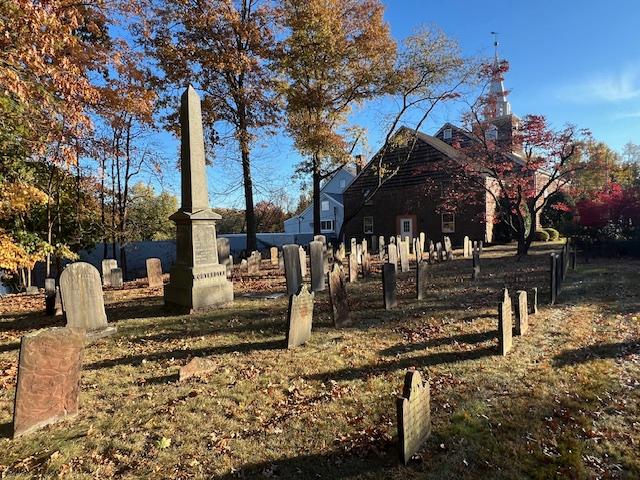
The historic church graveyard next to the church in the Fall of 2024
At this time, the church building was begun as members of the Saddle River and Pascack congregations took part in the construction of the edifice. The shell of the building was completed that fall, and the Rev. Stephen Goetschius presided at its dedication. The interior was completed in the spring of 1813, and the founding date of the church has been reckoned as May 3, 1813. The front and Pascack Road side of the church was constructed of sandstone quarried locally while fieldstone was used for the rear wall and east side.

The Demarest/Wortendyke/Banta family graveyard
In 1814 the boundary line of the Paramus church located one quarter mile to the south of the Pascack was annulled. A plan for the new church to be constitutionally organized was drawn up once consent was gained from consistories of neighboring congregations (whose members might wish to join the new congregation). On the third Tuesday of June in 1814, the Classis of Paramus met at Pascack and selected a committee to elect a consistory for the church. Those chosen Elders were John T. Eckerson, John Campbell, Garret Duryie, Esq., Jacob Banta, Esq. Deacons chosen were Garret J. Ackerman, Edward Eckeson, Hendric Storm and John F. Demarest. The newly installed pastor of the Saddle River Church, the Rev. Stephen Goetschius, became President of the Consistory.
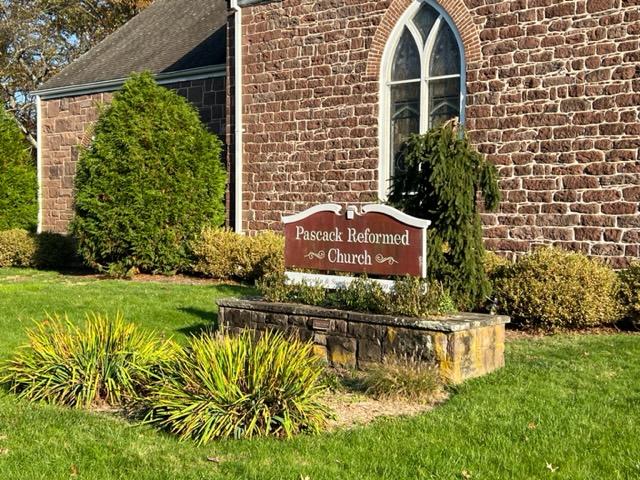
The church sign outside the church.
On August 29, 1814, with about 48 members, the new church was officially organized and incorporated as “The Consistory of the Congregation of Pascack in the County of Bergen.” This declaration was signed and sealed by all members of the Consistory on that date.
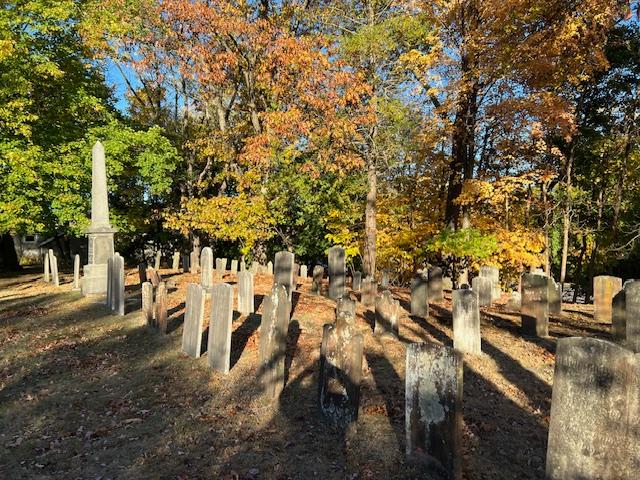
The historic graveyard next to the church
Following its organization, the Pascack Church and the Saddle River church became separate congregations served by one pastor, the Rev. Stephen Goetschius, who resided in the Goetschius family home (which still stands at East Saddle River Road and Lake Street in present day Upper Saddle River). Goetschius continued to be pastor of both churches until 1835 when he resigned due to old age. When he was over 80 years old, he could still ride a horse between the two churches! He passed from this life in the year 1837.
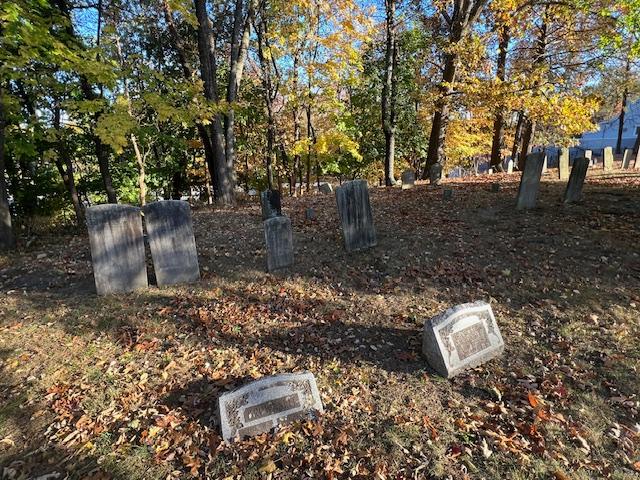
The Historic graveyard during the Fall of 2024
In 1834 with the advanced age of the previous pastor, the Rev. John Manley was called and become pastor of both churches upon the resignation of Stephen Goetschius in 1835. During this year there was some sentiment for separation between the two churches, as it became apparent that each congregation desired a minister of its own. Manley continued to serve as the pastor of the Saddle River Church until 1866 and served the Pascack Church as minister until 1853 when the latter church desired to have a service every Sunday. He lived on a small farm in the present day Upper Saddle River and was also engaged in farming. Manley died in New Brunswick, NJ on May 21,1871.
The year 1853 saw the start of a movement to obtain additional land for the expansion of the church cemetery and the erection of a parsonage due to the calling of a full time minister to serve the congregation at Pascack. On August 24,1855, a deed was given by Peter P. Wortendyke and Polly, his wife, to the Consistory of the church at Pascack for 15 acres of land for the consideration of $1,600.00. (Of this 15 acre parcel a portion was later sold to the Hackensack Water Company and another portion to the Borough of Park Ridge. Of the remaining 7.98 acres, 3.7 acres are in cemetery usage; the remainder is used for the parsonage and the Park Ridge Barrier Free Housing.) The first parsonage was built in 1855 on the site of the present church parsonage at Pascack Road and Fremont Avenue.
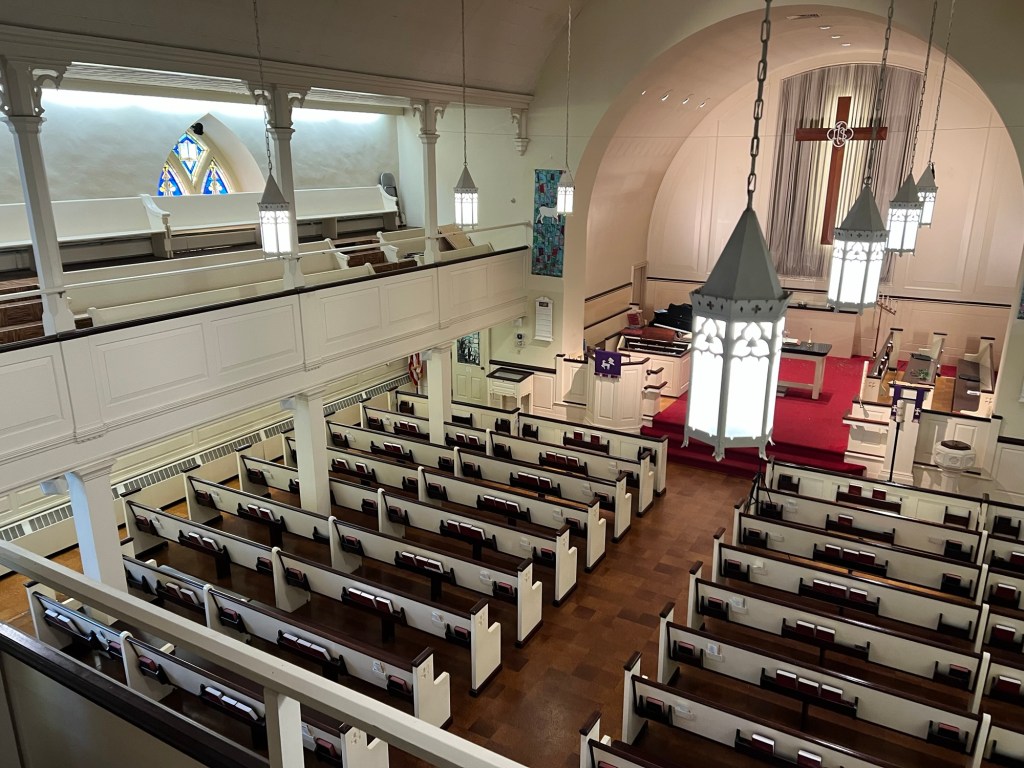
The inside of the church:

The interior of the church before service
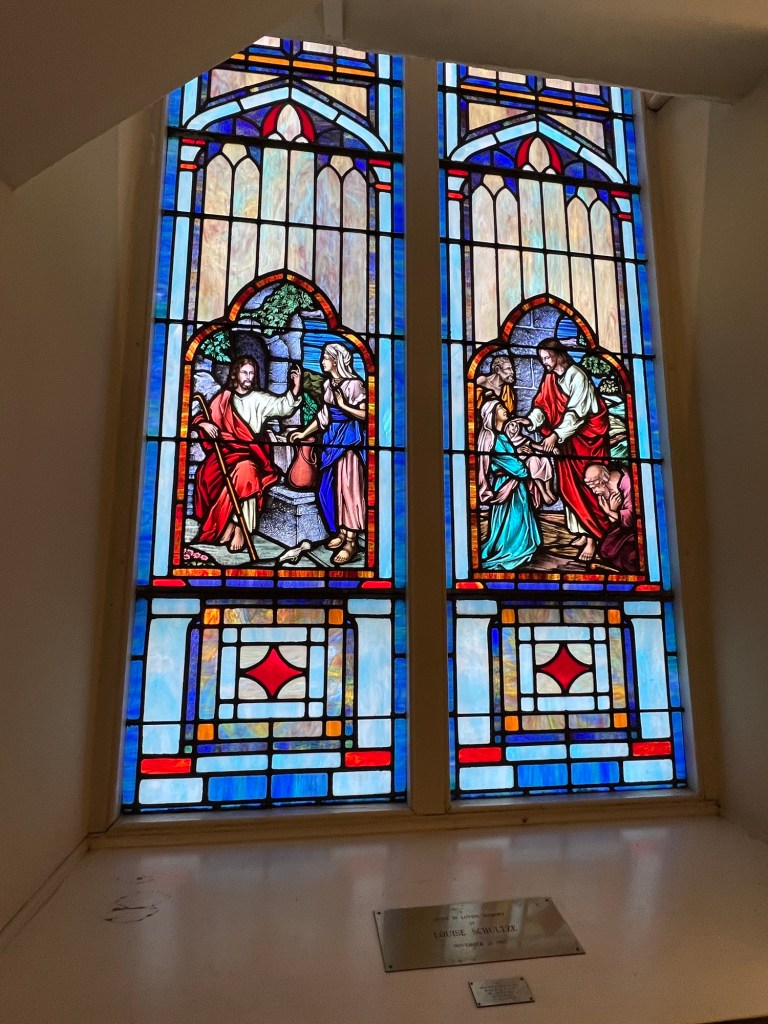
The beautiful stained glass windows

The beautiful stained glass windows of the church
Upon the departure of the Rev. John Manley in 1854, a call was made upon the Rev. John T. Demarest, who accepted the call and became the third pastor of the church and its first full time minister. Pastor Demarest and his family were the first to occupy the newly built parsonage. In 1857 John Demarest received an Honorary Doctor of Divinity Degree from Rutgers College and remained at Pascack until 1867. He died in New Brunswick, NJ on January 30,1897 and was buried at New Prospect, NY.
In 1868 the Rev. Benjamin Bartholf became pastor and served for five years. In 1872 a plan was put forth to tear down the church and replace it with a $12,000 edifice. That plan did not succeed and the original building remained.
The years 1873-1875 saw the church without a pastor. During this time the original stone building was remodeled at a cost of nearly $4,000, and its interior was renovated and refurnished. The parsonage was also rebuilt at this time at a cost of $1,000. A minister of the Classis, the Rev. Alexander McKelvey, served the congregation as its “Stated Supply Pastor.”
On April 20,1875, the Rev. Edward Lodewick was installed as pastor; his tenure continued for the next 28 years. On May 11, 1900 a reception was held for Rev. Lodewick and his wife in honor of the 25 anniversary of his pastorate. After his passing in the year 1910, Mrs. Lodewick erected a plaque to his memory at the rear of the Sanctuary.
Work was begun on the Parish House (Sunday School Building) in 1885 and was completed in 1887. The Church Sunday School–in existence as early as 1841, and which had previously met in the church balcony and the barn of G. J. Ackerman on Werimus Road in the present day Woodcliff Lake–now had a home of its own.
Another unsuccessful attempt was made to replace the church building in the year 1890. The next year saw the original church remodeled with the balcony lowered to its present form. A new bell was installed above the tower. A few years later the bell became the first fire alarm system for the newly formed Park Ridge Fire Department when its pull rope was extended to ground level on the outside of the tower. Further remodeling in the year 1893 included an addition to the rear of the church, and the choir was relocated from the balcony to a new loft behind the pulpit.
With the resignation of Mr. Lodewick in 1903 the church was once again without a pastor; on April 10, 1904, the Rev. Francis A. Seibert was installed as the new minister. On October 9, 1912, the congregation celebrated the 100th anniversary of the passing of the deed for the church property. The Sunday School’s celebration continued the next evening.
In 1921 the church received its first pipe organ, which was given by the family of J. Boyce Smith in his memory. During the month of April 1929 the church observed the twenty-fifth anniversary of Mr. Seibert’s pastorate and at a public reception the membership presented him with a fully equipped insured and licensed Chevrolet Coupe along with $125.00 for operating expenses of the vehicle. In addition to his faithful devotion to the congregation, Mr. Seibert was very much involved in service to the community; he served as Mayor of Park Ridge from 1914 to 1918.
On September 12,1931, the church was re-incorporated as “The Pascack Reformed Church of Park Ridge, New Jersey, Inc.” Six years later in 1937 the congregation celebrated its 125th year of ministry.
The end of the decade saw the passing of Mr. Seibert after 35 years of service to the Pascack Reformed Church. His pastorate is the longest on record, and he was the last minister to occupy the old parsonage.
The Rev. James Reid served as the next pastor for a short time, and was followed by the Rev. Francis E. Potter, who along with his wife moved into the newly constructed parsonage, which had been erected at a cost of $6,000. His ministry to the congregation was interrupted from 1944 to 1946 while he served as a Chaplain in the U.S. Navy. During that time the Rev. Gordon Markey served as the Interim Pastor.
During the 1940’s the church moved forward with an active Women’s Missionary Society, which maintained projects at home and abroad along, as well as a Ladies Aid Society which was active in fundraising activities. The Youth Group was very active at this time and an Evening Guild was established. In 1949 the Choir produced a show which raised enough money for new robes, and the first Men’s Club came into existence at this time. The same year saw the departure of Mr. Potter and shortly after, in September, the Rev. Wilbur E. Ivins was installed as pastor.
During the 1950’s the Upper Pascack Valley area grew and developed and so did the church. With greater activities it was necessary to renovate the basement of the Sunday School Building (previously known as the Parish House) along with an addition in 1953 with a complete renovation of the remainder of the building.
In 1955 the Evening Guild oversaw the work of illuminating the steeple. The same year saw the beginning of a weekly newsletter now known as “THE SPIRE.” Also in 1955 a retirement dinner was held for Mrs. George Bennet who retired after 50 years as Church Organist. In 1959 the 1893 addition to the church was demolished and replaced with the present much larger structure. Extensive rebuilding was done to the original portion of the church building (including removal of the wooden floor and the installation of a concrete floor topped off with tile). In 1960 the present pipe organ was installed in memory of Elsie Holloway Gowell, and in 1961 the Edward J. Sisley Memorial Carillon was dedicated. The year 1962 marked the 150th year of the life of the congregation and was celebrated by a year-long series of services and activities, including a Historical Pageant on October 28th.
In 1963 Mr. Ivins moved on to another church and a seminary student, Robert H. Pope, arrived for a summer assignment to fill in the gap until a new minister could be found. Mr. Pope liked the church and a delegation from the congregation informed him that they would be willing to wait until his graduation if he would accept a call to be the next pastor of the Pascack Reformed Church. He accepted and was ordained and installed in June of 1964, thereby becoming the tenth pastor in the history of the church.
Like many congregations Pascack Reformed Church felt the need for more space in the early 1960’s; therefore the Sunday School Building was renovated Fellowship Hall added to the Sunday School Building in 1965. (Previous plans for the Hall were for the erection of a separate building on a portion of land purchased in 1957, land now used for the church parking lot.) With the addition of Fellowship Hall the church opened its doors as a meeting place for various groups, a tradition that continues to this day.
In the nation’s bicentennial year, 1976, Pascack Reformed Church was honored with the erection and dedication of the Historical Marker which stands adjacent to the original church building on Pascack Road.
With the need for handicapped housing in the area becoming apparent in the early 1980’s, numerous members of the congregation led a movement which resulted in the erection of the Park Ridge Barrier Free Housing Complex (Woodland Gardens) on the unused portion of the Church Cemetery. The complex is accessible to Sulak Lane, and provides access for people with handicaps to reach various businesses and local facilities.
The 175th Anniversary celebration began with a church picnic in September of 1987, followed by various events to mark the occasion, and ended with a closing service on May l, 1988, in which former pastor Wilbur Ivins took part. The day concluded with refreshments in Fellowship Hall, during which historical items were on display.
Mr. Pope and his family were honored for his twenty-fifth anniversary as Pastor of Pascack Reformed Church on June 11, 1989, at a well attended luncheon after the Sunday morning service. Less than a year later, in March of 1990, he announced his plans for retirement and that December 30th would be his last Sunday.
In 1990 the congregation learned of the passing of former Pastor Francis E. Potter. On the afternoon of December 9th a “Retirement Worship Service” was held for Mr. Pope which was attended by well over 200 people. After the service a reception, which lasted well into the evening, was held in Fellowship Hall. Robert Pope along with his wife, Joey, departed for their retirement home in Walton, New York early the next month and shortly after Rev. David H. Smith became the interim pastor, who served until the arrival of the Rev. Paul G. Janssen in October of 1991.
The pastorate of Rev. Janssen had an unusual beginning when shortly before his installation service at 4:00 p.m. in the afternoon of Sunday, October 20,1991, the ballast of a fluorescent tube in the church balcony burned out. The ballast’s untimely death caused a smell of smoke in the building, so the Park Ridge Volunteer Fire Department was called to the scene and after a thorough check of both the church and Sunday School Building the service began 35 minutes later. At the conclusion of the service the packed church emptied into Fellowship Hall for a reception honoring the new pastor, the eleventh in the history of the church.’
On October 4th, 2015, Pascack Reformed Church installed it’s twelfth minister, the Rev. Larissa Romero – the first minister serving Pascack Reformed to graduate from Union Theological Seminary in the City of New York. She was also the first woman minister installed at the church, as well as its youngest, accepting the call at age 28. Sunday, January 1, 2023 launched the next pastorate at Pascack Reformed Church with our thirteenth minister, Sharon Gross-Gills.
Much more will be written as we travel into the future. The Pascack Reformed Church has a wonderful history of over 200 years of proclaiming the Gospel and ministering to the needs of people, and now looks forward to continuing into the future!
Carl W. Weil, Church Historian
Larissa Romero, Sharon Gross-Gill, Editors
The History of their Historic Cemetery:
(from the church website)

The Pascack Reformed Church Historic Cemetery
In 1813, shortly after the founding of the church, a cemetery was established at the rear of the building. At that time a one room schoolhouse, built in 1808, stood at the north end of the church property. This school eventually evolved into Park Ridge High School. Years later a 10 x 12 inch bronze plaque on a metal pole was installed at the site of the original building. The plaque remained until early 1989 when it was discovered missing.
The first burial in the cemetery was that of six year old Katherine Blauvelt in 1813; the most recent burial occurred in 1972. After 180 years the gravestone for the first interment is still legible. In 1893 several graves were moved due to the construction of an addition to the rear of the church. At this time the graves and their new locations are not known.
In 1959 49 grave sites were removed to permit construction of the present addition at the north end of the church. The remains of all were reburied in a vault, the front of which has a plaque containing the names and year of passing of all of the deceased. The gravestones for the aforementioned are mostly on the embankment at the east end of the cemetery and plans are being made to re-erect the stones at a suitable location in the cemetery as memorials. In 1912 and 1913 the New Jersey Historical Society did a study of this portion of the church cemetery and noted a 1745 gravestone with no further reference. The inventory received is incomplete and an attempt to obtain a complete reference will be made to the Society.

The historic cemetery
On at least two known occasions, graves were moved to Pascack from other locations. One such occasion involved two members of the Wortendyke Family who were previously buried on a farm in Wyckoff. The other involved several graves from an old cemetery in Hillsdale west of Broadway and slightly north of Parkview Drive. Evidence of another possible relocation, a rough stone with the initials “L.H.”, is located next to the grave of Ellen Holdrum, who died in 1820. It is possible that the grave marked “L.H.” is that of a member of the Holdrum Family who died earlier whose remains and stone were moved to Pascack after the establishment of the church cemetery.
While records and maps for the cemetery at the rear of the church may exist, they are not in the church’s possession. Many mysteries, therefore remain, including the discovery of human bones uncovered in 1965 when a trench was excavated for a new sanitary sewer line from Fellowship Hall to Wampum Road. When the time comes to replace the parking lot surface it is hoped that the area can be x-rayed for more remains especially the portion next to the cemetery directly behind Fellowship Hall.

The Hopper and Wortendyke family plots
When the church purchased the larger (southern) part of the church cemetery from the Wortendyke family in 1855, three older cemeteries already existed on the property: the Wortendyke Family Cemetery, the African American Cemetery, and the American Indian Cemetery.
The exact age of the Wortendyke Family Cemetery, located at the northeast corner of the larger cemetery, is not known, but the two oldest legible stones date to the year 1780. There may be older graves, however, since the Wortendyke Family had bought the property in 1735 and rented out land to several tenant farmers who lived in log cabins until Wortendyke moved from the present day Harrington Park in the year 1750.

The historic Demarest-Wortendyke-Bogart-Terhune family plots
The previously mentioned 1912 and 1913 inventory by the New Jersey Historical Society noted about 100 rough stones in the areas of the present day church cemetery all of which were noted as having “no marks” (inscriptions of any kind). Several Terhune family field stones are listed as being somewhere in the church cemetery by the Ackerman and Goff study dated May 1946. The oldest Terhune burial is listed as “1766 I.T.H.” and, along with the others, could be in the Wortendyke Family Cemetery. As of now only about 30 of the rough stones are visible and a future historical project is planned to raise all to their original elevation above ground and clean and study them for markings.
The African American Cemetery is located adjacent to the cemetery building directly behind the church parsonage and, like the Wortendyke Family Cemetery, is 50 feet by 100 feet in area. Its oldest known burial dates to 1834. Buried here are members of the families of Bergen County’s Free Blacks of the pre-Civil War periods. In addition, many of the men buried in the African-American cemetery were Civil War Veterans who had served with a Connecticut Regiment.
To the east of this cemetery in a rectangular hollow, cleared at a very early but unknown date, lies the American Indian Cemetery. There are no markings of any type in this area and knowledge of the burial grounds existence has been passed on by word of mouth through the years.
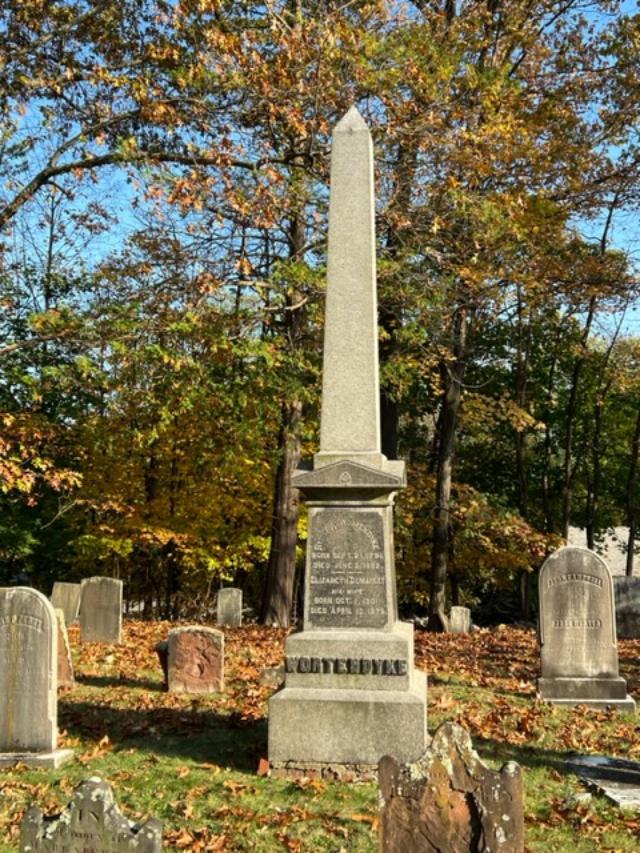
The Wortendyke/Demarest family marker.
The remaining area of the larger cemetery was laid out into 16 grave plots in 1855. Many of these plots were bought by the older area families, probably because the four and five hundred acre farms in the northern Bergen County area were being broken up into smaller parcels in the middle of the 19th century, and little room was left for family cemeteries.
With most of the older families leaving the area in late nineteenth and early twentieth centuries many of the plots were no longer used and in time the church saw fit to reclaim them through legal means and sub-divide the plots into smaller units.
In more recent times church members have purchased available smaller plots or single grave sites. There are now about six burials per year in the Pascack Reformed Church Cemetery. Burials are limited to owners of plots, and new sales of the very limited number of plots is restricted to members of the Pascack Reformed Church. It is hoped that in the near future all gravestones that are downed will be raised and those that are broken in both the main part of the cemetery and the one behind the church will be repaired.

The Wortendyke family plot at the Pascack Reformed Church
When research concerning the three older cemeteries in the southern portion of the cemetery continues, an application will be made for the erection of a second historical marker which will be an additional tribute to the American Indian tribe of the area and the early African and European American settlers of the Upper Pascack Valley area of Bergen County.

The beautiful historic cemetery is so breathtaking in the fall months.
Carl W. Weil, Church Historian
Larissa Romero, Editor
Visit from Bergen Community College for the Bergecco-Parc Consulting Inc. project ‘The Bergen 250-the 250th Anniversary of the Revolutionary War’:
As part of the Team project, I took my students on a tour of the church and its historic graveyard, which is home to the Wortendyke family plot. As part of the project’s ’Farm to Table Dinner’, there is to be a ‘Candlelight Walking tour’ of the graveyard after dinner. I also challenged the students to create a ‘Halloween Walking tour and Spaghetti Dinner’ fundraiser for these historic churches.
We were given private tour by the new church pastor, Pastor Sharon Gross-Gill, whose pride in this church and its history was shared with the students.
The tour started with a talk of the church’s place in Bergen County and its history. Then we toured the bell tower and the students got to ring the bell

The students touring the Bell tower

The students were given an opportunity to ring the bell

We then toured the historic graveyard after the tour of the church. This is the resting place of the Wortendyke family plot as well as members of the Demarest, Banta, Bauvelt, Van Ripper, DeBraun and Terhune families.
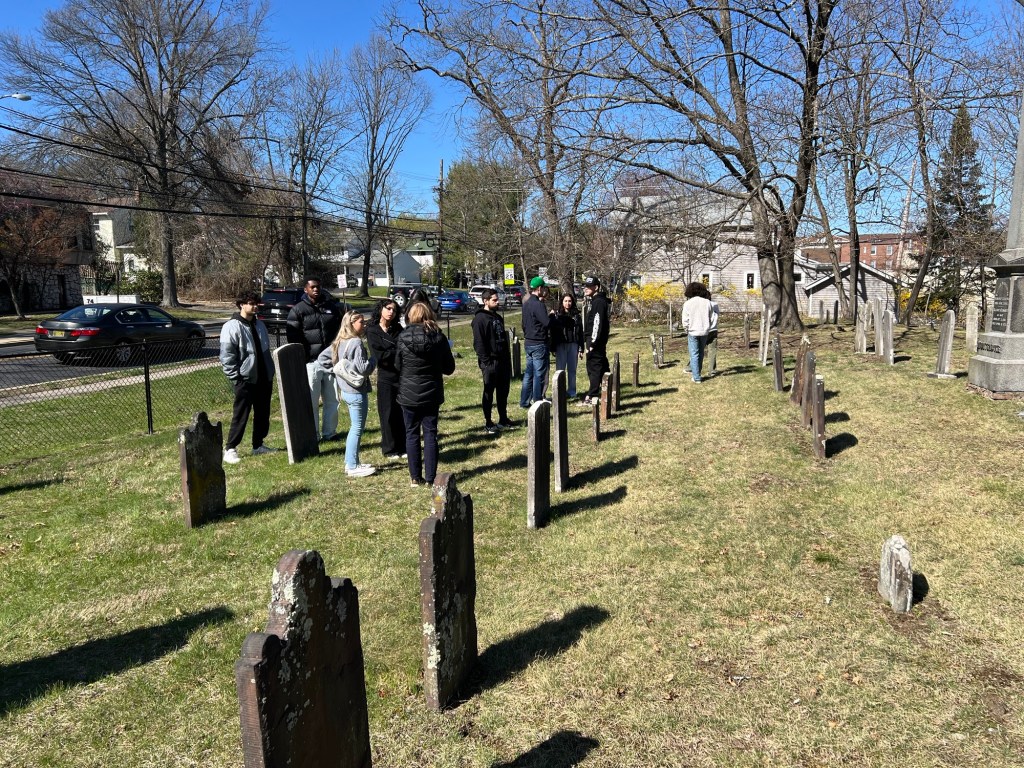
Barbara, one of the church historian’s and tour guide, explained that some of the graves dated back to 1635 long before the founding of the country.
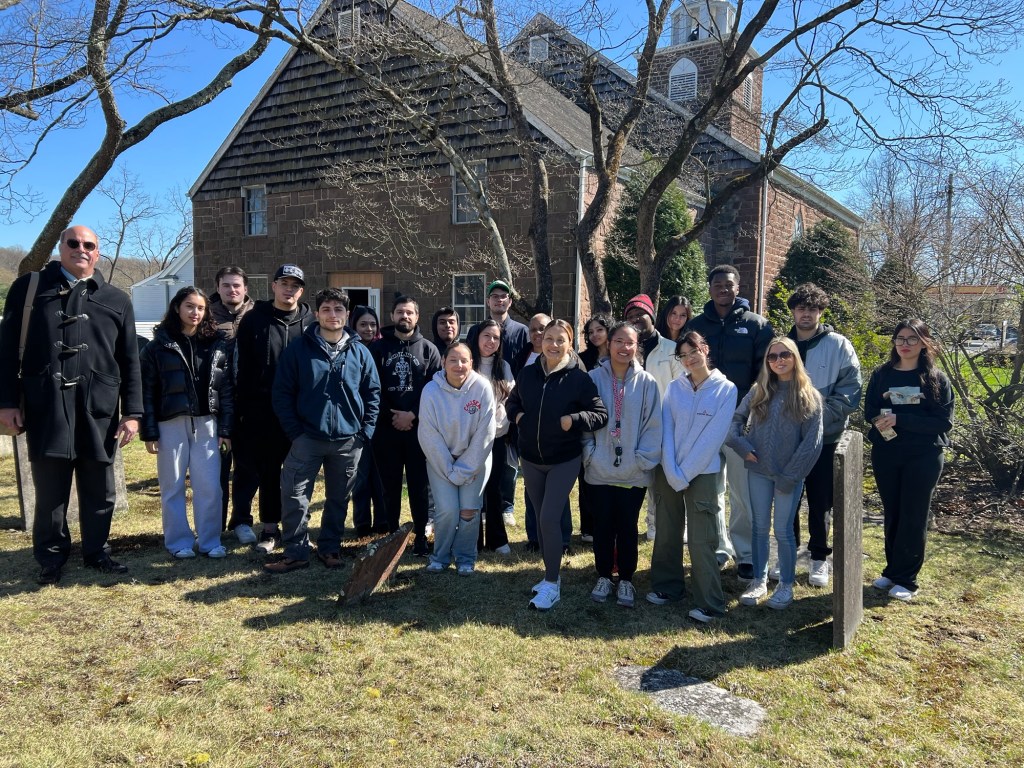
Before we moved onto the next site, we took a group shot with Pastor Gross-Gill. It was a very informative and interesting afternoon.
The Easter Holidays:
During the Holy Week I visited the church after visit to say ‘Thank you’ for the tour. I went for the Palm Sunday services and the sun finally broke and it was a nice day. The flowers were blooming and it was nice to be outside. It was a very nice Palm Sunday services.
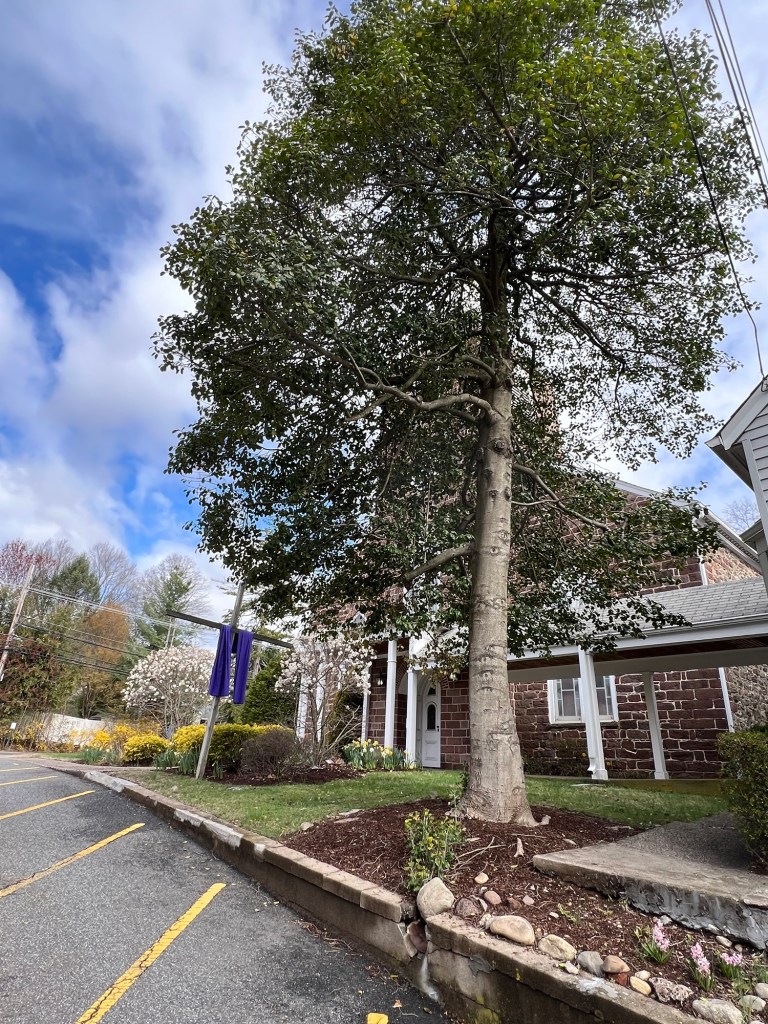
The church on Palm Sunday morning

The front of the church on Palm Sunday 2025
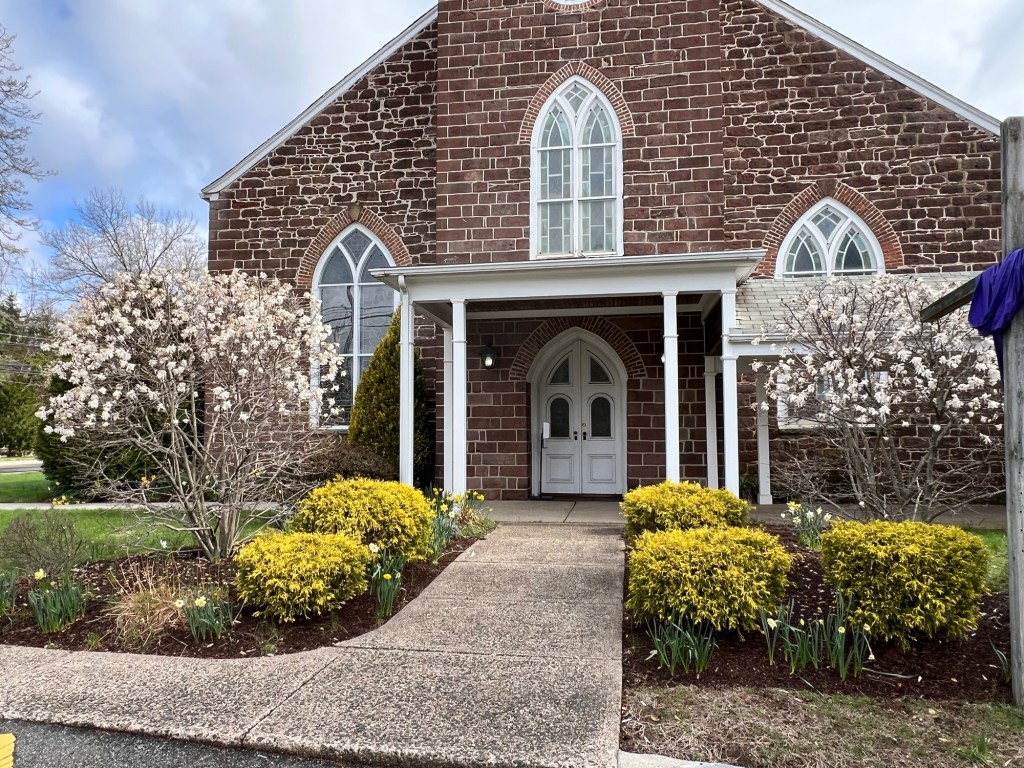
The front of the church in full bloom during the Easter holidays
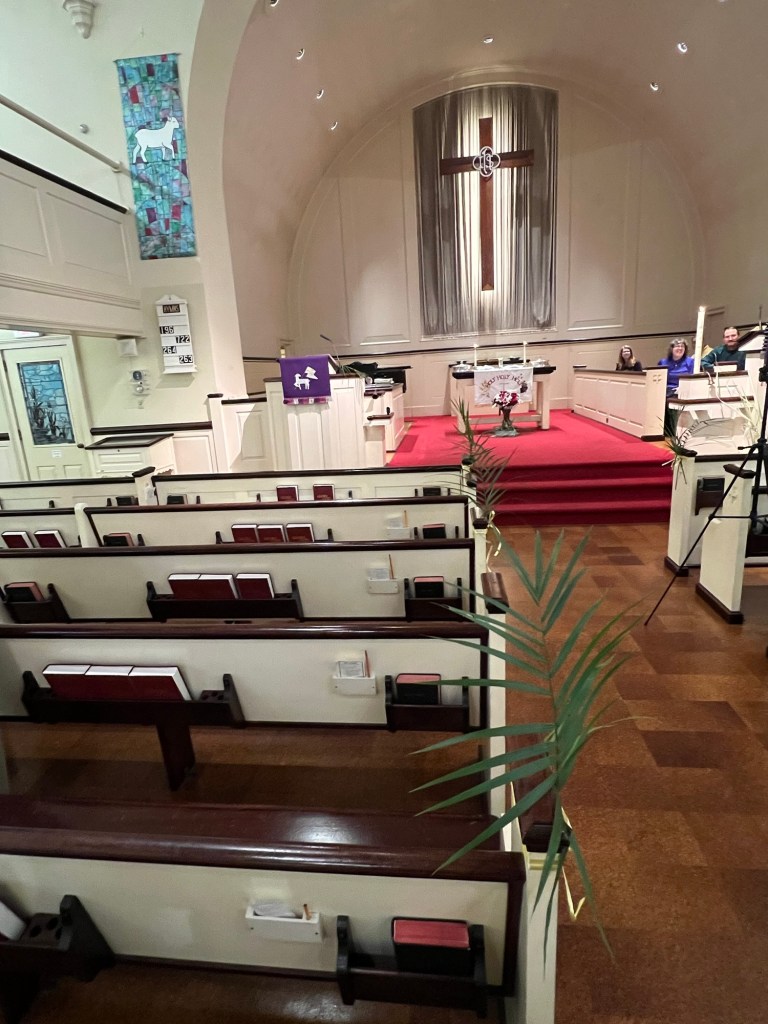
The inside of the church during Palm Sunday morning
















 Visiting a Museum: The Unique, Unusual, Obscure and Historical