The Blackwell House on Roosevelt Island finally opened for tours after a major renovation of the house. When I had visited Roosevelt Island the last time in 2017, the house was corded off and was not open for touring. It had looked like it was falling apart from the inside out.
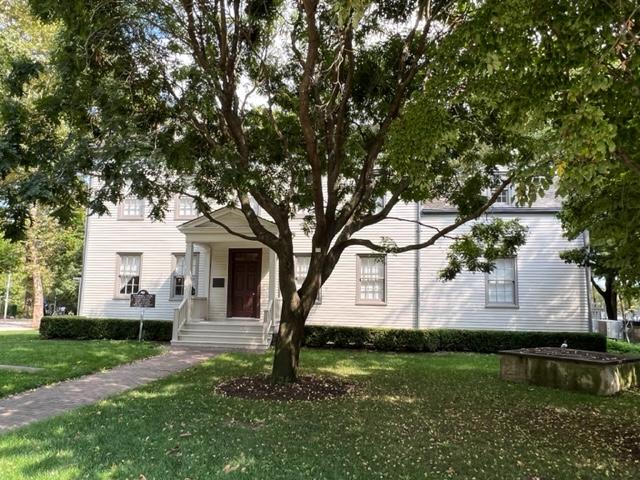
Historical Landmark sign
The home has now gone through a major renovation. The grounds outside were beautifully landscaped and gave the house a very warm and welcoming entrance to the property. In the middle of the summer, the flowers and trees were all in bloom and it was a nice view from the street. The house is conveniently located in the middle of the island, so it is not far from the tram and the subway.
The historical plaque in front of the house
I have to say that I was a little disappointed with the tour of the house what there was of it. The house had gone through a renovation but not a historic restoration, so the house is not a period piece with historic displays of furniture and art objects. It was like touring a modern home. I felt like I was walking through a 1980’s McMansion.
The new Living Room at the Blackwell House is not very historical.
When you enter the front hall, there is a reproduction of a portrait of Captain Blackwell, who was a Captain in the Revolutionary War. The house was built in 1796 for James Blackwell and added to in 1804, when the family fortunes had improved after the war.
The portrait of General Blackwell
The island had been ‘patented’ to Captain John Manning by British Governor Nicolls in 1668. Before the Dutch had arrived, the island had been used by the Native Americans for hunting and fishing. The island had been inherited by the captain’s stepdaughter, Mary Manningham Blackwell and her husband, Jacob Blackwell, thus named Blackwell’s Island, upon his death. The island passed to her children, James and Jacob. The island was sold to the City of New York in 1823 (Roosevelt Island history).
The historical pictures in the hallway of Roosevelt Island
All around the first floor, which is the only floor you can visit, there are all sorts of reproductions of historical maps and pictures of the island. The tour guide who had lived on the island his whole life, told me that the house had always been in disrepair and the local kids had thought it was haunted.
Now you can walk the grounds around the house and admire the beauty of the home from the outside. The only thing historical that I saw inside is when the tour guide opened the door to the cellar and showed me the stones that made up the foundation of the home. They had been quarried locally and still had the look of that time period.
The grounds of the Blackwell House
The home is nice for a quick tour but do not expect much from the history side of the house.
After visiting three historical homes in the Fishkill area covering the towns of Hopewell Junction and Wappingers Falls, my last stop of the day was the First Dutch Reformed Church of Fishkill, NY. The church was closed at this point with services being on Sunday’s only starting at 10:00am. I was able to tour around the church admiring its architecture, looking over the DuBois House which is also owned by the church and exploring the cemetery.
The cemetery was the most interesting being the final resting place of many of the ‘first families’ of the area, including family plots of the Van Wyck and Brinckerhoff families, who also intermarried with each other. There were sections dedicated just to the families and then to the blended ones.
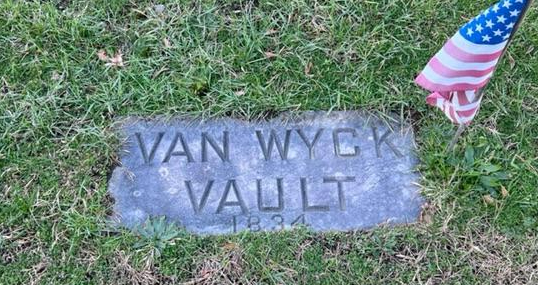
There were also members of the DuBois Family among others. What was interesting was toward the back of the cemetery near the new playground was the Van Wyck Family Vault. This large mound is noted with the stone maker in the front of the vault.
The Van Wyck family vault at the Fishkill Reformed Church Cemetery
The Church played an important role in worshipping in the community as it does today.
The Founding of the Church:
(From the Church records)
On October 10th, 1715, the Revered Petrus Vas of Kingston, NY under the direction of the Classis of Amsterdam, started two Dutch Reformed Churches, one in Poughkeepsie and the other in Fishkill. This occurred when the population of the are increased and they did not want to keep travelling to New Paltz for worship.
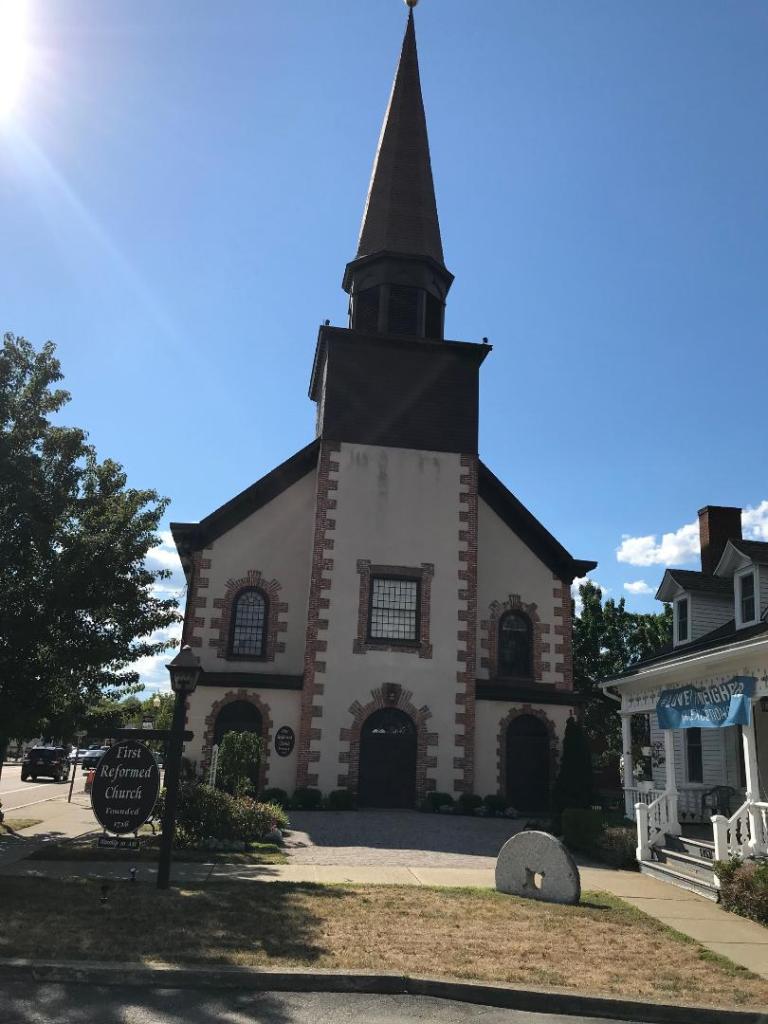
The First Reformed Dutch Church of Fishkill, NY at 1153 Main Street
The Church today:
(From the Church website)
The 20th Century brought additional changed to the property. Some gravestones were moved to make space for the Christian Education Building, which was constructed in 1964. The old chapel, a 19th century addition to the property was torn down. The playground is now located where the chapel was once. A Memorial Garden was added to the cemetery in 1980 and includes a columbarium for cremains. The sanctuary’s exterior was refurbished in 1975, the steeple reshingled and the rooster regilded in 1984.
In 1992, a condition survey was done (the church is the centerpiece of the Fishkill Village National Historic District). This report concluded that the sanctuary is one of the most significant nonresidential 18th Century buildings in New York, if not the country. The framing is a perfect example of an upside-down boat. While it was urged to pursue National Landmark Status for the church itself, it has not yet been done.
The Cemetery:
In 1995, a report on the preservation of cemetery gravestones was done. A Boy Scout Eagle Project, in 2002, recorded pictures and inscriptions of each stone in the cemetery and created a finder’s map of the cemetery.
The Enoch Crosby marker for a spy for the American forces during the Revolutionary War
The trial was performed here, and Enoch Crosby was allowed to escape. This marker is dedicated to that event.
The cemetery behind the church with the DuBois House and Church to the right:
The DuBois House:
(From the Church website)
The property was expanded in 1991 with the purchase of the DuBois House (named for the founding elder of the church). There is no record of when it was built but with structural similarities to the Van Wyck House made it believed to be built in the mid 1700’s. Abraham Brinckerhoff Rapalje purchased the house with fifty-four acres of land from his uncle, Abraham Brinckerhoff in 1790. Rapalje was the man hired by the consistory to do finish work after the church was enlarged following the Revolution. The house served as the hearing room for the court proceedings of the Committee of Safety over which John Jay, who would later become our nation’s first Supreme Court Justice presided.
The Committee of Safety played an important role in the story of Enoch Crosby, the Revolutionary Spy. The house was originally located east of its present location and was moved in 1929 to make way for the expansion of the Albany Post Road, now Route 9. The building is used for service to the community and church. It contains the church parlor and offices for the Minister and Secretary on the first floor and the office of the Music Director.
The Brinckerhoff/Van Wyck family plots
The Van Wyck family plot
The full Dutch Reformed Church of Fishkill cemetery and church
The Van Wyck Family Vault:
The History of the Dutch Reformed Church of Fishkill, NY:
By 1716, the population of the area had grown enough (though the whole county had only 440 people) that the settlers wanted their own church instead of having to cross the river to New Paltz or Kingston where the two closest Reformed Churches were located. Therefore, on October 10th, 1716, the Reverend Petrus Vas from Kingston under the direction of the Classis of Amsterdam started two Dutch Reformed Churches, one in Poughkeepsie and one in Fishkill.
While Poughkeepsie began building immediately, Fishkill did not begin building until 1725. Tradition and most published sources have it that Madame Brett by now a widow and the wealthiest landowner in the area gave the land for a churchyard while the land the church occupied was given by Johannes Ter Boss.
However, two deeds registered at the County Courthouse tell a different story. The first parcel of land, “it being that certain piece of land on which the Dutch Church so called now stands” was given by Madame Brett, through Jacob DuBois, it being the intent of him that the Reformed Nether Dutch Congregation of Rumbouth precinct “always be kept and preserved as a church or public edifice for the particular sole and only use and benefit of the aforementioned church to worship the Almighty God, in and to and for no other ends purposes use or uses whatsoever.” The second deed states that Obidiah Cooper and Esther, his wife, gave another small parcel of land to the church. These records were written thirty years after the fact and were not filed in Poughkeepsie until 1915.
There is also a deed from 1747 in which Johannes Ter Boss sells a parcel of land north of the Fishkill’s, reserving one acre for a meeting house. Every published history has this acre for the Rombout Presbyterian Church, which was built in 1747 about three miles from First Reformed. So, it would appear that there was confused between DuBois and Ter Boss, probably due to the old handwriting and a Frenchman, born in Leyden, Holland and a Dutchman. Another supporting piece of information is that there is no Ter Boss listed in the church records of The First Reformed Church, while the DuBois family is prominent, starting with Peter DuBois, the first elder.
It took seven years to build the original sanctuary. Field stone was brought by ox teams and the local inhabitants, and their slaves did the building. Work proceeded slowly because the men had fields to attend and families to support. The sanctuary was a small, square building with a hip roof and a cupola in the center, which supported a bell. The central door opened onto the street as the side door does today.
In 1785 the congregation decided to enlarge the original building. The east and west walls were taken down and the building was lengthened. A second story was added, and balconies suspended by iron rods were put into seat slaves. The tower and the steeple made with beams 18″ square and 80″ long rose 120 feet above the ground. The west end had four small windows.
In the midst of the reconstruction, John Stickland, an English traveler wrote “Here is a large Dutch Church, rapidly going to decay, probably never to be repaired.” However, construction continued, and the consistory hired Abraham Brinckerhoff Rapalje, who lived next door to build the new pulpit, new pews and to enclose the square lower section of the tower.
Five years later, in 1795, they hired him again to shingle the spire. With construction finished, the spire was topped with a gilded cock, symbolic of Peter’s denial of Jesus. It is actually about three feet high. It is one of the few left in the country.
The expanded sanctuary was remodeled in 1806. Columns were added to support the balconies and the pulpit and side pews were lowered to the level of the rest of the sanctuary. More alterations were made in 1854, when the balconies were narrowed and lowered. An alcove was made in the west end for the pulpit and the four small windows were replaced by the stained glass and painted windows. The alcoves and doors on each side of the tower were added.
The church decorated for Christmas in 2022
The chandeliers were imported from Holland and can be lowered by chains to the level of the pews for service. Gas replaced candles in the chandeliers in 1858. In 1908, they were electrified. In the late 1800’s, most of the ‘extra’ original property was sold for building lots at $100.00 each no one foreseeing the need for parking lots of the future.
(Disclaimer: I changed a few things around from the church history to make it flow better. More details are on the above link to the church’s history).
The entrance to the First Reformed Church of Fishkill in December 2022 decorated for the holidays.
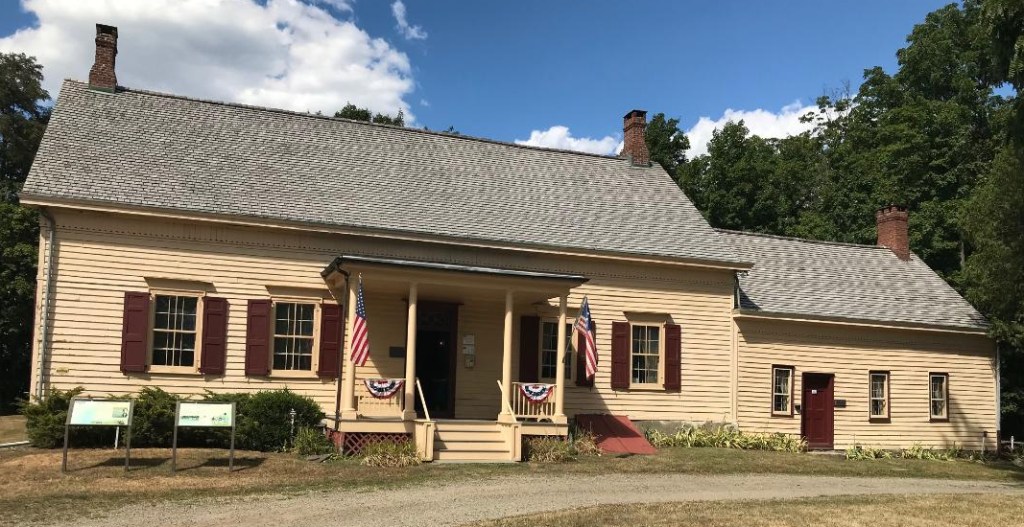
Visiting the Van Wyck Homestead is like stepping back into the past to see a part of our nation’s history. The homestead sits at a once pivotal point location in the Hudson River Valley and during the Revolutionary War, George Washington established his main northern supply depot here in October of 1776. After the war was over, the Van Wyck family returned to the home and lived here for five generations until the late 1800’s. The last member of the family, Sidney Van Wyck hung himself in the barn on the property (Van Wyck Homestead pamphlet).
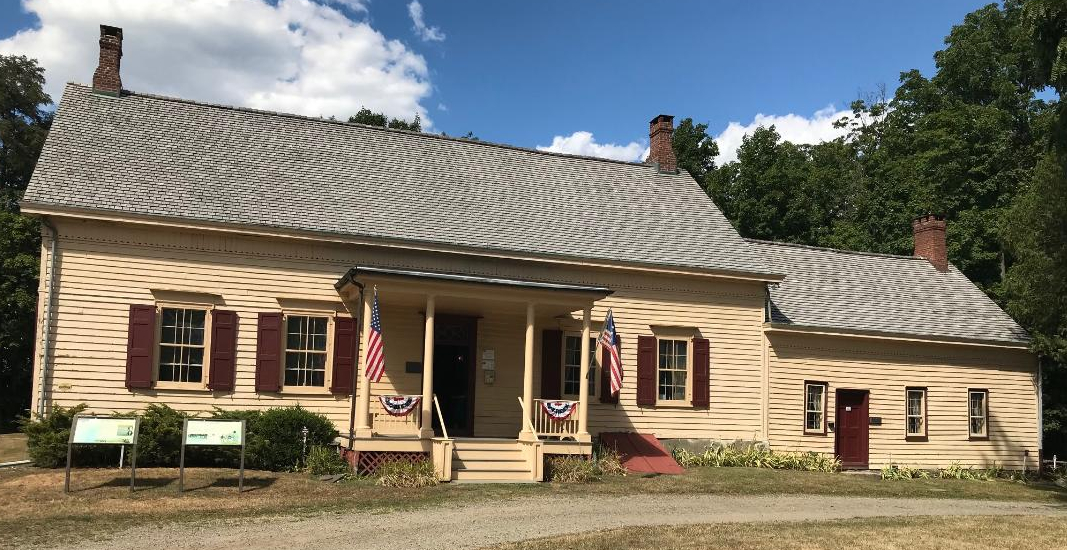
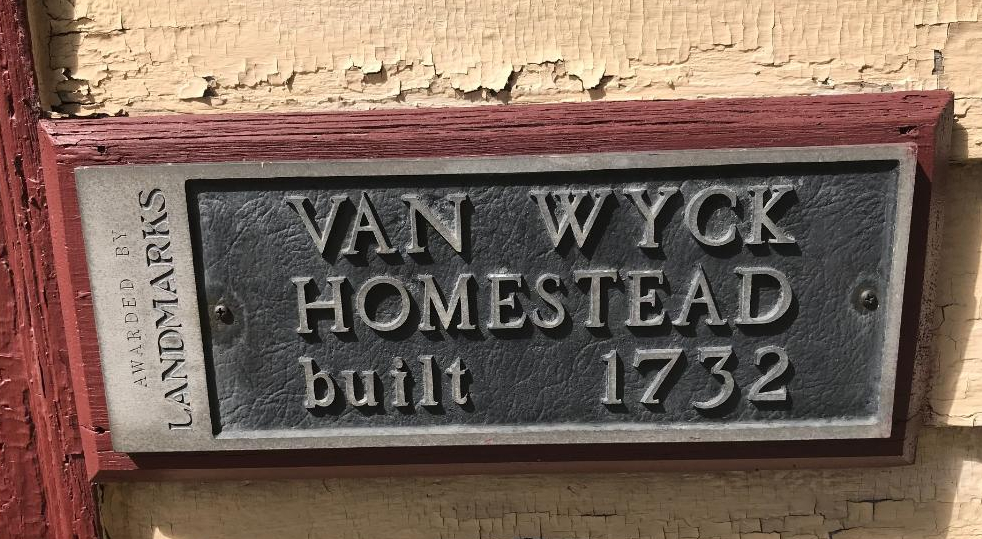
The house was built in two sections. The original section of the house off to the right of the building is the original section of the home that was built in 1732 and the larger section of the home was finished in the 1750’s.
The marker of the original home
When you enter the homestead, you are greeted in the hallway that runs the length of the main part of the home. To the right of the hallway is old living room and to the right of the hallway is the combination kitchen and dining room. The stairs leading to the upstairs, now serving as offices, are at the end of the hallway.
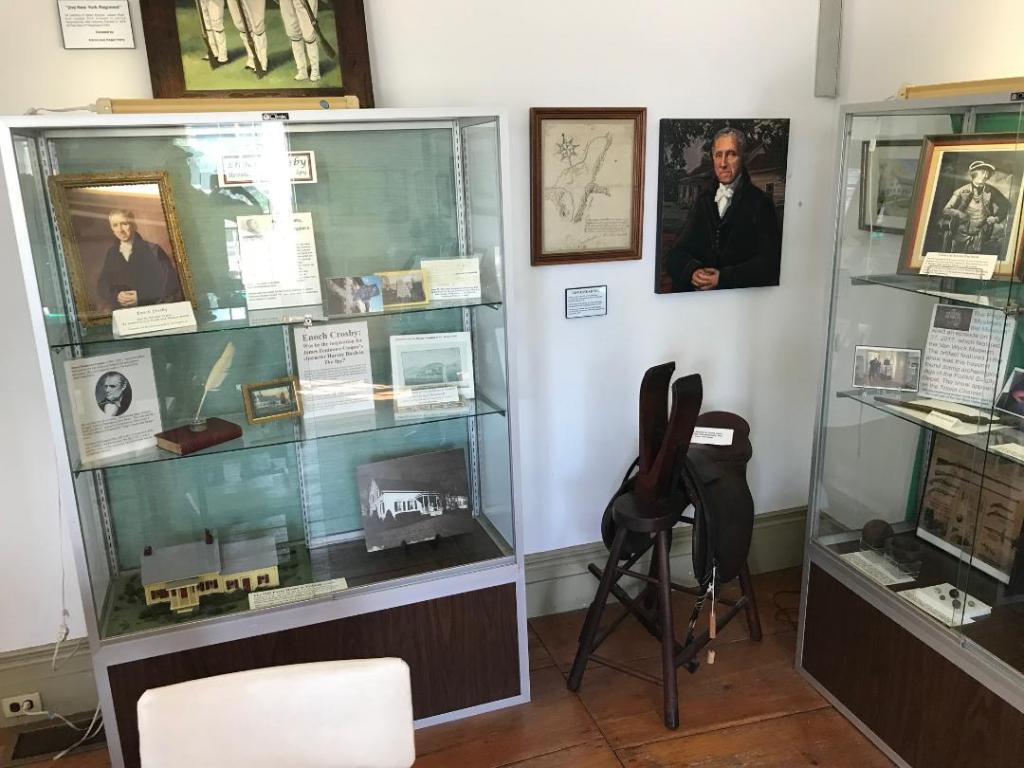
Another piece of Van Wyck furniture in the old Dining Room with the display case holding family heirlooms that have been donated over the years.
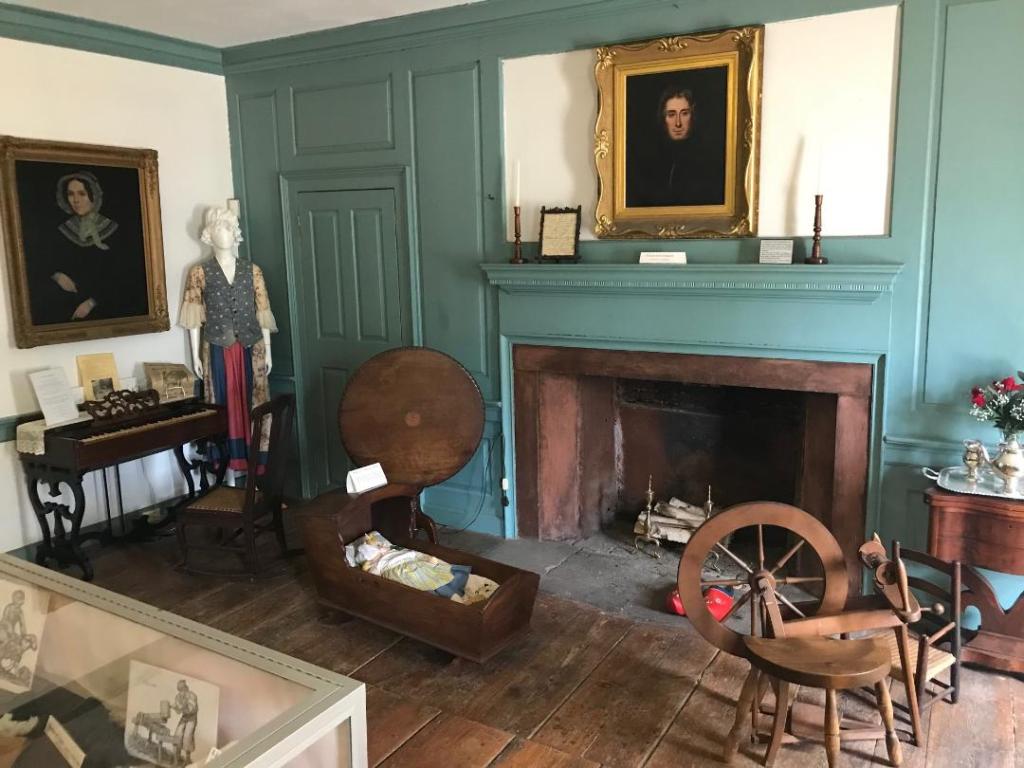
The former Dining Room of the Van Wyck home with the fireplace of the addition of the house. The crib in front of the fireplace is a recent donation from the Van Wyck family and had been used by the family for generations.
The family portrait above the fireplace was recently returned to the home and fit perfectly above the fireplace. The Spinning Wheel is another family heirloom donated to the house.
An original piece of Van Wyck furniture returned to its home
When you step down the stairs into the smaller part of the original part of the house, you will be greeted in by the original kitchen and living space. This was used by the family for all functions of work and social aspects of the farm.
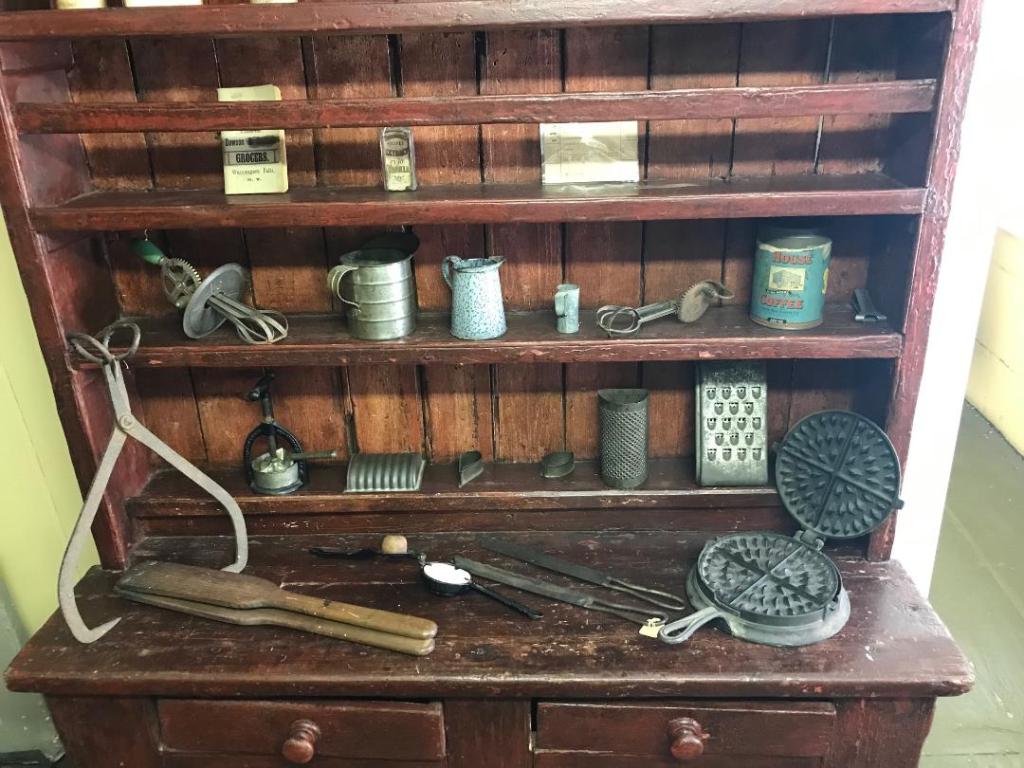
Items used in Colonial and Victorian kitchens
Items in the Colonial kitchen display which have not changed much over the years.
The Colonial Kitchen at the Van Wyck Homestead
To the right of the hallway is the old Living Room that is now used as a lecture hall and where meetings are held. The room was dedicated to George Washington for the service that he did for the area during the war.
The old Dining Room and lecture room
The Revolutionary War displays in the old Living Room
The room is lined with displays that are dedicated to the family and the war years. All sorts of artifacts and pictures are displayed here.
The display case in the old Dining Room
In the back of the home is the old Library that is now used a Research Library on the history of the area and of the Van Wyck family. Here you can research your roots in the community.
The Research Library at the Van Wyck Homestead
The Research Library at the Van Wyck Homestead
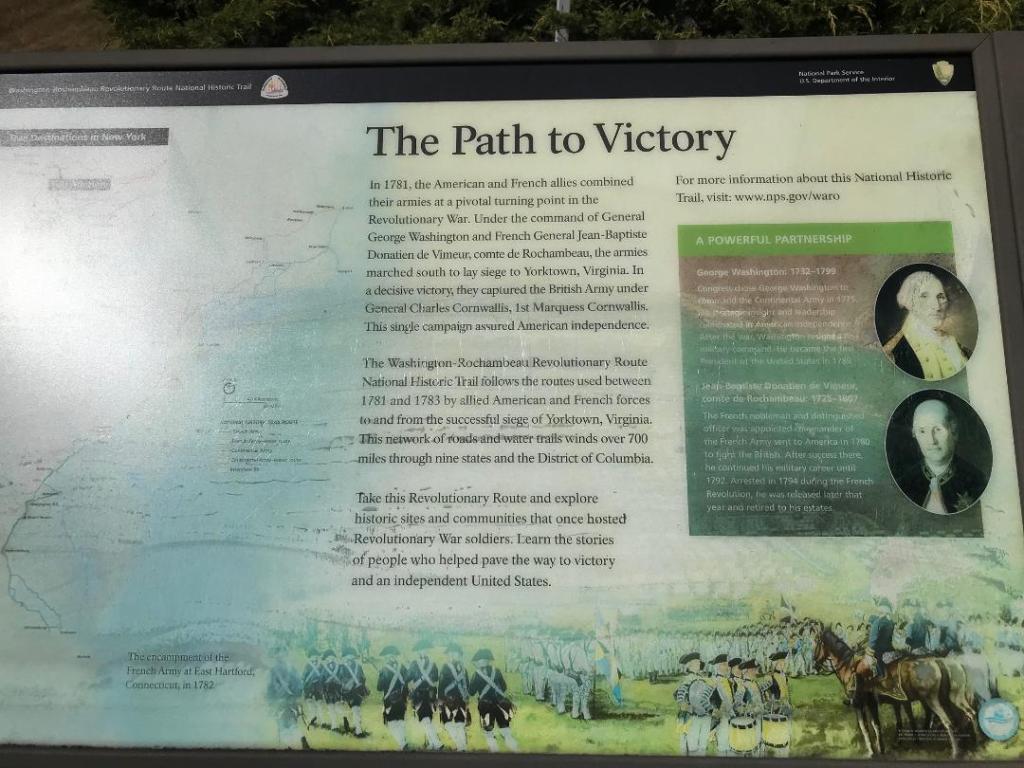
When you walk the grounds, the story boards tell the story of the home as it played a role in the history of the region and its place in the war years.
The Path to Victory
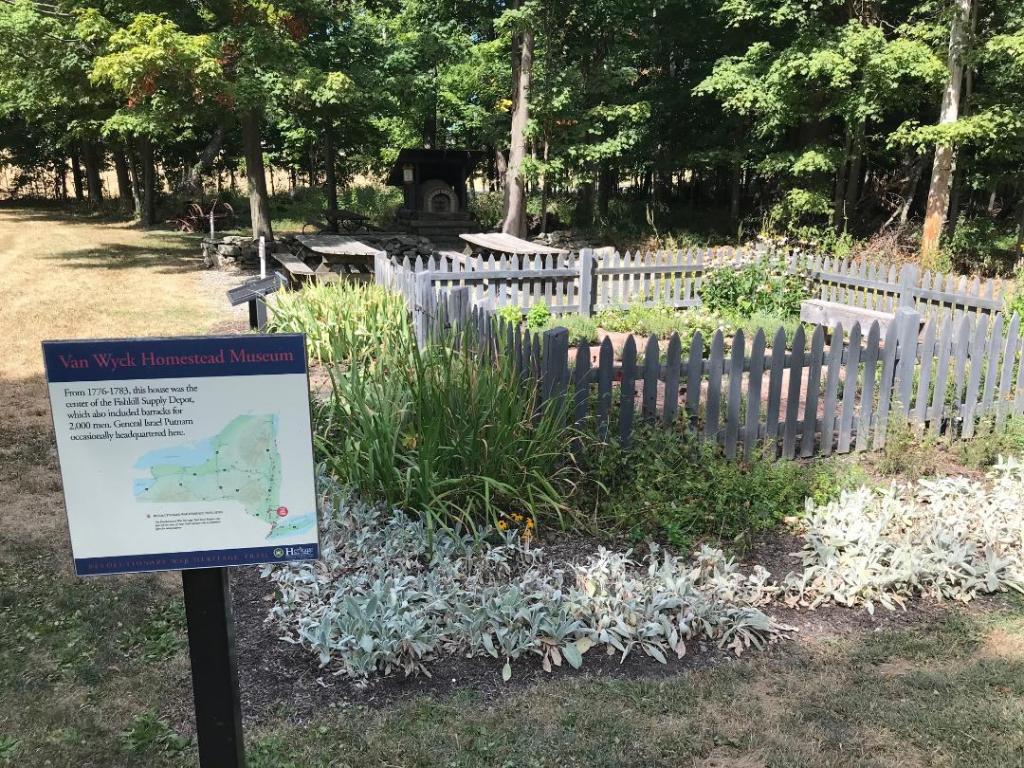
On the grounds of the home is also a working garden and the working beehive oven that is a recreation of the original that once stood on the property.
The Van Wyck Garden and outdoor over towards the back
History of the Van Wyck Homestead:
(From the Museum pamphlet)
In 1732, Cornelius Van Wyck from Hempstead, Long Island, acquired 959 acres from Madame Brett. He built the small east wing of the Van Wyck Homestead. By 1757, the larger west wing of the home had been added. During the Revolutionary War, George Washington established his main northern supply depot here in October of 1776. The Van Wyck house was requisitioned by the Continental Army to serve as the depot’s headquarters.
At the end of the Revolutionary War, the house reverted back to the owner, Issac Van Wyck. The old barracks and huts used for the war were torn down and the land went back to farming. The Van Wyck descendants lived in the house until the late 1800’s.
The original part of the house was built in 1732
By the mid-twentieth century, the house stood empty and was slated to be torn down for the new Interstate 84. The Fishkill Historical Society was formed in 1962 and after going to Albany, members were successful in getting the historical building saved and I-84’s plan changed. The Fishkill Historical Society was able to purchase the property and begin the restoration. This work is ongoing as we maintain this historical structure and grounds.
The Homestead is listed on the National Register and is part of the Hudson River Valley National Heritage Area. It is also part of the Rochambeau Trail which celebrates the French Alliance with the new United States.
The historic marker outside the house donated by the Daughters of the American Revolution. A cemetery for soldiers of the American Revolution were buried somewhere near the estate. When graves were discovered south of the museum, this could have been one of the resting places for them (Van Wyck pamphlet).
The City Island Nautical Museum at 190 Fordham Street
The City Island Nautical Museum
I recently took a trip to City Island, a small community just off the coast off the mainland of The Bronx (which is part of The Bronx) to visit the City Island Nautical Museum. This tiny museum located in the heart of the island is noted for its collection of ship building artifacts and items that are native to a community that once built the vessels for the America’s Cup.
The main hallway at the City Island Nautical Museum dedicated to the America’s Cup
City Island has a rich history in ship building, sail making and fishing it is reflected in the collection of materials in the museum and its archives. The museum really details the growth and history of the boating industry on the island and its importance in the local economy. What I found interesting was the rich history of the creation of the sailing ships for the America’s Cup tournament and how all the winning boats up until the 1980’s were built on the island and the one that lost the cup for us against Australia was the first one not built on the island.
The Nautical Room Gallery
Even Ted Turner’s boat “Courageous” was built on the island. There was a picture of the reunion of the boat winning twice at the museum with the crew’s signatures (The tour guide even said how he ‘freaked out’ members of the New York Yacht Club who did not consider him one of their own). All the sailing vessels lined the walls of the hallway of the museum.
The America’s Cup Race winners
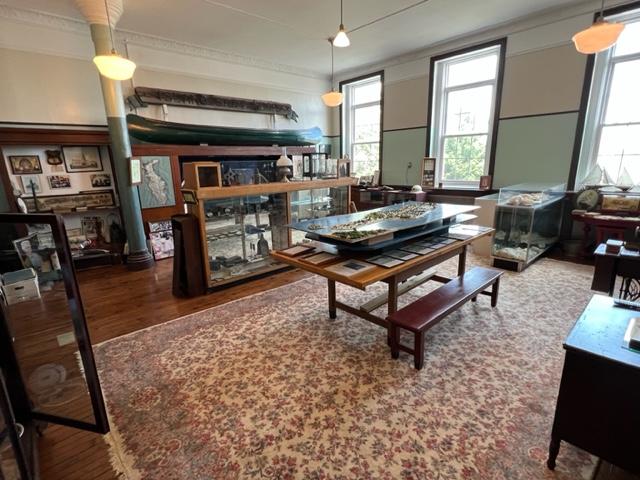
Each room of the museum was dedicated to a different theme. When I toured the Community Room in the back of the museum, it held the records of a lot of old businesses of City Island with pictures and items that were once part of the businesses. There was a small FDNY display, a small WWII display about local residents who fought in the war, wedding garments, maps of the island and a small display of arrowheads.
The Community Room Gallery
The Community Room-Map of City Island
The Community Rom-Items from businesses and homes.
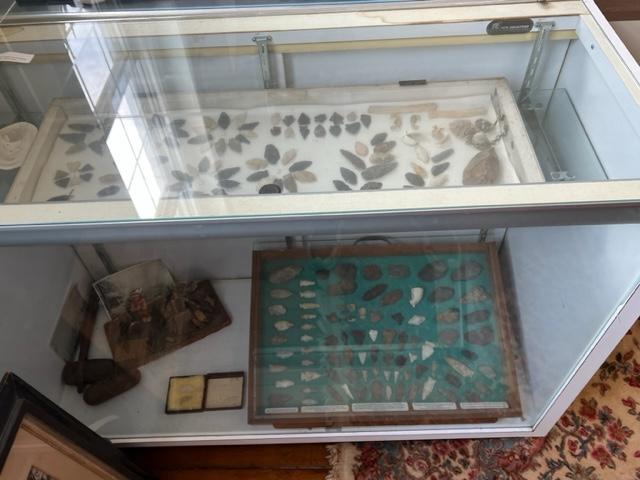
The Community Room-Arrowheads and Native American objects
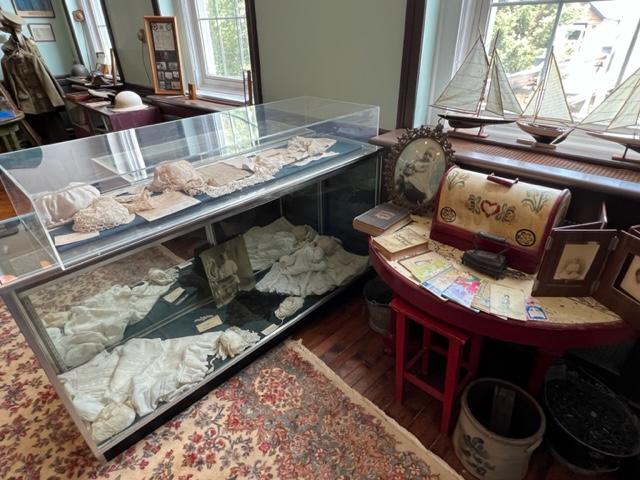
Baby clothes and household items
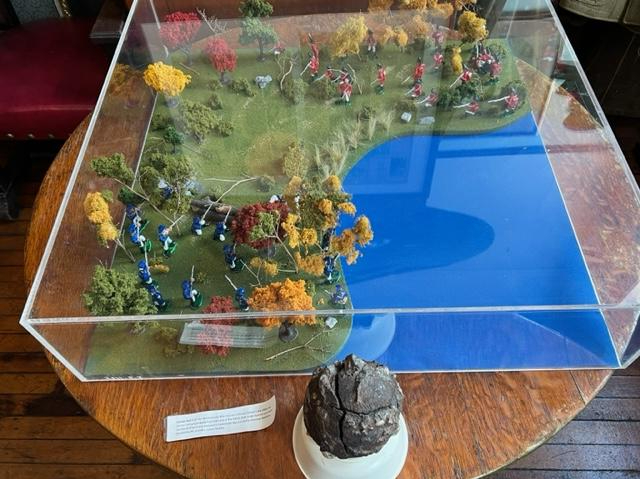
A cannonball from the Revolutionary War battle
Church Chairs in the Community Room
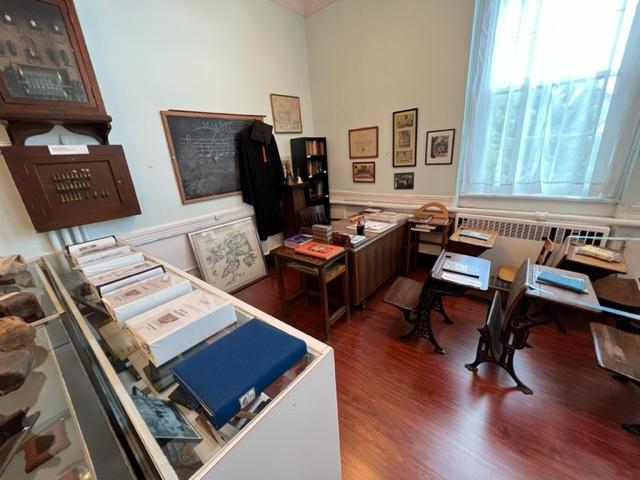
In the School Room, the concentration was on PS 17, which the museum is now housed in and its history with all the classroom group shot pictures, graduation pictures and a small classroom set up. There were more records and event items of the current PS 175, which is the K-8 school that the residents attend. There were also records and pictures of St. Mary, Star of the Sea School, the former Catholic school that used to be on the island as well.
The Schoolroom Gallery
The Schoolroom Gallery
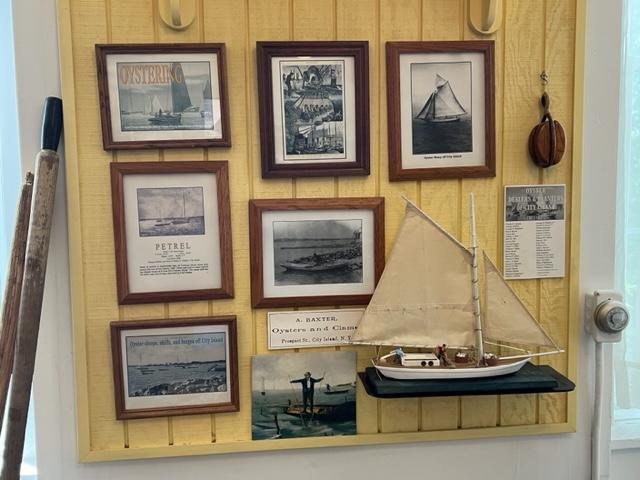
The Nautical Room needed an overall as there was too much going on in the room with pictures all over the walls, equipment for navigation and for fishing and records of the ship building companies that used to dot the island. There were boats in various shapes and sizes on display and the companies that built them like Wood Yacht, Nevins Yacht and Minneford Yacht. There was also the history of shipbuilding and sail making on the island. The tour guide told me there were no more ship builders on the island, but one sail maker left.
The Shipping making equipment
Locally made boats on City Island
The Library where all the research is done on the island and on the families and businesses that were once here was dominated by yachting pictures and nautical photography. It held all the City Island records and even the ship building plans.
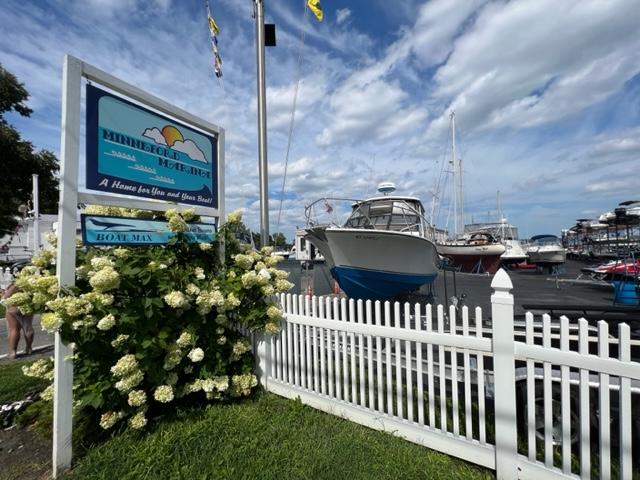
The Minneford Boatyard down the road from the museum is still operation today.
The City Island Nautical Museum Library
The museum has a lot to see but it needs to be a bit more organized to really showcase the collections properly. Still, it is one of the best museums I have seen with a nautical history theme. The best part is that you can see the whole museum in about an hour and this leaves you time to tour the island and see how the museum better explains why the island is the way it is right now.
The Ship display in the City Island Nautical Museum Library.
The History and set up of the City Island Nautical Museum:
(From the Museum pamphlet)
History of the Museum:
(From the Museum Pamphlet)
The City Island Nautical Museum is located in one of the island’s most picturesque and historic buildings, the former Public School 17, built in 1897 on one of the highest points on the island. When the residents of City Island voted in 1895 to separate from the town of Pelham in Westchester County and to become part of New York City, the City administration built the school, which continued in use until 1975. When the building was sold in 1986, the City reserved space for use by the City Island Historical Society and the Community Center and several old classrooms now serve as galleries for the museum.
The front main gallery is reserved for revolving exhibits. This exhibit that was being featured in the summer of 2023 was by local artist Liz Alderman.
The Liz Alderman Exhibit in the Front Gallery:
Local City Island Artist Liz Alderman at the City Island Nautical Museum in 2023.
The Liz Alderman Exhibit in 2023 at the museum
The Liz Alderman Exhibit of the local artist’s work.
The Liz Alderman Exhibit at the museum
The Main Hall and Gallery:
The Main Hall is lined with photographic essays featuring maps, the America’s Cup, City Island’s most beautiful boats, the City Island Bridges and historic buildings as well as a history timeline, models of a minesweeper and several rum runners, built during Prohibition and a handsome wooden kayak built in the 1930’s. The foyer contains the museum’s gift shop, featuring articles for sale such as books, t-shirts, photographs, postcards and nautical gifts and the desk where the docents greet visitors.
The Gallery features display cases with antique shipbuilding and sailmaking tools and the walls are covered with photographs of yachts built or serviced here and portraits of legendary City Islanders who contributed so much to the life and work on the island.
The Main hallway at the City Island Nautical Museum
The Walsh Library:
The recently refurbished library features a collection of books devoted to maritime history and many binders and scrapbooks featuring newspaper clippings, postcards and articles about City Island, Pelham Bay Park and Hart Island. There is an extensive selection of nautical magazines, including Yachting, Rudder, Wooden Boat and Classic Yacht, a data base of all boats built on City Island since 1848 and an impressive display of ship models. Special exhibitions regularly mounted in the library feature the work of local artists and photographs documenting aspects of City Island history.
The Library at the City Island Nautical Museum
The Nautical Room:
Shipyards, sail lofts, yachts and the people behind them are all honored here. Historical photographs, memorabilia and artifacts fill the room and tell the story of City Island’s rich nautical past. Also on display are tools used by sailmakers and shipbuilders, several ship models and some vintage outboard motors. Of particular interest in the room are several skiffs, a partially completed boat and a Buchman sailing canoe from the early 1930’s (all built on City Island).
Ship building display on City Island
The Community Room:
Celebrating City Island from its earliest days, the Community Room displays photographs, maps and memorabilia, including Native American arrowheads found in the area. The walls are covered with images of street scenes, stores, restaurants, private houses, and the waterfront then and now. Displays include a large relief map of City Island in about 1867, a diorama of the Battle of Pell’s Point that took place in October 1776, a niche devoted to City Island’s religious institutions and many antique home furnishings, including sewing machines, an ice box, and a 100-year-old typewriter. A large counter from Gilbert’s Pharmacy serves as a display case in the center of the room.
The Community Room at the City Island Nautical Museum
The Native American Collection in the Community Room
The School Room:
Student registers, graduation pictures, autograph books, report cards, the old school bell, and the other artifacts tell the story of City Island’s schools from the first schoolhouse built in 1838 to the present school, P.S. 175, built in 1975 and St. Mary, Star of the Sea RC School, which served the island for over 75 years. A section of the room is set up like a traditional school room, and a unique map of the naval training station that was located in Pelham Bay Park from 1917 to 1918 hangs on the wall.
























 Visiting a Museum: The Unique, Unusual, Obscure and Historical