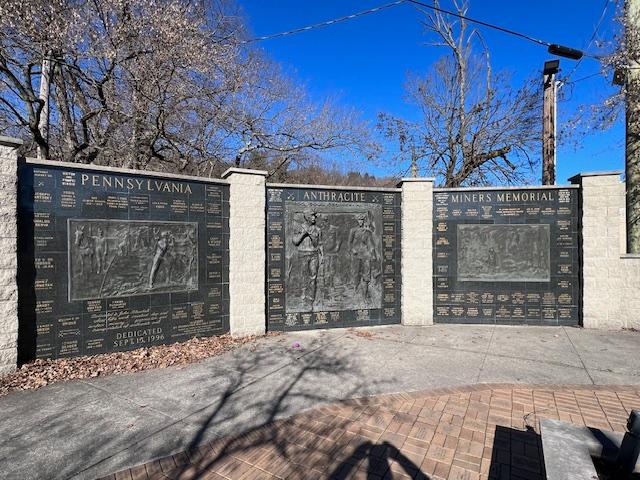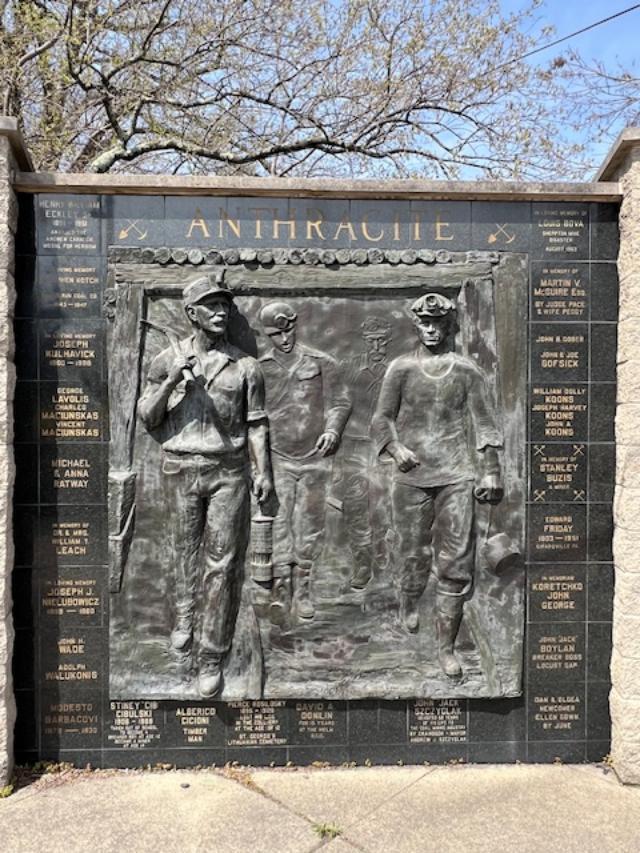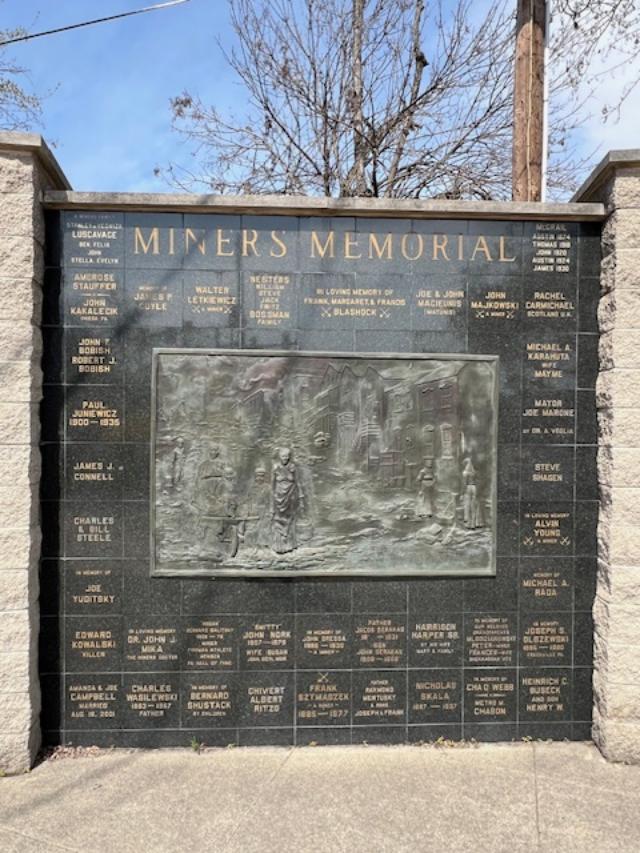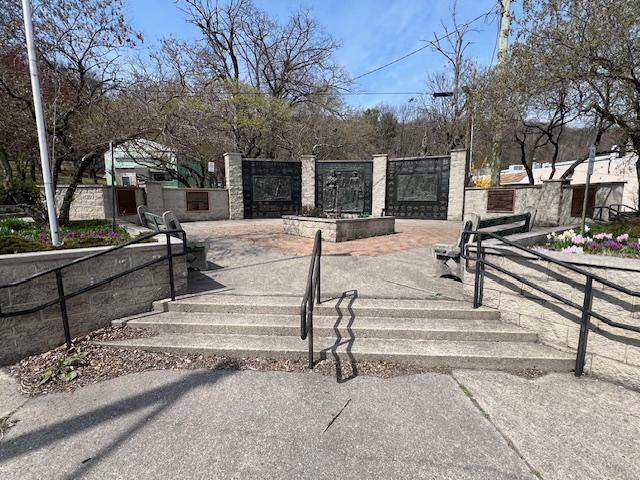
The memorial in Girard Park in Shenandoah, PA just off the edge of downtown.
Plaque One
Plaque Two
Plaque Three
When I was visiting Downtown Shenandoah, PA I had read about this memorial dedicated to miners in the area and to stop by to see it. It is a very touching memorial dedicated to the hard working men and women who work in the mines in the area and the sacrifices they have made so that we could have heat and energy over the last 150 years. This is dangerous work and they do not get enough credit for it.
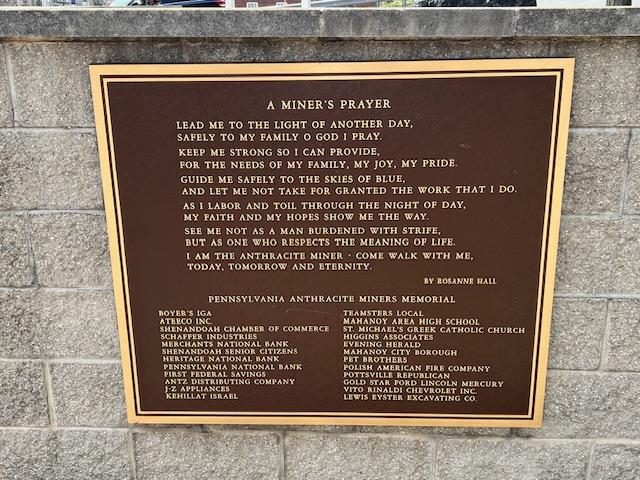
The Miner’s Prayer plaque
The memorial sits on the very edge of the northern part of downtown Shenandoah and the sad part is the condition of the both the park and the memorial like forgotten souls. Downtown Shenandoah has seen better days and with the mines not in production they way they once were, it is almost like a forgotten relic of the past. Still it is very touching to see this dedication to that hard work and determination of people who have performed this hard job and not given the credit for it.
Take time to read the names and see the inscriptions. It is a very moving place.
A piece of coal donated and dedicated to the monument
History of the Memorial (Zenos Frudakis website):
Pennsylvania Anthracite Miners Memorial relief bronze by Zenos Frudakis honors the thousands of hardworking and courageous coal miners who lived and worked in the anthracite region of Pennsylvania.
Comprised of three large bronze plaques, the monument’s left panel, titled “Life Underground,” tells the story of deep miners at work in coal pits. “The Passageway,” largest and central panel, illustrates four miners exiting a mine shaft. “Life Above Ground,” the right panel, shows row homes in Shenandoah in 1891. The monument is surrounded by bricks featuring the names of many of the miners, and benches where visitors can rest and reflect on the hardworking residents of the Upper Schuylkill Region who helped to build America.
The inscription on the Memorial (HBdg.org):
Their coal oil lamps dimly lighted the dismal tunnels while silhouetting their blackened faces that portrayed their exhausting labors and dedication to their families from sunrise to sunset. Only God knew their fate. As you walk this brick pathway toward the Pennsylvania Anthracite Miners Memorial. You will become a part of the miners’ world and the history they so painstakingly created with picks and shovels. Do not shed tears for them, but carry on the pride they chiseled with the sweat from their brows and each beat of their hearts. By Roseann Hall. Pennsylvania Anthracite Miners Memorial-Steven Souchuck, Joseph Baronowsky, Edward S. Kramer, Neil Delance, Albert James Sands Sr., John Lauritis, Bartholemew “Patsy” Swies, Stanley Rakowsky Sr., George Luscavage, David J. Roberts, Frank M. Twardzik, Gulden-Thompson Family, John J. “Jada” Grutza, John Bisco, Stanley Glinski, Christopher F. Casula, Thomas and Blanche Dower, John S. and Pauline G. Karlavage, Robert K. Ramsey, Adam Morris, Dyszel-Andrew, Barbara and Sons, Procuda-Steve, Nick, Russel, Albert Ritzo, B. Lewis and Shustack Family.
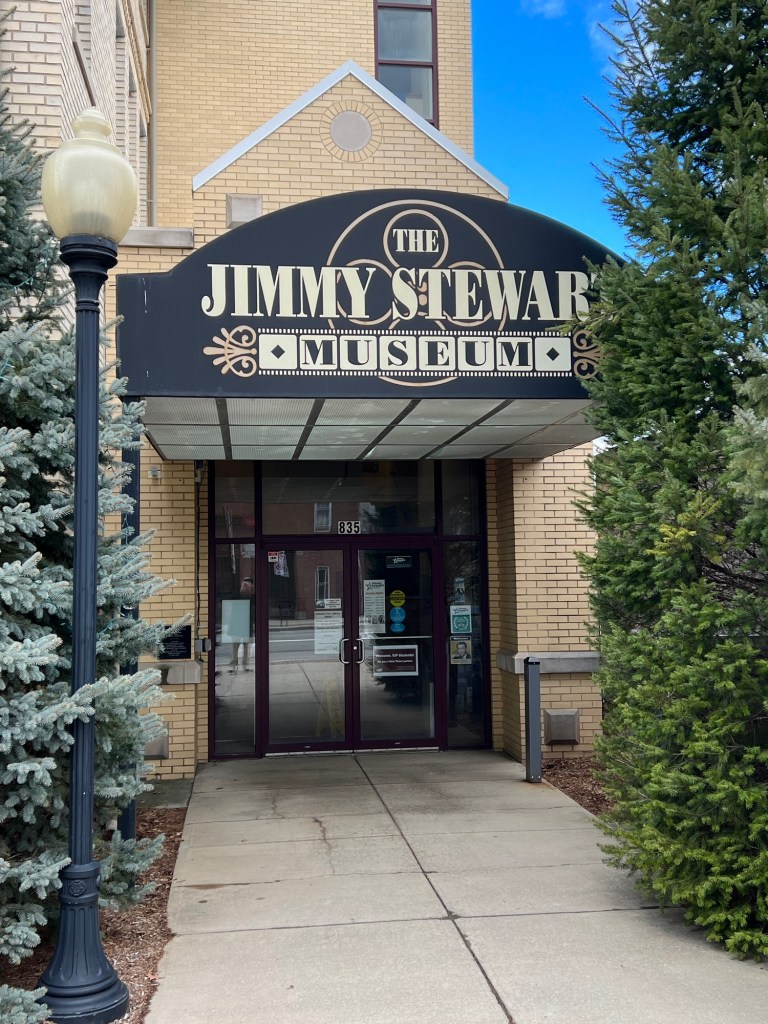
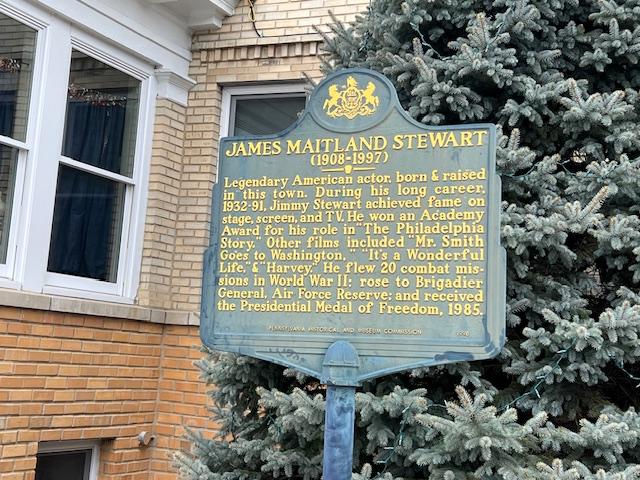
The Jimmy Stewart Museum is part of the Indiana Library. The museum is located on the second floor of the building.
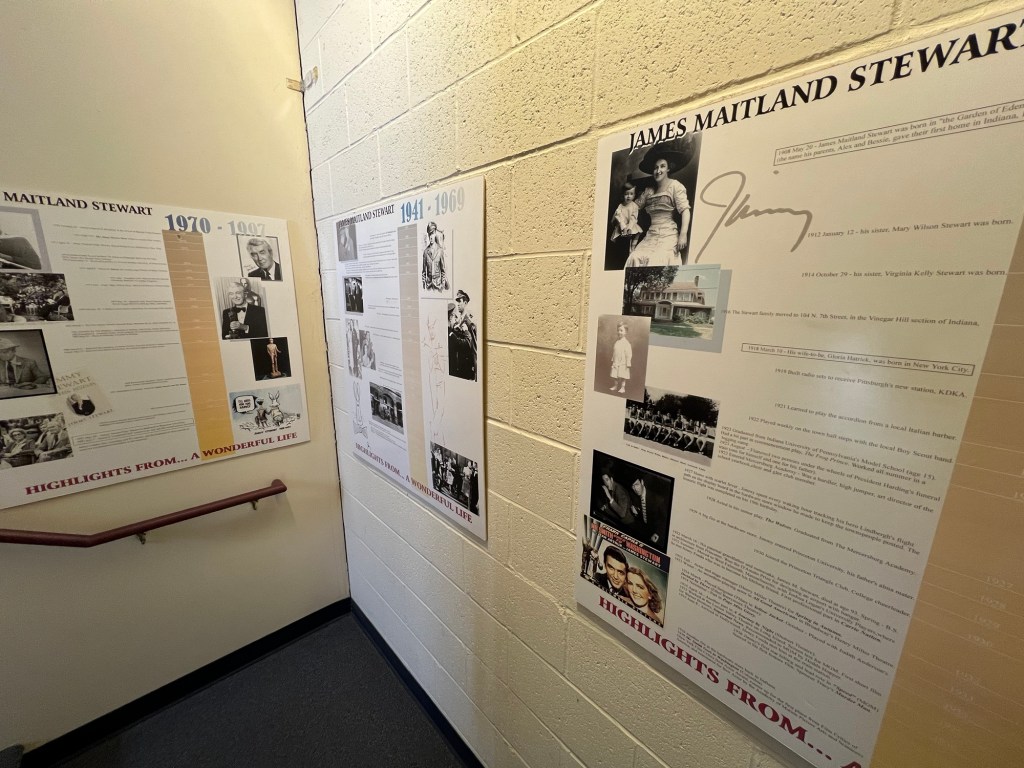
The timeline as you enter the museum.
The entrance to the museum:
The museum is a chronological story of not just Jimmy Stewart’s life and legacy but the contributions of his family going back almost five generations on both sides of his family.
The entrance to the museum.
The Stewart family on both his mother and father’s sides have been part of this part of Pennsylvania since the area was opened up during colonial times.
The Indiana Gallery:
The Indiana Gallery highlights the history of Jimmy Stewart’s hometown, Indiana, Pennsylvania along with Stewart’s early ancestors, a look at his early childhood, and his schooling through Princeton University. Highlights include a recreation of Stewart’s father Alex’s local hardware store, Jimmy’s Princeton jacket, and a life-size replica of the Jimmy Stewart statue (Museum website).
Both sides of the family participated in the Revolutionary War, the Civil War, the Mexican-American conflict and WWI and WWII including Jimmy Stewart’s contribution as a Navy pilot. His father and grandfather had been part of the business community owning a hardware business that spanned three generations until it closed in the 1960’s.
The Stewart family hardware store.
The family’s contribution to the Indiana business community was well noted. The Stewart’s “Big Warehouse” hardware store was prominent in Indiana for many years.
The family business
Jimmy Stewart’s Bedroom:
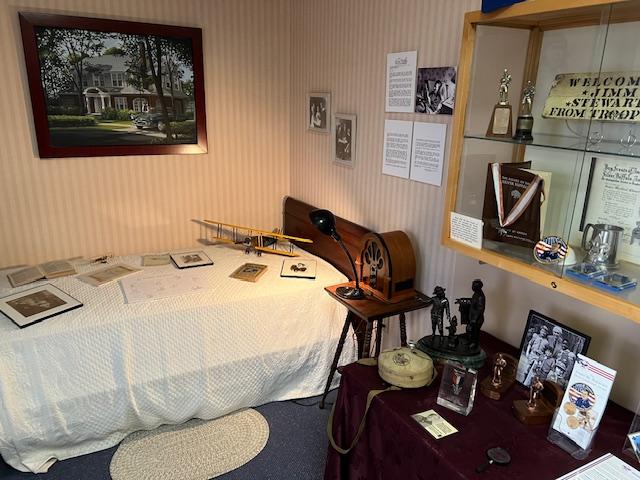
This gallery is a recreation of Jimmy’s boyhood bedroom from his home in Indiana, Pennsylvania. Jimmy’s boyhood bed is showcased along with family photos and his history with the Boy Scout of America. Another feature highlights Jimmy’s childhood hero, Charles Lindbergh, and his historic flight across the Atlantic Ocean. Highlights include his childhood bed, the Silver Buffalo Award from the BSA and an original painting of his childhood home (from the Museum website).
Jimmy Stewart’s boyhood bedroom.
The story of Jimmy Stewart starts here with his grandparents on both sides and their shaping of his future life. The museum continues with his life at Princeton University after his schooling in high school in Indiana, PA.
Jimmy Stewart’s college years at Princeton. Being recognized by the local fire department.
Jimmy Stewart’s college and post graduate years.
His Military Career:
The Military Gallery shines a light on the history of aviation and Jimmy’s early interest in flying. It continues with Stewart’s enlistment in WWII and showcases his highly decorated military career. There is also a special tribute to Stewart’s stepson who died in Vietnam. Highlights include 4 of his military uniforms, his military medals (including the Distinguished Flying Cross and the Croix de Guerre)(The Museum website).
Jimmy Stewart continued the long line of military service his family had served since the Revolutionary War and his step-son continued until his death in Vietnam.
The Military Gallery with many of Jimmy Stewart’s uniforms and awards and accolades.
Jimmy Stewart’s WWII uniforms
Awards and Military films that he was in plus pictures of his time in the armed forces.
The Hollywood Gallery:
The Hollywood Gallery wraps around our theatre and takes you through Stewart’s film career of over 80 films (1935-1991). Original movie posters, still pictures, costumes, props, movie summaries, and stories behind the scenes take you on a journey through the Golden Age of Hollywood and beyond. We shine the light on Stewarts’ collaborations with Frank Capra, Alfred Hitchcock, and westerns with Anthony Mann. The exhibit wraps up with a section featuring Stewart’s awards and accolades. Highlights include a western uniform and rifle from Winchester ’73, Stewart’s cowboy hat he wore in most of his westerns, the hat he wore in the movie Harvey and a plane propeller signed by the cast of Flight of the Phoenix and much more! (From the Museum website).
I had read on one of the signs that his family was not too sure what the Academy Award was and asked him to send it home so that he could display it in the store window which he promptly did. It was nice to see that he was humble enough to share this win with the community.
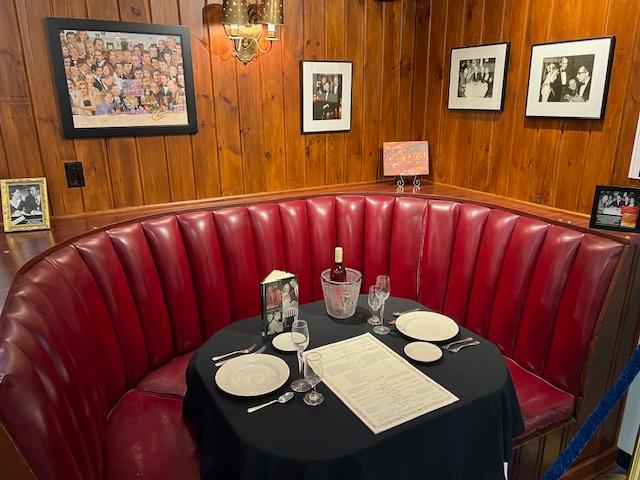
His booth at Chazen’s where he courted his wife and they frequently went to dinner.
The gallery of much deserved awards and accolades.
Movie posters of all of his films.
His Academy Award that he presented to his father who put it proudly in the family business window.
The display on the movie “Harvey”.
The trailer for “Harvey”.
Jimmy Stewart’s Office in California:
This gallery is a recreation of Jimmy Stewart’s office from his home in California. It includes Jimmy Stewart’s desk, grandfather clock, his tweed hat, office memorabilia, and family photos. Highlights include letters from Presidents Reagan, Bush, and Clinton, a personal letter from Frank Capra and his Autopen machine (from the Museum website).
Recreation of Jimmy Stewart’s office in California.
In the middle of the museum is a movie theater showing Mr. Stewart’s films during the day. When I was there they were showing “Dear Brigette”:
It was a fun film.
The Movie Theater:
The museum has a 50-seat vintage theater that shows a matinee movie every day at 1:00 pm. The movie that’s shown changes each week and showcases the over 80 films that Jimmy Stewart starred in. More classic movie posters adorn the walls of the theater and Jimmy Stewart biographies are available to be viewed upon request. Highlights include the screening of It’s A Wonderful Life from mid-November through December and the showing of all 4 Alfred Hitchcock/Jimmy Stewart films throughout the month of October (from the Museum website).
The museum is a tribute not just to a movie star but to someone who lived a life well lived. Jimmy Stewart’s contributions were more than just movies. It was a citizen who got involved and tried to make things better. The museum takes us through his world. It may have not been perfect but it was a life that many of us would like to live.
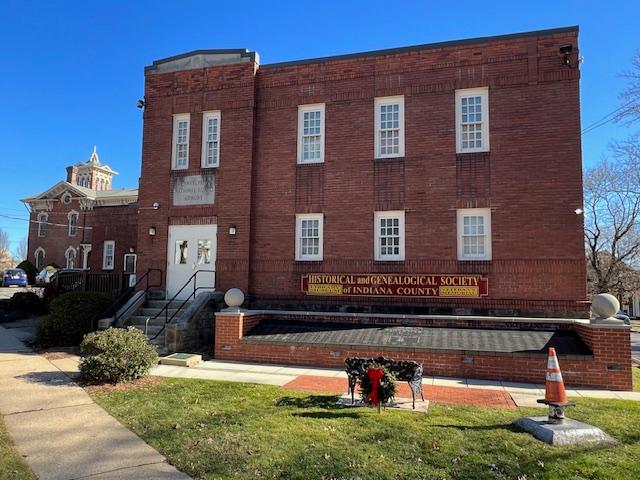
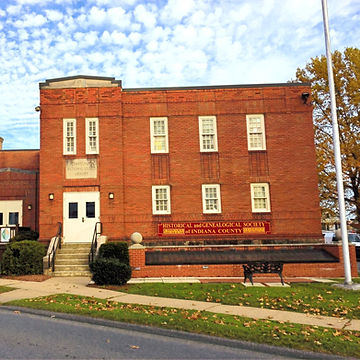
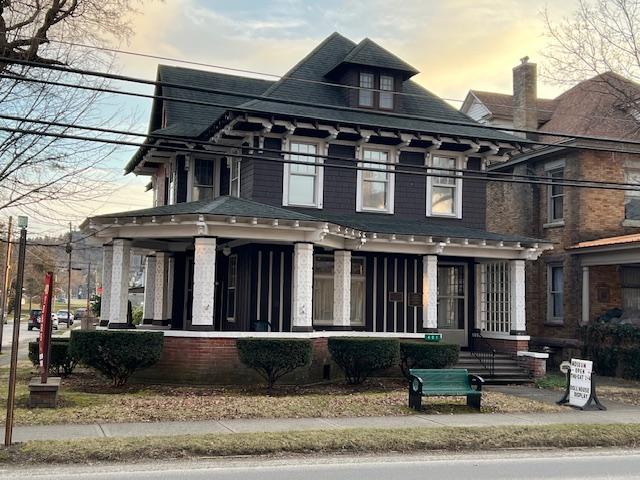
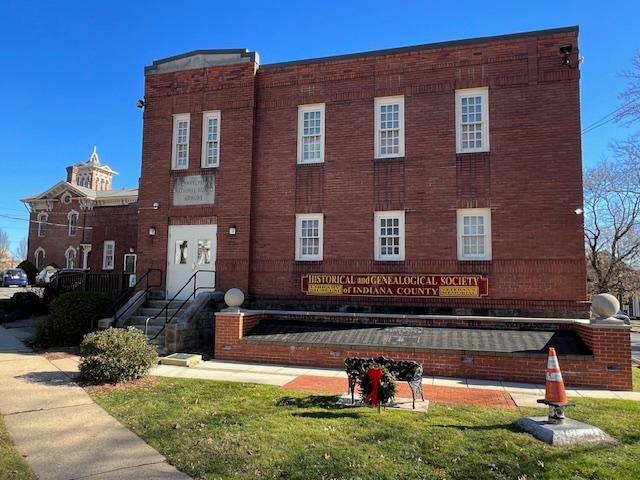
The Lattimer Mansion at 401 West Mahoning Street, home to the main collection.The sign welcoming you to the Society.
The Bennis Mansion across the street at 404 West Mahoning Street houses the furnishings, household items and dollhouse displays.
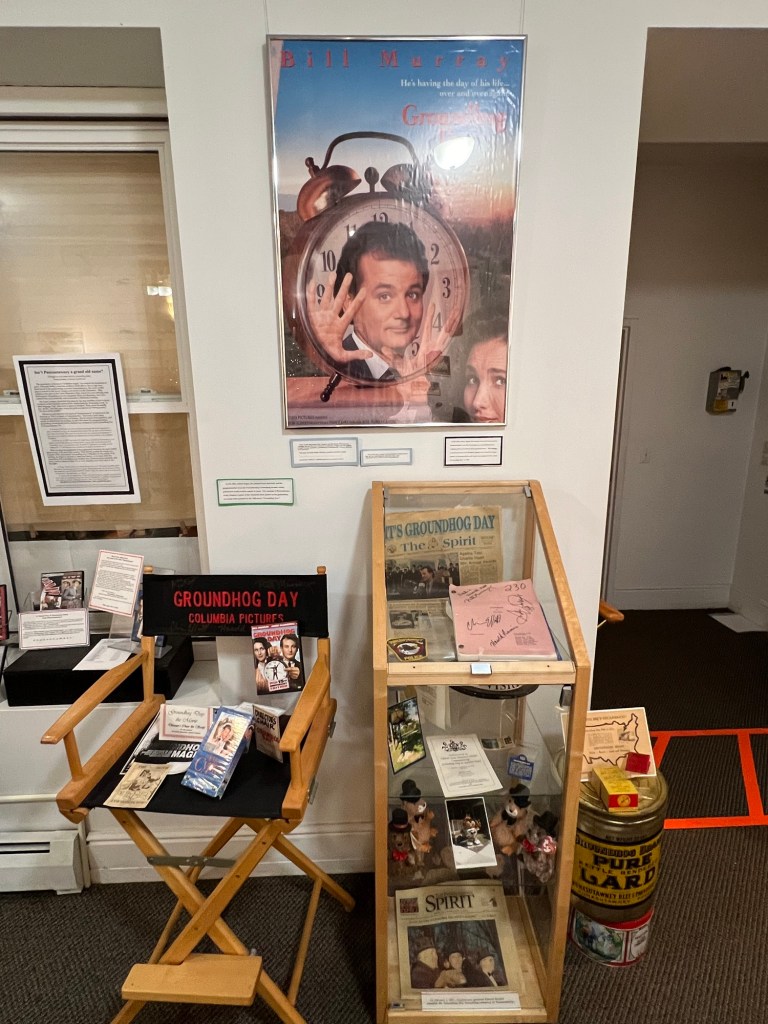
It had been eight years since I had visited the historical society and the organization has created a lot of interesting displays. The museum was busy during the Groundhog’s Day celebrations and there was a lot to see and do. They have an interesting display on the history of the movie “Groundhog’s Day” including a original script from the film. Since the film is being shown in establishments all over town, it is fascinating what the society was able to collect from the filmmakers over the years. They also have the history of the Groundhog’s Club as well and their development over the years.
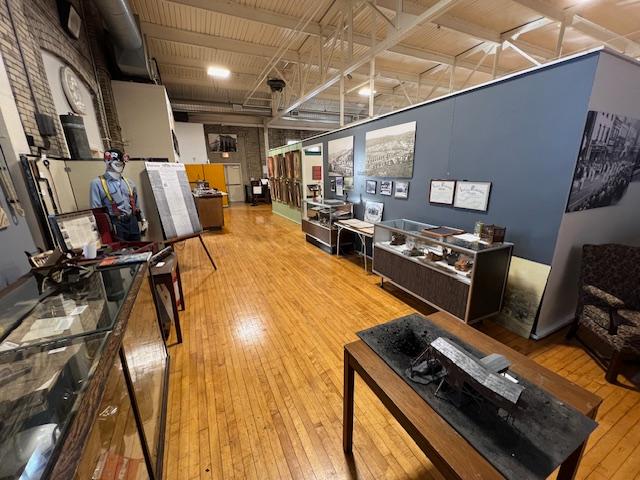
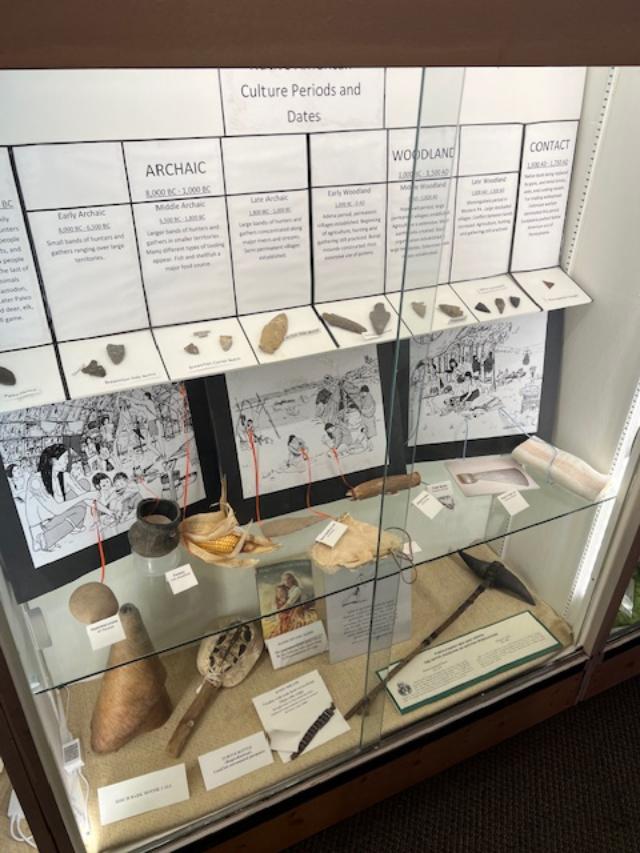
The Native American and Coal Mining displays show the development of the area along the old Indian trails and how it gained it population and wealth due to the mines. When the mines closed after the war, the fortunes of the area changed. The Groundhogs Festivities have really brought this back.
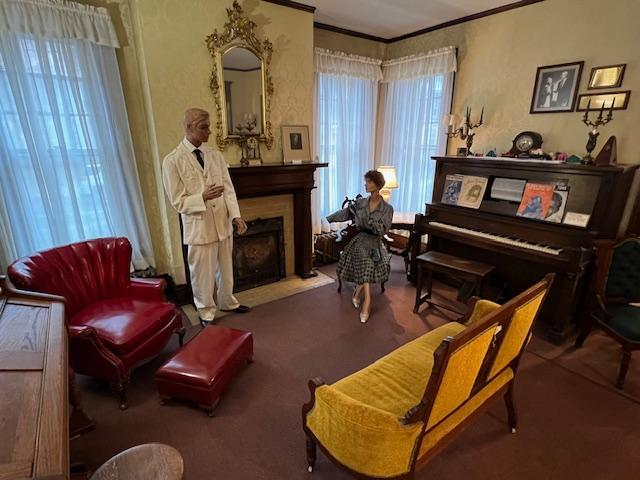
The Bennis Mansion across the street shows life in Victorian times to a once wealthy and prominent family in Punxsutawney. Each room is decorated with period furnishings and decorations. There is also a Dollhouse Exhibit going on from December 2023 through February 2024.
The Founding of the Museum (from the Society website):
The Society was begun in 1978 with the primary purpose of preserving the history of the Punxsutawney Area.
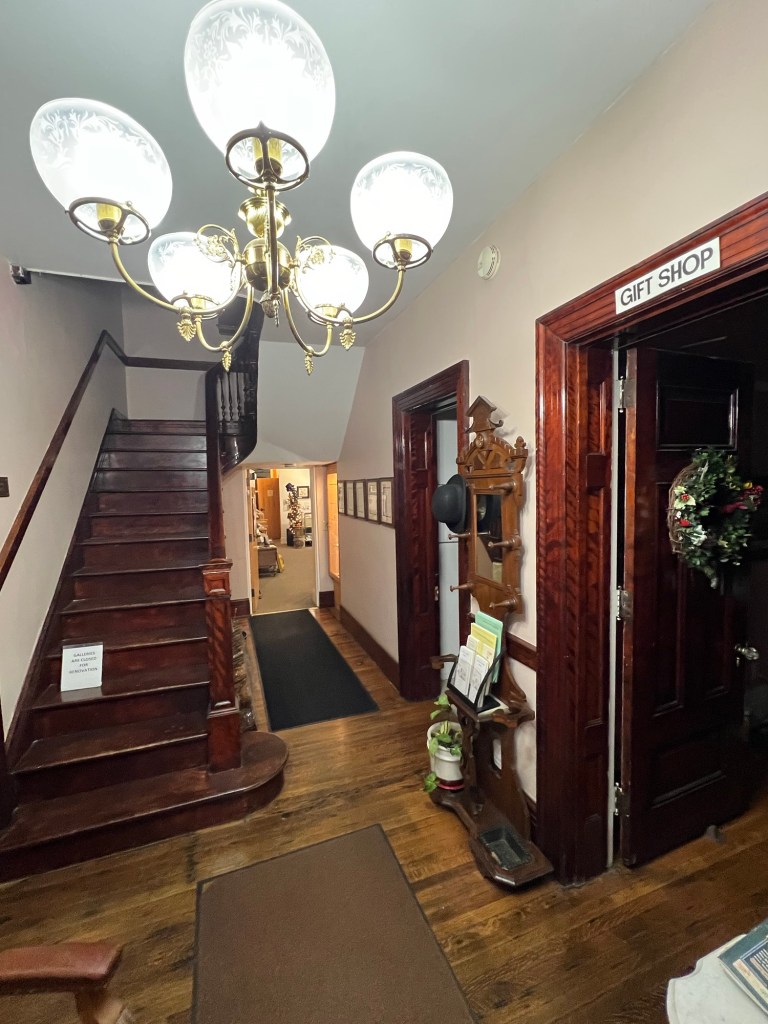
The entrance to the Lattimer Mansion and entrance to the museum.
The Mission of the Society (from the Society website):
The purpose of the Society shall be to receive, collect and preserve the historical and genealogical records and artifacts of the area; to maintain a library and museum for their perpetuation and care; to encourage the preservation and restoration of material things and places that are of historical significance to the area; to exhibit artifacts of historical, genealogical and cultural value; to educate persons about subjects of historical, genealogical and cultural significance.
The Main Gallery:
The history of the town, its businesses and the people who live here.
The main gallery entrance of the museum.
The Front Gallery Groundhog Club history.
History of the Historical Society (The HGSP website):
The Punxsutawney Area Historical and Genealogical Society has an extensive museum complex. There are many rooms full of historical artifacts from the area which include displays of:
Native American history and artifacts
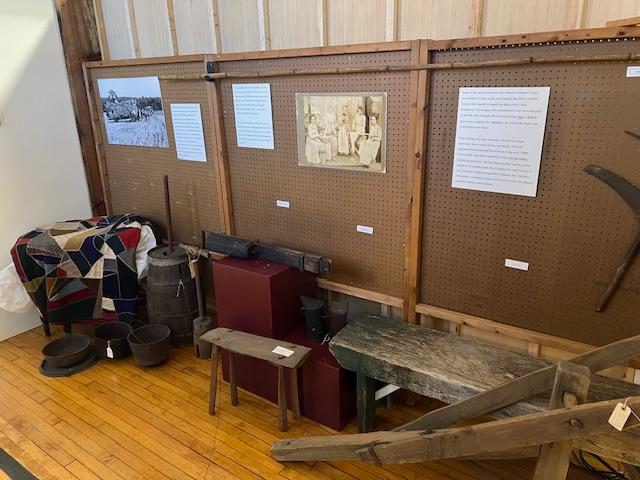
early settler tools and utensils
regional lumbering history
area coal mining and coke production history
local railroading history
quilts, clothing and decorative arts from Punxsutawney’s “Early Days” through the “Boomtown” era to our recent past
uniforms and artifacts documenting military, public and community service history
radios and early televisions
photographic documentation of the region’s history
Punxsutawney Groundhog Day history
old photographs
old postcards
Exhibits in the Griffiths’ Galleries of the Lattimer House include: “Punxsutawney Area Legacy of Artists & Artisans” which tells the history of the region through the eyes of past photographers, painters and illustrators, sculptors and crafters.
The founding of the Groundhog’s Club.
Groundhogs Day uniform for its members.
Displays in the Bennis House highlight other area artists, past and present, as well as the varied ethnic background which helped form our community.
The Bennis House Living Room display
The founding of the town displays.
The Founders Display
The Founding of the town.
Snyder Hill Schoolhouse
The Snyder Hill Schoolhouse is located on Snyder Hill just south of town. It is a restored country schoolhouse.
The Snyder School was typical of the one- or two-room country schools used years ago. From 1886 to 1959 (73 years) the school provided education for hundreds of children, many of them living today. It was the sole means of education for most of our rural population.
A one-room school consisted of eight grades and one teacher willing to accept hard and trying work. Usually overworked, the teacher undertook to teach as many thirty or more pupils in the eight grades. Younger children learned from older children, as in a large family.
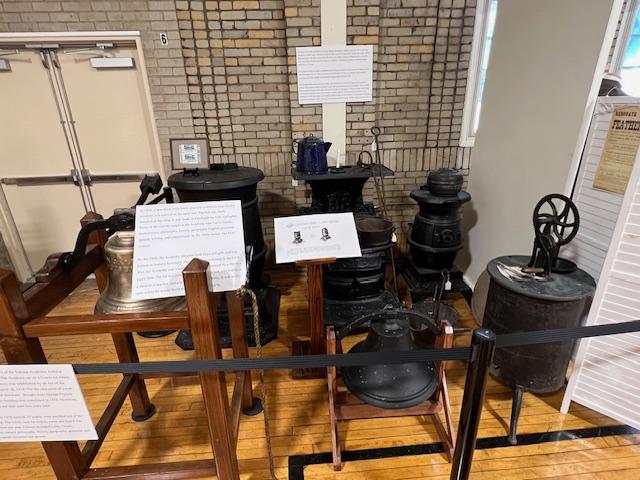
The Snyder Hill Schoolhouse has been restored with old desks, books and other materials that were used during the time this type of school existed. Snyder Hill Schoolhouse is surrounded by woods and rolling farm land. Your first steps inside are on hardwood floors. The only source of heat was a large pot-bellied stove that was once covered in the winter with little mittens being dried by the fire. The boys and girls each had their own separate cloakroom on either side of the main entrance. Chalk boards with the day’s lessons lined the front wall behind the teacher’s desk; all of this can be experienced during your visit. The school is open by appointment for individuals or tours.
The history of the movie “Groundhog’s Day”:
Posters and script from the film.
The script from the film.
The film was not shot here but in Woodstock, IN. Only some of the travel shots as you are entering town made the film.
The making of the film “Groundhogs Day”.
The 2024 reunion in Chicago for “Harold Ramis Day” in Chicago.
The town history:
The history of Groundhog’s Day in Punxsutawney, PA
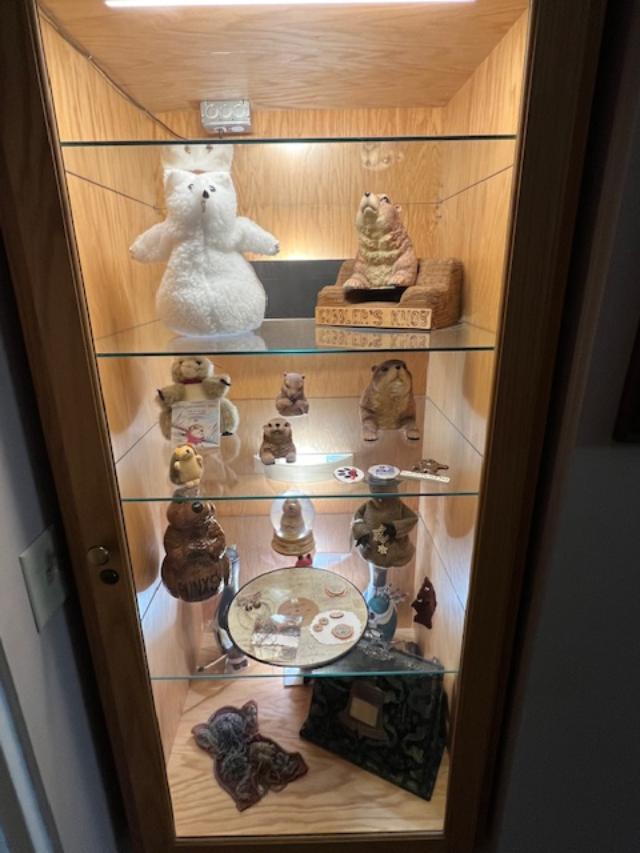
The Groundhog Display.
History of the Native Americans in the area (Society website):
Punxsutawney’s Groundhog legend pre-dates the area’s first white settlers. The first inhabitants of the area, the Delaware Indians, shared in the Punxsutawney “Groundhog” roots with their own Indian version of “legend and lore.”
The Native American display at the museum.
Punxsutawney was originally a campsite halfway between the Allegheny and Susquehanna rivers. It is located on the earliest known trail to the East, the Shamokin path. The area was, at times, occupied by Shawnee or Delaware Indians and, sometimes, by Senecas or Iroquois.
According to the original “Creation” Story of the Delaware Indians, the “Lenni Lenape” (or original people), who were their forebears, began life as animals in “mother earth” and emerged centuries later to hunt and live as men. Thus it was that Oijik (Wejak), or Wojak, which was carried over to us as “‘Woodchuck”, came to be recognized as the “grandfather” of the earliest known inhabitants of this area.
The Native American display at the museum.
Although the area previously served as a “border” between Indian nations, the displaced Delawares settled in large numbers about 1723 because of the pressures from white men in the East and Iroquois intrigue. The main move toward the west followed between l740 and l760 as the result of further pressure.
It was during this period that an lndian sorcerer first appeared in various forms and attacked travelers from the East. He was hunted and killed in combat by a young chief. His body was burned to destroy the “evil medicine” but miraculously turned to searing sandflies, or “ponksad,” which plagued the area and the Indians. From that time the Indians called the location, ” Ponksaduteney,” which meant the “town of the sandflies.” The sandflies are now gone, but the “ghost of the spelling” is with us to stay.
The Native American display at the museum is quite extensive. There are many interesting artifacts.
The displays at the Museum:
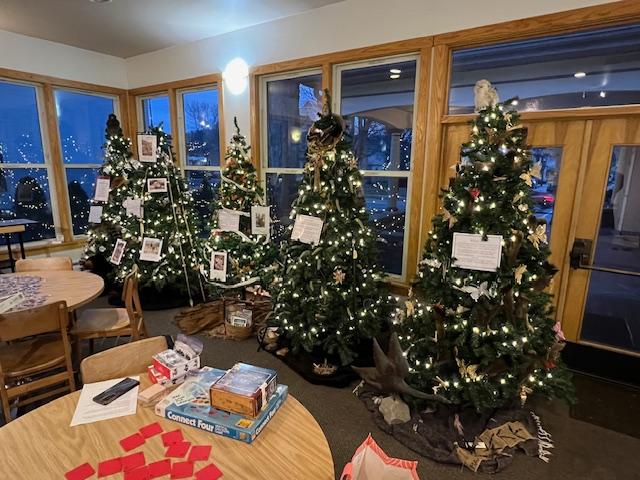
As part of the Christmas celebration in 2023 and held over for Groundhog’s Day is the Native American Christmas tree display. The theme was dedicated to the Native Americans from the area.
The Christmas tree display dedicated to the Native Americans.
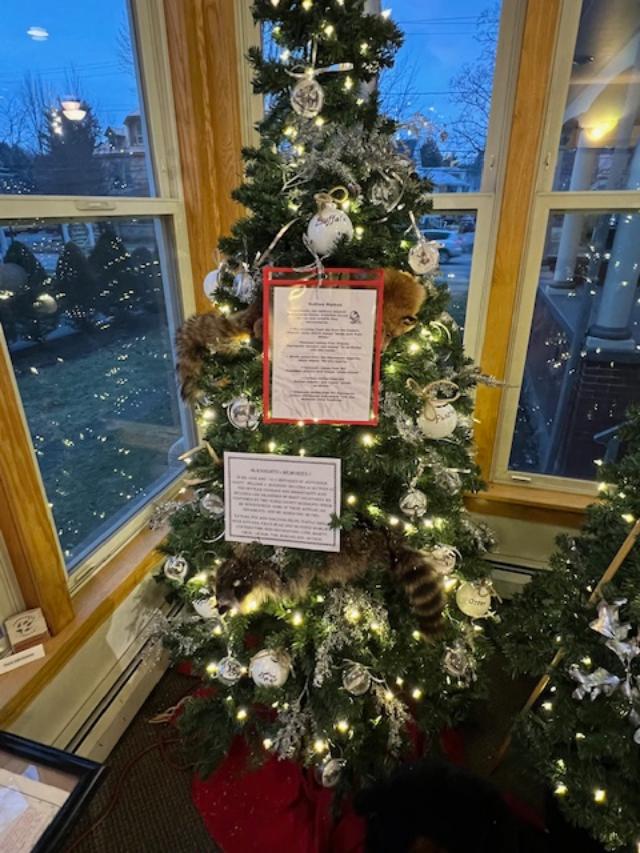
The beautiful decorations on the tree.
The sign describing the tree and its decorations.
Across the street at the Bennis House, the museum had a display of Dollhouses and the different houses that had been donated over the years to the museum.
The history of the Bennis House (from the Society pamphlet on the Bennis House history):
Edward C. McKibbon, secretary of the Punxsutawany Iron Works, purchased this town lot from the James E. Mitchell estate in 1901. T.E. Bennis purchased the McKibben property located on the corner of West Mahoning Street and Morrison Avenue in 1918. Members of the T.E. Bennis family occupied the house until 1982. In 1902, Mr. McKibbon contracted with E.J. Lawrence to build the house, which he first occupied in 1903.
The Bennis House display of the Log Cabin made with Lincoln Logs. In the cases are collections of china patterns over the years. In the Parlor are a portrait of Jefferson County Judge William P. Jenks, son Punxsutawney’s of first settlers, John and Mary Barclay Jenks. The dress from 1866 was worn by Mary Rebecca Jenks, the daughter of Judge William P. and Sarah C. Jenks.
The family china in the displays.
The Gingerbread House in the Parlor on the first floor.
The Bennis House Living Room on the first floor.
Dorothy Bennis Cooney, the youngest daughter, donated the house and property to the Punxsutawney Area Historical & Genealogical Society in 1982. The house has served as a place to display artifacts of Punxsutawney’s history since that time. The house is designed in a “Craftsman Style” with a Swiss influnence. When the Society received the house, the previous owner advised that it had been designed by a “Famous New York Architect”. (PHS Society)
On display in the entry-way is a unique piece of furniture which accommodated the need of visitors for a place to hang hats and coats and to store items.
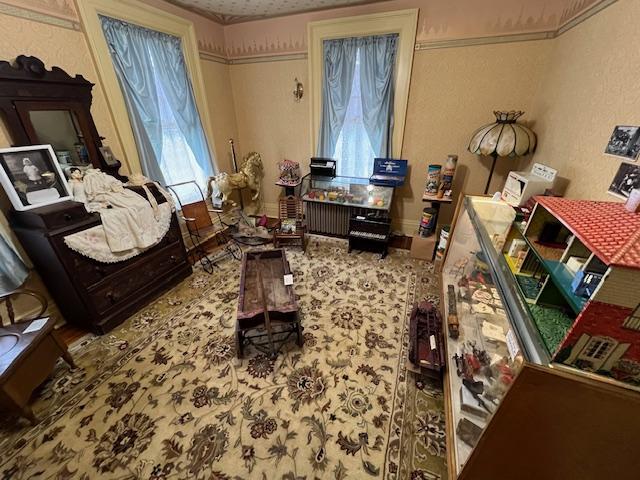
The Second floor of the Bennis House has a wonderful display of Children’s Toys.
The Children’s Room with the display of the Fisher Price Doll House. The toys range from the 1850’s through the 1960’s.
The Toy display on the second floor.
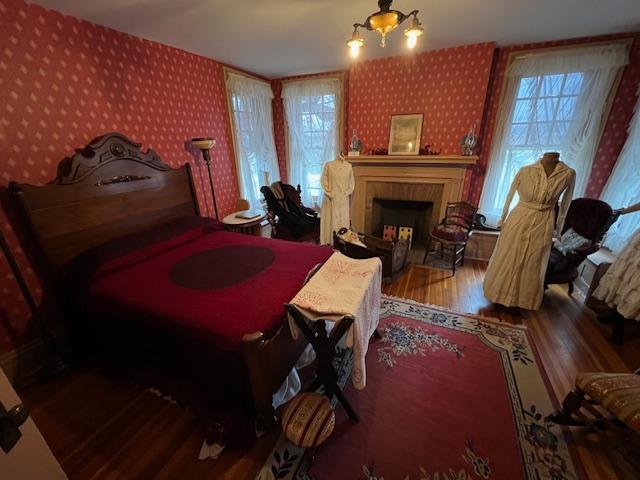
The Bennis House second floor bedroom.
The Military Room on the second floor has all sorts of interesting uniforms on display.
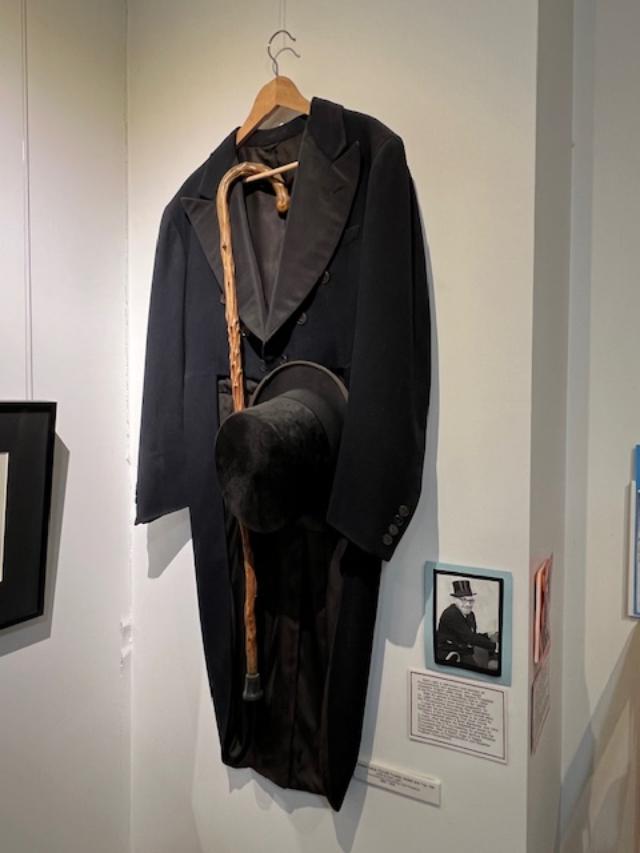
The upstairs room dedicated to religious artifacts and furnishings.
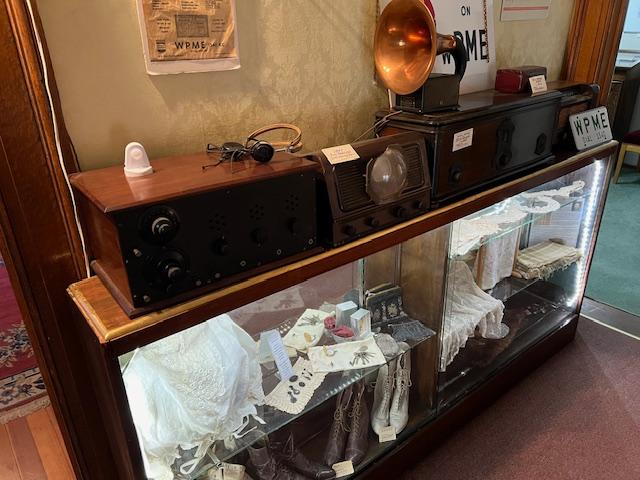
The clothing and Electronics display on the second floor. These items range from the 1850’s to 1930.
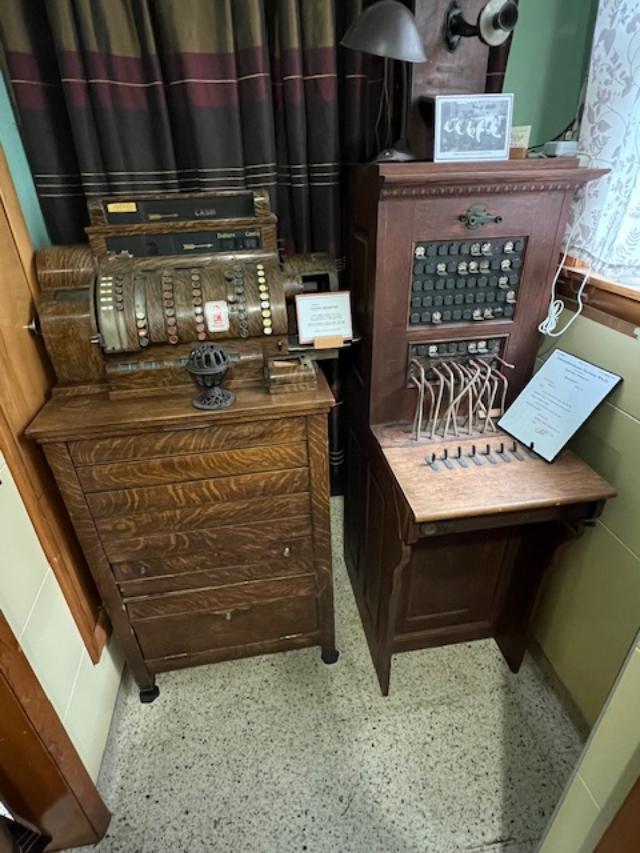
The Cash Register and switchboard machine on the second floor. The cash register was originally used in Loeb’s Store and last used in Harl’s Shoe Store. The switchboard operation was from Punxsutawney.
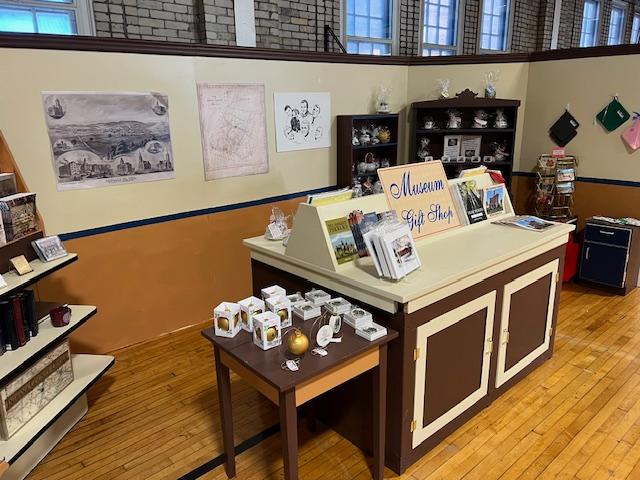
After the tour is over, you have to visit their gift shop in the Lattimer House.
The two homes house an interesting display of life in Punxsutawney over the years and the artifacts represent life from the early 1800’s to the 1960’s. If you are interested in more than the history of Groundhog’s Day, the society offers that and so much more.
The entrance to Gobbler’s Knob when you arrive in the morning.
“Are you off to see the Groundhog?” is a famous line in the movie “Groundhog’s Day”. The one thing is that the scene in the movie was shot in the square of Woodstock, ID. The real Gobbler’s Knob is located in Punxsutawney, PA, the real home of Phil.
The welcome sign to Gobblers Knob.
Located just outside the downtown (ironically behind a Walmart; talk about progress), Gobblers Knob is located in what was once woods in the back of town has become an open field with a stage, Visitors Center and gift shop. Every years thousands of people flock to this small town literally in the middle of Pennsylvania to see the Groundhog’s Day Festival.
Taking the bus to Gobblers Knob on Groundhog’s Day morning.
Gobbler’ Knob is the famous home of the “Groundhogs Day” festival and swells into a crowd of more than thirty thousand people from all over the world. It is an incredible event to join in.
I attended the festivities here twice. Once in 2016 and again in 2024 and I have to say that it is something you have to do once in your life just to experience the excitement of the morning that Phil sees his shadow.
Arriving in the morning for the prediction.
The signs were out and lit for the prediction. No one knew how Phil would react. Would he see his shadow or not?
They emphasize both predictions.
The History of Groundhog’s Day (From the Groundhog’s Club website):
The Christian religious holiday of Candlemas Day has become most commonly associated with the current celebration, but it’s roots are older than that. The celebration started in Christianity as the day, (February 2nd), when Christians would take their candles to the church to have them blessed. This, they felt, would bring blessings to their household for the remaining winter.
As time rolled on the day evolved into another form. The following English folk song highlights the transition to weather prognostication.
If Candlemas be fair and bright, Come, Winter, have another flight; If Candlemas brings clouds and rain, Go Winter, and come not again.
This “interpretation” of Candlemas Day became the norm for most of Europe. As you can read, there is no mention of an animal of any kind in the preceding song. It wasn’t until this traditional belief was introduced to Germany that an animal was introduced into the lore, hence another evolution of February 2nd. If, according to German lore, the hedgehog saw his shadow on Candlemas Day there would be a “Second Winter” or 6 more weeks of bad weather. As German settlers came to what is now the United States, so too came their traditions and folklore. With the absence of hedgehogs in the United States, a similar hibernating animal was chosen. This leads us to yet another evolution in the legend and to present day Punxsutawney.
In Punxsutawney, 1886 marked the first time that Groundhog Day appeared in the local newspaper. The following year brought the first official trek to Gobbler’s Knob. Each year since then has seen a steady increase in participation of the celebration from people all over the world.
When the knob is full that morning you can feel the excitement of the crowd. From three in the morning until Phil comes out to make his prediction, there are all sorts of bands, comedians and singers to entertain the crowds all morning.
The main stage in the distance.
The crowds get bigger as the morning gets later, most arriving before 6:00am.
The singers entertaining the crowds.
The stage was always filled with entertainment acts.
The entertainment for the evening until the top hats arrive and the fun begins. First they are the introductions of the VIPs, like the Governor of Pennsylvania showed up as well as all the other politicians to follow him.
The governor of Pennsylvania talking to the crowd.
Then the camera’s arrive and it time for the prediction. Will it be an early Spring or will Winter keep going.
It’s time to start the show.
The arrival of the Punxsutawney Groundhog’s Club starts the program.
Phil did not see his shadow in 2024. Spring is on its way!
On the day after Groundhog’s Day, I went back to Gobblers Knob to visit it when it wasn’t so chaotic and crowded. It can magical in its own way in that you see the field and knob empty and realize that people all over the world watch the activities here every February 2nd. It is fascinating to just think about.
The entrance to Gobblers Knob the Saturday after Groundhog’s Day 2024.
The history of the site.
The historical marker of the site.
The stage area when it is quiet.
The end of the ceremony on Groundhog’s Day people were still milling around.
Gobbler’s Knob from the stage area.
The entrance display to the field.
The field when things were quiet after the event the next day.
Groundhogs Day in Punxsutawney, PA is a real experience that you should experience once. To sit out in the field with thousands of others to celebrate the day is a lot of fun. Until next year.