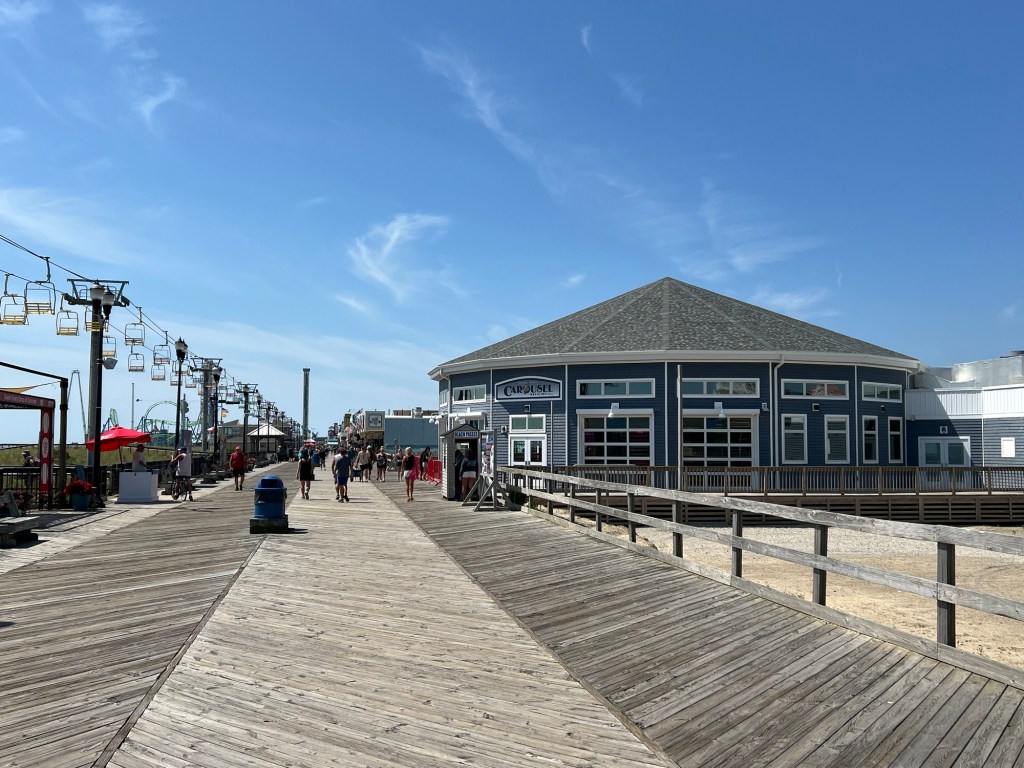
The Seaside Heights Historical Society at 1400 Boardwalk in Seaside Heights, NJ
The Carousel Pavilion and Museum sign
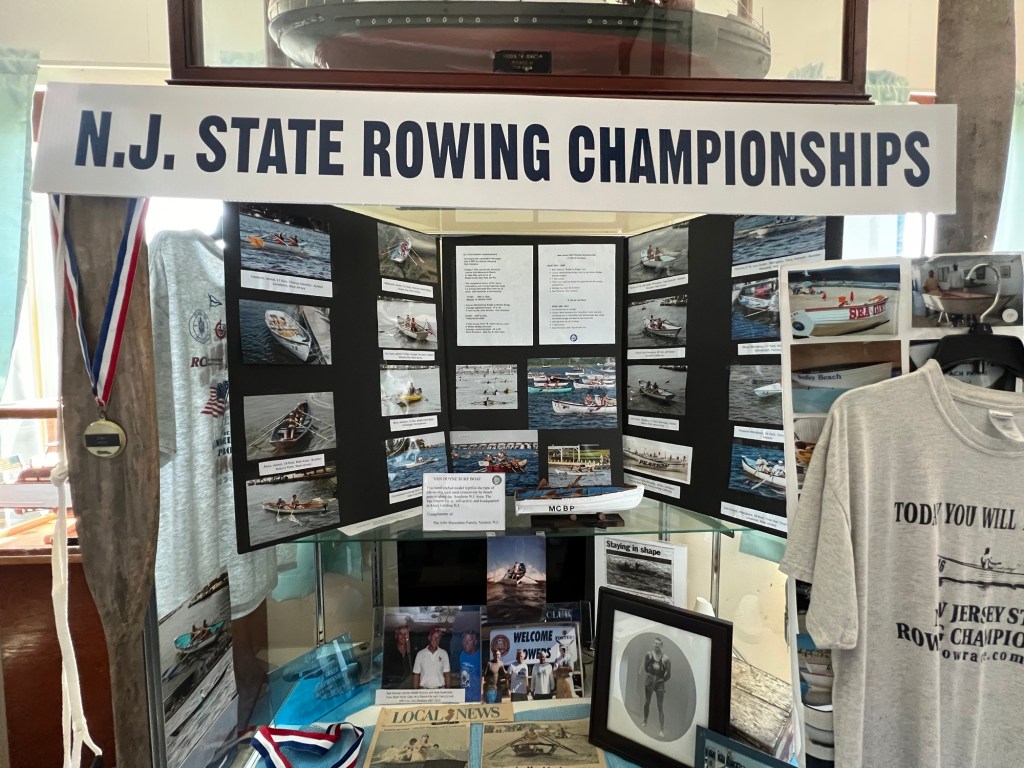
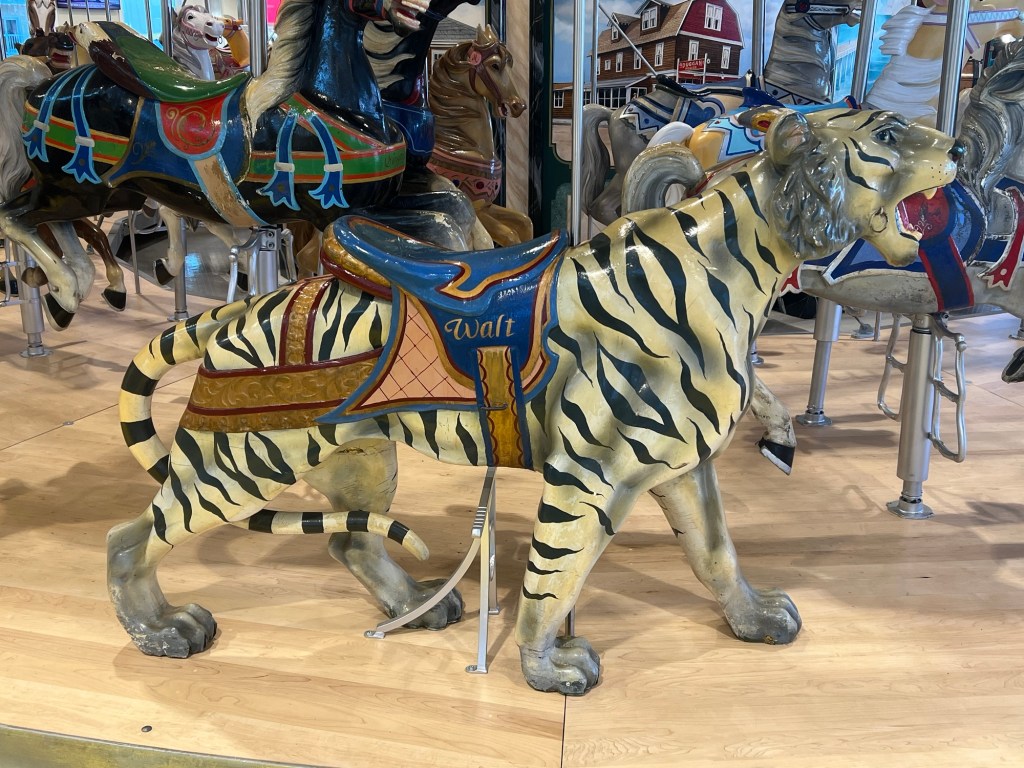
The new Seaside Heights Historical Society Museum features this recently restored carousel and many small displays surrounding the walls of the building. This will grow in the future.
The historic Seaside Heights Carousel lovingly restored by the Society
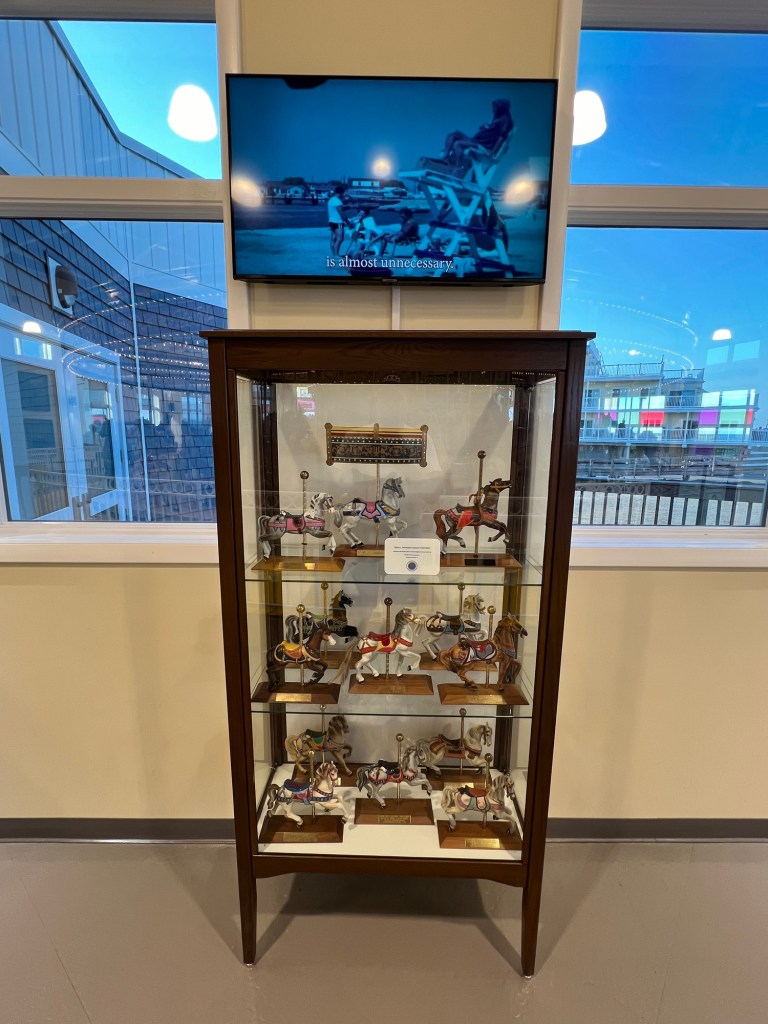
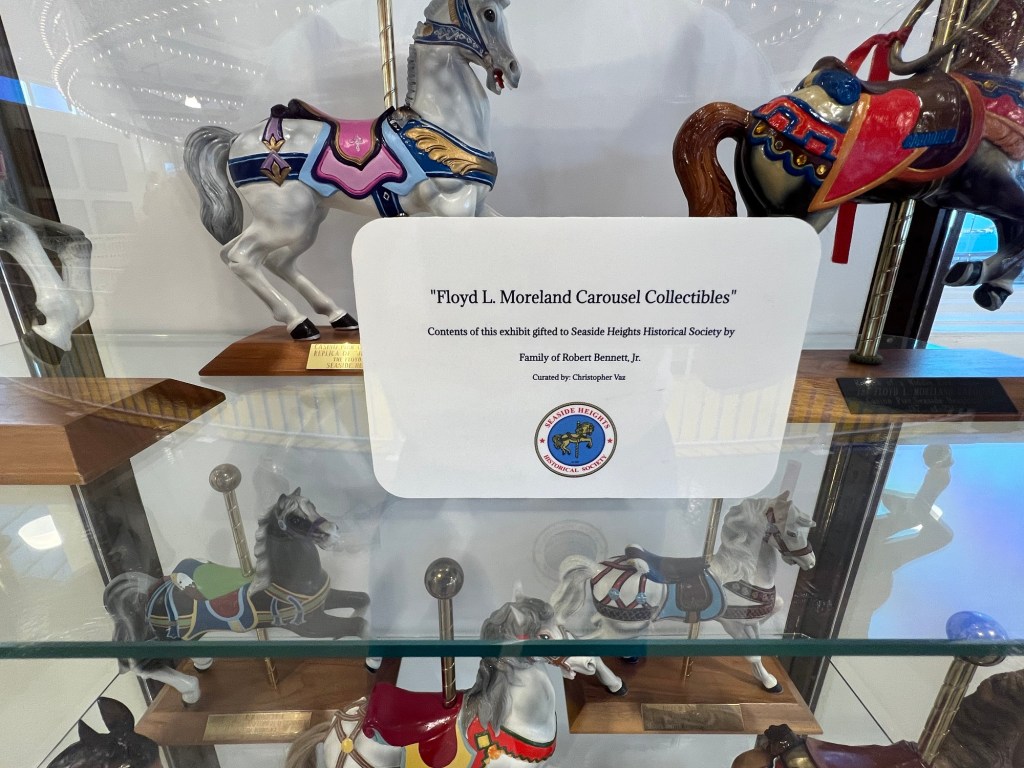
The inside of has a couple of small displays which will be expanded on in the future. Dr. Moreland’s collection of carousel horses were on display in two cases around the building.
Dr. Moreland’s display of carousel horses
The display sign
On display also above this display were vintage videos of days at the Seaside Heights Beach. These videos show people enjoying themselves at the shore.
The other display case of carousel horses
There was also a display on panels from the carousel that could not be repaired but were so beautiful that they were mounted to see the before and after pictures.
Some of the original panels from the carousel
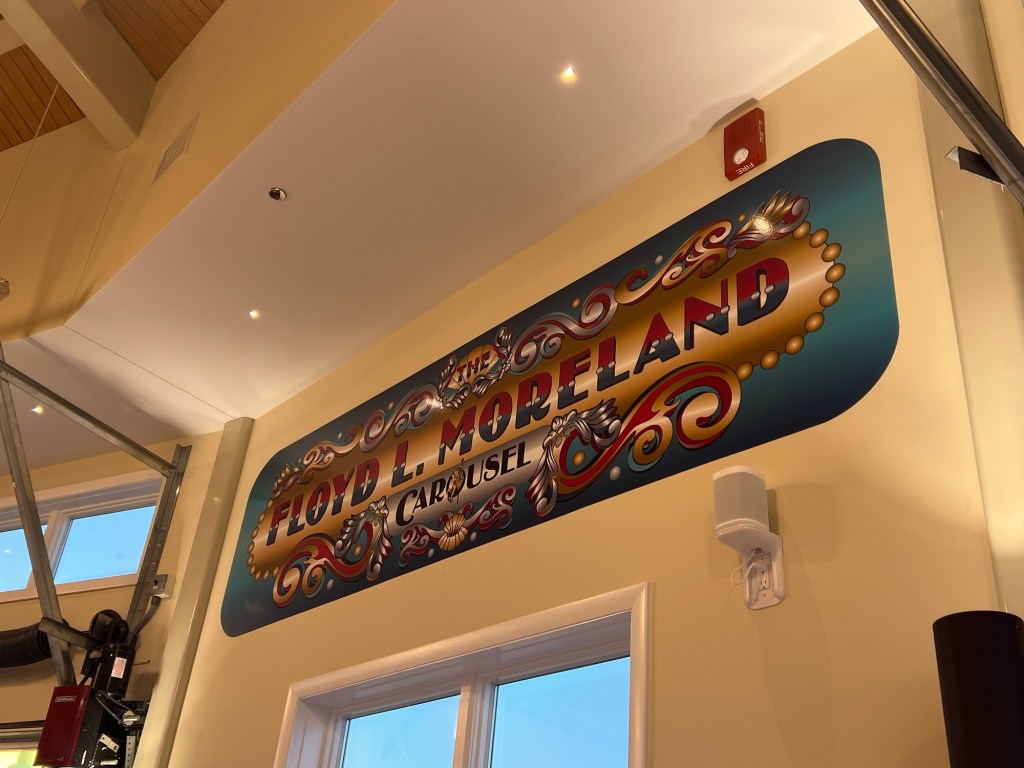
The plaque dedicated to Dr. Floyd L. Moreland
When I was talking with one of the volunteers who was assisting with the carousel that evening, he told me there will be more displays of artifacts from this beach community in the future. So there is more to look forward to in the coming year.
The carousel before the start of the ride
For right now this museum has a wonderful display of carousel horses and a short history of the town. You can also take a three minute ride on the beautiful carousel listening to the entertaining music. It will be an evening of returning to your childhood.
This is a great start to a wonderful museum.
The new displays:
Postcards from Seaside Heights
Historic City Map Sign
Historic Hodge Podge sign:
City Map and Hodge Podge artifacts in the collection’s back room
The new Seaside Heights Historical Society Museum sign:
The new Museum sign outside the museum
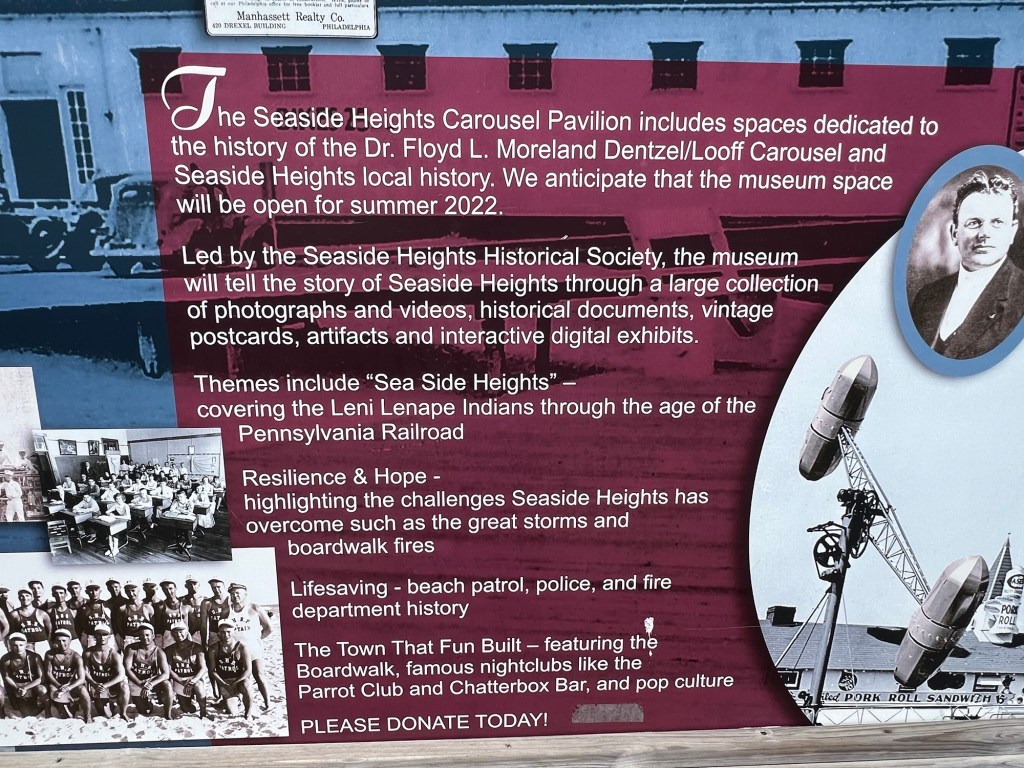
The upcoming highlights of the new museum
The historic pictures of life at the Seaside Heights Beach
The view of the museum from the end of the boardwalk
The front of the Red Brick Schoolhouse Museum/Chatham Township Historical Society at 24 Southern Boulevard
The historical sign of the Mount Vernon School
The museum sign that welcomes you to the museum
The Mission Statement of the Museum:
(from the museum website)
The Historical Society of the Township of Chatham was established to increase the knowledge, awareness and preservation of the Township of Chatham history.
I visiting the Red Schoolhouse Museum on the first Sunday of the month and found a delightful little museum filled with artifacts that represent life in Chatham during various times in the town’s history. The museum has two floors with displays telling the history of the Township of Chatham from the beginnings with the Lenape Tribe living in the area to modern times.
The Museum gallery
On the first floor there is the special exhibitions that rotate in the museum. Some of the themes of the exhibitions were Children’s Toys and Playthings through the ages, Wedding gowns and formal wear and Revolutionary War items. The museum also has an interesting exhibition on the Lenape Indians who lived in this region before the Dutch arrived.
Wedding Gowns and Formal Wear exhibition on the first floor
Dressmaking and Sewing in the home and in business
Children’s Toys and Playthings through the ages
Children’s dolls and stuffed animals
The Train display of electric antique items
Revolutionary War and Trade items on the top shelf and historical cameras
The second floor has displays that tell different stories. The display cases have Native American artifacts, farming equipment, household items, pictures of the town at different stages of development, the community changes from a farming to business with the advent of the railroad. Here you see the changes in household items as time goes on.
The Lenape Display
Native American stone objects
The Arrowhead collection
Each display tells an interesting story of the Township of Chatham. Looking over how the towns in the area developed I didn’t even know there was a Village of Chatham and a Township of Chatham. I was also impressed with their toy collection which should be a conversation piece to any group of elementary school students. I think this would be interesting to seniors as well on times have changed since they were children. The museum really has something for everyone. All different stories are being told at this museum and the collection continues to grow when residents pasts become part of the museum’s future.
The display on resident Reverend Samuel Tuttle
The Statement of Purpose:
(from the museum website)
The Historical Society of the Township of Chatham, a volunteer, not-for-profit organization founded in 1975, is dedicated to increasing knowledge, awareness and preservation of our town’s unique historical heritage. We maintain the Red Brick Schoolhouse Museum where we coordinate our educational programs, research, and preservation advocacy as well as manage the discovery, collection, and conservation of materials that illustrate the history of the area prior to and after European settlement.
Artifacts from one of the museum’s historic digs
The audience served by the Society’s programs includes members of the Society, residents, students and visitors to the community, scholars, the public in general as well as businesses and governmental agencies in the area.
The display of the history of the Red Brick Schoolhouse
The Schoolhouse and Native American collections
The Society carries out a broad range of activities. It oversees the Red Brick Schoolhouse Museum and library; mounts permanent, temporary, and traveling exhibits; coordinates education programs with local schools; and sponsors a public lecture series. In addition, the Society publishes pertinent materials related to local history; acquires, preserves and curates the Society’s collections and archival materials; and researches the history of the Township of Chatham and its environs. Further, it allows access to the Society’s store of knowledge as far as may be feasible to all who wish to examine or study it; supports a historic marker program; cooperates with other local historical societies and organizations; and uses electronic media to awaken public interest.
Historic artifacts at the museum
About the Museum:
(from the museum website)
The Red Brick Schoolhouse was built in 1860 and used until 1928 when the town’s five rural schools were replaced by the Southern Boulevard School. The schoolhouse was deeded to the town and, for many years, was used as the Town Hall. When the town offices were relocated in 1988, the building was put into the charge of the Historical Society for use as a museum.
The display semi professional baseball and town development
The museum has a permanent exhibit on the second floor which is arranged according to the town’s original school districts. Each district highlights, not only that school, but also the industries, farming activities, and the people who lived in each district.
The objects reflecting different times in the town’s history
The first floor is a large meeting room where our lecture series is presented. The room contains a number of displays as well, including antique toys, food preparation equipment, dresses, and various locally manufactured items.
The Museum Collections:
(from the museum website)
Oral Histories: Beginning in the late 1970s, members of the Society began recording oral histories by the elder residents of the Township. About 75 have been collected thus far in this ongoing project.
The Great Swamp display
Books: The Society has numerous books, old and recent, concerning the history of New Jersey, Morris County, Chatham Township, and the surrounding area. Books can be used only at the museum.
Documents: Various town documents including poll books, road district records, tax records, among others, dating from as early as the 1840s are available upon request for study at the museum.
Artifacts from the dairy farms, the local community and pictures of the schools
Artifacts: The museum is full of a wide spectrum of artifacts that reflect life in the Township throughout its history.
The schoolhouse and electronic display near the staircase
Photographs: The Society has a large collection of original and scanned photographs of the activities, places, and people of the Township. Early images provide a window into the Township’s past. More recent images are forming the record for the next generation of history-lovers.
The Schwartz Dairy Farm pictures
Articles from the Schwartz Family Dairy Farm, one of the former businesses of town
Maps: The Society has a number of old maps of Chatham and the immediate area, which can be viewed at the museum.
The changes in the town and its development over the years
Archeological Artifacts: In 1983-84, members of the Society undertook an archeological dig at the site of the Nathaniel Bonnel V House. The house, on River Road, was built in 1756 and burned in 1940, then the land was abandoned. When a condominium development was planned for the area, the Society was granted permission for the dig. Artifacts found during the archeologist-guided excavation are displayed in the museum.
The Bonnel House archeological dig
There is something for everyone to see at the museum.
I took a trip to a well known to the well known beach community of Point Pleasant Beach to see what other activities were available rather than just spending time at the Boardwalk. After about an hour there, there was not much else to see or do. I found it in the Point Pleasant Historical Society Museum, a small gallery that is a treasure trove of artifacts and information on the history of the town. The collection may be small but it is packed with interesting tidbits of the history of this shore town and its development from a small fishing and farming community to the well known resort town that it is today.
The gallery is located in the back of City Hall just off the main downtown area a few blocks away. It may seem unassuming but there is a lot to look at the museum. On top of the local amusement industry and the development of the Jenkinson Boardwalk and Aquarium, there was the growth of the town of local businesses that contributed to the direction that the town is now.
Some of the most interesting artifacts had to deal with local disasters in the surrounding communities such as the Morro Castle Ocean Liner fire of 1934 and the Hindenburg disaster in Lakehurst in 1937. These aspects of ‘Dark Tourism’ are displayed with artifacts from those incidents. There is a small collection of Lenape artifacts from when this was a seasonal fishing village of the Native Americans and artifacts from both the Point Pleasant Fire and Police Departments on their early development in the town. You could also see the change in the types of cottage businesses that cater to the locals versus the tourists.
Take time to look through the cases and see all the interesting objects that the collection carries. They also have a room dedicated to town history and family lineage if your intention is to find family members or the history of a business such as Jenkinson’s or even the Jersey Mike’s chain which originated in this town. There is a lot to see and explore in about an hour to an hour and a half.
Mission Statement:
The mission of the Point Pleasant Historical Society and Museum is to preserve and share the rich history of both Point Pleasant Beach and Point Pleasant Boro. The Society traces it roots back to about 1976 when long time local resident, Margaret “Peg” Busse planted the seed of a need for a historical society to properly preserve the history, artifacts and memories of days gone by.
Peg worked tirelessly to sign up new members and offered her home and yard for meetings. She advanced our goals, kept our records, and made the Shore Harbor Historical Society famous for Beach Plum Jam until retiring in 1990. We thank her and Victoria Hassett and Carolyn Martin who together wrote the book on the society. Since 1990, Jim and Pat Malone have guided the organization selflessly and Richard and Sharon Morris have worked tirelessly to organize and administer the museum.
The Point Pleasant Historical Museum at 416 New Jersey Avenue.
This wonderful little museum is a large one room display of the history of the town of Point Pleasant and the surrounding businesses. Each display holds the town’s treasures and the key to its past both for shore development and its progression as a tourism destination.
The development of the original Point Pleasant City at the turn of the last century.
The town had been home to the Native American tribes until the arrival of colonists and its development in the late 1800’s. What was once a farm was developed into the current town it is today. As tourism developed after the Civil War to WWI, businesses developed, amusements, hotels and bathing pavilions were added and services catering to this population sprung up.
The main gallery of the Point Pleasant Historical Museum
The museum display cases are broken down into the local history of the town. The local community administration of Fire and Police is displayed here.
The town historical records and local business, schools and Native American history are displayed here.
The Lenape display of Native American artifacts in the collection
The Point Pleasant Police Department Jail cell door showing its past as part of the town fabric
The original fire trumpet of the Chief of the Point Pleasant Fire Department
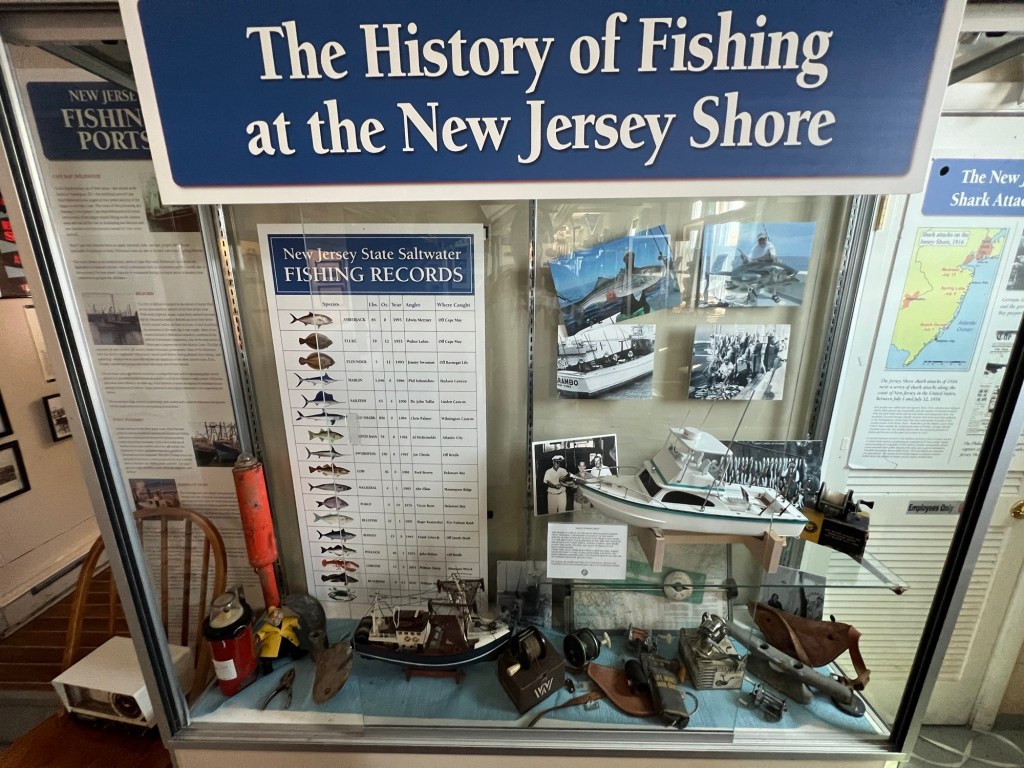
The development of the Boating and Fishing industries of the area
The museum also covers local famous disasters such as the Hindenburg disaster which happened in Lakehurst, NJ and the Moro Castle Cruise fire of the 1934. They even had the artifacts from the sites.
The Moro Castle Cruise disaster of 1934
The Hindenburg disaster of 1937 took place in Lakehurst, NJ
The Society also has a nice collection on local businesses. You could see how the businesses of the town developed from catering to a nautical and farming economy to the tourism and amusement industry. The problem with a town that depends too much on tourism is when the off season comes, how to you pivot the business to locals. You are now seeing this development in the downtown where there is a growth of clothing and antique stores.
The Pleasant Farms dairy farm (now a dealership)
The Jenkinson Boardwalk in its early years
What I thought was interesting is that this is where the Jersey Mikes sub chain started. In the town’s historical records are the original records of the first store along with the story of the company. This is a good selling point for the town.
The original Jersey Mike’s store in Point Pleasant, NJ
The collection contains a little bit of this and that in the cases as the membership is working to grow the collection. As the collection grows, we will see more of what makes the town of Point Pleasant the special place that it is as a community.
The collection case of items from residents personal homes
The collection case of community departments and hobbies
The collection case of business related items and household items
The collection of vintage bottles
Some of the interesting artifacts that I saw the head of a ship mass. The volunteer had said that this had washed up on shore and was donated by the people who found it.
The face from the ship bulkhead that was found washed up on shore
The bathing and swimming aspect of the beach community.
This delightful little museum is a nice rainy day adventure when you are in Point Pleasant on your way to discovering its funky downtown. It just goes to show that there is a lot more to this beach community than just the boardwalk and the beach.
An eel basket from the fishing industry
US Armed Forces collection of the WWII era
Beach art and history of the community of Point Pleasant
It is a perfect rainy day activity or for people who are interested in the history of the town, this little hidden gem is the place to start.
The Old North Church in Downtown Dumont, NJ is one of a series of Dutch Reformed Churches in Bergen County. This stately church still operates on a weekly basis and services are held on Sunday mornings. The cemetery to the back of the church is historic and interns some of the original families of Bergen County, NJ.
Old North is a Protestant Church affiliated with the Reformed Church in America. It is the oldest Protestant denomination with a continuous ministry in the United States and is a member of the Presbyterian/Reformed Family of Churches.
The actual Old North congregation dates back to 1724 and was organized in that year. A congregation of the settlers in what was known as Schraalenburgh (Dutch for “low ridge”) was formed at the time under the care of the “Church on the Green” in Hackensack. In 1725, Schraalenburgh Church built – stood about a city block east of the present South Church, Bergenfield. It was octagonal in shape. The Parsonage and minister for the church were located in Hackensack.
The historic sign of the church’s building
The Church Timeline:
(Taken from the Old North Church website)
1750 (Approximately) Congregation gradually divided into two – under the leadership of two pastors both meeting in the same building.
1799 One congregation left and built the present South Church. The second congregation continued to worship in the old church for about two years.
1801 The second congregation built “North Reformed Protestant Dutch Church of Schraalenburgh” on the land given by Major Isaac Kipp. The building was erected by Peter Durie of New York, who later moved to Tenafly to be near the project
The inscription over the front door, in Dutch, reads,
“Let peace come quickly to all. The North Church at Schraalenburgh built 1801.”
“In all places where I record my name, there shall I come to thee and bless thee.” Exodus 20:24
1833 Services in Dutch entirely discontinued.
1834 Parsonage (Pastor’s house) was built.
1836 Stoves were installed in four corners of Sanctuary.
1846 Sunday School is organized and met in the balcony.
1859 Sanctuary was enlarged eighteen feet. The side walls now had four windows instead of the original three. The back west wall was reconstructed with red brick and the red sand stones that were on the west wall and are now part of the sides blending with the original stones.
1868 The first furnace was installed in the Sanctuary. The clear glass panes in the Sanctuary were replaced with colored stenciled glass from Germany.
1888 Organ was installed in front of Sanctuary (attributed to W.H. Davis) powered by a water motor.
1894 Town name was changed from Schraalenburgh to Dumont in honor of Old North parishioner and 1st Mayor, Dumont Clarke.
1911 Town clock installed in the steeple.
1912 The first Church House built.
1918 World War I, Church House used almost exclusively by soldiers from Camp Merritt.
1919 Camp Merritt Town Memorial monument placed on church property. The flagpole (since replaced) made from artillery gun barrels was moved from Camp Merritt to church yard.
Dr. John Spring began his ministry and served for 34 years. He was formerly Chaplain at Camp Merritt and saw the congregation through the difficult years of the Great Depression.
During his ministry, Old North became mother church to a number of Reformed churches in surrounding towns. Mrs. Spring served as organist & choir director.
The entrance to the church from Washington Avenue
1923 Organ rebuilt by Clark & Fenton, Nyack, NY., electrified and moved to the north wall.
1925 Old North charters Boy Scout Troop 64.
1926 Steeple hit by lightning. The first church house burned.
1949 Old North charters Cub Scout Troop 131.
1954 Major repairs and Sanctuary redecorated.
1962 New Church House dedicated.
1969 Church steeple completely renovated and the clock was removed.
1972 New Tellers 26 rank pipe organ installed. The Choir organ division was given in honor of Mrs.
Spring. Sanctuary was redecorated.
1974 Old North celebrates its 250th Anniversary. New windows installed in Church House.
Dr. Albert Van Dyke retires after 16 years of service.
1980 Complete renovation of downstairs kitchen.
1983 Reverend Richard Vander Borgh becomes 13th Pastor.
1990 The End of the Earth Church Korean Congregation shared usage of church.
1996 150th Anniversary of Sunday School.
1999 275th Anniversary Celebrated.
2000 Air conditioning installed in Sanctuary.
2001 200th Anniversary of Church building. Church steeple painted.
2002 Cross replaces Reformed Church in America Coat of Arms in the sanctuary chancel.
2006 Light Alliance Korean Church of NJ shared usage of church.
2012 3-year major renovation of steeple and structures are complete.
2013 Installation of a state of the art Carillon–- sending forth music and hymns into the community.
2014 Reverend Richard Vander Borgh retires after 31 years.
2015 Reverend Susan E. Kerr installed as the 1st woman and14th minister of Old North Reformed
Church.
2017 Stair lift installed at Chapel entrance to make the Church House and the sanctuary accessible
for all. Handicapped bathroom and baby changing station are installed.
2018 Ye Old North Thrift Shoppe community ministry begun.
Community Thrift Shoppe begun in Church House ground floor.v. Richard and
Joan Vander Borgh.
Community Thrift Shoppe begun in Church House ground floor.
The Light of Christ Church shares usage of space.
2019 Electronic LED sign installed.
Memorial Plaque dedicated for new Auditorium chairs.
The electronic sign in the front of the church.
2021 Legacy Project Renovations.
The Old North Church Cemetery:
The church cemetery to the back of the church has some of the original families of Bergen County buried in their yard. The graves go all the way up to 1911 (Wiki).
The signage for the Old North Church Cemetery
The graveyard contains some of the old families in Bergen County